
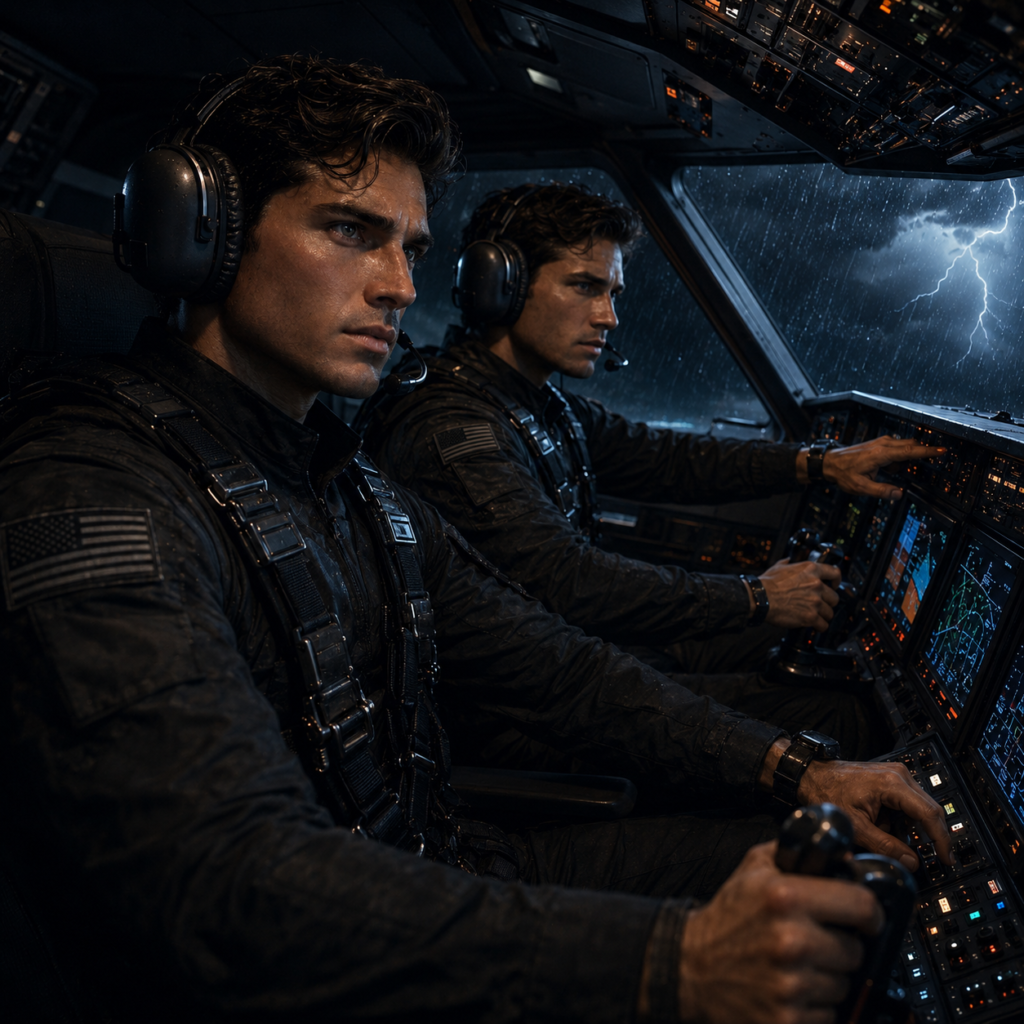
Pilot Systems Engineer
The Pilot Systems Engineer is the third and highest Advancing Position within Independent Integration Systems Engineering (XSE), paired with the third Advancing Asset, the XSE Vantage Point. This position represents mastery of XSE as an integrated practice: the ability to bring together the 40 Factors of XSE, XSE’s 2FA, the XESAS Synthesis, Derived Dynamics, Dynamic Mechanics, feedback, Inputs and Outputs, system life-cycle analysis, Sources and Resources, and other applicable XSE methods into a coherent approach for understanding, navigating, sustaining, and advancing a System of Interest (SOI).
The title Pilot is intentional. A pilot does not create the laws governing flight, control every environmental condition, or eliminate uncertainty. A skilled pilot learns the system, understands the instruments, evaluates available information, maintains awareness of changing conditions, anticipates hazards, makes informed choices, monitors feedback, and continually adjusts course.
Likewise, the XSE Pilot Systems Engineer does not presume complete control over reality. The Pilot seeks to understand reality accurately enough to navigate within it intelligently and with integrity.
Within XSE, becoming the Pilot means progressing beyond studying individual Factors or techniques to mastering their integration, interactions, and application as a complete system.
Reaching the Pilot Position
The Pilot Systems Engineer position is reached after successfully progressing through XSE’s Two-Factor Authentication (2FA) and mastering the applicable Derived Dynamics and Dynamic Mechanics necessary to employ the XESAS Synthesis as a whole.
XSE’s 2FA consists of two complementary sets:
20 Actual Factors represent elements of reality that must be considered within the analysis: Mind, Body, Spirit; their Gateways; the seven Spheres of Integration; and the seven Domains of Study.
20 Analytical Factors provide the architecture through which those Actual Factors are investigated and integrated: the X, Y, and Z Axes; Take Time, Build Strength, and Rise Above; the seven Advancing Assets and Positions; and the seven Axioms.
Passing through XSE’s 2FA therefore means more than memorizing forty terms. The Pilot must understand how these Factors relate, interact, influence one another, and contribute to the condition and behavior of the SOI.
This is where Derived Dynamics and Dynamic Mechanics become especially important.
From Factors to Dynamics
A system is not merely a collection of parts.
Once Factors interact, they can produce relationships, effects, patterns, feedback, dependencies, tensions, reinforcement, resistance, cascading consequences, and other system behavior. XSE examines these resulting interactions through its Derived Dynamics and Dynamic Mechanics.
The Pilot therefore progresses beyond asking:
What Factors are present?
and begins asking:
What are these Factors doing together?
The distinction is fundamental.
Identifying the components of a system provides only part of the picture. The Pilot must also investigate the dynamics emerging from their interaction and the mechanics through which those dynamics operate within the system.
The resulting XESAS Synthesis is consequently not a static inventory. It is an integrated representation of a system in motion.
Mastering the XESAS Synthesis
From the Pilot position, XSE is employed through the XESAS Synthesis as a whole.
The Pilot considers the SOI itself while simultaneously investigating its relevant Factors, Gateways, Spheres, Domains, Sources, Resources, Inputs, Outputs, dependencies, interfaces, environmental conditions, stakeholders, feedback loops, life-cycle stage, Current Reality, Trajectory, Derived Dynamics, Dynamic Mechanics, and relationships with surrounding systems.
The Pilot continually asks:
What is happening?
Why is it happening?
What is interacting to produce it?
Where did the relevant Inputs originate?
What Outputs are being produced?
Where are those Outputs going?
What feedback is returning?
What is strengthening the system?
What is degrading it?
What is its present life-cycle condition?
What Trajectory is emerging?
What has not yet been adequately investigated?
The objective is to synthesize these answers into an increasingly accurate understanding of the SOI rather than treating any individual observation as the whole system.
Operating From the XSE Vantage Point
The Pilot Systems Engineer is paired with the XSE Vantage Point because mastery requires an analytical position broad enough to integrate what has been learned.
The Vantage Point is XSE’s astronomical conceptual perspective: the Pilot attempts to mentally move beyond the constraints of immediate circumstances, habitual assumptions, limited viewpoints, and excessive proximity to the SOI in order to examine the larger system.
From this position, the Pilot can move conceptually between:
Detail ↔ Factor ↔ Relationship ↔ Dynamic ↔ System ↔ Surrounding Systems ↔ Larger Context
The objective is not permanent detachment. Sometimes the Pilot must descend into minute technical details; at other times, those details must be viewed from much farther away to understand their significance within the whole.
The Pilot therefore learns to change analytical altitude.
Critical and Creative Intelligence
Piloting requires both disciplined analysis and the ability to perceive possibilities that have not yet been considered.
The X Axiom—“Using critical & creative thinking augments intelligence”—therefore becomes integral to Pilot practice.
Critical thinking enables the Pilot to examine evidence, test assumptions, identify inconsistencies, distinguish facts from inference, evaluate competing explanations, and scrutinize conclusions.
Creative thinking expands the search space. It enables the Pilot to consider alternative configurations, relationships, explanations, perspectives, and potential solutions.
Neither is sufficient alone.
Creative thinking without adequate critical evaluation can produce unsupported conclusions. Critical thinking without creative exploration can remain trapped inside the assumptions defining the original problem.
The Pilot uses both.
Choice, Application, and Strength
Analysis alone does not advance a system.
Through the Y Axiom—“The application of optimal choices enhances strength”—the Pilot connects understanding to application.
The Pilot evaluates choices according to the SOI’s Current Reality, objectives, constraints, Resources, risks, expected consequences, life-cycle condition, and available evidence. A choice judged optimal under one set of conditions may cease to be optimal when those conditions change.
Application therefore leads back into feedback.
Analyze → Choose → Apply → Observe → Receive Feedback → Reassess → Adjust
The Pilot does not assume that an intelligent decision remains optimal indefinitely. Reality supplies new information, and the Synthesis must remain responsive to it.
Authentic and Ultimate Sources
The Z Axiom—“Seeking authentic and ultimate sources maximizes freedom” directs the Pilot toward the origins of information and the Resources upon which the system depends.
The Pilot does not merely ask whether information is available.
The Pilot asks:
Where did it come from?
What is the original Source?
Has it been altered, summarized, interpreted, or removed from context?
What Resources support the claim or system?
Is there a more authentic or ultimate Source available?
This sourcing discipline protects the Synthesis from becoming increasingly detached from reality through repeated assumptions, derivative information, or unsupported claims.
Truth and Integrity at the Foundation
The Pilot’s analysis remains governed by XSE’s foundational Axioms:
Alpha Axiom: Integrity is founded on truth.
First Axiom: True & optimal intelligence is founded on integrity.
Second Axiom: True & optimal strength is founded on integrity.
Third Axiom: True & optimal freedom is founded on integrity.
The X, Y, and Z Axioms build upon this foundation.
Accordingly, Pilot mastery is not defined simply by the ability to produce an effective outcome. The Pilot continually examines whether the analysis, Sources, choices, methods, and Outputs remain aligned with truth and integrity.
Optimization detached from integrity is not XSE optimization.
Inputs, Outputs, and Feedback
Every SOI receives Inputs and produces Outputs.
Those Outputs may become Inputs into other systems, producing effects that travel through families, organizations, communities, technologies, environments, economies, or other interconnected systems. Some of those effects may eventually return as feedback to the original SOI.
The Pilot therefore considers more than immediate results.
A choice that appears beneficial when viewed only at the point of action may look very different after downstream Outputs, delayed consequences, feedback, and effects upon surrounding systems are considered.
Pilot-level analysis consequently asks:
What happens next—and what happens because of what happens next?
This is essential for understanding cascading effects and system consequences.
Entropy, Maintenance, and Sustaining the System
Systems require attention to remain functional.
The Pilot recognizes that the absence of active advancement does not necessarily leave a system unchanged. Entropy, deterioration, changing environments, depleted Resources, accumulated stresses, obsolete information, and unresolved weaknesses can move systems toward degradation.
Sustaining a system therefore requires continuing feedback and appropriate corrective action.
For a human applying XSE to their own life, this supports the broader concept of becoming a sustaining systems engineer of oneself: continually monitoring relevant conditions, learning from feedback, maintaining what is strong, identifying degradation, and making appropriate adjustments rather than assuming that a previously optimized condition will sustain itself automatically.
Navigating Turbulence
The aviation metaphor becomes especially useful when conditions become unstable.
A pilot cannot order turbulence to disappear. The pilot can monitor conditions, understand the aircraft, use appropriate instrumentation, alter course when warranted, manage controllable variables, and respond within the limits of available capability.
The XSE Pilot approaches system turbulence similarly.
Unexpected Inputs, disrupted Resources, environmental changes, failures, conflicting objectives, human decisions, emerging risks, or events outside the Pilot’s control can alter the SOI.
The Pilot’s strength lies not in controlling everything but in maintaining sufficient awareness, orientation, adaptability, and integrity to respond intelligently to changing reality.
Piloting is navigation within reality, not mastery over reality.
Current Reality, Life Cycle, and Trajectory
The Pilot must know where the system actually is before determining where it should go.
Current Reality establishes the evidence-supported present condition of the SOI.
The Y Axis helps locate the system within its actual life-cycle condition. Historical Epochs provide context for how the system arrived there. Current Inputs, Outputs, feedback, Derived Dynamics, and Dynamic Mechanics help explain what is occurring now.
Trajectory then asks where those conditions appear to be leading.
This distinction prevents goals from being mistaken for present conditions.
The Pilot may have a destination, but effective navigation requires an accurate starting position.
Fourth-Dimension Exploration
From the XSE Vantage Point, the Pilot may also undertake Fourth-Dimension Exploration when it is relevant to the SOI.
This can include established temporal, spatial, mathematical, philosophical, or carefully identified metaphorical interpretations of dimensionality.
The Vantage Point and Fourth Dimension are not synonymous.
The Vantage Point is the analytical position from which the Pilot observes and integrates; Fourth-Dimension Exploration is one avenue of investigation available from that position.
The Pilot may look across Epochs, consider past and prospective conditions, test whether a mathematical representation is dimensionally sufficient, investigate whether surface observations conceal relevant underlying properties, or examine other defensible dimensional questions.
The objective is not to presume hidden realities. It is to prevent the limits of the present representation from automatically becoming the limits of the investigation.
Freedom Within Constraints
The image of flight also expresses an important feature of Pilot status: freedom does not require the absence of constraints.
An aircraft flies precisely because its design and operation function within physical reality. A pilot’s freedom to navigate depends partly upon understanding and respecting those constraints.
Likewise, the Pilot Systems Engineer seeks greater freedom through accurate understanding, integrity, intelligent analysis, optimal application, authentic sourcing, adequate Resources, and adaptive response—not through denial of limitations.
Some constraints can be changed. Some can be mitigated. Some can be navigated. Others must simply be recognized.
Knowing the difference is part of mastery.
The Pilot Feedback Cycle
At the Pilot level, XSE becomes an ongoing process rather than a one-time analysis:
Observe → Establish Current Reality → Investigate → Analyze the Factors → Identify Derived Dynamics → Understand Dynamic Mechanics → Synthesize → Evaluate Sources and Resources → Generate and Evaluate Choices → Apply → Monitor Inputs and Outputs → Receive Feedback → Reassess Life-Cycle Position and Trajectory → Adjust → Repeat
Each cycle can produce new information.
New information can alter the Synthesis.
An altered Synthesis can change what constitutes the optimal next choice.
The Pilot therefore remains calibrated to reality rather than permanently committed to an outdated model of it.
Beyond the Individual
Although Independent Integration begins with the individual, the Pilot’s analysis does not end there.
XSE’s seven Spheres of Integration extend from the Individual through Family/Home, Professional/Business, Community/Local, National/Country, Global/World, and Cyber/Beyond.
The Pilot therefore considers how the SOI interacts with progressively larger systems and how its Outputs may affect others.
This is particularly important because optimization at one level can create unintended degradation elsewhere. A solution beneficial to one subsystem is not necessarily optimal for the larger system.
The Vantage Point helps the Pilot continually move between these levels rather than confusing local optimization with systemic optimization.
What “Soaring” Means in XSE
The Pilot metaphor culminates in the concept of soaring.
Soaring does not mean achieving a life without resistance, uncertainty, limitation, failure, or changing conditions. Nor does Pilot status imply omniscience or infallibility.
It represents the capacity to navigate increasingly complex systems with greater awareness of what is happening, what is changing, what can be influenced, what cannot be controlled, where reliable information can be found, and how one’s own choices affect the emerging Trajectory.
The Pilot may encounter turbulence.
The Pilot may discover that an earlier conclusion was incomplete.
The Pilot may need to change course.
Indeed, the willingness to update the Synthesis when reality supplies better information is part of competent piloting.
The destination matters, but so do instrumentation, orientation, feedback, course correction, system condition, surrounding conditions, and the integrity of the Pilot’s decisions along the way.
The Pilot Systems Engineer
The Pilot Systems Engineer represents the highest Advancing Position within XSE: the position at which the individual has progressed through XSE’s 2FA and mastered the applicable Derived Dynamics and Dynamic Mechanics sufficiently to integrate and employ the complete XESAS Synthesis from the XSE Vantage Point.
The Pilot seeks to understand the SOI across Factors, relationships, Inputs and Outputs, Sources and Resources, feedback, life-cycle stages, Epochs, Current Reality, Trajectory, surrounding systems, and relevant dimensional considerations. Critical and creative thinking expand and discipline analysis; optimal choices translate understanding into action; authentic and ultimate sourcing strengthens the foundation of knowledge; and continuing feedback keeps the Synthesis responsive to reality.
The Pilot does not seek perfect control.
The Pilot seeks orientation, understanding, integrity, adaptability, and increasingly skillful navigation.
To become an XSE Pilot Systems Engineer is to progress from identifying the pieces of a system to understanding their integration, from understanding their integration to recognizing the dynamics they produce, and from recognizing those dynamics to skillfully navigating the system as reality continues to change.
In XSE, that is the meaning of taking the controls and learning to soar.
The XSE Pilot Systems Engineer is an educational designation within the XSE framework. It does not by itself constitute licensure or authorization to practice professional engineering, medicine, mental-health care, nutrition/dietetics, or another regulated profession. XSE applications should remain within applicable qualifications, laws, professional scopes of practice, and appropriate referral boundaries.