
Understanding the Spirit

The word “spirit” is used in many different ways across ordinary language, philosophy, religion, and theology. Because these meanings are not interchangeable, XSE distinguishes them before defining its formal Spirit Aspect.
Common and Generic Uses of “Spirit”
In ordinary, cultural, philosophical, and religious usage, the term may refer to several different concepts, including:
Mind or consciousness: sometimes used loosely to describe interior awareness, thought, or subjective experience.
Attitude or disposition: as in being “in good spirits.”
Energy, courage, or enthusiasm: as when someone acts “with spirit.”
Character or shared identity: as in the “spirit of a community,” “team spirit,” or the “spirit of an age.”
Soul or inner self: used with substantially different meanings across philosophical and religious traditions.
Ghost or disembodied presence: commonly used for what is believed to be a deceased human soul or another spiritual presence.
Vital principle, life force, or spiritual energy: some philosophical or religious traditions use “spirit” for one or more of these concepts. Their meanings differ substantially and should not automatically be identified with the human spiritual soul.
Distilled alcohol: an unrelated usage in which “spirits” refers to distilled alcoholic beverages.
These meanings should not be treated as automatically equivalent. In particular, terms such as spirit, soul, consciousness, life force, energy, ghost, and spiritual being may refer to fundamentally different concepts or realities depending upon context.
Spiritual Reality
Beyond these common or generic usages, classical Christian understanding uses the word spirit in more precise ways and recognizes spiritual reality as extending beyond the human spiritual soul.
The Holy Spirit is the Third Person of the Most Holy Trinity. The Holy Spirit is uncreated and divine, not a spiritual creature or one being among other created spirits.
Angels are created, personal, purely spiritual beings possessing intellect and will. Unlike human beings, angels are not naturally composed of body and soul.
Fallen angels, traditionally called demons, are spiritual creatures that were created good but freely rejected the good. They remain finite created beings. Their activity may affect human beings, particularly through temptation and deception, but they do not possess unlimited power and should not automatically be presumed to explain ordinary psychological, biological, interpersonal, social, environmental, or other phenomena.
The human spiritual soul is fundamentally different from an angelic spirit. A human being is naturally a unified corporeal and spiritual person. The spiritual soul is the immaterial and rational principle of human life and the form of the body; body and soul together constitute one human nature and one human person.
Following bodily death, the human spiritual soul continues to exist; however, this separated state is not the complete state of the human person, whose nature is bodily and spiritual.
Use Within XSE
XSE therefore does not derive its formal definition of the Spirit Aspect merely from common, metaphorical, or culturally variable uses of the word.
Within XSE, Spirit refers specifically to the human person considered in relation to the spiritual soul and its properly spiritual powers, orientation, and activity.
XSE does not reduce all relevant reality to biological, psychological, social, environmental, technological, or computational processes. At the same time, XSE does not claim that systems engineering can independently establish the existence or nature of spiritual realities or exhaustively explain them.
Where questions concerning spiritual beings, spiritual causation, or other explicitly spiritual realities arise, XSE treats them as matters requiring appropriate philosophical and theological Sources rather than as conclusions established by systems engineering alone.
Such causes should not be inferred merely because an event is unusual, difficult to explain, morally troubling, or presently unexplained.
Accordingly:
XSE may acknowledge and accommodate spiritual reality without claiming that systems engineering itself can independently establish its existence or nature or exhaustively explain it.
The sections that follow define the Spirit Aspect precisely within XSE and explain how it is distinguished from Mind, Body, non-human spiritual beings, and the many ordinary uses of the word “spirit.”
So What is the Spirit?
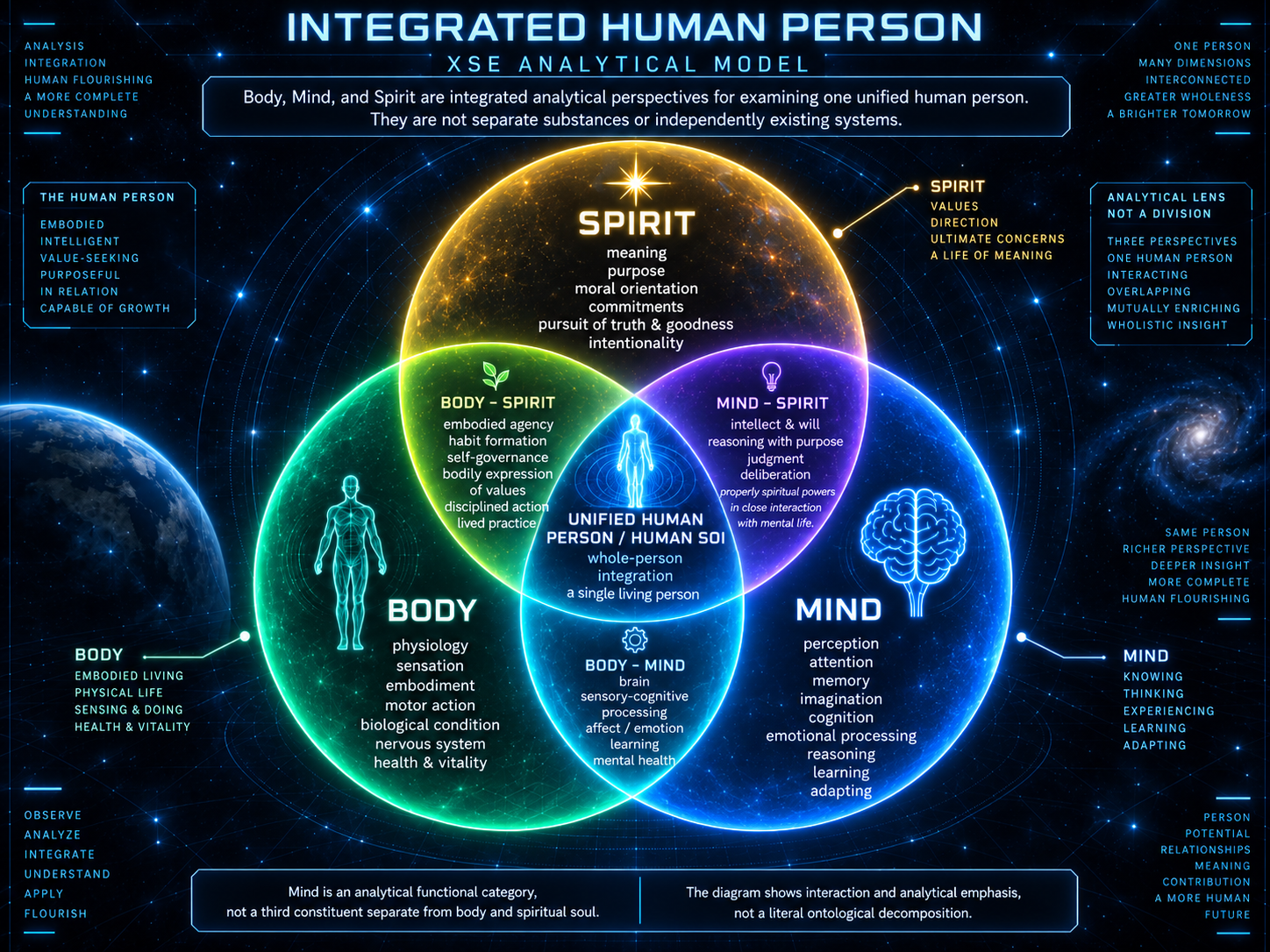
In XSE, Mind, Body, and Spirit are the three formal Human Aspects among XSE’s 20 Actual Factors. They are used as integrated analytical perspectives for examining one unified human person; they are not three separate substances, natures, or independently existing systems, nor are they themselves members of XSE’s 20 Analytical Factors.
The human person is a profound unity of corporeal body and spiritual soul. Mind is used by XSE as a functional category for examining cognitive and psychological operations of the embodied person, not as a third constituent separate from body and soul.
Spirit
In XSE, the Spirit Aspect refers to the human person considered in relation to the spiritual soul and its properly spiritual capacities, orientation, and activity.
The human spiritual soul is the immaterial, rational, and immortal principle of life of the person and is the form of the body, such that body and soul constitute one human nature and one human person.
Through the spiritual powers of intellect and will, the human person is capable of knowing truth, recognizing and choosing the good, acting freely, and directing action toward a proper end. Human beings are naturally ordered toward truth and goodness, yet intellect, will, desires, habits, and conduct can become disordered.
Reason, reflection, education, disciplined formation, and moral development can assist natural human growth, correction, and the development of virtue. XSE addresses these natural dimensions of human development and does not claim to explain or produce supernatural life or perfection.
Within XSE, the Spirit Aspect is therefore an Actual Factor used as an analytical perspective on the person’s spiritual and orientational life, not an exhaustive model or mechanistic explanation of the soul.
Mind
In XSE, Mind is the Human Aspect used to examine cognitive and psychological operations of the human person, including attention, perception, memory, imagination, understanding, reasoning, judgment, learning, and related mental processes.
Mind is not a separate substance alongside Body and Spirit.
Intellectual activity belongs to the unified human person and proceeds through the spiritual power of intellect, while many cognitive and psychological operations also involve the person’s sensory, bodily, neurological, emotional, and experiential life.
Within XSE, Mind is therefore an Actual Factor used as an analytical perspective for examining mental and cognitive functioning without implying that the human person’s intellectual or psychological life can be exhaustively reduced to biological processes or to a systems model.
Body
In XSE, Body refers to the corporeal and biological reality of the human person.
The human body is not merely an instrument, container, or machine occupied by the soul, but an integral dimension of the one human person and shares in the dignity proper to that person.
Animated by the spiritual soul, through the body the human person senses, acts, communicates, and interacts corporeally with the material world.
Bodily health, limitations, capacities, habits, environment, injury, fatigue, and other physical conditions can therefore influence the functioning and development of the whole person.
Within XSE, Body is therefore an Actual Factor used as an analytical perspective for examining the corporeal and biological conditions of the human SOI without reducing the person to biology, physical capability, performance, or bodily state.
Formal XSE classification: Mind, Body, and Spirit are Actual Factors.
Analytical use: they function as integrated Human Aspects through which XSE examines the unified human person.
Human ontology: one human person constituted in the unity of body and spiritual soul.
XSE analysis: Mind, Body, and Spirit provide distinct but integrated perspectives without claiming to exhaustively define or explain the human person.
Systems Interpretation of the Spirit

Within XSE, the Spirit Aspect may be examined in systems terms as the perspective concerned with the human person’s properly spiritual powers—particularly intellect and will—and with their orientation and activity in relation to truth, goodness, moral judgment, intentionality, meaning, and purpose.
The spiritual soul is not treated as an emergent property, a parallel subsystem, or a mechanistic control element. Rather, it is the immaterial and rational principle of human life and the form of the body, such that body and soul together constitute one living human nature and one human person.
Accordingly, XSE does not model the Spirit Aspect as an internal “operator” directing otherwise independent mental and bodily subsystems. The human person as a whole knows, chooses, acts, relates, and develops through bodily and spiritual powers and capacities proper to the unified person. XSE uses the Spirit Aspect to examine how the person’s spiritual powers, judgments, commitments, intentions, moral orientation, and pursuit of truth and goodness may influence the integration and Trajectory of the whole person.
From a systems perspective, rightly ordered intellect, will, desires, habits, and conduct can contribute to greater coherence among the person’s thoughts, choices, actions, relationships, and long-term direction. Conversely, persistent or reinforced alignment with falsehood, disordered priorities, contradictory commitments, or harmful choices may contribute to internal conflict, weakened coherence, or fragmentation. The presence of struggle, uncertainty, temptation, or conflicting impulses by itself does not establish a failure of Integrity.
The Spirit Aspect therefore gives XSE an analytical perspective for examining orientation, meaning, intentionality, moral coherence, and properly spiritual human activity, while recognizing that the spiritual soul itself cannot be exhaustively described, reduced to, or explained by systems-engineering models.
Origin of the Spirit Aspect

Because XSE treats the human person as a unified corporeal and spiritual being, the question of when the Spirit Aspect applies to the human SOI is fundamental.
From a biological standpoint, fertilization marks the beginning of a new, living human organism with its own internally coordinated developmental process. Across normal continuous development, the embryo, fetus, infant, adolescent, and adult represent successive life-cycle stages of the same living human organism rather than different kinds of beings replacing one another.
Development therefore concerns the maturation and exercise of capacities belonging to an already-existing human being. A capacity need not be presently observable in order to belong to the nature of that being. An infant does not cease to belong to a rational human nature because abstract reasoning is not yet exercised, just as a sleeping or unconscious adult does not cease to possess intellectual powers because they are not currently expressed.
The spiritual soul itself is not an empirically measurable structure, genetic sequence, or biological mechanism. Biology can establish the existence, organization, continuity, and development of the human organism; it does not experimentally detect or prove the spiritual soul. Philosophical anthropology addresses the nature of the human being identified by biology.
The empirical evidence of a continuously developing human organism beginning at fertilization is consistent with—and provides relevant evidence for—philosophical analysis that rejects positing an unexplained ontological transition by which an already-existing human organism would become a fundamentally different kind of being at some later developmental milestone. Implantation, neurological development, consciousness, viability, birth, and later cognitive development represent developmental changes, not the appearance of a new human organism replacing the one already developing.
Accordingly, XSE applies the Spirit Aspect from fertilization—the beginning of the human SOI—without claiming that the precise presence of the spiritual soul is empirically detectable or demonstrable through biological science. This does not mean that an embryo is presently reasoning, making moral judgments, or exercising deliberate choice. It means that XSE analyzes the developing individual according to the nature of the human being who exists, while recognizing that the exercise and observable expression of spiritual, cognitive, psychological, and bodily capacities develop across the life cycle.
Biology identifies the developing human organism. Philosophical reasoning considers the nature of that organism. XSE applies its Human Aspects consistently across the life of the human SOI without claiming that science or systems engineering can empirically detect or exhaustively explain the spiritual soul.
Within the XSE model, Body, Mind, and Spirit are applicable across the entire life of the human SOI, while the particular structures, capacities, operations, and activities examined through those Aspects emerge, mature, change, diminish, or become temporarily inactive across the human life cycle.
Spirit as Morale and Shared Disposition

In ordinary language, the word “spirit” is often used to describe morale, enthusiasm, confidence, determination, or the shared disposition of a group—as in “team spirit,” “high spirits,” or “esprit de corps.” Within XSE, this ordinary usage is distinguished from the formal Spirit Aspect and from the human spiritual soul.
Nevertheless, the phenomenon described by this ordinary use can be significant within human systems. Positive morale and constructive group cohesion may support motivation, communication, cooperation, resilience, engagement, creativity, and persistence toward shared goals. Conversely, chronically poor morale, distrust, discouragement, or destructive group dynamics may weaken cooperation and performance.
Within XSE, these effects are generally examined through multiple interacting Factors rather than attributed directly to the Spirit Aspect alone. Relevant considerations may include Mind, relationships, psychological conditions, leadership, environment, communication, values, commitments, and group culture.
Accordingly, expressions such as “high spirits” and “team spirit” describe important human and organizational phenomena, but they represent a common or metaphorical use of the word “spirit,” not a technical definition of the XSE Spirit Aspect.

Evidence Concerning Team Spirit, Cohesion, and Performance
The ordinary-language concept of “team spirit” overlaps with several constructs studied scientifically, particularly team cohesion, teamwork quality, mutual support, morale, engagement, and group viability. These constructs are not equivalent to XSE’s formal Spirit Aspect, but research indicates that they can materially influence the functioning and performance of human groups.
Research on teamwork and cohesion provides several relevant findings:
Teamwork quality and performance: Hoegl and Gemuenden (2001), Teamwork Quality and the Success of Innovative Projects examined 145 software-development teams and defined Teamwork Quality through communication, coordination, balanced contributions, mutual support, effort, and cohesion. Higher teamwork quality was significantly associated with team performance and was strongly related to team members’ satisfaction and learning.
Cohesion and team effectiveness: Barrick, Stewart, Neubert, and Mount (1998), Relating Member Ability and Personality to Work-Team Processes and Team Effectiveness studied 51 work teams and found relationships among team-member characteristics, social cohesion, team viability, and supervisor-rated performance. Their findings demonstrate that cohesion operates within a broader system of individual characteristics and team processes rather than functioning as an isolated cause of effectiveness.
Broader evidence from meta-analysis: Beal, Cohen, Burke, and McLendon (2003), Cohesion and Performance in Groups: A Meta-Analytic Clarification of Construct Relations found across prior studies that cohesion was related to multiple forms of group performance, although the strength of the relationship depended upon the type of performance being measured and the degree of interdependence within the team’s work.
Contemporary meta-analytic evidence: Grossman and colleagues, The Team Cohesion–Performance Relationship: A Meta-Analysis Exploring Measurement Approaches and the Changing Team Landscape analyzed 195 samples involving more than 12,000 participants and found team cohesion to be meaningfully related to team performance. Their analysis also showed that the relationship varies according to how cohesion is defined and measured and according to characteristics of the team itself.
Cohesion is not automatically beneficial without limit: Wise (2014), The Impact of Team Cohesion on Team Performance: The Dark Side of Network Density found evidence of an inverse-curvilinear relationship between cohesion and team performance, indicating that greater cohesion does not necessarily produce indefinitely greater performance. This is an important systems consideration: a beneficial system property can become maladaptive when pursued without regard for other requirements, perspectives, or constraints.
Cohesion can be behaviorally observable: Hung and Gatica-Perez (2010), Estimating Cohesion in Small Groups Using Audio-Visual Nonverbal Behavior demonstrated that perceived cohesion in small groups could be estimated from patterns of audiovisual nonverbal behavior. Their work illustrates that group cohesion is not merely an abstract description but can have observable behavioral manifestations.
Taken together, the research supports a qualified conclusion: constructive cohesion, mutual support, communication, coordinated effort, and positive group dynamics can contribute to human and organizational performance, satisfaction, resilience, and continued participation. However, these relationships are contextual rather than absolute, and cohesion alone does not guarantee good judgment, innovation, ethical conduct, or successful outcomes.
From an XSE perspective, this distinction is important. A group can possess exceptionally high morale and cohesion while being poorly informed, wrongly directed, resistant to criticism, or committed to harmful goals. Team spirit therefore cannot substitute for Truth or Integrity.
In XSE, the scientific literature on cohesion and teamwork supports the importance of the ordinary and collective meaning of “team spirit”, while XSE’s formal Spirit Aspect remains a separate concept concerned with the human person in relation to the spiritual soul and properly spiritual powers, orientation, and activity.
The Spirit is Innately Integrated with the Mind and Body.

The Interconnection of Body, Mind, and Spirit
Within XSE, Body, Mind, and Spirit are integrated analytical perspectives on one unified human person. They are distinguishable for purposes of analysis, but they do not function as isolated or independently existing systems. Conditions examined through one Aspect may influence the functioning, expression, and Trajectory of the whole person.
Scientific investigation can empirically examine biological and psychological phenomena and can study observable or self-reported phenomena associated with spiritual life, such as meaning, purpose, hope, religious or spiritual practices, spiritual struggle, and perceived connectedness. Such measures do not constitute empirical measurement of the spiritual soul itself.
Body–Mind Interaction
The relationship between bodily and psychological functioning is especially well established. Sleep, nutrition, physical activity, illness, pain, neurological function, hormones, medications, fatigue, and other bodily conditions can influence attention, memory, mood, cognition, emotional regulation, and behavior.
Conversely, psychological states and patterns of behavior can affect bodily functioning through pathways involving stress physiology, sleep, activity, autonomic regulation, health-related behaviors, and other mechanisms.
Within XSE, these relationships are examined as an important Body–Mind analytical overlap.
Body and Spiritual Activity
Bodily conditions can affect the circumstances under which the person exercises spiritual powers and pursues meaning, truth, goodness, commitments, and purpose.
Severe fatigue, pain, illness, sleep deprivation, neurological impairment, or chronic physiological stress may make sustained attention, reflection, disciplined action, prayer, deliberation, or fulfillment of commitments more difficult. This does not mean that bodily condition determines spiritual worth or the state of the soul. Rather, the human person is embodied, and bodily conditions can influence the ease, difficulty, and outward expression of human action.
In the other direction, judgments, commitments, purposes, and deliberate choices can influence bodily life through habits and behavior—for example, patterns of rest, exercise, substance use, eating, self-discipline, adherence to appropriately prescribed or recommended care, and care for one’s physical health.
Within XSE, these relationships are examined as a Body–Spirit analytical overlap.
Mind and Spiritual Activity
Mental and psychological processes interact closely with properly spiritual human activity.
Perception, memory, imagination, attention, emotion, learned associations, and mental models provide important conditions within which the person reasons, judges, deliberates, and chooses. At the same time, intellect and will are not reducible to these psychological processes within XSE’s model.
The person’s judgments, commitments, understanding of meaning, moral orientation, and pursuit of truth and goodness can also influence attention, interpretation, emotional responses, decisions, and patterns of thought.
Within XSE, these relationships are examined as an important Mind–Spirit analytical overlap.
Stress and Whole-Person Functioning
Chronic stress can affect multiple dimensions of the person simultaneously. Physiologically, prolonged stress may influence sleep, cardiovascular activity, immune and endocrine processes, energy, and other bodily functions. Psychologically, it may impair concentration, emotional regulation, memory, judgment, or perceived resilience.
Stress can also affect a person’s lived engagement with meaning, commitments, relationships, moral priorities, or religious and spiritual practices. However, within XSE, difficulty experiencing peace, meaning, or spiritual consolation during periods of stress is not automatically interpreted as a defect in the person’s Spirit Aspect or a failure of Integrity.
XSE therefore treats stress as a whole-person systems condition whose effects may propagate across Body, Mind, relationships, habits, choices, and spiritual activity.
Contemplative and Mind–Body Practices
Research has examined practices such as mindfulness meditation, controlled breathing, relaxation techniques, contemplation, and prayer in relation to psychological and physiological outcomes.
Research on some meditation-based interventions has reported modest improvements in measures such as anxiety, depressive symptoms, pain, psychological distress, and some physiological indicators associated with stress. These findings show that deliberate mental and behavioral practices can influence measurable aspects of bodily and psychological functioning.
They do not, by themselves, demonstrate or quantify spiritual transformation. A practice may have physiological or psychological effects regardless of its philosophical or religious meaning, while explicitly spiritual practices may possess purposes that extend beyond what empirical health research can measure.
XSE therefore distinguishes the measurable effects of a practice from its spiritual meaning or purpose.
Trauma and Spiritual Struggle
Trauma may be associated with effects across multiple Human Aspects.
Bodily effects may include hyperarousal, sleep disturbance, pain, or altered stress responses. Psychological effects may include changes in memory, attention, emotional regulation, trust, perceived safety, and interpretation of experience.
Traumatic experiences may also be accompanied by spiritual struggle, including questions concerning meaning, hope, trust, guilt, justice, identity, belief, or ultimate purpose. Research has documented both positive and negative changes in religious and spiritual beliefs following traumatic experiences.
XSE therefore avoids assuming that trauma is exclusively psychological or physical while also avoiding the opposite error of interpreting psychological or bodily symptoms automatically as evidence of spiritual causation.
Whole-Person Perspective
Some contemporary whole-person and person-centered models recognize that biological, psychological, social, existential, and spiritual concerns may all be relevant to human well-being.
This does not mean that every problem requires intervention in every dimension. Rather, within XSE, analysis remains sufficiently broad to identify significant interactions without reducing the person to only one level of explanation.
Within XSE, the purpose of examining Body, Mind, and Spirit together is therefore not to collapse their distinctions, but to prevent fragmented analysis of a person who exists and acts as a unified whole.
Meaning, Purpose, and Resilience
Research frequently associates meaning, purpose, hope, religious or spiritual coping, perceived connectedness, and commitment to personally significant ends with resilience and various measures of psychological well-being.
Within XSE, these relationships are interpreted cautiously and in context. Meaning and purpose do not function as simple biological treatments, and association does not necessarily establish direct causation. Their effects may operate through several interacting pathways, including stress appraisal, motivation, behavior, relationships, social support, perseverance, decision-making, and health-related practices.
Within XSE, orientation toward truth, what is genuinely good, legitimate commitments, meaning, and properly ordered ends may influence choices and patterns of action that subsequently affect Mind, Body, relationships, and long-term Trajectory.
Summary
Research strongly supports substantial interaction between bodily and psychological functioning and also documents meaningful relationships among physical health, mental health, behavior, meaning, purpose, religious or spiritual practices, spiritual struggle, and perceived spiritual well-being.
These findings do not empirically establish or measure the spiritual soul. Rather, they demonstrate that the observable life of the human person is deeply interconnected.
XSE therefore treats Body, Mind, and Spirit as distinct but interacting analytical perspectives on one unified human person. Bodily conditions can influence cognition and the exercise of human agency; psychological conditions can influence bodily functioning and the person’s engagement with meaning and purpose; and judgments, commitments, moral orientation, and deliberate choices can shape mental, behavioral, relational, and bodily Trajectory.
The purpose of this integrated analysis is not to reduce one Aspect to another, but to develop a more complete understanding of the human person and of the interacting conditions relevant to XSE’s analysis of Integrity, Strength, and Advancement.

Collective Insight Summary
Scientific and clinical literature documents meaningful associations and interactions among bodily health, psychological functioning, behavior, meaning, purpose, religious or spiritual practices, spiritual struggle, coping, and perceived spiritual well-being. These findings are consistent with XSE’s use of Body, Mind, and Spirit as interacting analytical perspectives on one unified human person.
The research does not empirically establish the existence of the spiritual soul or measure its nature, condition, or activity. Rather, it investigates observable, reportable, behavioral, psychological, physiological, and clinical phenomena associated with the person’s lived religious or spiritual life.
Evidence supports several important conclusions:
- Bodily conditions can substantially influence psychological functioning and the circumstances in which a person reflects, deliberates, acts, practices religion, fulfills commitments, and pursues meaning and purpose.
- Psychological states can influence bodily functioning and can affect how meaning, hope, religious belief, spiritual struggle, and purpose are experienced and expressed.
- Meaning, purpose, religious or spiritual coping, personally significant values, social support, and related factors are associated with various measures of resilience and well-being. Within XSE, these relationships are interpreted cautiously and are not treated as evidence of direct causation without further support.
- Meditation and related practices can produce measurable psychological and physiological effects, but within XSE, those effects are not equated with spiritual transformation.
- Spiritual concerns and spiritual struggle may be relevant in clinical contexts involving illness, adversity, bereavement, or trauma.
- Some contemporary whole-person and person-centered models provide practical frameworks for considering physical, psychological, relational, existential, and spiritual concerns together when relevant to the individual.
A contemporary example is the U.S. Department of Veterans Affairs Whole Health model, which considers multiple interconnected dimensions of health and well-being, including the body, mind, relationships, values, purpose, and “Spirit & Soul.”
XSE Interpretation
XSE does not conclude from this research that Body, Mind, and Spirit are three independent systems, nor that the spiritual soul is an empirically measurable health variable.
Instead, the research documents something more limited but highly important: the observable life of the unified human person exhibits extensive interaction among bodily, psychological, behavioral, relational, existential, and religious or spiritual phenomena.
Accordingly, XSE examines these interactions through its Body, Mind, and Spirit analytical perspectives while preserving the distinctions among them.
The arrows below indicate the analytical direction of an interaction being examined; they do not imply that Body, Mind, and Spirit are independent systems or that the spiritual soul has been isolated as an empirically measurable causal variable.
| Analytical Relationship | Examples of Observable Interaction |
|---|---|
| Body → Mind | Sleep, illness, pain, neurological condition, physical activity, and physiological states can influence cognition, emotion, attention, and behavior. |
| Mind → Body | Stress, emotion, behavior, and psychological conditions can influence sleep, autonomic activity, health-related behavior, and other bodily processes. |
| Body → Spirit | Bodily condition can affect the circumstances in which reflection, disciplined action, religious practice, fulfillment of commitments, and pursuit of meaning and purpose occur. |
| Mind → Spirit | Attention, memory, emotion, perception, trauma, and psychological states can affect the person’s engagement with meaning, hope, commitments, belief, and purpose. |
| Spirit → Mind | Judgments, commitments, moral orientation, meaning, purpose, hope, and pursuit of truth and goodness may influence thought, attention, interpretation, decisions, and psychological coping. |
| Spirit → Body | Judgments, commitments, purposes, and deliberate choices may influence bodily Trajectory through behavior, habits, self-discipline, health-related practices, and responses to adversity. |
Final Summary
The research does not empirically establish or measure the spiritual soul as a separate experimental variable. Rather, it shows that physical health, psychological functioning, behavior, relationships, meaning, purpose, religious or spiritual life, and coping are frequently interconnected in the lived human person.
For XSE, these findings support an integrated analytical approach without reducing one Aspect to another or treating empirical research as proof of the spiritual soul.
The human person remains the unified System of Interest; Body, Mind, and Spirit provide distinct but interacting analytical perspectives through which that person may be more completely examined.
It's mentally, spiritually, & physically damaging to act in opposition to what is right & true

Value–Action Alignment, Moral Conflict, and Integrity
Human beings can experience significant internal and interpersonal consequences when their actions conflict with their judgments, commitments, values, beliefs, or moral principles. Research in psychology and behavioral science has examined related phenomena including cognitive dissonance, self-affirmation, values-guided behavior, moral judgment, guilt, psychological flexibility, and ethical decision-making.
Within XSE, however, alignment with personal values alone is not sufficient to establish Integrity. Personal values and beliefs may themselves be incomplete, mistaken, contradictory, or harmful. XSE therefore distinguishes subjective value-consistency from deeper alignment among objective truth, sound judgment, what is genuinely good, legitimate commitments, and action.
Cognitive Dissonance
When a person’s actions conflict with previously held attitudes or beliefs, the resulting inconsistency can produce cognitive dissonance—a state of psychological conflict that may motivate the person to reconsider the behavior, the belief, or the interpretation of what occurred.
Research by van Veen et al. (2009), “Neural Activity Predicts Attitude Change in Cognitive Dissonance” found that experimentally induced cognitive dissonance engaged the dorsal anterior cingulate cortex and anterior insula—regions implicated in conflict monitoring and affective or interoceptive processing—and that activity in these regions predicted subsequent attitude change.
This illustrates an important XSE principle: persistent contradiction among judgment, belief, and action can create internal pressure toward some form of resolution. That resolution, however, is not automatically movement toward objective truth. A person may correct the behavior, revise an erroneous belief, rationalize the behavior, or adopt another interpretation.
Values, Stress, and Self-Affirmation
Research also indicates that engagement with personally important values can influence responses to stress.
Creswell et al. (2005), “Affirmation of Personal Values Buffers Neuroendocrine and Psychological Stress Responses” found that participants who reflected on personally important values before undergoing a laboratory stress challenge exhibited lower cortisol responses than participants in the control condition.
The finding supports a relationship among self-relevant values, psychological processes, and physiological stress responses. It does not establish that every instance of acting contrary to one’s values causes stress, nor that all personally held values are objectively good.
Within XSE, the evidence supports the conclusion that important commitments and a person’s understanding of self can influence psychological and bodily responses.
Values and Action
Values can also influence willingness to act.
Hebert et al. (2021), “Values Intervention as an Establishing Operation for Approach in the Presence of Aversive Stimuli” found that participants were more willing to approach experimentally established aversive stimuli when the action was connected with a personally identified value.
This finding is consistent with the emphasis placed on values-guided action and psychological flexibility within Acceptance and Commitment Therapy research. XSE cites this literature for educational comparison and does not present it as a clinical intervention model.
For XSE, the relevant point is that meaningful commitments can function as important drivers of behavior. The mere possession or pursuit of a personal value, however, does not establish that the value or resulting action is good.
The Content of Values Matters
Research on ethical decision-making further illustrates why XSE cannot define Integrity simply as consistency with one’s personal values.
Fritzsche and Oz (2007), “Personal Values’ Influence on the Ethical Dimension of Decision Making” found that different classes of personal values related differently to ethical decision-making, with altruistic values positively associated with ethical decision-making and self-enhancement values negatively associated with ethical decision-making.
Accordingly, XSE asks not only:
“Am I acting consistently with what I value?”
but also:
“Are my judgments, values, commitments, and actions aligned with objective truth and what is genuinely good?”
The second question is essential because consistency alone can produce a highly coherent but wrongly directed Trajectory.
Guilt, Shame, and Moral Conflict
Actions believed to be wrong may be followed by guilt, remorse, shame, anxiety, defensiveness, or attempts at justification. Within XSE, these responses are not treated as interchangeable.
Guilt often centers more strongly on a negatively evaluated action—I did something wrong—whereas shame often involves a broader negative evaluation of the self—there is something wrong with me. These are useful general distinctions rather than absolute categories.
The mere presence of guilt or psychological discomfort does not prove that a person has actually acted wrongly. Conscience, beliefs, memories, social pressure, psychological conditions, and incomplete information can all affect how actions are evaluated.
XSE therefore treats such experiences as evidence requiring investigation, not automatic proof of moral guilt or loss of Integrity.
Relationships, Trust, and Credibility
Where inconsistencies between stated commitments and actual behavior become visible to others, they may also affect relationships.
Repeated dishonesty, broken promises, hypocrisy, betrayal, or conduct inconsistent with legitimate responsibilities can weaken trust, credibility, cooperation, and relational stability. However, the consequences depend upon the nature of the action, the obligation involved, the expectations of others, subsequent correction or restitution, and the broader context.
XSE therefore examines not only internal consistency but also the Inputs, Outputs, consequences, obligations, and relational effects of action.
XSE Interpretation
Within XSE, Integrity is more demanding than psychological comfort or simple consistency between preferences and behavior.
A person may experience psychological comfort while pursuing falsehood or harmful ends. A person may also experience severe internal conflict while doing something difficult but genuinely right.
Accordingly, XSE does not define Integrity as:
“Act according to whatever you currently value.”
Rather, XSE examines whether the person’s understanding, judgments, commitments, choices, habits, and actions are becoming coherently ordered toward objective truth and what is genuinely good.
When contradictions arise, they can therefore become important investigative signals. XSE examines questions such as:
What does the person believe to be true?
What does the person judge to be good or right?
What values or commitments are operating?
What action actually occurred?
Are these elements consistent with one another?
Is the underlying belief or value itself sound?
What consequences followed?
Is rationalization, avoidance, self-deception, or incomplete information present?
What correction, reconciliation, learning, or change may be required?
Summary
Research supports the conclusion that beliefs, values, judgments, and behavior can interact in psychologically and behaviorally important ways. Inconsistency may contribute to cognitive conflict and efforts to restore coherence, while personally significant values can affect motivation, stress responses, and behavior.
The scientific evidence does not establish that psychological consistency itself equals moral goodness.
For XSE, the deeper objective is therefore not merely value–action congruence, but progressively strengthened coherence among objective truth, what is genuinely good, sound judgment, legitimate commitments, deliberate choice, and actual conduct.
Integrity requires more than consistency. It requires consistency with what is true and genuinely good.
You put yourself at a disadvantage when you deny the truth

Conscience, Cognitive Dissonance, Rationalization, and Resistance to Truth
Human beings may sometimes act contrary to their judgments, stated beliefs, commitments, values, or moral convictions because of social pressures, competing desires, fear of consequences, perceived obligations, insecurity, habit, or other influences. Such conflicts can produce psychological tension, but within XSE they are not reduced to a single mechanism.
One relevant phenomenon is cognitive dissonance, which occurs when important attitudes, beliefs, choices, or behaviors are experienced as inconsistent. The resulting conflict may motivate a person to restore greater psychological consistency. This may occur through changing behavior, reconsidering a belief, changing an attitude, reinterpreting what happened, minimizing the significance of the inconsistency, or rationalizing the choice.
Within XSE, cognitive dissonance is not treated as a direct measurement of conscience or moral guilt. A person can experience dissonance while being morally right, morally wrong, or mistaken about the situation.
Cognitive Dissonance and Attitude Change
van Veen et al. (2009), “Neural Activity Predicts Attitude Change in Cognitive Dissonance” found that experimentally induced cognitive dissonance engaged the dorsal anterior cingulate cortex and anterior insula and that activity in these regions predicted subsequent attitude change.
This supports the conclusion that inconsistency between behavior and prior attitudes can generate psychological conflict and motivate subsequent changes in attitude. It does not establish that every such change represents denial, rationalization, or movement toward objective truth.
Choice Justification
Kitayama et al. (2013), “Neural Mechanisms of Dissonance: An fMRI Investigation of Choice Justification” found that difficult choices between similarly attractive alternatives engaged the dorsal anterior cingulate cortex and left anterior insula, regions implicated respectively in cognitive conflict and aversive emotional arousal. Subsequent choice-justifying attitude change was predicted by activity in the posterior cingulate cortex during the choice process.
Participants subsequently showed choice-justifying attitude change, increasing their relative preference for the chosen option compared with the rejected option.
This illustrates choice justification: after making a difficult decision, people may alter their evaluations in a manner that makes the decision appear more coherent.
Within XSE, this is important because a person’s later confidence in a choice does not necessarily establish that the original choice was correct.
Resistance to Disconfirming Information
Batson (1975), “Rational Processing or Rationalization? The Effect of Disconfirming Information on a Stated Religious Belief” examined what happened when participants who had publicly expressed a religious belief encountered information apparently inconsistent with that belief. Participants who both expressed the belief and accepted the disconfirming information as valid subsequently showed an increase in expressed belief under the experimental conditions studied.
The study illustrates that disconfirming information does not always produce straightforward correction. Under some circumstances, prior commitment in the face of accepted disconfirming information may be followed by stronger expressed commitment rather than straightforward belief revision.
The finding does not establish that people universally reject contrary evidence or that increased conviction necessarily results from guilt, shame, denial, or rationalization.
Moral Rationalization and Self-Image
Tsang (2002), “Moral Rationalization and the Integration of Situational Factors and Psychological Processes in Immoral Behavior” describes moral rationalization as a process through which a person may reinterpret conduct that conflicts with moral principles in a way that allows the conduct to appear morally acceptable. The proposed model incorporates situational influences, cognitive dissonance, self-affirmation, competing motivations, and the desire to preserve a positive moral self-concept.
This distinction is particularly relevant to XSE. Human beings do not necessarily respond to contradiction by correcting themselves. They may also justify, minimize, reinterpret, externalize, selectively attend to evidence, or change their stated beliefs in ways that reduce psychological conflict without resolving the underlying problem.
Conscience and Objective Truth
Within XSE, conscience is not equated with emotion, psychological discomfort, personal preference, or cognitive dissonance.
Conscience is not merely a feeling or psychological state; it involves the person’s practical moral judgment concerning the moral quality of a concrete act. Such judgment may be sound or mistaken and therefore requires appropriate formation, reflection, investigation, and attention to objective truth and what is genuinely good.
Consequently:
feeling guilty does not by itself prove guilt;
feeling comfortable does not by itself prove innocence;
and
experiencing cognitive dissonance does not by itself establish which competing belief, judgment, or action is true or morally correct.
For XSE, these experiences are therefore investigative signals rather than final verdicts.
External Pressure and Responsibility
Social expectations, fear, coercion, group pressures, authority structures, economic consequences, relationships, and other external conditions can influence human choices.
Their presence does not automatically eliminate responsibility, nor does psychological research allow responsibility to be calculated from the existence of pressure alone. The nature and degree of freedom, knowledge, intention, pressure, habit, and other relevant circumstances must be examined individually.
XSE therefore examines both the internal orientation of the person and the external pressures, circumstances, and influences relevant to the person’s choice.
Resistance, Habit, and the Progressive Avoidance of Truth
Repeated rationalization can make it increasingly difficult for a person to recognize or acknowledge contradictions in beliefs and conduct. Habits of avoidance, selective interpretation, self-justification, or refusal to examine evidence can reinforce an existing Trajectory.
Psychologically, these patterns may be examined through mechanisms such as cognitive dissonance reduction, motivated reasoning, defensive processing, habit, and moral rationalization.
At the moral and spiritual level, Christian moral and spiritual language also recognizes the possibility of progressive resistance to truth and goodness, sometimes described as a “hardening of the heart.” This is not a psychological diagnosis, and XSE does not infer such a spiritual condition merely from observable behavior.
XSE instead identifies patterns of contradiction, avoidance, rationalization, selective interpretation, or resistance that warrant further investigation while preserving the distinction between psychological observation and spiritual or moral judgment.
XSE Interpretation
Facing an uncomfortable truth can require courage because truth may demand acknowledgment of error, responsibility, restitution, change, or abandonment of a previously defended position.
Yet psychological discomfort itself is not the objective. The goal is not simply to eliminate cognitive dissonance or to make the person feel internally consistent.
A person can reduce or resolve dissonance by correcting an error—or by rationalizing it.
XSE therefore seeks something more demanding: progressively stronger alignment among objective truth, sound judgment, properly formed conscience, legitimate commitments, deliberate choice, and actual conduct.
Psychological consistency can be achieved through rationalization. Integrity requires reconciliation with truth.
The Constructive Value of Facing Truth

Facing an uncomfortable truth can be difficult, particularly when it requires acknowledging error, accepting responsibility, reconsidering a long-held belief, changing behavior, or confronting painful circumstances. Nevertheless, honest engagement with reality can support several constructive outcomes:
- Personal Growth: Acknowledging mistakes, limitations, and inaccurate beliefs creates opportunities for learning, correction, and development. Growth becomes more possible when the person is willing to examine what actually occurred rather than defend an inaccurate interpretation.
- Greater Integrity: Facing truth can help bring beliefs, judgments, commitments, choices, and conduct into greater alignment with objective truth and what is genuinely good. This is more demanding than simply acting consistently with one’s existing preferences or values.
- Freedom from Sustained Rationalization: Recognizing reality can reduce the need to continually defend, conceal, minimize, or reinterpret contradictions. Although acknowledging truth may initially increase discomfort, it can create the conditions for more coherent judgment and action.
- Healthier Relationships: Honesty, appropriate transparency, acknowledgment of wrongdoing, correction, and fulfillment of legitimate commitments can contribute to trust and relational stability. Where harm has occurred, facing truth may also make apology, restitution, reconciliation, or appropriate boundary-setting possible.
- Increased Resilience: Confronting difficult realities can support the development of a person’s capacity to tolerate uncertainty, accept legitimate consequences, adapt to changing circumstances, correct errors, and continue acting constructively under adversity.
Facing truth does not guarantee immediate comfort, reconciliation, psychological relief, or favorable consequences. Sometimes truth requires difficult decisions, painful acknowledgment, or acceptance of circumstances that cannot immediately be changed.
Within XSE, the objective is therefore not simply to feel better after confronting reality, but to become increasingly capable of perceiving reality accurately, accepting what is true, correcting what can be corrected, and acting in accordance with sound judgment and what is genuinely good.
When significant emotional, psychological, relational, legal, medical, or other difficulties are involved, appropriate support from trusted individuals or appropriately qualified professionals acting within their respective scopes may assist the person in responding prudently and constructively.
Truth may be difficult to face, but accurate orientation to reality provides an essential foundation for meaningful correction, Integrity, and constructive Advancement.
Free Spirit... Come Back Again...

Clean Conscience and a Free Spirit
The expressions “clean conscience” and “free spirit” are often associated with inner peace, authenticity, and freedom from unnecessary internal conflict. Within XSE, however, both terms require careful definition so they are not reduced to subjective comfort, personal preference, or unrestricted self-expression.
Within XSE, a clean conscience is not understood merely as feeling innocent or feeling no guilt. Conscience may be well formed or mistaken, and a person may feel psychologically comfortable while acting wrongly or feel distressed while doing what is genuinely right.
Within XSE, a clean conscience refers to a condition in which the person has honestly examined conduct, sought appropriate formation and correction of moral judgment, and is not knowingly persisting in unresolved contradiction with what is rightly judged ought to be done in accordance with objective truth and what is genuinely good.
Likewise, “free spirit” is used here as an ordinary-language expression rather than a technical definition of the XSE Spirit Aspect. It does not mean freedom from truth, legitimate obligations, responsibility, or moral limits. Properly understood, it refers to a person who is increasingly free from domination by fear, superficial conformity, deception, disordered pressures, or the need to maintain a false appearance.
Authenticity and Alignment
Authenticity is valuable when it means living truthfully rather than merely expressing whatever one happens to feel or desire.
A clean conscience involves increasing coherence among judgment, commitment, choice, and conduct. A properly understood free spirit likewise reflects the courage to live according to convictions that have been honestly examined and ordered toward objective truth and what is genuinely good.
Neither concept therefore means simply:
“Do whatever feels most authentic to you.”
Within XSE, authentic living requires that the person’s beliefs, values, judgments, and commitments themselves remain open to examination and correction.
Integrity and Honesty
Integrity and honesty are central to both ideas.
A clean conscience requires willingness to recognize wrongdoing, correct falsehood, fulfill legitimate obligations, and avoid deliberate self-deception. A free spirit, properly understood, is not dependent upon pretense or continual conformity to expectations that conflict with truth or legitimate responsibilities.
Together, these qualities can support greater internal coherence because the person has less need to hide, rationalize, manipulate appearances, or maintain contradictory positions.
Freedom from Unresolved Moral Conflict
Within XSE, a clean conscience is not equated with the absence of every painful emotion.
A person may still experience remorse, sorrow, regret, uncertainty, or the consequences of past choices even after honestly acknowledging wrongdoing and beginning appropriate correction. Such emotions do not necessarily indicate an unhealthy conscience.
Rather, a clean conscience involves increasing freedom from knowingly persisting in unresolved contradiction with what one rightly judges ought to be done in accordance with objective truth and what is genuinely good.
Similarly, a free spirit does not mean freedom from all pressure or restraint. It refers more appropriately to increasing freedom from unjustified fear, deception, destructive conformity, disordered attachments, or pressures that interfere with sound judgment and responsible action.
Values and Objective Good
Both concepts involve values, but XSE does not treat all personally held values as automatically sound.
A person can consistently follow a mistaken value and still act contrary to objective truth or what is genuinely good. Conversely, personal growth may require abandoning or correcting a previously held value after discovering that it was false, disordered, or harmful.
Accordingly, XSE asks not only:
“Am I living according to my values?”
but also:
“Are the values I am living according to sound, truthful, and genuinely good?”
Inner Peace and Coherence
Greater alignment among objective truth, sound judgment, conscience, legitimate commitments, and conduct may contribute to greater inner coherence and peace.
However, inner peace is not itself proof of moral correctness. Psychological comfort can coexist with rationalization, denial, or mistaken beliefs, just as difficult moral action may temporarily produce anxiety, sorrow, or conflict.
Within XSE, peace is therefore understood as a possible fruit of rightly ordered living, not an infallible test of whether a decision is good.
Freedom to Live Truthfully
A properly understood free spirit possesses the courage to live openly and truthfully without being controlled by superficial expectations, fear of appearances, or unnecessary pretense.
This does not mean rejecting legitimate authority, obligations, relationships, or social responsibilities. Rather, it means becoming more capable of acting from sound judgment, rightly ordered commitments, and responsible freedom rather than from fear, deception, or conformity for its own sake.
A clean conscience can support this freedom because the person has less need to conceal, justify, or defend conduct known to be wrong.
Mind–Body–Spirit Integration
Within XSE, conscience, freedom, judgment, emotion, behavior, bodily condition, habits, and spiritual orientation are examined as interacting features of the one unified human person.
A clean conscience and rightly ordered freedom may contribute to greater whole-person coherence, but within XSE they are not treated as automatic indicators of complete physical, psychological, or spiritual well-being.
A person can possess Integrity while also experiencing illness, grief, trauma, psychological distress, or difficult external circumstances.
Resilience and Responsible Freedom
Truthful self-examination, sound commitments, and responsible freedom may support resilience by helping the person respond to adversity without abandoning legitimate principles or relying on persistent self-deception.
This does not guarantee ease, confidence, psychological comfort, or favorable outcomes. Rather, it may support the person’s capacity to remain oriented toward reality, make necessary corrections, endure difficult circumstances, and continue acting constructively.
XSE Interpretation
Within XSE, a clean conscience is not merely a comfortable conscience, and a free spirit is not an unrestricted one.
Within XSE, both concepts are understood in relation to objective truth, Integrity, sound judgment, rightly ordered freedom, legitimate obligations and commitments, and what is genuinely good.
A person may feel free while actually being governed by impulse, fear, habit, social pressure, or false belief. Likewise, a person may feel guiltless while remaining unwilling to examine wrongdoing.
XSE therefore does not define freedom as the absence of limits.
Freedom is not mere license to do whatever one desires. Within XSE, true and rightly ordered freedom is strengthened as the person becomes increasingly capable of recognizing, choosing, and living in accordance with what is true and genuinely good.
Summary
Living with a clean conscience and living with a free spirit can be closely related when both are properly understood.
A clean conscience reflects increasing coherence among objective truth, properly formed moral judgment, legitimate commitments, deliberate choice, and conduct, together with a willingness to acknowledge and correct wrongdoing when necessary.
A free spirit reflects increasing freedom from fear, deception, destructive conformity, disordered pressures, and unnecessary pretense, enabling the person to act with greater responsibility and Integrity.
Together, they point toward a form of freedom that is not merely freedom from constraint, but freedom for truth, goodness, responsibility, and constructive human flourishing.

Research Related to Authenticity, Conscience, Moral Identity, and Spiritual Well-Being
Research and scholarly literature related to authenticity, conscience, moral identity, spirituality, and well-being provide useful insight into themes that overlap with XSE’s discussion of a clean conscience and a free spirit.
These sources do not establish that subjective authenticity, psychological comfort, or consistency with one’s personal convictions is equivalent to moral Integrity. Rather, they help illuminate how authenticity, moral identity, conscience, spirituality, meaning, and well-being may relate to one another in human experience.
1. Authenticity and Well-Being
Sutton (2020), “Living the Good Life: A Meta-Analysis of Authenticity, Well-Being and Engagement” synthesized findings from 75 studies involving more than 36,000 participants.
The meta-analysis found positive associations between authenticity and several measures of psychological well-being and engagement.
This supports the conclusion that greater reported authenticity is associated with higher measures of psychological well-being and engagement. It does not establish that whatever a person experiences as “authentic” is therefore morally right, objectively true, or conducive to Integrity.
Within XSE, authenticity is therefore valuable when it reflects truthful self-understanding and conduct increasingly aligned with objective truth and what is genuinely good.
2. Conscience, Moral Integrity, and Freedom
Machinek (2021), “Freedom of Conscience as a Subject of Contemporary Controversies” examines conscience from philosophical and theological perspectives, including its relationship to freedom, moral integrity, moral truth, authority, and personal responsibility.
This source is conceptual rather than experimental. It is useful for understanding conscience not merely as subjective preference, emotional comfort, or private conviction, but as a practical moral judgment that should remain oriented toward truth and what is genuinely good.
Within XSE, this supports the distinction between:
“acting according to whatever I currently believe”
and
“acting according to a conscience that is honestly examined, appropriately formed, and increasingly aligned with objective truth and what is genuinely good.”
3. Spirituality, Moral Identity, and Ethical Predisposition
Vitell et al. (2016), “Spirituality, Moral Identity, and Consumer Ethics: A Multi-Cultural Study” examined relationships among spirituality, moral identity, and ethical predispositions across participants from several countries.
The study found that internalized moral identity and spirituality were associated with stronger ethical predispositions, although the relationships varied across cultural contexts.
This suggests that moral identity and spiritual orientation may be related to how individuals evaluate ethical conduct.
Within XSE, such findings are relevant to the ways judgments, commitments, identity, and spiritual orientation may relate to decisions and behavior, while still requiring independent evaluation of whether the underlying values, beliefs, and judgments are themselves sound.
4. Spiritual Experience, Meaning, and Health-Related Measures
Kass, Friedman, Leserman, Zuttermeister, and Benson (1991), “Health Outcomes and a New Index of Spiritual Experience” developed the Index of Core Spiritual Experience (INSPIRIT) to examine relationships among reported spiritual experiences, life orientation, and health-related measures.
In their sample of medical outpatients, higher INSPIRIT scores were associated with greater reported life purpose and satisfaction and with fewer reported medical symptoms.
These findings are observational and do not establish that spiritual experience directly causes improved physical health. Rather, they illustrate that self-reported spiritual experience can be associated with measures of meaning, well-being, and perceived health.
Within XSE, such findings are considered evidence concerning observable and reportable phenomena associated with spiritual life, not as empirical measurement of the spiritual soul itself.
XSE Interpretation
Taken together, these sources provide empirical evidence and conceptual scholarship concerning relationships among authenticity, psychological well-being, conscience, moral identity, spirituality, ethical orientation, meaning, and perceived health.
They do not establish that subjective authenticity, personal conviction, psychological comfort, or inner peace is equivalent to moral truth or Integrity.
A person may feel highly authentic while acting according to mistaken beliefs. A person may also experience discomfort while correcting an error, accepting responsibility, abandoning a false belief, or doing something genuinely right.
Accordingly, XSE does not ask only:
“Am I being true to myself?”
It also asks:
“Is the self I am expressing becoming more accurately oriented toward objective truth and what is genuinely good?”
Summary
Taken together, research and scholarly literature document meaningful relationships and conceptual connections among authenticity, well-being, moral identity, conscience, spirituality, ethical orientation, and meaning, although within XSE these relationships and concepts are interpreted cautiously and in context.
Within XSE, authenticity and freedom are not ends detached from truth. They are most constructive when the person’s beliefs, judgments, values, commitments, choices, and conduct remain open to examination, correction, and increasing alignment with objective truth and what is genuinely good.
Authenticity is not merely expressing the self as it currently is; it can also require correcting the self in light of truth.
Free Spirit to Soar

The expression “free spirit” can evoke the image of an eagle soaring high above the ground—unburdened, capable of gaining altitude, widening its Vantage Point, adapting to changing conditions, and moving with purposeful freedom.
Within XSE, however, a free spirit does not mean a person who experiences no guilt, fear, restraint, responsibility, or internal conflict. Nor does it mean unrestricted self-expression or freedom from legitimate obligations.
Within XSE, the expression describes a person becoming increasingly free from deception, persistent rationalization, disordered fear, destructive conformity, unnecessary pretense, and other influences that interfere with sound judgment and responsible action. This freedom is ordered toward objective truth, what is genuinely good, legitimate obligations, Integrity, and constructive Advancement.
Like an eagle gaining altitude, a person described in this way can develop greater analytical and perspectival distance from pressures that unnecessarily restrict clear perception and responsible choice.
1. Freedom from Unresolved Contradiction
A free spirit is not simply “free from guilt.” Appropriate guilt or remorse may sometimes call attention to conduct requiring acknowledgment, correction, restitution, or change.
The more constructive form of freedom is increasing freedom from knowingly maintaining falsehood, unresolved contradiction, persistent rationalization, or unnecessary concealment.
When a person honestly examines what occurred and corrects what can responsibly be corrected, less effort may be required to defend inaccurate interpretations or maintain contradictory positions.
Freedom from guilt is not the objective; reconciliation with truth is.
2. Courage in the Presence of Fear
A free spirit is not necessarily fearless.
Fear can communicate relevant information concerning danger, uncertainty, loss, vulnerability, or consequences. Courage involves the capacity to recognize such information without allowing unjustified or disordered fear to govern every decision.
Within XSE, greater freedom therefore means becoming increasingly capable of acting from sound judgment and responsible choice even when fear is present.
Like an eagle navigating changing winds, freedom involves adaptation rather than the absence of difficult conditions.
3. Greater Room for Creativity and Innovation
Fear of appearances, excessive conformity, persistent self-doubt, deception, or the need to defend a false position can narrow the range of possibilities a person is willing to consider.
Greater freedom from these constraints may create more room for critical thinking, creative thinking, exploration, experimentation, and responsible innovation.
This does not mean that eliminating fear or guilt automatically produces creativity. Rather, a person who is less dominated by unnecessary defensive pressures may be better positioned to investigate alternatives and consider possibilities more openly.
Within XSE, creative freedom remains governed by objective truth, Integrity, legitimate requirements, available evidence, and what is genuinely good.
4. Openness to New Experiences and Stronger Evidence
A rightly ordered free spirit remains open to learning.
This includes willingness to encounter new experiences, consider unfamiliar perspectives, revise inaccurate assumptions, and respond to stronger or more authoritative evidence when warranted.
Openness does not mean accepting every novelty or abandoning sound principles. It means remaining sufficiently free from attachment to one’s previous position that correction remains possible.
Adaptability to truth is part of Integrity.
The ability to change one’s understanding when stronger evidence requires it is therefore a form of Strength rather than weakness.
5. Adaptive Resilience
A free spirit is not someone who avoids adversity or simply “bounces back” from every challenge.
Within XSE, resilience refers to the capacity to remain oriented toward reality, adapt appropriately, protect or recover relevant Strength where possible, learn from feedback, and continue constructive Advancement under changing conditions.
Setbacks may involve grief, uncertainty, limitation, failure, or consequences that cannot immediately be overcome. Resilience does not require pretending otherwise.
Like an eagle adjusting its flight to changing currents, adaptive Strength depends upon accurate awareness of actual conditions.
6. Freedom from Destructive Conformity
A free spirit is not free from all social expectations.
Human beings exist within families, relationships, organizations, communities, laws, and other systems containing legitimate obligations and responsibilities.
The relevant freedom is from conformity for its own sake, particularly when fear of appearances, group pressure, deception, or illegitimate expectations interfere with sound judgment.
A person may therefore resist an unjustified pressure while still respecting legitimate authority, responsibilities, relationships, and obligations.
Within XSE, responsible independence does not mean isolation or rejection of social order. It means retaining the capacity to investigate, judge, and act responsibly.
7. Truthful Self-Expression and Authenticity
A free spirit can express the self more openly, but XSE does not define authenticity as:
“Express whatever you currently feel, desire, or believe.”
Beliefs, desires, values, and self-conceptions may themselves require examination and correction.
Authenticity is most constructive when the person becomes increasingly capable of living truthfully, without unnecessary pretense, deception, or dependence upon external validation.
Accordingly, authentic self-expression remains open to the possibility that the self being expressed may also need development.
Authenticity is not merely expressing the self as it currently is; it can also require correcting the self in light of truth.
8. Inner Coherence, Peace, and Well-Being
Greater alignment among objective truth, sound judgment, properly formed conscience, legitimate commitments, deliberate choice, and conduct may contribute to greater inner coherence and peace.
However, psychological comfort is not an infallible indicator of Integrity.
A person may feel comfortable while rationalizing wrongdoing, and a person doing something genuinely right may experience fear, sorrow, uncertainty, or significant psychological difficulty.
For this reason, XSE treats peace and positive emotion as possible fruits of rightly ordered living rather than proof that a person’s judgment or conduct is correct.
The Eagle as an XSE Metaphor
The eagle provides a useful metaphor for the properly understood free spirit because its flight suggests altitude, perspective, movement, adaptability, and freedom from unnecessary encumbrance.
Within XSE, the metaphor is understood through the Vantage Point:
Like an eagle gaining altitude, a person can seek sufficient analytical and perspectival distance from immediate pressures, appearances, fears, assumptions, and emotional reactions to examine Current Reality from a broader frame of reference.
The goal is not escape from reality, but a clearer view of it.
Greater perspective can help the person:
distinguish truth from appearance,
recognize relevant Sources and Resources,
detect contradiction or rationalization,
identify legitimate obligations,
consider alternative courses of action,
adapt to stronger evidence,
and choose a more constructive Trajectory.
The eagle therefore symbolizes not unrestricted flight, but freedom for clearer perception and responsible movement.
Research Context
Scholarly literature concerning spirituality, authenticity, moral identity, meaning, and well-being can provide useful insight into some of the observable human experiences associated with this metaphor.
Hogan (2009), in “On Spirituality and Education,” argues that spirituality is an appropriate subject for scientific and educational investigation and considers possible relationships among spirituality, thinking, creativity, and human development. The work is useful as conceptual scholarship but does not establish that freedom from fear or guilt directly causes creativity.
Fernando and Chowdhury (2010), in “The Relationship Between Spiritual Well-Being and Ethical Orientations in Decision Making,” examined relationships between dimensions of spiritual well-being and ethical orientation among Australian business executives. Their findings support associations between aspects of spiritual well-being and ethical orientation but do not establish that spiritual well-being itself causes ethical behavior or validates the XSE concept of a free spirit.
These and related sources therefore provide context concerning observable and reportable dimensions of spirituality, meaning, ethical orientation, creativity, and well-being. Within XSE, these sources are not interpreted as empirical measurement of the spiritual soul or as proof of the complete XSE model.
XSE Interpretation
Within XSE, “free spirit” is an ordinary-language image of rightly ordered freedom, not a technical synonym for the formal Spirit Aspect.
A free spirit is not defined by the absence of guilt, fear, responsibility, restraint, or difficulty. Rather, the phrase represents increasing freedom from deception, persistent rationalization, destructive conformity, disordered fear, unnecessary pretense, and other influences that interfere with sound judgment and responsible action.
This form of freedom can create greater room for clear perception, learning, creativity, adaptation, truthful self-expression, responsible choice, and constructive Advancement.
Like an eagle gaining altitude, the person seeks a broader Vantage Point—not to escape reality, but to see it more clearly.
A free spirit does not symbolize unrestricted flight. It symbolizes a person becoming increasingly free from what wrongly restrains sound judgment and responsible action, and increasingly capable of moving in accordance with objective truth, what is genuinely good, responsible freedom, and Integrity.