
The 2 Sets of Factors Authenticating XSE
Think of XSE’s 2FA (Two-Factor Authentication) as two categories of Factors—Actual and Analytical— that must be comprehensively considered and appropriately applied to authenticate the use of XSE’s complete 40-Factor methodology.

Two-Factor Authentication of the 40-Factor XSE Method
In Independent Integration Systems Engineering (XSE), 2FA (Two-Factor Authentication) is XSE’s abstract methodological verification concept for establishing that both categories of its 40-Factor architecture—the 20 Actual Factors and the 20 Analytical Factors—have been comprehensively considered and appropriately applied to the System of Interest (SOI).
The term intentionally draws upon the familiar logic of two-factor authentication: when access to an important system is protected by two required factors, satisfying only one does not complete authentication.
XSE applies that principle metaphorically to its methodology.
A claim that XSE’s complete 40-Factor method has been applied cannot be supported by considering only what XSE classifies as the Actual Factors, nor by employing only its Analytical Factors.
Both Factors of the Factor architecture must authenticate.
This creates the simplest meaning of XSE’s 2FA:
2 Categories of Factors: Actual + Analytical → Authenticate XSE’s 40-Factor Method
Factor One: The 20 Actual Factors
The first side of XSE’s 2FA consists of the 20 Actual Factors—the human, systemic, contextual, and disciplinary realities and considerations that XSE requires to be investigated as applicable to the SOI.
They comprise:
3 Aspects of the Human
3 Gateways
7 Spheres of Integration
7 Domains of Study
These Factors direct the Investigative Systems Engineer toward the actual human, systemic, contextual, and disciplinary realities and considerations relevant to the SOI rather than allowing them to be assumed away or unnecessarily excluded from investigation.
Factor Two: The 20 Analytical Factors
The second side consists of XSE’s 20 Analytical Factors—the conceptual architecture XSE uses to organize, analyze, orient, and advance investigation of the SOI.
They comprise:
3 XSE Axes
Y Axis — System Life Cycle Stage
Z Axis — Sources and Resources
3 Elements of Luxxacation
Take Time
Build Strength
Rise Above
7 Advancing Assets & Positions
XSE Zenith
Luxury Systems Engineer
Investigative Systems Engineer
7 Axioms
Together:
20 Actual Factors + 20 Analytical Factors = 40 Factors of XSE = XSE’s 2FA
The underlying systems principle is straightforward:
Investigation must remain grounded in Current Reality, while Current Reality must be subjected to sufficiently rigorous analysis to become increasingly well understood.
Neither side alone represents complete application of XSE’s 40-Factor methodology.
The XSE Key: Preparing to Enter Investigation
The progression toward 2FA begins before authentication itself.
It begins with the XSE Key.
At the accessible Luxury Systems Engineer level, the Key is first grasped, symbolizing Strategic Detachment and humility. The Systems Engineer steps outside the immediacy of the self, situation, moment, assumptions, biases, attachments, and perceived limitations sufficiently to reconsider the system from a broader reference frame.
This initiates the Torque of Luxxacation:
Take Time → Build Strength → Rise Above
But grasping the Key is not the same as entering full XSE investigation.
For that, the Key must be applied.
Grasp the Key → initiate Luxxacation.
Apply the Key → engage the XSE Keyway and enter deeper investigation.
The Key does not complete 2FA.
It prepares the Systems Engineer to approach authentication with the humility necessary to admit:
My present understanding may be incomplete. Something may be missing. I need to investigate.
The XSE Keyway: Engage the Vacancy
The XSE Keyway represents the interface through which the Key engages XSE’s deeper investigative architecture.
Importantly, the Keyway does not symbolize a narrow or restricted view.
It symbolizes an opening.
Its negative space represents the vacancy inherent in incomplete human understanding: information may be missing; a Source may not yet have been found; an assumption may remain untested; a Factor may have been overlooked; a relationship may not yet be understood; or the investigator may simply not yet know what they do not know.
The Keyway therefore carries forward the humility introduced by the Key.
The Key says: step outside what you presently see.
The Keyway asks: what might be absent from what you presently know?
Applying the XSE Key to this vacancy symbolically unlocks XSE’s 2FA investigative passageway.
The Investigative Lens: How the Passageway Is Examined
The Keyway is not separate from the next Advancing Asset.
It is represented as negative space within the XSE Investigative Lens.
This visual relationship is significant.
The vacancy of the Keyway represents what remains unknown or insufficiently established; the Lens represents the disciplined Investigative Skills used to examine it.
Thus, humility and investigation become integrated:
Acknowledge what you lack → focus the Lens → investigate what you do not yet understand.
The Investigative Systems Engineer develops and applies XSE’s 12 Investigative Skills, represented collectively by the Investigative Lens. These provide the disciplined investigative capability through which the 40 Factors, their supporting evidence and Sources, relevant relationships, and the developing system understanding are examined.
Together, the Keyway and Lens symbolically integrate investigative humility—acknowledging what may be missing—with disciplined investigation directed toward discovering what Current Reality supports.
These skills answer a different question from 2FA.
2FA asks:
What XSE Factors must be comprehensively addressed?
The Investigative Lens asks:
How competently and reliably are they being investigated?
Both are necessary.
Authenticating the 40 Factors
The Investigative Systems Engineer does considerably more than memorize forty Factor names or complete a checklist.
Each applicable Factor must be interrogated in relation to the SOI.
For example:
What is present?
What is absent?
How do we know?
What Source supports that determination?
How reliable is the Source?
What remains uncertain?
What evidence contradicts the developing model?
What alternative explanation should be considered?
Which Sources and Resources are involved?
What Inputs and Outputs cross relevant Gateways?
How does this Factor relate to other Factors?
How does the condition change across Epochs?
What Trajectory appears to be developing?
This is what gives authentication substantive meaning within XSE.
Authentication is not merely the presence of information.
It requires sufficient investigation to establish that the Factor architecture has been comprehensively considered and appropriately applied with supportable reasoning.
Actual + Analytical: The Verification Principle
The deeper significance of XSE’s 2FA is therefore greater than the numerical observation that XSE contains two categories of twenty Factors.
It establishes a methodological safeguard:
Actual Factors prevent XSE analysis from becoming detached from the realities it is intended to investigate.
Analytical Factors prevent those realities from being approached without the complete organizing and reasoning architecture XSE requires.
Together, they provide XSE’s two-factor check against incomplete application of its 40-Factor method.
This does not guarantee that every conclusion reached through XSE is correct.
Human knowledge remains limited; Sources can be incomplete or unreliable; evidence can change; uncertainty can remain; interpretations can be mistaken; and models may require revision. XSE’s 2FA therefore authenticates methodological engagement with the required Factor architecture—not the infallibility or ultimate truth of the resulting conclusion.
Rather, 2FA establishes whether XSE’s required Factor architecture has been comprehensively engaged.
This distinction is essential to the integrity of the concept.
Protecting the Integrity of XSE Application
XSE’s 2FA also protects the integrity of the term XSE itself.
A superficial use of Luxxacation, for example, may provide value at its intentionally accessible level, but it does not constitute complete application of XSE’s 40-Factor methodology.
Likewise:
Using only the Actual Factors is not complete XSE 2FA.
Using only the Analytical Factors is not complete XSE 2FA.
Naming all 40 Factors without investigating them is not mastery.
Checking forty boxes without examining evidence, Sources, relationships, uncertainty, Dynamics, and Mechanics does not complete the investigative passageway.
XSE’s 2FA therefore functions as an internal methodological safeguard against representing partial use of the Factor architecture as comprehensive XSE application.
Passing 2FA Is Necessary—But It Is Not the Entire Passageway
This distinction is essential.
2FA authenticates the 40-Factor architecture. It does not, by itself, constitute mastery of the entire XESAS Synthesis.
The Investigative Systems Engineer must progress beyond Factor identification and application into the relationships among applicable Factors.
This is where investigation proceeds into Derived Dynamics and Dynamic Mechanics.
The engineer begins asking:
What emerges when these Factors interact?
What changes when one Factor changes?
What reinforcing or counteracting relationships appear?
What system behavior is being produced?
Through what mechanisms does that behavior operate?
How does it propagate through Gateways, Spheres, Epochs, or other relevant system relationships?
XSE therefore moves progressively from:
Factors → Relationships → Derived Dynamics → Dynamic Mechanics → Integrated System Understanding
The Investigative Systems Engineer must also demonstrate mastery of the Investigative Skills necessary to support that understanding.
Thus:
20 Actual Factors
+
20 Analytical Factors
= XSE 2FA
+ Investigative Skills
+ Factor Relationships
+ Derived Dynamics
+ Dynamic Mechanics
+ Integration & Demonstrated Mastery
= Completion of the Investigative Passageway
From Authentication to the XSE Vantage Point
Completion of this investigative progression marks advancement from Investigative Systems Engineer to Pilot Systems Engineer.
At this transition, the advancing Position of Pilot Systems Engineer is paired with the advancing Asset of the XSE Vantage Point.
The Pilot does not abandon the Key, Investigative Skills, 40 Factors, or investigative architecture upon advancement. Rather, these become integrated capabilities within the Pilot’s operation of the complete XESAS Synthesis.
The progression can therefore be expressed as:
XSE KEY
Detach with humility.↓
XSE KEYWAY
Engage the vacancy.↓
INVESTIGATIVE LENS
Develop and apply the 12 Investigative Skills.↓
XSE 2FA
Authenticate comprehensive consideration and appropriate application of the 20 Actual + 20 Analytical Factors.↓
FACTOR RELATIONSHIPS
Investigate integration and interaction.↓
DERIVED DYNAMICS
Determine what emerges from those relationships.↓
DYNAMIC MECHANICS
Understand how resulting system behavior operates.↓
INTEGRATION + DEMONSTRATED MASTERY
↓
GRADUATION / ADVANCEMENT
↓
PILOT SYSTEMS ENGINEER ↔ XSE VANTAGE POINT
Assume the Vantage Point and skillfully employ the integrated XESAS Synthesis from the broader astronomical analytical position.
Throughout this progression—and especially from the expanded perspective of the Vantage Point—the Pilot remains cognizant of human limitations and oriented toward the XSE Zenith: Truth.
The relationship is important:
The Pilot attains the advancing Position.
The Pilot assumes the Vantage Point.
The Pilot remains oriented toward the Zenith—Truth.
The Zenith itself is not a position of exhaustive knowledge attainable by the Pilot.
In Short
XSE’s 2FA (Two-Factor Authentication) is XSE’s abstract methodological verification concept requiring comprehensive consideration and appropriate application of both categories of its 40-Factor architecture: the 20 Actual Factors and the 20 Analytical Factors. The XSE Key, representing Strategic Detachment and humility, is applied to the XSE Keyway—the meaningful vacancy within the Investigative Lens—to unlock entry into deeper investigation. The Investigative Systems Engineer then employs the 12 Investigative Skills to investigate and authenticate engagement with both sides of XSE’s 2FA and proceeds beyond the individual Factors into their relationships, Derived Dynamics, and Dynamic Mechanics. XSE’s 2FA authenticates methodological engagement with the required Factor architecture; it does not guarantee the infallibility or ultimate truth of the resulting conclusions. Only after sufficient integration and demonstrated mastery of the complete investigative architecture does the Investigative Systems Engineer advance to Pilot Systems Engineer, paired with the XSE Vantage Point, from which the integrated XESAS Synthesis can be skillfully employed while remaining oriented toward the XSE Zenith—Truth.
The 40 Factors of XSE

20 Actual Factors

Within XSE, “Actual Factors” refers to the human, systemic, contextual, and disciplinary realities and considerations that may directly or indirectly affect, interact with, or otherwise be relevant to the System of Interest (SOI). The 20 Actual Factors are intended to ground XSE investigation in Current Reality rather than allowing relevant conditions or considerations to be excluded simply because they are unrecognized, overlooked, difficult to observe, or insufficiently understood.
The four sets of XSE Actual Factors are the 3 Aspects of the Human, 3 Gateways, 7 Spheres of Integration, and 7 Domains of Study. Together, they provide a structured framework for investigating relevant dimensions of the SOI and its larger context. Their applicability, condition, relationships, and significance must be investigated rather than merely assumed. The logic supporting XSE’s inclusion of these Factors is further explained in the sections below.
XSE uses illustrative representations of the Actual Factors, including color associations of blue, red, and white to distinguish the MBS Aspects of Mind, Body, and Spirit. These figures are conceptual and diagrammatic representations rather than literal depictions. Their purpose is to assist the Systems Engineer in visually organizing Factors, relationships, and relevant considerations during system investigation and analysis.
XSE's Four Sets of Actual Factors (3-3-7-7)

The 3 Aspects of the Human: Body, Mind & Spirit
Within XSE’s 20 Actual Factors, Body, Mind, and Spirit are distinguished as three foundational Aspects of the Human for purposes of systems investigation.
This analytical distinction does not imply that the human person is composed of three separate substances or independent parts. Rather, the human person is understood as an integrated unity of body and spiritual soul, while XSE distinguishes Body, Mind, and Spirit as useful analytical Aspects for investigating different but deeply interrelated dimensions of the human person.
Body addresses the physical and biological dimension, including physical capabilities, limitations, condition, needs, functions, and interactions with the surrounding environment.
Mind addresses cognitive and psychological functioning, including perception, reasoning, learning, memory, attention, emotion, judgment, decision-making, and other mental processes relevant to the System of Interest. Within XSE, Mind is an analytical category and is not intended to identify a third substance separate from the body and spiritual soul.
Spirit addresses the spiritual dimension of the human person, grounded in the spiritual soul, and directs consideration toward meaning, ultimate purpose, conscience, moral responsibility, and spiritual orientation, including realities that transcend purely material considerations. Within XSE, Spirit is not presented as a medical or psychological construct, nor as something reducible to biological measurement. Distinguishing Spirit from Mind for analytical purposes does not imply the existence of a separate “spirit” in addition to the spiritual soul.
Together, the three Aspects establish an important XSE principle:
The human person should not be investigated merely according to bodily condition, mental functioning, or spiritual dimension in isolation. XSE analytically distinguishes Body, Mind, and Spirit while recognizing their profound interrelationship within the integrated human person.
For XSE’s 2FA, each Aspect is considered as applicable to the SOI, including its relevant relationships with the other Aspects and with XSE’s remaining Actual and Analytical Factors.
Accordingly:
XSE Analytical View → Body | Mind | Spirit
Integrated Human Person → Body + Spiritual Soul in profound unity
The three-Aspect XSE structure therefore provides analytical differentiation without ontological fragmentation of the human person.
The 3 Gateways in XSE refer to the components in systems engineering that permit entry and exit into and out of the system, based on the rules and validations enforced by control points within. In XSE the 3 Gateways pertain to the Mind, Body, and Spirit.
- Function of Gateways: Gateways act as the access points or interfaces between the system and the external world (or between subsystems within a larger system).
- Role in Data Flow: Gateways facilitate the flow of data or resources into and out of the system, handling the logistics of format conversion, protocol alignment, and connectivity.
These 7 Spheres are diagramatic representations of the levels of human integration (MBS), beginning with: 1. Independent Integration (X) of the Individual, 2. Family/Home, 3. Professional/Business, 4. Community/Local, 5. National/Counry, 6, Global/World, 7. Cyber/Beyond. Whether or not a person acknowledges or believes that they are a part of a larger system, they are an integral part of each one of these spheres as demonstrated on The 7 Spheres of Integration.
The 7 Domains of Study used in XSE are: 1. Law, 2. Psychology, 3. Biology and applicable sciences, 4. Human Factors Engineering, 5. Environmental & Occupational Safety & Health, 6. Manpower, Personnel, & Training and 7. Survivability & Habitability. The first 3 domains of study are specifically chosen in accordance with the 3 Aspects of the Human (MBS). As explained on each of the respective domain pages: 1. Law corresponds to the spirit, 2. Psychology corresponds to the mind, and 3. Biology and applicable sciences corresponds to the body. The last four domains of study (4-7) are retained from Human Systems Integration (HSI) which is an approach to systems engineering widely used by governments and large organizations throughout the world. XSE retains these 4 domains not only because of the innate value that they provide, but also as an indispensable analytical tool to assist with reverse engineering, especially of the individual. Please see each of the specific pages on the domains of study for more details.
20 Analytical Factors

Once the Actual Factors are understood, XSE protocol proceeds towards positioning the Actual Factors on the XSE Epoch-Transcending Synergizing Axiomatic System using the components and Axioms contained in the Analytical factors, which function together iteratively to advance the system into a state of optimization. Analytical factors refer to various elements or components that may be considered, evaluated, or utilized in the process of analysis. These factors may involve theoretical frameworks, mathematical models, logical reasoning, or qualitative assessments. These factors are often integral to analytical methodologies and techniques used in fields such as science, engineering, business, and data analysis. Analytical factors can include variables, parameters, criteria, metrics, indicators, and other relevant aspects that are examined or measured to gain insights, make decisions, or solve problems. The selection and interpretation of analytical factors play a crucial role in the accuracy, effectiveness, and relevance of analytical processes and outcomes.
XSE's Four Sets of Analytical Factors (3-3-7-7)

The 3 Elements of XSE are the 3 elements of the “torquing” motion of XSE, also known as Luxxacation. Namely: Take Time (take time to honestly evaluate the current state of the system, where it’s current trajectory leads to vs the actual desired results of the system, then decide what you have to do differently to achieve that goal), Build Strength (the application of those best choices arrived at in the previous/first element), Rise Above (always improve system, repeating Luxxacation as an iterative process for system advancement).
The 7 Advancing Assets & Positions of XSE
XSE’s 7 Advancing Assets & Positions form a progressive architecture consisting of four Advancing Assets and three corresponding Advancing Positions. The three Positions—Luxury Systems Engineer, Investigative Systems Engineer, and Pilot Systems Engineer—represent progressive levels of engagement with XSE, while the four Assets—XSE Key, Investigative Skills, XSE Vantage Point, and XSE Zenith—provide the symbolic capabilities, instruments, positions of perspective, and orienting reference associated with that advancement.
The first Advancing Position, Luxury Systems Engineer, is paired with the XSE Key. Grasping the Key symbolizes Strategic Detachment and humility: stepping outside oneself, the immediate moment, current biases, assumptions, attachments, and perceived limitations sufficiently to consider the system from a broader reference frame. This initiates the Torque of XSE’s accessible top-level synopsis, Luxxacation: Take Time → Build Strength → Rise Above. When deeper XSE study is pursued, the Key is subsequently applied to the XSE Keyway, unlocking entry into XSE’s 2FA investigative passageway.
The second Advancing Position, Investigative Systems Engineer, is paired with Investigative Skills, symbolized by the XSE Investigative Lens. This is XSE’s active learning and investigative position—not yet its position of mastery. The Investigative Systems Engineer develops disciplined Investigative Skills while progressing through XSE’s 2FA: the 20 Actual and 20 Analytical Factors, and then deeper into relevant Factor relationships, Derived Dynamics, and Dynamic Mechanics. The meaningful vacancy of the XSE Keyway within the Investigative Lens reinforces the humility required to recognize what remains unknown, while the Lens represents the disciplined investigation used to pursue increasingly supportable understanding. When sufficient integration and mastery of the required investigative architecture are demonstrated, the Investigative Systems Engineer graduates to the third and highest attainable XSE Position: Pilot Systems Engineer.
The Pilot Systems Engineer is paired with the XSE Vantage Point. Having completed the investigative passageway, the Pilot is positioned to integrate and skillfully employ the complete XESAS Synthesis from XSE’s broader astronomical perspective. The Vantage Point represents the clearest and most comprehensive defensible view of the SOI and its larger context that the Pilot can construct within human limitations—including consideration of the Systems Engineer, SOI, System of Context, interconnected systems, Sources and Resources, relevant Epochs and Trajectories, and appropriate established or exploratory considerations associated with the Fourth Dimension. The Vantage Point does not represent omniscience; it represents the advanced position from which the Pilot continues to investigate, integrate, evaluate, and navigate the system while remaining aware of the limits of human knowledge and perception.
The fourth Advancing Asset, the XSE Zenith, stands apart from the three paired Assets because it is not paired with a humanly attainable Advancing Position. The Zenith symbolizes Truth, represented within XSE as a diamond emitting light and embedded within the Vantage Point. Its placement communicates an essential distinction: the Pilot may become increasingly well-positioned to seek, recognize, and conform understanding to Truth, but the Pilot does not become Truth, possess exhaustive knowledge of reality, or attain an unlimited perspective. Truth remains the orienting reference against which Sources, observations, models, assumptions, analyses, and conclusions must continually be tested.
The advancement architecture can therefore be summarized as:
XSE KEY ↔ LUXURY SYSTEMS ENGINEER
Detach & Initiate — Grasp the Key and start the Torque of Luxxacation.↓
XSE KEYWAY → INVESTIGATIVE PASSAGEWAY
Engage — Apply the Key, acknowledge the vacancy, and enter deeper XSE investigation.
↓
INVESTIGATIVE SKILLS / LENS ↔ INVESTIGATIVE SYSTEMS ENGINEER
Learn & Investigate — Develop Investigative Skills; authenticate the 40 Factors through XSE’s 2FA; investigate Factor relationships, Derived Dynamics, and Dynamic Mechanics.↓
DEMONSTRATED MASTERY
↓
XSE VANTAGE POINT ↔ PILOT SYSTEMS ENGINEER
Integrate & Navigate — Employ the complete XESAS Synthesis from the broader astronomical position.↓ / THROUGHOUT
XSE ZENITH = TRUTH
Orient — Truth remains the reference toward which XSE investigation and understanding are directed; it is an Advancing Asset, not a fourth human Position.
There are 7 axioms used in Independent Integration Systems Engineering:
The Alpha Axiom- “Integrity is founded on truth.”
The First Axiom- “True and optimal intelligence is founded on integrity.”
The Second Axiom- “True and optimal strength is founded on integrity.”
The Third Axiom- “True and optimal freedom is founded on integrity.”
The X Axiom- “Using critical and creative thinking augments intelligence.”
The Y Axiom- “The application of optimal choices enhances strength.”
The Z Axiom- “Seeking authentic and ultimate sources maximizes freedom.”
These Axioms are used within the XSE Axiomatic Method as means for valuation, plotting, positioning, analysis, application and performance of X Systems Engineering within the XSE Axiomatic System. See The XSE Axiomatic System for more details.
The XSE Peak: A Summary of XSE's 40 Factors
At the core of the XSE Axiomatic System is XSE’s Alpha Axiom: “Integrity is founded on truth.”
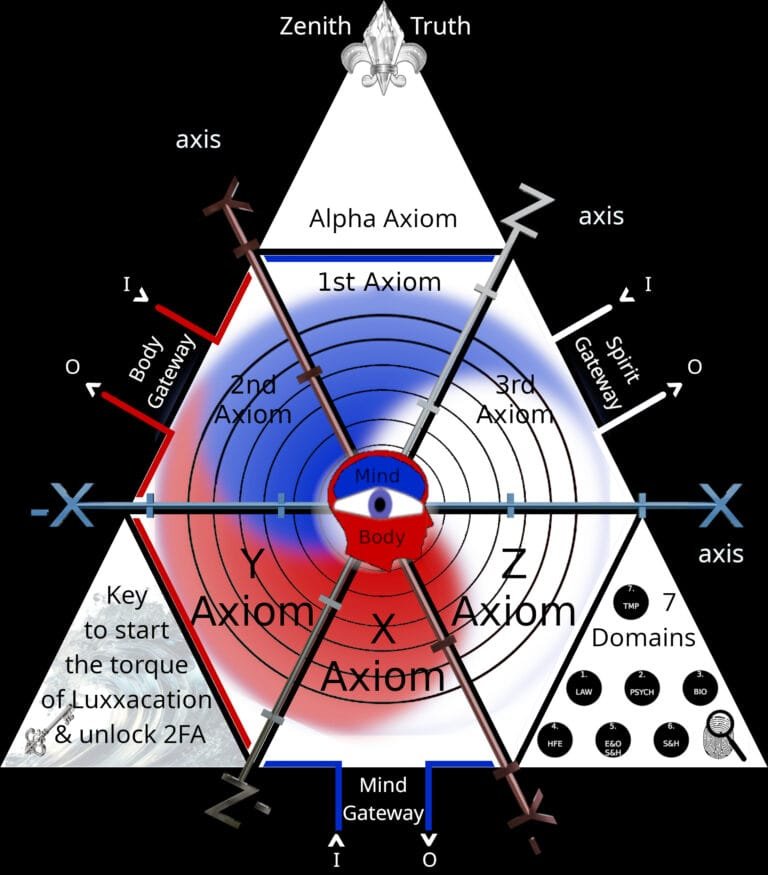
The Diagram below shows the Alpha Axiom: “Integrity is founded on truth” at the top of the XSE Peak, therefore positioning Truth at the Zenith (marked with the diamond at the top of the peak). At the foundation are the irrefutable axioms that appeal logically to common sense, in particular, the X, Y, & Z Axioms (see below). The diagram below shows the intentional hierarchy of then the 1st-3rd Axioms above the X,Y, and Z Axioms. Ascending to the Zenith can only be achieved through seeking truth, as depicted on the peak with the Alpha Axiom “Integrity is founded on truth.” The journey to the zenith of the XSE Peak is approached by first grasping the XSE Key, to start the “Torque” of XSE and for complete XSE functional analysis, both the 7 spheres of integration and the 7 domains of study must be taken into account as inputs and outputs passing through the Gateways of the system.
Breaking Down the Factors Individually
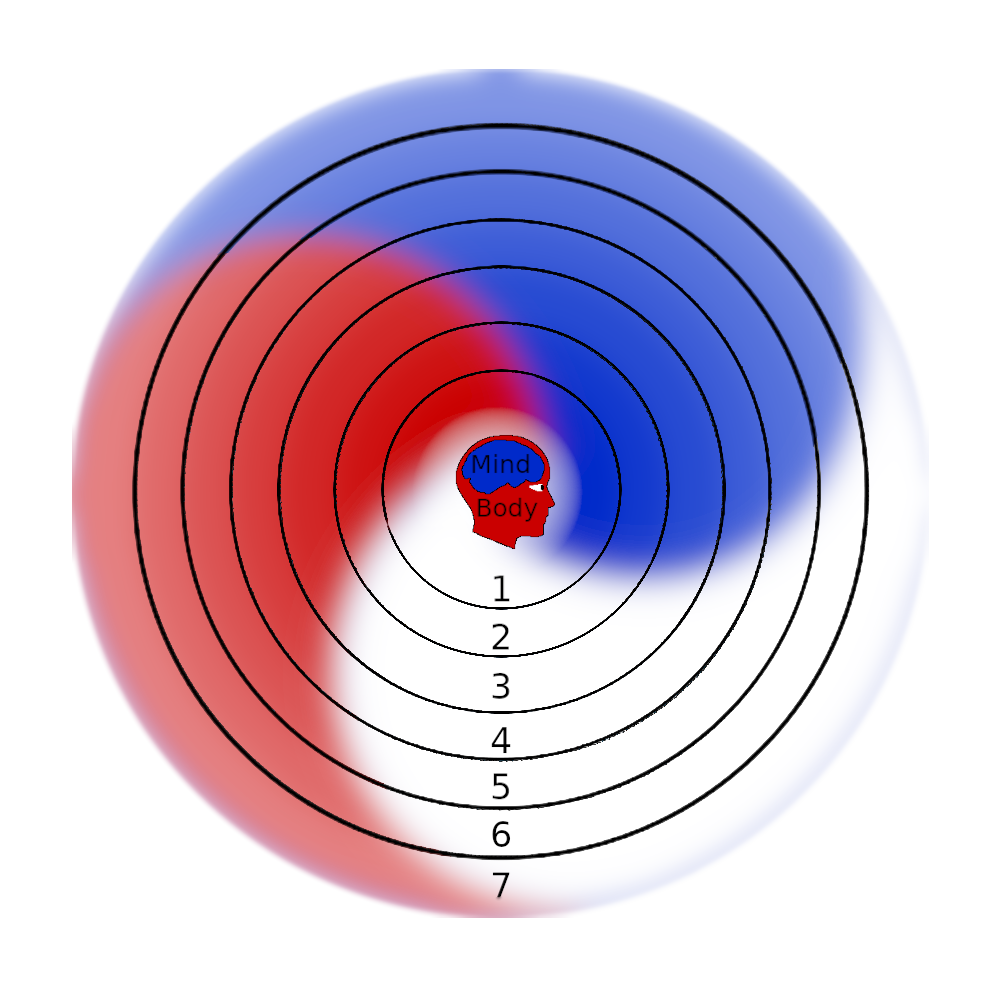
Above: the 3 aspects of the human are shown color coded (blue is for the mind, red is for the body, white is for the spirit) and are carried throughout the Seven Spheres of Integration (shown as rings around the individual in the center), from: 1. Independent Integration (X), 2. Family/ home, 3. Business/ Professional, 4. Community/ local, 5. National, 6. Global, & 7. Beyond. For analysis, plot the system on the X, Y, and Z axis, and evaluate the influence related to each sphere as inputs and outputs passing through the 3 Gateways.

The X Axiom (Using critical and creative thinking augments intelligence) correlates to the 1st mathematical dimension and 1st element of Luxxacation (“torquing” motion): “Take Time” and to the First Axiom (True and optimal intelligence is founded on integrity), which correlates to the X Axis (measuring system analysis), shown in blue (for the mind) above.
o o o o o o o Above: The 7 domains of study are depicted as 7 satellites revolving around the SOI and 7 Spheres as shown below in the XSE Framework 3-D Model. For complete XSE functional analysis, each of the 7 domain’s influences must be evaluated as inputs and outputs of the 3 Gateways of the 3 Aspects (Mind, Body, and Spirit) of the system.

The Y Axiom (The application of optimal choices enhances strength) correlates to the 2nd mathematical dimension and 2nd element of Luxxacation (“torquing” motion): “Build Strength” and to the Second Axiom (True and optimal strength is founded on integrity), which is derived from the Y Axis (for plotting actual stage of system life cycle), shown in red (for the body) above.

The Z Axiom states that “Seeking authentic & ultimate sources maximizes freedom” is correlated to the third dimension and 3rd element of Luxxacation (XSE’s “torque”): “Rise Above” & the 3rd Axiom (True & optimal freedom is founded on integrity), which is based on the Z Axis (rating of sources) shown white for the spirit above.
From the Fortified Foundation of the XSE Peak to the Zenith: Truth
The Advancing Assets of XSE, namely: 1. The XSE Key (used to unlock XSE’s 2FA and turn on the “torque” of XSE’s Luxxacation), 2. Investigative Skills (used to pass through XSE’s 2FA in order to enter the XSE Vantage Point), & 3. The XSE Vantage Point (used to gain all-encompassing and astronomical view of systems and explore the 4th dimension) are also markers of where a person is in the knowledge and application or practice of Independent Integration Systems Engineering. Grasping the XSE Key correlates to the Position of XSE’s Luxury Systems Engineer. Investigative Skills are the 2nd advancing asset and correlate to the Position of XSE’s Investigative Systems Engineer, signifying a stage of questioning, learning and applying the factors used in XSE, and seeking science-based facts and ultimately, the truth. The Advancing Assets of XSE are retained and built-upon, therefore, as one enters the Vantage Point, they maintain and still leverage the first two Advancing Assets for their benefit, but now are able to operate from the vantage point, which not only provides an all-encompassing and astronomical view of systems, but likewise also positions the individual as an XSE Pilot Systems Engineer, having passed through XSE’s 2FA, and skilled in exploration of the 4th dimension and set on a path of seeking and finding the Zenith of XSE: Truth.
The three axes create the framework for XESAS’s epoch-transcending, axiomatic coordinate architecture.
Above is shown the XSE Framework 3-D model. For an overview of the formula of how to apply these factors, see The XSE Method.
...which is fully visible by entering XSE's Vantage Point to explore the 4th dimension.

The XSE Key to accelerating advancement begins by taking a step back—moving beyond the constraints of your immediate position and perspective to ultimately enter the XSE Vantage Point. From this astronomical analytical position, the Pilot Systems Engineer seeks the broadest defensible view of the System of Interest, looking across its Factors, relationships, Epochs, surrounding systems, and relevant perspectives—including investigation of the Fourth Dimension where applicable.
Then look beyond the exterior of the SOI. What is it actually made of? What is its substance? What lies beneath its immediately observable representation? Is its underlying structure strong, integrated, and capable of sustaining its intended function—or is it weak, fragmented, or vulnerable when subjected to stress?
The answer cannot be determined from appearance alone. It requires investigation of the relevant Actual Factors, Analytical Factors, Sources and Resources, Inputs and Outputs, relationships, Derived Dynamics, Dynamic Mechanics, and other conditions affecting the SOI. The goal is to move beyond what merely meets the eye and determine, as accurately as available evidence permits, what the system is, how it is integrated, how it behaves, and what it can actually withstand.