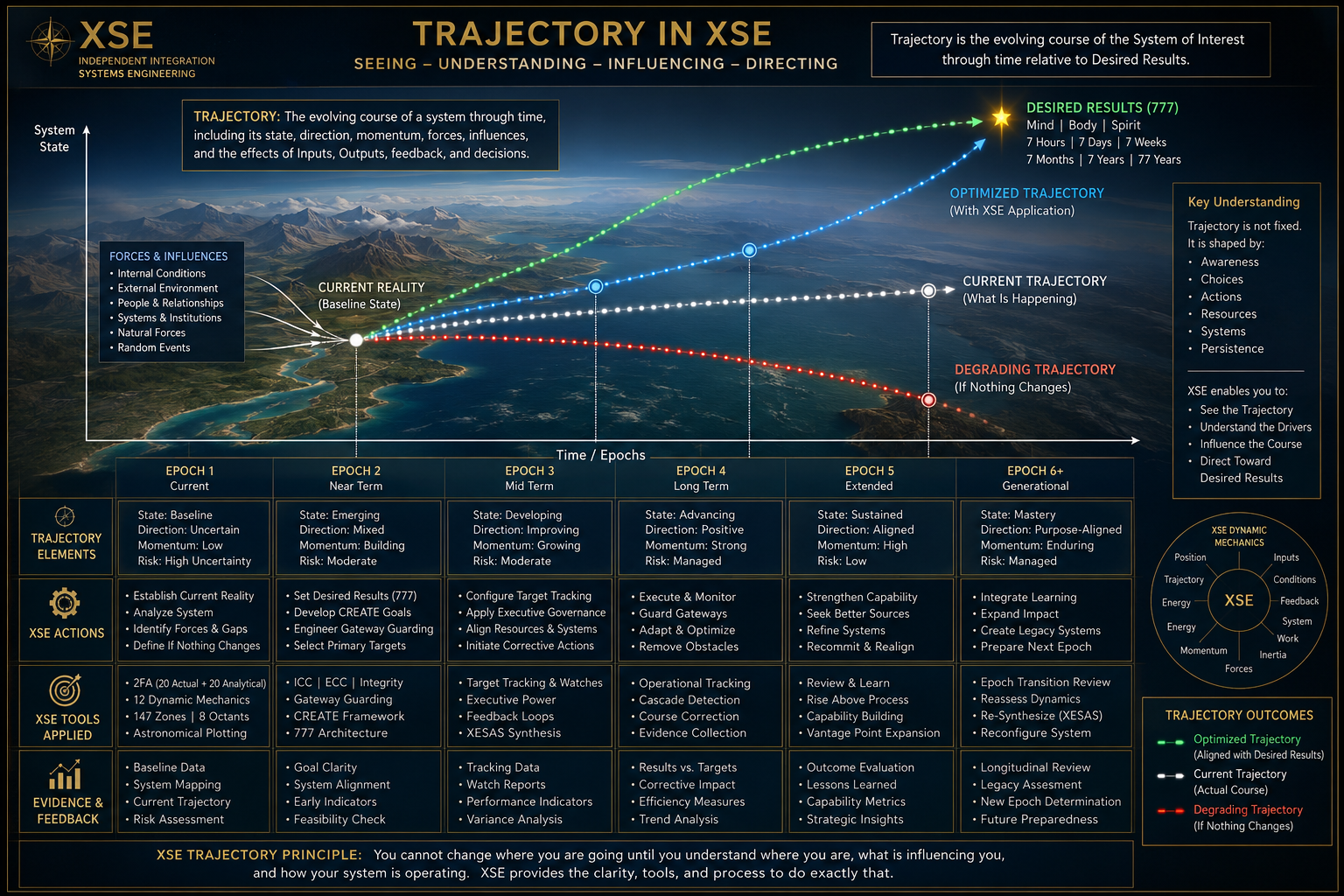
Where are You & Your SOI Going?

Trajectory is a Core XSE Dynamic Mechanic describing the evolving course of a System of Interest (SOI) through time—where the system is actually heading as its state, operation, Dynamic Mechanics, choices, conditions, interactions, Gateway exchanges, feedback, Sources, Resources, constraints, and other relevant influences interact.
Within Independent Integration Systems Engineering (XSE), Trajectory represents the developing course of the SOI, rather than merely its condition at one point in time.
Trajectory considers the relationship among:
- where the system has been;
- where it is now;
- the direction in which it is changing;
- the Dynamic Mechanics contributing to that change;
- the internal and external conditions influencing its operation;
- and the prospective states toward which continued operation may contribute.
A fundamental XSE Trajectory question is:
If this system continues operating substantially as it is now, where is it heading?
Trajectory is not destiny, certainty, or deterministic prediction. It represents an evolving and influenceable system course. When the SOI, its environment, operation, choices, Gateway Guarding, Sources, Resources, Forces, feedback, or other relevant conditions change, its Trajectory may change as well.
Trajectory Within XSE Dynamic Mechanics
Trajectory is one of the 12 Core XSE Dynamic Mechanics.
XSE Dynamic Mechanics is the higher-order Derived Dynamic describing important mechanics through which the SOI itself operates and changes. The surrounding Spheres represent larger systems whose Forces, conditions, Sources, Resources, exchanges, and feedback may influence that operation and change.
The 12 Core XSE Dynamic Mechanics are:
- System Mass
- System Energy
- System Distance
- System Displacement
- Trajectory
- Rate of Change
- Velocity
- Acceleration / Deceleration
- Inertia
- Momentum
- System Force
- System Work
This architecture is important because Trajectory describes only one dimension of the SOI’s dynamic operation.
Trajectory tells us the developing course.
The remaining Dynamic Mechanics help investigate such questions as:
- Mass: What constitutes the relevant substance or operational body of the SOI?
- Energy: What capacity is available for operation and change?
- Distance: How far apart are relevant system conditions?
- Displacement: What meaningful change in state or positioning has actually occurred?
- Rate of Change: How rapidly is the relevant condition changing?
- Velocity: How rapidly and in what direction is meaningful change occurring?
- Acceleration / Deceleration: How is that rate of change itself changing?
- Inertia: What tends to preserve the existing state or resist change?
- Momentum: What accumulated operation is sustaining the existing course?
- Force: What internal or external influences are acting upon the system?
- Work: What effective operation is actually producing meaningful system change?
Thus:
Trajectory describes the developing course; the 12 Core XSE Dynamic Mechanics provide a larger mechanical framework for investigating how that course is being produced, sustained, resisted, accelerated, slowed, or redirected.
Trajectory Is More Than Change
Not every change represents a meaningful change in Trajectory.
A system can fluctuate, temporarily deviate, or experience short-term variation while its larger course remains substantially unchanged.
Trajectory concerns the developing directional course of system operation through time.
Relevant characteristics may include:
Direction
Where is the SOI heading?
Drift
Is it gradually moving away from an intended or previously established course?
Deviation
Has meaningful departure from a relevant reference course occurred?
Correction
Is operation being redirected toward an intended or more appropriate course?
Stability
How consistently is the course being maintained?
Transition
Is the SOI moving meaningfully between system states, configurations, or life-cycle conditions?
Prospective Course
Toward what future conditions might continued operation plausibly contribute?
Concepts such as Rate of Change, Velocity, Acceleration/Deceleration, Inertia, and Momentum should not be treated as sub-elements of Trajectory. They are separate but interacting Core XSE Dynamic Mechanics that help explain how the Trajectory is developing.
Current State Is Not Trajectory
XSE distinguishes among Current State, Dynamic Mechanics, and Trajectory.
Current State asks:
What is the condition of the SOI now?
Dynamic Mechanics asks:
What is dynamically happening to and within the SOI?
Trajectory asks:
What course is developing as a consequence of that operation through time?
Two systems can therefore occupy apparently similar Current States while possessing substantially different Dynamic Mechanics and Trajectories.
For example, two organizations might presently show similar financial performance.
One may be:
- acquiring customers;
- strengthening Resources;
- increasing capability;
- reducing liabilities;
- and developing constructive Momentum.
The other may be:
- losing customers;
- consuming essential Resources;
- accumulating liabilities;
- experiencing unfavorable Forces;
- and developing deteriorating Momentum.
Their present states may look similar.
Their dynamic operation and developing courses may be radically different.
This is why XSE investigates both Current Reality and Current Trajectory during Take Time.
Trajectory, Desired Results, and System Distance
A critical XSE distinction is:
Trajectory describes where the SOI is actually heading. Desired Results (777) establish where the SOI intends to go.
The two should never be confused.
A person or system may possess clearly articulated Desired Results while operating on a Trajectory that does not reasonably support them.
Conversely, actual operation may already be moving substantially toward the intended Results.
System Distance helps investigate the relevant separation between Current Reality and a selected Desired Result, while System Displacement helps characterize meaningful change that has actually occurred.
The relationship can therefore be represented as:
CURRENT REALITY
↓
CURRENT DYNAMIC MECHANICS
↓
CURRENT TRAJECTORY
compared with:
DESIRED RESULTS (777)
with System Distance helping describe relevant separation and System Displacement helping describe actual meaningful movement.
Trajectory therefore provides an important reality check:
Does the SOI’s actual developing course support the Results it says it intends to achieve?
Trajectory and CREATE Goals
Once Desired Results establish intended Results, CREATE Goals establish actionable and Testable objectives intended to contribute to those Results.
CREATE Goals are:
Courageous • Realistic • Envisioned • Aligned • Testable • End-Dated
The relationship becomes:
Current Reality & Trajectory
↓
Desired Results (777)
↓
CREATE Goals
↓
Configured Operation
↓
System Work & Other Dynamic Mechanics
↓
Changed State
↓
Potentially Changed Trajectory
CREATE Goals can therefore function as deliberately engineered interventions into system operation.
Depending upon the SOI and circumstances, they may contribute to:
- reducing relevant System Distance;
- producing meaningful Displacement;
- overcoming Inertia;
- interrupting undesirable Momentum;
- establishing constructive Momentum;
- applying or responding to Forces;
- altering Rate of Change;
- influencing Velocity;
- producing System Work;
- and ultimately redirecting Trajectory.
Trajectory and Gateway Guarding
Gateway Guarding is a Derived Dynamic with an important relationship to Trajectory because it regulates selected exchanges through the Mind, Body, and Spirit Gateways.
Repeated Gateway exchanges can alter the operating conditions affecting the SOI.
For example:
Gateway Guarding
↓
Changes Relevant Inputs and Outputs
↓
Changes Feedback, Conditioning & Operating Conditions
↓
Changes Relevant Dynamic Mechanics
↓
Contributes to Changes in State and Trajectory
Gateway Guarding should therefore not be described as the sole controller of Trajectory.
Rather:
Gateway Guarding regulates important exchanges capable of influencing the Dynamic Mechanics through which Trajectory develops.
Trajectory, Mass, and Energy
The addition of System Mass and System Energy is particularly important to Trajectory analysis.
System Mass
System Mass concerns the relevant substance, constitution, accumulated structure, components, and operational body of the SOI insofar as these affect its dynamic behavior.
It encourages investigation beyond surface appearance:
What is this system actually made of, and how does its constitution affect the way it operates and changes?
Different SOIs—or the same SOI at different times—may respond differently to similar Forces because their underlying constitution differs.
System Energy
System Energy concerns the relevant capacity available for system operation, activity, and change.
Without sufficient Energy, Resources, or other enabling conditions, a theoretically desirable Trajectory may not be operationally sustainable.
Mass and Energy therefore deepen Trajectory analysis by requiring investigation not only of where the SOI is heading, but also of the system actually traveling that course and the capacity available to sustain or alter its operation.
For human systems, these are systems-engineering constructs and should not be interpreted as medical measurements or diagnoses.
Trajectory, Force, Inertia, and Momentum
Several Dynamic Mechanics are particularly useful for explaining why an established Trajectory may persist or become difficult to change.
System Force
System Force describes a relevant internal or external influence capable of contributing to change in system state, direction, rate, configuration, or Trajectory.
Forces may be:
- propelling;
- restraining;
- deflecting;
- corrective;
- or destabilizing.
System Inertia
System Inertia concerns the tendency of an established state, configuration, pattern, or course to resist change.
It asks:
What makes the present condition or course difficult to change?
System Momentum
System Momentum concerns the accumulated tendency of established operation to continue along its developing course because existing actions, structures, conditioning, feedback, Resources, relationships, or other conditions are sustaining it.
It asks:
What is keeping this course going?
Thus:
Trajectory describes the course. Force helps explain what acts upon it. Inertia helps explain resistance to changing it. Momentum helps explain the tendency of established operation to continue.
Recognizing an undesirable Trajectory therefore does not automatically eliminate the Dynamic Mechanics sustaining it.
Trajectory, Velocity, and Acceleration
Trajectory tells us the course, but several other mechanics provide greater precision regarding how that course is developing.
Rate of Change
How rapidly is the relevant system condition changing?
Velocity
How rapidly and in what direction is meaningful system change occurring?
Acceleration / Deceleration
Is that Velocity or Rate of Change increasing, decreasing, or otherwise changing?
This enables XSE to distinguish among conditions such as:
- constructive Trajectory that is accelerating;
- constructive Trajectory that is slowing;
- undesirable Trajectory that is worsening rapidly;
- undesirable Trajectory that is decelerating following intervention;
- or relatively stable operation exhibiting little meaningful directional change.
Thus:
Knowing where the SOI is heading is important; understanding how rapidly that course is developing and whether its movement is strengthening or weakening provides a substantially richer dynamic picture.
Trajectory and System Work
System Work concerns effective operation that produces meaningful system change.
This distinction matters because:
Activity does not necessarily constitute System Work.
A system can expend substantial effort, Energy, time, or Resources while producing little meaningful Displacement.
System Work may contribute to:
- reducing System Distance;
- producing Displacement;
- overcoming Inertia;
- altering Momentum;
- responding to or generating relevant Forces;
- changing Velocity;
- and redirecting Trajectory.
Within Luxxacation, System Work becomes particularly evident during Build Strength, when the configuration engineered through Take Time is actually placed into operation.
Trajectory and Executive Power
For applicable human systems, Executive Power has an especially important relationship with Trajectory.
Executive Power is a Derived Dynamic and one of the Three Integrated Mechanics of XSE.
It integrates the mechanical principle of:
POWER
with the familiar mechanical relationship:
Power = Work ÷ Time
Within XSE this is a systems-engineering analogue, not a claim that human executive functioning is literally measurable as mechanical wattage.
Executive Power concerns the effectiveness and timeliness through which executive-volitional governance becomes actual System Work.
Willpower functions as a central volitional capacity within Executive Power by helping the individual hold an appropriately governed direction under resistance.
Thus:
ECC Governance
↓
Willpower Helps Hold Direction
↓
Executive Power Carries Direction Into Timely Work
↓
System Work Interacts With Other Dynamic Mechanics
↓
State Changes
↓
Trajectory May Change
This makes Executive Power particularly important when an SOI recognizes that its present Trajectory should be altered but must still translate that recognition into actual operation.
Trajectory and the Three Integrated Mechanics of XSE
XSE distinguishes the 12 Core Dynamic Mechanics from three especially important mechanical principles that are already integrated into broader Derived Dynamics.
These are the Three Integrated Mechanics of XSE:
Executive Power — POWER
Can the SOI translate appropriately governed direction into effective and timely System Work?
Luxxacation — TORQUE
How can the SOI deliberately reorient and transform its operation?
Astronomical Plotting — POSITION
Where is the SOI positioned within the larger system being navigated, and how is that Position changing?
These mechanical principles are not duplicated among the 12 Core Dynamic Mechanics because they already have broader XSE expressions through their respective Derived Dynamics.
Their relationship to Trajectory is particularly important:
Position helps establish where the SOI is. Torque supports deliberate reorientation. Power supports timely execution. Trajectory describes the developing course produced through actual operation over time.
Trajectory and Target Tracking
Target Tracking provides recurring operational evidence from which Trajectory and other Dynamic Mechanics can be investigated.
At strategically positioned Watches during Build Strength, Target Tracking asks:
What is actually happening during operation?
Repeated observations may reveal whether the SOI appears to be:
- remaining On Target;
- beginning to drift;
- deviating;
- successfully Resetting;
- repeatedly moving off course;
- stabilizing;
- accelerating;
- decelerating;
- or developing another meaningful pattern.
A single Watch ordinarily does not establish a Trajectory.
Instead:
Watches → Days → Weeks → Operating Cycles → Longer Periods
can create longitudinal systems evidence from which developing patterns become increasingly visible.
Thus:
Dynamic Mechanics provides the framework for interpreting system operation; Target Tracking provides recurring evidence from actual operation.
Trajectory and the X, Y, and Z Axes
Trajectory should also be investigated through XSE’s three analytical Axes.
X Axis — System Analysis
What does critical and creative analysis reveal about how and why this Trajectory is developing?
Y Axis — System Life-Cycle Stage
Where is the SOI within its actual life cycle, and what does this Trajectory mean from that Position?
Z Axis — Sources and Resources
What Sources and Resources are informing, enabling, constraining, strengthening, weakening, or potentially capable of changing this Trajectory?
Together, the three Axes establish the analytical coordinate architecture through which Dynamic Mechanics and Trajectory can be evaluated.
Trajectory and the 8 Octants
The 8 Octants are themselves a Derived Dynamic within XSE.
They arise from the positive and negative combinations of the X, Y, and Z Axes and provide a higher-order means of organizing system positioning within the XSE Axiomatic System.
Trajectory and Octant positioning are related but distinct.
Trajectory describes the developing course of the SOI. The 8 Octants provide higher-order coordinate regions through which relevant system positioning can be evaluated.
A developing Trajectory may therefore contribute to movement toward, within, or away from particular Octant conditions.
The +++ Octant provides the only coordinate region containing positive valuation across all three Axes and therefore the region within which the highest XSE valuation—XSE Zenith—can be approached.
Trajectory, the 147 Zones, and Astronomical Plotting
These concepts can be understood in layers.
147 Zones
Help identify where relevant conditions are occurring across the integrated human-system architecture.
7 Domains of Study
Help determine through which fields those conditions should be investigated.
X, Y, and Z Axes
Establish the analytical coordinate architecture.
8 Octants
Provide a Derived Dynamic for higher-order positive and negative positioning.
12 Core XSE Dynamic Mechanics
Describe how the SOI itself is dynamically operating and changing.
Gateway Guarding
Regulates important Inputs and Outputs capable of influencing that operation.
Astronomical Plotting
Provides the navigational representation through which relevant Position, state, Dynamic Mechanics, Desired Results, and change across time may be represented and investigated.
The important distinction is:
Dynamic Mechanics describes the SOI’s dynamic operation and change; Astronomical Plotting represents relevant consequences of that operation for investigation and navigation.
Or:
SOI + Surrounding System Interaction
↓
Dynamic Mechanics
↓
Changing State & Trajectory
↓
Changing Zone / Octant Conditions
↓
Astronomical Plotting
The plot represents the system.
It is not the system itself.
Trajectory and Luxxacation
Luxxacation provides the transformational Torque of XSE through:
Take Time → Build Strength → Rise Above
Each Element interacts differently with Trajectory.
| Luxxacation Element | Relationship to Trajectory |
|---|---|
| Take Time | Establish Current Reality, investigate Dynamic Mechanics and Current Trajectory, establish Desired Results, and engineer or recalibrate the intended course |
| Build Strength | Put the configuration into operation through Gateway Guarding, Executive Power, System Work, and other relevant operation |
| Rise Above | Seek stronger Sources, Resources, knowledge, capability, support, and other assets capable of improving subsequent operation |
The recursive relationship becomes:
Investigate Current Reality
↓
Analyze Dynamic Mechanics
↓
Evaluate Trajectory
↓
Establish Desired Results
↓
Engineer Course
↓
Build Strength / Perform System Work
↓
Observe Actual Change
↓
Rise Above / Improve Sources & Resources
↓
Return to Take Time
↓
Reassess and Reconfigure
Trajectory is therefore not merely something XSE observes.
It is something XSE seeks to investigate, evaluate, and—where appropriate and realistically possible—deliberately influence through whole-system engineering and recursive Luxxacation.
Trajectory and XESAS Synthesis
Within XESAS Synthesis, XSE Dynamic Mechanics is the higher-order Derived Dynamic, with Trajectory functioning as one of its 12 Core Dynamic Mechanics.
XESAS Synthesis may therefore integrate findings concerning:
- System Mass;
- System Energy;
- System Distance;
- System Displacement;
- Trajectory;
- Rate of Change;
- Velocity;
- Acceleration / Deceleration;
- Inertia;
- Momentum;
- System Force;
- System Work;
- the 40 Factors;
- Desired Results;
- Gateway Guarding;
- Target Tracking;
- Sources and Resources;
- constraints;
- and other relevant Derived Dynamics.
Trajectory contributes the critical question:
Given Current Reality and the Dynamic Mechanics presently operating, where is the current configuration taking the SOI—and what configuration would better support its intended Results?
Trajectory is therefore both evidence considered during configuration and an evolving consequence of subsequent operation.
Trajectory Within and Across Epochs
Trajectory is particularly important within the Epoch-Transcending architecture of XESAS.
An Epoch represents a meaningful system life-cycle-defined period or state.
Trajectory may be examined:
Within an Epoch
to investigate the course developing within the present system condition.
Between Epochs
to investigate the Dynamic Mechanics associated with transition from one meaningful system condition into another.
Across Epochs
to investigate longer-term patterns involving:
- Trajectory;
- Mass;
- Energy;
- Momentum;
- Inertia;
- Forces;
- Displacement;
- Acceleration / Deceleration;
- consequences;
- and directional change.
A new Epoch does not erase the Dynamic Mechanics or consequences of previous operation.
Earlier decisions, Inputs, Outputs, Sources, Resources, Forces, constraints, Work, conditioning, and feedback may continue influencing subsequent system states.
This is one reason XESAS is Epoch-Transcending rather than merely Epoch-based.
Trajectory Is Influenceable, Not Predetermined
Trajectory should never be interpreted as destiny.
Current Dynamic Mechanics can provide useful evidence concerning the course presently developing, but complex systems remain subject to:
- changing conditions;
- new information;
- choices;
- unexpected events;
- changing Sources and Resources;
- intervention;
- learning;
- Gateway Guarding;
- feedback;
- adaptation;
- competing Forces;
- and uncertainty.
For applicable human systems, personal agency and intentional choice remain relevant.
Accordingly, XSE treats Trajectory as:
- dynamic;
- investigable;
- influenceable;
- adaptive;
- recursively shaped;
- and uncertain.
The purpose of Trajectory analysis is not deterministic prediction.
It is to recognize consequential direction and developing patterns early enough to support better-informed systems-engineering decisions and appropriate course correction.
Trajectory for Non-Human Systems
Trajectory applies beyond human systems.
For an organization, Trajectory might concern movement toward growth, decline, increased capability, instability, maturity, restructuring, or another relevant state.
For a project, it might concern movement toward timely completion, schedule slippage, budget overrun, successful delivery, or failure to satisfy requirements.
For a technical system, it might concern increasing degradation, stable operation, changing reliability, maintenance requirements, or transition toward another operating condition.
For software, it might concern performance, reliability, technical debt, security posture, adoption, scalability, or another relevant developing course.
The specific variables depend upon the SOI.
The underlying question remains:
Given the SOI’s Current State, Dynamic Mechanics, operation, interactions, feedback, and surrounding conditions, where does its present course appear to be taking it?
Investigative and Scope Considerations
Within XSE, Trajectory is a Core XSE Dynamic Mechanic used for systems-engineering investigation of developing system course.
For complex—and particularly human—systems, XSE’s mechanical terminology should be understood as systems-engineering constructs and analogues, not claims that human beings or other complex SOIs literally conform to simplified mechanical equations.
Trajectory analysis does not claim:
- certainty concerning future events;
- deterministic prediction;
- complete causal knowledge;
- unlimited system control;
- elimination of uncertainty;
- or exhaustive explanation of human agency or personhood.
For applicable human systems, XSE Trajectory analysis is educational and strategic. Questions involving medical, psychological, legal, nutritional, or other regulated professional matters should be addressed by appropriately qualified professionals where applicable.
Trajectory is therefore best understood as:
a systems-engineering representation of developing course—not a declaration of inevitable outcome.
Concise Definition
Trajectory is one of the 12 Core XSE Dynamic Mechanics, describing the evolving course of a System of Interest through time—where the SOI is actually heading as its state, operation, Dynamic Mechanics, choices, Gateway exchanges, feedback, Sources, Resources, constraints, surrounding-system interactions, and other relevant conditions combine. Trajectory is investigated alongside System Mass, System Energy, Distance, Displacement, Rate of Change, Velocity, Acceleration/Deceleration, Inertia, Momentum, Force, and Work to understand how the SOI’s course is developing and how it may, where appropriate and realistically possible, be deliberately influenced in relation to Current Reality, Desired Results, Integrity, and changing life-cycle conditions.
You are either retrogressing or advancing

The Dynamic Nature of Human Systems: Stability, Change, Advancement, and Retrogression
Human life is inherently dynamic. Even during periods in which a person appears to be “standing still,” the human System of Interest (SOI) and the larger systems surrounding it continue operating across time.
The SOI possesses substance and structure. Energy is used and replenished. Internal and external Forces act upon it. Inputs and Outputs continue through its Gateways. Environments change. Relationships develop. Sources and Resources shift. Choices accumulate. Feedback from previous operation affects subsequent conditions. Inertia may resist change, while Momentum may sustain an established course.
Within Independent Integration Systems Engineering (XSE), apparent stagnation should therefore not automatically be interpreted as an absence of system dynamics.
Through XSE Dynamic Mechanics, the human SOI can be investigated in terms of 12 Core Dynamic Mechanics:
- System Mass
- System Energy
- System Distance
- System Displacement
- Trajectory
- Rate of Change
- Velocity
- Acceleration / Deceleration
- Inertia
- Momentum
- System Force
- System Work
These mechanics provide a more precise framework than simply asking:
Am I moving forward or backward?
Instead, XSE asks:
What is dynamically happening to and within the SOI? What is remaining relatively stable? What is changing? What Forces are acting upon it? What Energy and Resources are available? What is resisting or sustaining change? What meaningful Work is occurring? And what Trajectory is developing through time?
Apparent Stagnation Does Not Mean a Static System
A person may experience a period in which little visible progress appears to be occurring.
That does not necessarily mean that nothing is happening.
A system may exhibit relative stability in one condition while significant Dynamic Mechanics are operating elsewhere.
For example:
- a professional position may remain unchanged while capability and knowledge are increasing;
- an outward routine may remain similar while relationships are strengthening or deteriorating;
- a Desired Result may remain distant while Resources are being accumulated;
- little visible Displacement may occur while substantial Work is being performed to overcome Inertia;
- a behavior may remain temporarily stable while the Forces sustaining it are weakening;
- or System Energy may be directed toward recovery and maintenance rather than outward expansion.
Conversely, visible activity does not necessarily indicate advancement.
A person can be extraordinarily busy while producing little meaningful System Work, Displacement, or reduction in System Distance from important Desired Results.
XSE therefore distinguishes among:
activity, operation, change, movement, maintenance, advancement, and retrogression.
They are not interchangeable.
System Mass: What Is Actually Changing?
Before evaluating movement, XSE can investigate the SOI itself.
System Mass concerns the relevant substance, constitution, accumulated structure, components, and operational body of the SOI insofar as these affect its dynamic behavior.
For a human SOI, this encourages investigation of the integrated system rather than reducing the person to a single behavior, metric, or outward appearance.
The question becomes:
What constitutes this SOI, and how does that constitution affect its capacity to maintain, resist, undergo, or produce change?
This is important because apparently similar systems may respond very differently to similar Forces.
A change that is easily sustained by one SOI may place substantial demands upon another because their:
- Resources;
- capabilities;
- conditioning;
- responsibilities;
- environments;
- accumulated structures;
- constraints;
- relationships;
- or other relevant system conditions
are different.
Thus, XSE does not evaluate change independently of the actual system undergoing that change.
System Energy: What Capacity Is Available for Operation?
System Energy concerns the relevant capacity available for system operation, activity, maintenance, and change.
Every human system operates under real limitations.
Attention, time, physical capacity, knowledge, Resources, recovery, environmental support, and other enabling conditions affect what can realistically be accomplished.
This means that a lack of visible advancement should not automatically be interpreted as lack of effort or character.
The SOI may be allocating substantial Energy toward:
- maintaining essential functions;
- meeting responsibilities;
- recovery;
- resisting destabilizing Forces;
- adapting to changed conditions;
- or preserving an already valuable state.
Likewise, a system may attempt to produce more Work than its available Energy and Resources can sustainably support.
XSE therefore asks:
What Energy is available, where is it being directed, what is consuming it, and does the present allocation support the intended system configuration?
For human applications, System Energy is a systems-engineering construct rather than a medical measurement. Persistent fatigue, illness, or other health concerns require appropriate healthcare evaluation.
Continuous Internal and External Change
Human systems exist within larger systems that also change.
Relevant changes can occur across the Seven Spheres of Integration:
- Individual;
- Family / Home;
- Professional / Business;
- Community / Local;
- National / Country;
- Global / World;
- Cyber / Beyond.
Economic conditions change. Technology develops. Organizations restructure. Relationships evolve. Laws and policies change. Information environments shift. New opportunities, Resources, constraints, and Forces emerge.
The human SOI also changes across time through factors such as:
- learning;
- experience;
- aging;
- conditioning;
- repeated choices;
- habits;
- relationships;
- environmental exposures;
- skill development;
- and accumulated feedback.
The 12 Core Dynamic Mechanics describe how the SOI itself is operating and changing, while the surrounding Spheres represent larger systems whose Forces, conditions, Sources, Resources, exchanges, and feedback may influence that operation and change.
Accordingly, maintaining a desirable state can itself require continuing regulation and System Work.
Stability Can Be an Achievement
This is an important refinement to the simplistic idea that a person must always be either advancing or declining.
Within XSE:
Stability is not necessarily stagnation.
Sometimes maintaining a valuable system state despite destabilizing Forces represents highly successful operation.
Consider a system exposed to substantial opposing Force.
If it maintains its desired state, little net Displacement may be visible—but significant Work, Energy, Gateway Guarding, or Executive Power may have been required to preserve that Position.
Similarly:
- maintaining a skill may require practice;
- maintaining a relationship may require continuing investment;
- maintaining physical capability may require repeated activity;
- maintaining organizational performance may require adaptation;
- maintaining boundaries may require Gateway Guarding;
- and maintaining an intended course may require continual correction.
Therefore:
An absence of visible advancement does not necessarily indicate retrogression. Maintaining a valuable state against Forces that would otherwise degrade it may itself represent successful System Work.
The relevant question is whether that stability is appropriate, intentional, sufficiently sustainable, and coherent with Current Reality and Desired Results.
Inertia and Resistance to Change
System Inertia is particularly important when investigating apparent stagnation.
System Inertia describes the tendency of an established system state, configuration, pattern, or course to resist change.
A person may sincerely intend change while existing:
- habits;
- conditioning;
- routines;
- environmental arrangements;
- commitments;
- constraints;
- relationships;
- feedback loops;
- structures;
- or Resource limitations
continue supporting the present condition.
The person may therefore perform considerable Work while initially producing relatively little Displacement.
Rather than immediately labeling this as failure, XSE asks:
What Inertia is resisting the intended change, and what would be required to alter it?
This transforms “I am stuck” from a conclusion into an investigative systems question.
Momentum and Accumulating Patterns
System Momentum helps explain why established operation may increasingly tend to continue.
Repeated:
- choices;
- behaviors;
- Gateway exchanges;
- environmental configurations;
- relationships;
- routines;
- feedback;
- and System Work
can progressively reinforce an existing course.
Constructive operation can develop constructive Momentum.
Destabilizing operation can develop undesirable Momentum.
This means small actions can matter not merely because of their immediate Results, but because of the larger patterns to which repeated operation contributes.
A single action may produce little visible Displacement while repeated operation progressively changes Momentum and eventually produces substantial system change.
The reverse is also true: seemingly minor destabilizing patterns may become increasingly consequential when recursively reinforced.
Multiple Forces Can Produce Little Visible Movement
Human systems are continuously affected by internal and external influences.
Within XSE, System Force concerns an influence capable of contributing to change in system state, direction, rate, configuration, or Trajectory.
Relevant Forces may arise through:
- environments;
- relationships;
- responsibilities;
- incentives;
- constraints;
- Sources;
- Resources;
- Inputs and Outputs;
- feedback;
- Gateway conditions;
- organizations;
- opportunities;
- deliberate interventions;
- and interactions with other systems.
Importantly:
Little visible Displacement does not necessarily mean that little is dynamically occurring.
Several substantial Forces may oppose one another.
For example:
Propelling Force → SOI ← Restraining Force
If these influences substantially counteract one another, observable movement may remain limited despite significant dynamic interaction.
This is another reason XSE avoids equating little movement with nothing happening.
System Work Versus Mere Activity
XSE also distinguishes between activity and System Work.
System Work concerns effective operation that produces meaningful change in the state, configuration, capability, Position, or functioning of the SOI.
A person can expend considerable:
- time;
- Energy;
- effort;
- attention;
- or Resources
while producing little meaningful change.
Conversely, a strategically selected intervention may produce substantial change with comparatively little wasted activity.
This is one reason Take Time is essential within Luxxacation.
The objective is not simply:
Do more.
It is:
Determine what Work actually needs to be done, then configure the system to perform it effectively.
Advancement, Stability, and Retrogression
XSE can meaningfully distinguish among advancement, stability, and retrogression, but these must be evaluated relative to Current Reality, Desired Results, Integrity, system requirements, and other appropriate reference conditions.
Advancement
Advancement describes meaningful system change toward more desirable, capable, integrated, appropriately configured, or otherwise positively valued conditions consistent with relevant Desired Results and governing XSE principles.
Stability
Stability describes relative maintenance of a system state, capability, configuration, or course.
Depending upon circumstances, stability may be:
- desirable;
- undesirable;
- temporary;
- protective;
- strategically necessary;
- or evidence of substantial successful Work against destabilizing Forces.
Retrogression
Retrogression describes meaningful movement toward deterioration, loss of capability, fragmentation, increasing undesirable System Distance, or other negatively valued conditions.
Therefore:
Movement is not automatically advancement. Stability is not automatically failure. Change is not automatically improvement. And activity is not automatically Work.
The direction, quality, context, and consequences of system change matter.
Trajectory Brings Change Together Across Time
Trajectory is one of the 12 Core XSE Dynamic Mechanics and describes the evolving course of the SOI through time.
Trajectory asks:
Given Current Reality and the Dynamic Mechanics presently operating, where does this course appear to be taking the system?
A person who feels “stuck” may actually be experiencing any number of different dynamic conditions:
- little meaningful Displacement;
- substantial Inertia;
- competing Forces producing little net movement;
- constructive change occurring too gradually to be easily perceived;
- System Work whose Results have not yet become visible;
- insufficient Energy or Resources for the intended change;
- constructive or undesirable Momentum;
- successful maintenance against destabilizing Forces;
- or different dimensions of the SOI changing in different directions.
XSE seeks to distinguish among these possibilities rather than assigning all of them the single label stagnation.
Dynamic Mechanics and the Three Integrated Mechanics
The 12 Core Dynamic Mechanics describe important mechanics through which the SOI itself operates and changes.
XSE also identifies Three Integrated Mechanics, in which three major mechanical principles are incorporated into broader Derived Dynamics:
Executive Power — POWER
Executive Power concerns the effectiveness and timeliness through which executive-volitional governance becomes meaningful System Work.
Its mechanical analogue emphasizes:
Power = Work ÷ Time
The issue is not merely whether Work occurs, but whether appropriate Work occurs within the time in which it matters.
Luxxacation — TORQUE
Luxxacation provides the transformational Torque of XSE through:
Take Time → Build Strength → Rise Above
It provides the recursive architecture through which the SOI can investigate its present course, engineer a configuration, operate it, obtain improved Sources and Resources, and reorient again.
Astronomical Plotting — POSITION
Astronomical Plotting integrates the mechanical principle of Position, representing relevant system state and positioning within the larger navigational architecture.
Together:
Astronomical Plotting helps establish where the SOI is positioned. Luxxacation provides Torque for reorientation. Executive Power provides Power for timely execution. The 12 Core Dynamic Mechanics describe how the SOI itself is dynamically operating and changing.
Executive Power and the Difference Between Intention and Change
For applicable human systems, recognizing that change is needed does not itself produce change.
A person may:
- know what should be done;
- establish a Desired Result;
- formulate a CREATE Goal;
- recognize an undesirable Trajectory;
- and still fail to translate that governance into timely System Work.
This is where Executive Power becomes critical.
Willpower—the closest familiar secular concept—functions as a central volitional capacity supporting Executive Power by helping the person hold an appropriately governed direction under resistance.
Executive Power is broader because it concerns the capacity to:
- prioritize;
- initiate;
- restrain;
- persist;
- regulate Gateways;
- follow through;
- correct;
- Reset;
- and carry governance into timely Work.
Thus:
Recognizing Trajectory provides information. Reorienting through Luxxacation establishes a course. Executive Power helps turn that course into operation.
Entropy as a Carefully Bounded Systems Analogy
The concept of entropy can provide a useful analogy, but it should be used carefully.
In thermodynamics, entropy has a precise scientific meaning. Human decline, disorder, lack of motivation, or personal failure should not be presented as literal thermodynamic entropy.
Within XSE, anti-entropic terminology functions as a systems-oriented analogy for deliberate efforts to:
- preserve;
- organize;
- strengthen;
- repair;
- recalibrate;
- or improve
system functioning against conditions that might otherwise contribute to degradation.
Human systems require continuing:
- Inputs;
- Energy;
- Resources;
- maintenance;
- learning;
- regulation;
- adaptation;
- and System Work.
Skills may require practice. Relationships may require attention. Capabilities may require maintenance. Knowledge may become outdated. Environments change.
Thus:
Maintenance itself may constitute important System Work.
Take Time as an Anti-Entropic Element of Human Systems Reorientation
This is why Take Time can appropriately be characterized within XSE as:
An Anti-Entropic Element of Human Systems Reorientation
Take Time interrupts purely reactive operation long enough to investigate:
- Current Reality;
- System Mass;
- available System Energy;
- Current Trajectory;
- System Distance;
- System Displacement;
- Inertia;
- Momentum;
- relevant Forces;
- Sources and Resources;
- Gateway conditions;
- Target Tracking evidence;
- Desired Results;
- and other relevant Factors and Derived Dynamics.
The Systems Engineer can then determine whether the current configuration should be:
- maintained;
- strengthened;
- corrected;
- redirected;
- replaced;
- or otherwise reconfigured.
The resulting configuration enters Build Strength, where Executive Power, Gateway Guarding, System Work, and the other Dynamic Mechanics become evident through actual operation.
Rise Above then seeks stronger Sources, Resources, knowledge, support, tools, and capabilities.
The process recursively returns to Take Time.
The More Precise XSE Principle
The older proposition that a person is always either moving forward or backward contains an important intuition: human systems do not exist outside time, and continued operation has consequences.
However, XSE provides a more precise formulation.
Human systems are continuously operating within changing conditions, but their dynamic state cannot always be reduced to simple forward or backward movement. An SOI may simultaneously advance, maintain, decline, resist change, accumulate Momentum, expend Energy, perform Work, or experience opposing Forces across different dimensions of the system.
The objective of XSE Dynamic Mechanics is to investigate those differences.
Instead of merely asking:
“Am I progressing?”
XSE can ask:
What constitutes the SOI? What Energy is available? What Forces are acting upon it? What is changing? What is resisting change? What Work is actually being accomplished? What Momentum is accumulating? What Distance remains? What Displacement has occurred? What Trajectory is developing? And does that developing course support the intended Desired Results?
Conclusion
Human systems should not be understood as simply moving forward or backward every second.
Reality is considerably more dynamic.
A person may be:
- advancing in one dimension;
- maintaining another;
- retrogressing in another;
- overcoming substantial Inertia elsewhere;
- conserving Energy;
- resisting destabilizing Forces;
- accumulating Resources;
- performing Work whose Results are not yet visible;
- or building Momentum that may substantially influence future Trajectory.
XSE Dynamic Mechanics provides a framework for investigating this complexity rather than reducing it to a binary judgment.
Because human systems operate through time within changing internal and external conditions, apparent stagnation does not mean that nothing is happening. The 12 Core XSE Dynamic Mechanics—System Mass, System Energy, System Distance, System Displacement, Trajectory, Rate of Change, Velocity, Acceleration/Deceleration, Inertia, Momentum, System Force, and System Work—help distinguish meaningful advancement, retrogression, stability, resistance, capacity, and emerging change. The Three Integrated Mechanics then provide a higher-order navigational relationship: Astronomical Plotting represents Position, Luxxacation supplies Torque for reorientation, and Executive Power supplies Power for translating appropriately governed direction into timely System Work. Through recursive XSE application, the Systems Engineer can investigate what is actually occurring and deliberately configure available operation toward increasingly constructive Desired Results within the realities and limitations of the system.
Trajectory when you are the SOI

When the Person Is the System of Interest
When the System of Interest (SOI) is the person themselves, Independent Integration Systems Engineering (XSE) provides a structured systems-engineering framework for examining how the integrated human system is presently functioning, how it is changing over time, what is influencing that change, where its current course appears to lead, and how deliberate reconfiguration may influence future operation.
The person is not treated as a machine or reduced to mechanical equations. Rather, XSE applies systems concepts to help organize and investigate complex relationships among the person’s:
- Mind, Body, and Spirit;
- choices and behaviors;
- habits and conditioning;
- Executive Control Center (ECC);
- Integrative Convergence Center (ICC);
- Executive Power and willpower;
- relationships and environments;
- Inputs and Outputs;
- Gateway Guarding;
- Sources and Resources;
- constraints and opportunities;
- feedback;
- life-cycle conditions;
- and interactions across the Seven Spheres of Integration.
Within this architecture, XSE Dynamic Mechanics provides a particularly important means of examining how the SOI itself is constituted, energized, influenced, resisted, moved, changed, and directed across time.
The central question therefore expands from simply:
Where am I heading?
to:
How is my system actually operating and changing? What is producing, resisting, sustaining, accelerating, or redirecting that change? Where is the resulting Trajectory taking me? Where am I positioned within the larger system? And how does that compare with where I intend to go?
The Person as the First Sphere of Integration
When the individual person is the SOI, XSE begins with the First Sphere of Integration: Individual / Independent Integration.
This does not mean the person operates in isolation.
The surrounding Spheres may provide:
- Forces;
- conditions;
- Sources;
- Resources;
- Inputs;
- Outputs;
- constraints;
- opportunities;
- relationships;
- environmental influences;
- and feedback
that affect the person’s operation.
Thus:
The 12 Core XSE Dynamic Mechanics describe how the individual SOI itself is operating and changing, while the surrounding Spheres represent the larger systems whose conditions and interactions may influence that operation and change.
Independent Integration therefore concerns self-governance within an interconnected larger system, not independence from all external influence.
Personal XSE Dynamic Mechanics
When the person is the SOI, XSE Dynamic Mechanics examines the mechanics through which the person persists, changes, resists change, moves, redirects, and undergoes meaningful transformation over time.
XSE Dynamic Mechanics is itself a Derived Dynamic and contains 12 Core XSE Dynamic Mechanics:
1. System Mass
System Mass concerns the relevant physical mass, material constitution, and composition of the embodied SOI insofar as these affect operation and response to physical conditions and change.
For a human SOI, this may include relevant physical characteristics such as:
- body mass;
- body composition;
- tissues;
- skeletal structure;
- organs;
- fluids;
- and other material constituents.
It asks:
What physically constitutes the embodied SOI, and how might that constitution matter to the mechanics being investigated?
System Mass does not redefine beliefs, personality, knowledge, relationships, or values as literal mass.
2. System Energy
System Energy concerns energy available, stored, transferred, transformed, or expended within the SOI in relation to its capacity for operation and System Work.
For an embodied human SOI, biological energy processes are genuinely relevant to function. However, System Energy is not synonymous with subjective motivation, mood, vitality, or Executive Power.
It asks:
What energetic capacity is available for operation, recovery, maintenance, and meaningful Work?
For human applications, medical questions involving fatigue, metabolism, illness, or abnormal physiological function remain matters for appropriately qualified healthcare professionals.
3. System Distance
System Distance is the meaningful separation between two relevant system states or reference conditions, frequently between Current Reality and a Desired Result.
It asks:
How much meaningful difference exists between where I am and where I intend to be?
4. System Displacement
System Displacement is the net meaningful change actually accomplished between two observation points.
It asks:
What has actually changed—not merely what activity occurred?
A person may expend substantial effort and Energy while producing little meaningful Displacement.
5. Trajectory
Trajectory is the evolving course of the person’s system through time.
It asks:
Given how I am actually operating, where does this course appear to be taking me?
Trajectory is not destiny. It describes a developing and influenceable course.
6. Rate of Change
Rate of Change describes how rapidly a relevant system condition is changing.
It asks:
How quickly is meaningful change occurring?
7. System Velocity
System Velocity adds direction to Rate of Change.
It asks:
How rapidly am I changing, and in what direction?
8. System Acceleration / Deceleration
System Acceleration / Deceleration describes how Velocity or Rate of Change itself is changing.
It asks:
Is this pattern gaining speed, slowing, stabilizing, or beginning to reverse?
9. System Inertia
System Inertia is the tendency of an established state, configuration, habit, pattern, or course to resist change.
It asks:
What is making the present condition difficult to change?
10. System Momentum
System Momentum is the accumulated tendency of an established course to continue because existing operation and reinforcing conditions are sustaining it.
It asks:
What is keeping this course moving?
11. System Force
System Force is an internal or external influence capable of contributing to change in system state, direction, rate, configuration, operation, or Trajectory.
It asks:
What is presently pushing, pulling, restraining, redirecting, correcting, or destabilizing this system?
12. System Work
System Work is effective operation or applied effort that produces meaningful change in the SOI.
It asks:
What am I actually doing that is producing meaningful change rather than merely consuming time, Energy, or effort?
Together, these 12 mechanics provide a much richer picture than Trajectory alone.
Current State Is Not Current Trajectory
A person’s Current System State describes relevant conditions as they presently exist.
XSE Dynamic Mechanics describes what is dynamically happening to and within the SOI.
Trajectory describes the developing course resulting from that operation across time.
These are related but distinct.
Two people may appear to occupy similar Current States while possessing very different Dynamic Mechanics.
For example, two people might presently have similar professional capabilities.
One may be:
- deliberately learning;
- strengthening Sources and Resources;
- performing meaningful System Work;
- building constructive relationships;
- and developing constructive Momentum.
The other may be:
- allowing skills to become outdated;
- losing important Resources;
- repeatedly postponing necessary Work;
- increasing System Distance from Desired Results;
- and developing greater Inertia.
Their outward states today may look similar.
Their Dynamic Mechanics and developing Trajectories may be very different.
XSE therefore asks not only:
Where am I?
but also:
What is happening dynamically from where I am?
Mind, Body, and Spirit as the Integrated Human SOI
When the person is the SOI, XSE considers:
Mind | Body | Spirit
as distinct but interacting Aspects of the integrated person.
Accordingly, personal advancement should not be reduced to one isolated metric such as:
- career;
- finances;
- productivity;
- appearance;
- academic achievement;
- social status;
- or another single Result.
Change in one Aspect may influence conditions in the others.
Apparent advancement in one area may also impose costs elsewhere.
For example:
- professional advancement may alter sleep, relationships, or attention;
- physical improvement may affect confidence or behavior;
- repeated informational Inputs may influence decisions and priorities;
- spiritual orientation may affect values, commitments, and long-term direction.
XSE therefore evaluates personal Dynamic Mechanics in relation to whole-person Integrity.
A Result that appears beneficial in isolation may warrant reconsideration if the means used to obtain it repeatedly degrade the integrated human system elsewhere.
The Three Gateways and Personal Operation
The Mind, Body, and Spirit Gateways are interfaces through which relevant Inputs and Outputs interact with the human system.
Mind Gateway
May involve Inputs and Outputs associated with:
- information;
- learning;
- attention;
- media;
- conversation;
- reasoning;
- interpretation;
- communication;
- and intellectual activity.
Body Gateway
May involve:
- nutrition-related choices;
- movement;
- exercise;
- rest;
- sleep-related practices;
- physical environments;
- sensory exposures;
- routines;
- and behavioral Outputs.
Spirit Gateway
Within XSE’s educational framework, this may involve voluntarily examined matters associated with:
- values;
- purpose;
- gratitude;
- hope;
- courage;
- conscience;
- meaningful commitments;
- attachments;
- and deeper orientation.
The Gateways are important interfaces, but they are not the sole controllers of Trajectory.
Many Factors, Forces, conditions, Dynamic Mechanics, Sources, Resources, and external systems influence the SOI.
Gateway Guarding as Deliberate Regulation
Gateway Guarding is the Derived Dynamic through which selected Inputs and Outputs are intentionally admitted, encouraged, restricted, rejected, produced, inhibited, or prevented across the Mind, Body, and Spirit Gateways.
For a CREATE Goal, the person may identify:
YES Input — something deliberately admitted or sought.
YES Output — something deliberately produced or enacted.
NO Input — something deliberately restricted, rejected, avoided, or refused.
NO Output — something deliberately inhibited, prevented, discontinued, or refused.
Repeated Gateway Guarding may influence Dynamic Mechanics through relationships such as:
Gateway Guarding
↓
Changed Inputs / Outputs
↓
Changed Feedback, Conditioning & Operating Conditions
↓
Changed Energy, Resources or System Forces
↓
Interaction With Inertia & Momentum
↓
Changed System Work
↓
Changed Velocity / Displacement
↓
Changed Trajectory
Gateway Guarding therefore provides one important means through which intended configuration can influence actual operation.
Personal Trajectory
Within this larger architecture, Trajectory remains essential.
Trajectory describes the person’s evolving course through time as their:
- state;
- choices;
- habits;
- System Forces;
- Gateway conditions;
- Inputs and Outputs;
- Sources and Resources;
- relationships;
- constraints;
- environments;
- Energy;
- System Work;
- feedback;
- and other relevant conditions
interact.
A foundational personal XSE question remains:
Given where I am now and how I am presently operating, where does this course appear to be taking me if nothing meaningful changes?
Trajectory is not a prophecy.
It is a systems-engineering representation of developing course.
Personal Trajectory and Desired Results (777)
XSE distinguishes sharply between:
Where am I actually heading?
and:
Where do I intend to go?
The first concerns Trajectory.
The second concerns Desired Results (777).
For applicable human systems, Desired Results are considered across:
Mind | Body | Spirit
and across the time horizons:
7 Hours | 7 Days | 7 Weeks | 7 Months | 7 Years | 77 Years
This creates a future-state reference architecture against which Current Reality and Trajectory can be examined.
Conceptually:
CURRENT REALITY
↓
CURRENT DYNAMIC MECHANICS
↓
CURRENT TRAJECTORY
compared with:
DESIRED RESULTS (777)
System Distance can then help characterize meaningful separation between Current Reality and intended Results.
CREATE Goals: Engineering Operational Change
Desired Results establish intended future Results.
They do not themselves produce them.
CREATE Goals translate relevant Desired Results into actionable operational goals.
CREATE Goals are:
Courageous
Realistic
Envisioned
Aligned
Testable
End-Dated
For applicable human systems, CREATE Goals are developed across Mind, Body, and Spirit, helping prevent personal systems engineering from focusing exclusively on one Aspect.
The architecture becomes:
Current Reality
↓
Current Dynamic Mechanics & Trajectory
↓
Desired Results (777)
↓
CREATE Goals
↓
Gateway Guarding
↓
ECC Governance
↓
Executive Power
↓
Actual Operation / System Work
↓
Changed Dynamic Mechanics
↓
Changed State & Trajectory
A CREATE Goal can therefore function as a deliberate intervention into the operating dynamics of the SOI.
It may seek to:
- reduce System Distance;
- produce meaningful Displacement;
- overcome Inertia;
- interrupt undesirable Momentum;
- build constructive Momentum;
- introduce Corrective Force;
- alter Velocity;
- improve Rate of Change;
- produce System Work;
- or redirect Trajectory.
Executive Power and Personal Self-Governance
When the person is the SOI, Executive Power becomes especially important.
Executive Power is a Derived Dynamic and one of the Three Integrated Mechanics of XSE, integrating the mechanical concept of Power.
In mechanics:
Power = Work ÷ Time
Within XSE, this relationship emphasizes that effective Work cannot always be separated from when it occurs.
Executive Power describes the operational capacity, effectiveness, and timeliness through which executive-volitional governance becomes meaningful System Work.
It includes relevant capacities for:
- prioritization;
- initiation;
- restraint;
- persistence;
- Gateway implementation;
- correction;
- Reset;
- follow-through;
- and timely execution.
Willpower is the closest familiar secular concept to Executive Power and functions as a central volitional capacity within it.
Willpower helps the person hold an appropriately governed direction under resistance.
Executive Power is broader:
The ECC governs. Willpower helps hold the direction. Executive Power carries that direction into timely System Work.
This distinction is particularly important when the person knows what should be done but repeatedly delays acting upon it.
The SOI does not remain suspended during unnecessary postponement. Existing Forces, Inertia, Momentum, Inputs, Outputs, Energy demands, and feedback continue affecting the system.
Thus, for personal systems engineering:
Recognizing the correct course is not sufficient; the course must eventually become operation.
Primary Target and Dynamic Mechanics
The Primary Target identifies an obstacle, behavior, influence, pattern, temptation, condition, or other significant source of deviation presently considered especially important to the next operating cycle.
Dynamic Mechanics adds useful questions:
Is the Primary Target functioning as a destabilizing or deflecting Force?
Is repeated interaction with it building undesirable Momentum?
Has it become embedded within System Inertia?
What Energy or Resources are being consumed by it?
What constructive condition should replace it?
What Gateway Guarding could alter the conditions sustaining it?
What System Work would contribute to meaningful replacement rather than temporary suppression?
This shifts the focus from merely eliminating an unwanted condition toward engineering a constructive replacement configuration.
Target Tracking: Observing Actual Dynamic Change
Plans become meaningful only when they encounter real operating conditions.
Target Tracking provides recurring operational observations through strategically positioned Watches.
It helps answer:
What is actually happening now?
Target Tracking may record relevant conditions involving:
- Mind;
- Body;
- Spirit;
- CREATE Goals;
- Gateway Guarding;
- the Primary Target;
- Executive Power;
- Resets;
- and actual course correction.
Repeated Watches create longitudinal evidence.
That evidence may reveal patterns involving:
- System Energy;
- System Distance;
- System Displacement;
- Trajectory;
- Rate of Change;
- Velocity;
- Acceleration / Deceleration;
- Inertia;
- Momentum;
- relevant System Forces;
- and System Work.
Thus:
XSE Dynamic Mechanics provides the framework for interpreting change; Target Tracking provides recurring evidence from actual operation.
Sources and Resources
Human Dynamic Mechanics cannot be reduced to willpower or Executive Power.
People operate within real:
- time limitations;
- knowledge;
- capabilities;
- responsibilities;
- financial conditions;
- relationships;
- tools;
- environments;
- Energy limitations;
- opportunities;
- constraints;
- support systems;
- and uncertainties.
The Z Axis — Sources and Resources is therefore critical.
A person can investigate:
Which Sources are shaping my understanding and choices?
How authentic, reliable, and appropriate are they?
What Resources currently support my intended course?
Which Resources are insufficient or missing?
What Resources could reduce Inertia or increase capacity for System Work?
What stronger Sources or Resources should be sought during Rise Above?
Sources and Resources can therefore become major contributors to personal Dynamic Mechanics.
Dynamic Mechanics and the Seven Spheres
The individual’s Core Dynamic Mechanics are centered on the person as SOI.
However, many of the conditions influencing those mechanics may arise through interaction with the surrounding Spheres:
Individual
Family / Home
Professional / Business
Community / Local
National / Country
Global / World
Cyber / Beyond
For example:
Professional Demands
↓
Time / Resource Constraints
↓
Changes in Body Gateway Conditions
↓
Changes in Rest, Routine, or Energy
↓
Changes in Mind Gateway Conditions
↓
Changes in Individual Operation
↓
Outputs Into Family / Professional / Cyber Spheres
↓
Feedback
These surrounding systems may introduce Forces, constraints, Sources, Resources, Inputs, Outputs, opportunities, and feedback that change the conditions under which the SOI operates.
Thus:
The Core Dynamic Mechanics are SOI-centered but not SOI-isolated.
Dynamic Mechanics Across the Life Cycle
People operate within changing life-cycle conditions.
The Y Axis — System Life-Cycle Stage helps investigate the person’s actual life-cycle Position rather than assuming chronological age alone sufficiently describes system state.
Within XESAS, meaningful life-cycle-defined periods or states can be distinguished as Epochs.
Dynamic Mechanics may therefore be examined:
Within an Epoch
What mechanics are presently operating?
Between Epochs
What mechanics contributed to meaningful transition?
Across Epochs
What Mass-related conditions, Energy conditions, Forces, Momentum, Inertia, Work, Displacement, and Trajectory have persisted or changed across longer periods?
The question becomes:
What is the actual life-cycle Position of my system, what Dynamic Mechanics contributed to bringing it here, and what mechanics am I now establishing for the next course?
The Three Integrated Mechanics of the Personal SOI
Three of XSE’s Derived Dynamics also function as the Three Integrated Mechanics of XSE.
They provide a higher-order architecture for personal governance, navigation, and reorientation.
Executive Power — POWER
How effectively can I translate appropriately governed choice into timely System Work?
Executive Power is especially connected to Independent Integration and the practical exercise of available agency.
Astronomical Plotting — POSITION
Where am I within the larger system I am navigating?
Astronomical Plotting represents relevant Position, Current State, Desired Results, Dynamic Mechanics, Forces, movement, and Trajectory through XSE’s broader navigational architecture.
Luxxacation — TORQUE
How can I deliberately reorient from my present Position and course?
Luxxacation supplies recursive transformational Torque through:
Take Time → Build Strength → Rise Above
Together:
Executive Power = Govern and Execute
Astronomical Plotting = Locate and Navigate
Luxxacation = Reorient and Maneuver
The 12 Core Dynamic Mechanics describe what is dynamically happening to and within the SOI.
The Three Integrated Mechanics help the person govern, locate, and deliberately reorient that SOI within the larger interconnected system.
Personal Dynamic Mechanics and Luxxacation
Personal Dynamic Mechanics are recursively investigated and deliberately influenced through Luxxacation.
Take Time → Build Strength → Rise Above
Take Time — Understand and Engineer the Course
During Take Time, the person can:
- establish Current Reality;
- examine System Mass where relevant;
- examine System Energy;
- determine Current Trajectory;
- identify System Distance;
- investigate Displacement;
- investigate Forces, Inertia, Momentum, Velocity, and Rate of Change;
- establish Desired Results (777);
- develop CREATE Goals;
- engineer Gateway Guarding;
- identify the Primary Target;
- configure Target Tracking;
- and perform XESAS Synthesis.
Build Strength — Operate the Course
The engineered configuration enters reality.
The person performs actual:
- choices;
- behaviors;
- routines;
- Gateway Guarding;
- restraint;
- persistence;
- Executive Power;
- correction;
- Reset;
- and System Work.
Dynamic Mechanics then develop through real operation rather than planning alone.
Rise Above — Strengthen the Next Course
The person:
- reviews;
- learns;
- seeks better Sources;
- seeks better Resources;
- improves capability;
- obtains support;
- and prepares the system for improved subsequent operation.
The system then returns to Take Time.
Thus:
Luxxacation supplies XSE’s recursive transformational Torque through which personal Dynamic Mechanics can be repeatedly investigated and deliberately reoriented.
Astronomical Plotting: Representing Personal Position and Change
Astronomical Plotting is both a Derived Dynamic and XSE’s Integrated Mechanic of Position.
It provides a multidimensional navigational representation of relevant:
- Current Position;
- system state;
- 147-Zone conditions;
- 8-Octant positioning;
- X, Y, and Z coordinates;
- Forces;
- Dynamic Mechanics;
- Desired Results;
- movement;
- Displacement;
- and Trajectory across time.
The distinction is important:
Dynamic Mechanics describes how the human SOI is operating and changing. Astronomical Plotting represents where that operation places the SOI within the larger XSE navigational architecture.
Conceptually:
Actual Human-System Operation
↓
XSE Dynamic Mechanics
↓
Changed State & Trajectory
↓
Changed Zone / Octant Conditions
↓
Astronomical Plotting
The plot can help the person investigate and navigate the system.
The map is not the person, and the representation is not the underlying reality itself.
The 147 Zones and 8 Octants
The 147 Zones and 8 Octants are also Derived Dynamics within XSE.
147 Zones
Provide fine-grained multidimensional localization of relevant system conditions, interactions, strengths, vulnerabilities, Forces, and effects.
8 Octants
Provide higher-order positioning across the positive and negative combinations of the X, Y, and Z Axes.
Together with Astronomical Plotting, they help answer:
Where are relevant conditions occurring?
How is the SOI positioned within the larger analytical architecture?
How is that Position changing?
The 147 Zones and 8 Octants do not themselves produce the Dynamic Mechanics.
They help organize and represent relevant conditions resulting from system operation.
XESAS Synthesis and Reconfiguration
The information gathered through XSE ultimately has to be brought back together.
XESAS Synthesis is the Derived Dynamic through which relevant findings are reintegrated into a coherent whole-system configuration.
It may integrate findings concerning:
- the 40 Factors;
- Current Reality;
- the 12 Core Dynamic Mechanics;
- Current Trajectory;
- Desired Results;
- CREATE Goals;
- Gateway Guarding;
- Primary Target;
- Target Tracking;
- Executive Power;
- ICC–ECC alignment;
- 147 Zones;
- 8 Octants;
- Astronomical Plotting;
- Sources and Resources;
- Integrity;
- life-cycle Position;
- and other relevant Derived Dynamics.
The objective is to determine:
Given what is now understood, how should the relevant parts of the system work together during the next operating cycle?
That produces a recursive process:
Observe
→ Analyze
→ Interpret Dynamic Mechanics
→ Synthesize
→ Configure
→ Operate
→ Track
→ Learn
→ Reconfigure
The person therefore becomes not merely the subject being analyzed, but an active participant in the continuing systems-engineering process.
Dynamic Mechanics Are Influenceable, Not Deterministic
One of the most important principles when applying Dynamic Mechanics to a person is that these constructs do not imply mechanical determinism.
System Inertia does not eliminate agency.
Momentum does not make continued movement inevitable.
A System Force does not guarantee a particular response.
Mass does not determine human worth or destiny.
Energy does not define motivation or character.
Trajectory does not establish fate.
Executive Power does not grant unlimited control.
People can:
- learn;
- reconsider;
- choose differently;
- seek help;
- change environments;
- establish boundaries;
- improve Gateway Guarding;
- acquire Resources;
- seek stronger Sources;
- modify routines;
- develop capability;
- interrupt patterns;
- Reset;
- recover from deviation;
- and reconfigure important portions of their lives.
Likewise, events and conditions outside individual control can substantially alter the system.
Dynamic Mechanics therefore provides a structured language for investigating patterns and relationships of operation and change, not a claim that human beings can be reduced to predictable physical mechanisms.
Freedom, Agency, and Independent Integration
When the person is the SOI, XSE also distinguishes between having available freedom and effectively exercising that freedom.
A person may possess a meaningful choice yet repeatedly fail to translate that choice into action.
Executive Power is particularly relevant here.
Freedom provides meaningful scope for agency and choice. Willpower helps sustain an appropriately governed direction. Executive Power translates that direction into timely System Work.
This does not mean the person controls everything.
The SOI remains affected by:
- external Forces;
- biology;
- law;
- Resources;
- other people’s choices;
- environmental conditions;
- responsibilities;
- uncertainty;
- and circumstances beyond personal control.
Independent Integration therefore means:
meaningful self-governance within reality—not total independence from or control over reality.
Appropriate Professional Boundaries
When the person is the SOI, XSE may help organize:
- observations;
- questions;
- goals;
- system relationships;
- Sources;
- Resources;
- feedback;
- records;
- Intended Results;
- and courses of action.
It does not replace appropriately qualified professional services.
Medical concerns should be addressed with appropriately licensed healthcare professionals. Mental-health concerns may require appropriately qualified mental-health professionals. Legal, financial, nutrition-related, and other regulated or specialized matters may similarly warrant appropriate professional guidance.
XSE functions here as an educational, coaching, strategic, and systems-engineering framework, not as medical diagnosis or treatment, psychotherapy, legal advice, or another licensed professional service.
Conclusion
When the person is the System of Interest, XSE expands personal-development analysis into a broader investigation of how the integrated human system is actually constituted, operating, changing, resisting change, and interacting with the larger systems around it.
The process can be summarized as:
Assess Current Reality
→ Examine the 12 Core XSE Dynamic Mechanics
→ Determine Current Trajectory
→ Establish Position Through the Larger XSE Architecture
→ Compare With Desired Results (777)
→ Develop CREATE Goals
→ Engineer Gateway Guarding
→ Identify the Primary Target
→ Apply XESAS Synthesis
→ Use Luxxacation / Torque to Reorient
→ Use ECC Governance + Willpower + Executive Power to Execute
→ Perform System Work
→ Observe Through Target Tracking
→ Evaluate Displacement and Changed Dynamic Mechanics
→ Represent Relevant Position Through Astronomical Plotting
→ Seek Better Sources & Resources
→ Reconfigure
→ Continue
The objective is not to engineer a perfectly controlled or predictable human life.
Rather, it is to develop the capacity to become a more capable sustaining systems engineer of oneself: able to investigate Current Reality, understand the mechanics influencing one’s present course, accurately consider one’s Position within the larger system, establish meaningful Desired Results, deliberately configure operation, translate appropriate choices into timely Work, observe what actually occurs, learn from feedback, and repeatedly recalibrate in response to reality.
When the person is the SOI, XSE Dynamic Mechanics helps explain what is dynamically happening to and within the individual; Astronomical Plotting helps represent where the person is positioned; Luxxacation provides Torque for deliberate reorientation; and Executive Power provides the Power through which appropriately governed direction becomes timely System Work. Together, these structures help bridge the gap between wanting life to change and understanding, governing, and influencing how change actually occurs.
XSE Dynamic Mechanics, Trajectory, the X–Y–Z Axes, and Gateway Guarding
The System of Interest (SOI) operates and changes through time within a multidimensional field of interacting XSE Factors, Derived Dynamics, relationships, conditions, Inputs, Outputs, Sources, Resources, constraints, feedback, System Forces, and surrounding-system influences. XSE Dynamic Mechanics describes important mechanics through which the SOI itself is constituted, energized, sustained, resisted, moved, changed, accelerated, decelerated, redirected, and transformed over time. Trajectory is one of those mechanics and describes the developing course of the SOI. The X, Y, and Z Axes provide the analytical coordinate architecture through which relevant system conditions can be investigated and positioned, while the Gateways provide interfaces through which relevant Inputs and Outputs interact with applicable human systems and Gateway Guarding provides deliberate regulation of selected exchanges.
This distinction is fundamental.
The SOI should not be understood as literally traveling along the X, Y, and Z Axes.
Rather:
The SOI operates and changes in reality. XSE Dynamic Mechanics describes important mechanics of that operation and change. The X, Y, and Z Axes provide an analytical coordinate architecture through which relevant aspects of the SOI can be investigated and positioned.
When the person is the SOI, the 12 Core XSE Dynamic Mechanics are centered upon what is dynamically happening to and within the individual, while surrounding Spheres may introduce Forces, conditions, Sources, Resources, exchanges, constraints, opportunities, and feedback that influence that operation.
The Structural Roles
Several XSE structures participate in understanding system operation, change, positioning, and navigation, but they perform different functions and should not be conflated.
In condensed form:
X, Y, Z Axes = analytical coordinate architecture
Gateways = interfaces
Inputs / Outputs = exchanges
Gateway Guarding = deliberate exchange regulation
XSE Dynamic Mechanics = mechanics of SOI constitution, capacity, persistence, movement, and change
Trajectory = developing course
147 Zones = fine-grained evaluative localization
8 Octants = higher-order multidimensional positioning
Executive Power = Integrated Mechanic of Power / timely execution
Luxxacation = Integrated Mechanic of Torque / reorientation
Astronomical Plotting = Integrated Mechanic of Position / navigational representation
Target Tracking = recurring operational observation and feedback
XESAS Synthesis = whole-system integration and configuration
Each contributes something different to the overall XSE architecture.
X, Y, and Z Axes — The Analytical Coordinate Architecture
The three Axes establish distinct analytical dimensions through which the SOI can be investigated.
X Axis — System Analysis
The X Axis examines relevant:
- system structure;
- relationships;
- interactions;
- dependencies;
- feedback;
- patterns;
- constraints;
- Forces;
- risks;
- opportunities;
- leverage points;
- Dynamic Mechanics;
- and other system characteristics.
It asks:
What does analysis of the available evidence reveal about how this system is actually structured, operating, and changing?
The X Axis can therefore investigate:
- Mass-related characteristics where relevant;
- Energy conditions;
- Distance;
- Displacement;
- Trajectory;
- Rate of Change;
- Velocity;
- Acceleration/Deceleration;
- Inertia;
- Momentum;
- Forces;
- and System Work.
The X Axis does not itself produce those mechanics.
It provides an analytical dimension through which they can be investigated.
Y Axis — System Life-Cycle Stage
The Y Axis positions the SOI according to its actual system life-cycle stage or condition, rather than merely chronological age or calendar time.
It asks:
Where is this system actually positioned within its life cycle, and what does its present operation mean from that Position?
This becomes especially important when examining transitions among meaningful Epochs.
The same Dynamic Mechanic may carry different significance depending upon whether a system is:
- emerging;
- developing;
- expanding;
- stabilizing;
- transitioning;
- declining;
- recovering;
- being replaced;
- or undergoing another meaningful life-cycle condition.
For example, an increase in Energy expenditure or System Work may be appropriate during one life-cycle stage and unsustainable during another.
The Y Axis therefore provides essential context for interpreting Dynamic Mechanics and Trajectory.
Z Axis — Sources and Resources
The Z Axis investigates relevant:
- Sources of information;
- evidence;
- knowledge;
- expertise;
- Resources;
- tools;
- capabilities;
- support;
- opportunities;
- and Resource constraints.
It asks:
What Sources and Resources are influencing what the SOI understands, what it can accomplish, and what becomes possible next?
Sources and Resources may substantially affect Dynamic Mechanics.
For example, a newly acquired Resource may:
- reduce System Distance;
- increase available operational capacity;
- support System Work;
- reduce the practical effect of Inertia;
- strengthen Corrective Force;
- or enable redirection of Trajectory.
Likewise, the loss of an important Resource may reduce operating capacity or introduce new constraints.
The Z Axis helps investigate these relationships.
Gateways — Human-System Interfaces
For applicable human systems, the Mind, Body, and Spirit Gateways are interfaces through which relevant Inputs and Outputs interact with the person.
The Gateways themselves are not Dynamic Mechanics.
They provide interfaces of exchange.
Likewise, the Gateways do not automatically determine which exchanges should occur.
That higher-order regulatory function belongs to:
Gateway Guarding
The distinction is:
Gateways = interfaces
Inputs and Outputs = exchanges
Gateway Guarding = deliberate regulation of selected exchanges
Dynamic Mechanics = mechanics through which the SOI’s constitution, capacity, persistence, movement, and change can be characterized
Repeated Gateway exchanges may nevertheless significantly alter conditions influencing the Dynamic Mechanics of a human SOI.
Gateway Guarding — Regulatory Architecture
Gateway Guarding is the XSE Derived Dynamic through which relevant Inputs and Outputs are deliberately selected, admitted, sought, reinforced, encouraged, restricted, rejected, inhibited, prevented, or discontinued across the Gateways.
For applicable human systems, Gateway Guarding operates across:
Mind Gateway | Body Gateway | Spirit Gateway
and CREATE Goal specifications may identify:
YES Input
YES Output
NO Input
NO Output
These specifications help translate Desired Results and CREATE Goals into more precise operating conditions.
XSE therefore asks not only:
What is entering and leaving the system?
but also:
Which relevant exchanges should be deliberately encouraged, restricted, produced, or prevented in support of the intended configuration?
Gateway Guarding and XSE Dynamic Mechanics
Gateway Guarding does not simply “control Trajectory.”
Rather, Gateway Guarding can change conditions that subsequently interact with multiple Core Dynamic Mechanics.
For example:
Gateway Guarding
↓
Changes Relevant Inputs / Outputs
↓
Changes Exposure, Feedback, Conditioning & Operating Conditions
↓
May Affect Energy, Resources & System Forces
↓
Interacts With Existing Inertia
↓
May Strengthen, Weaken or Redirect Momentum
↓
May Change System Work
↓
May Alter Rate of Change / Velocity / Acceleration
↓
May Produce Different Displacement
↓
May Contribute to a Changed Trajectory
This relationship is not necessarily linear.
Complex systems may contain:
- delays;
- competing Forces;
- reciprocal feedback;
- cross-Sphere effects;
- nonlinear responses;
- Resource limitations;
- and unexpected interactions.
Gateway Guarding is therefore an important regulatory contributor to system operation, not a singular master control over all resulting Dynamic Mechanics.
The Mind Gateway and Dynamic Mechanics
The Mind Gateway concerns relevant cognitive, informational, attentional, and communicative exchanges.
Examples may include:
- information;
- media;
- learning;
- conversation;
- communication;
- attentional Inputs;
- ideas;
- interpretations;
- and cognitive Outputs.
Repeated Mind Gateway conditions may influence:
- knowledge;
- attention;
- reasoning;
- learning;
- decision-making;
- priorities;
- behavior;
- and subsequent system operation.
Those effects may contribute to changes in:
- System Forces;
- Inertia;
- Momentum;
- Rate of Change;
- System Work;
- Executive Power;
- and eventually Trajectory.
The Mind Gateway should not be equated with the X Axis.
The Mind Gateway is an interface within an applicable human SOI; the X Axis is an analytical dimension through which the entire SOI can be investigated.
The Body Gateway and Dynamic Mechanics
The Body Gateway concerns relevant physical, behavioral, sensory, environmental, and functional exchanges.
Examples may include:
- food and nutrition-related Inputs;
- movement;
- exercise;
- rest and sleep-related practices;
- sensory exposure;
- physical environments;
- routines;
- and behavioral Outputs.
Repeated Body Gateway conditions may influence:
- physical capability;
- recovery;
- conditioning;
- energy availability;
- routines;
- performance;
- and subsequent system operation.
These conditions may therefore influence:
- System Energy;
- System Force;
- Inertia;
- Momentum;
- Velocity;
- System Work;
- and Trajectory.
The Body Gateway should not be equated with the Y Axis.
The Body Gateway is a human-system interface; the Y Axis concerns the life-cycle Position of the entire SOI.
The Spirit Gateway and Dynamic Mechanics
Within XSE’s educational framework, the Spirit Gateway concerns relevant exchanges associated with deeper orientation.
These may include voluntarily examined influences associated with:
- values;
- purpose;
- gratitude;
- hope;
- courage;
- conscience;
- meaning;
- commitments;
- attachments;
- and other orientational conditions.
Repeated Spirit Gateway conditions may influence:
- priorities;
- choices;
- commitments;
- motivation;
- restraint;
- persistence;
- ICC orientation;
- and longer-term directional tendencies.
Those conditions may subsequently influence Executive Power, System Work, Momentum, and Trajectory.
The Spirit Gateway should not be equated with the Z Axis.
The Spirit Gateway concerns an Aspect-specific human-system interface; the Z Axis investigates Sources and Resources throughout the SOI and its relevant environment.
The 12 Core XSE Dynamic Mechanics
XSE Dynamic Mechanics is a Derived Dynamic containing 12 Core Dynamic Mechanics through which the SOI’s constitution, capacity, persistence, resistance, movement, and meaningful change can be investigated.
1. System Mass
Describes the relevant physical mass, material constitution, and composition of a physical or embodied SOI insofar as those characteristics affect its operation and response to physical conditions and change.
What physically constitutes the relevant SOI?
For human applications, Mass should remain a physical/material concept and should not be used to redefine beliefs, personality, or values as literal mass.
2. System Energy
Describes energy available, stored, transferred, transformed, or expended within the SOI in relation to its capacity for operation and System Work.
What energetic capacity is available for operation, maintenance, recovery, and change?
For human systems, Energy has genuine physical and biological relevance but should not be equated with motivation, mood, willpower, or Executive Power.
3. System Distance
Describes meaningful separation between relevant system states or reference conditions.
When Desired Results provide the reference:
How far is Current Reality from the intended Result?
4. System Displacement
Describes the net meaningful system change actually accomplished between relevant observation points.
What has actually changed?
5. Trajectory
Describes the evolving course of the SOI through time.
Where is the system actually heading?
6. Rate of Change
Describes how rapidly a relevant system condition is changing.
How quickly is change occurring?
7. System Velocity
Describes the rate and direction of meaningful system change.
How rapidly and in what direction is the system changing?
8. System Acceleration / Deceleration
Describes changes in Velocity or Rate of Change over time.
Is change speeding up, slowing down, or beginning to redirect?
9. System Inertia
Describes the tendency of an established state, configuration, pattern, or course to resist change.
What makes the existing condition difficult to alter?
10. System Momentum
Describes the accumulated tendency of an established course to continue because existing operation and reinforcing conditions are sustaining it.
What is keeping this course moving?
11. System Force
Describes a relevant internal or external influence capable of contributing to change in state, direction, rate, configuration, operation, or Trajectory.
What is pushing, restraining, redirecting, correcting, or destabilizing the system?
12. System Work
Describes effective operation or applied effort that produces meaningful system change.
What operation is actually accomplishing change?
Together, these mechanics provide a much more complete description of how the SOI itself is operating and changing than Trajectory alone.
Trajectory Within Dynamic Mechanics
Trajectory remains particularly important because it integrates the consequences of system operation into a developing course through time.
However, Trajectory should not be treated as the sole output of Gateway regulation or any other single influence.
Instead:
Trajectory develops through the interaction of Current State, System Mass and Energy where relevant, Forces, Inertia, Momentum, Work, Gateway conditions, Sources, Resources, feedback, constraints, choices, environmental conditions, and other relevant Factors and Derived Dynamics.
A simplified relationship is:
CURRENT SYSTEM STATE
MASS / MATERIAL CONSTITUTION
ENERGY / AVAILABLE CAPACITY
SYSTEM FORCES
INERTIA & MOMENTUM
GATEWAY CONDITIONS
SOURCES & RESOURCES
SYSTEM WORK
FEEDBACK & CONSTRAINTS
↓
CHANGING SYSTEM STATE
↓
DISPLACEMENT / RATE / VELOCITY
↓
DEVELOPING TRAJECTORY
Trajectory is therefore one Dynamic Mechanic within a much larger operating architecture.
Trajectory and Desired Results
A central XSE distinction remains:
Trajectory describes where the SOI is actually heading.
Desired Results (777) establish where the SOI intends to go.
The relationship between Current Reality and a Desired Result can be investigated partly through System Distance.
Thus:
CURRENT REALITY
↓
CURRENT DYNAMIC MECHANICS
↓
CURRENT TRAJECTORY
compared with:
DESIRED RESULTS (777)
↓
RELEVANT SYSTEM DISTANCE
This comparison can reveal whether current operation reasonably supports the Results the SOI intends to pursue.
CREATE Goals as Engineered Interventions
When Current Trajectory does not adequately support Desired Results, XSE does not assume that awareness alone will change the course.
CREATE Goals translate Desired Results into actionable operational goals.
For applicable human systems, CREATE Goals are developed across:
Mind | Body | Spirit
and are:
Courageous, Realistic, Envisioned, Aligned, Testable, and End-Dated.
CREATE Goals may therefore function as deliberate interventions intended to influence relevant Dynamic Mechanics.
A CREATE Goal may seek to:
- reduce System Distance;
- produce meaningful Displacement;
- overcome Inertia;
- interrupt undesirable Momentum;
- establish constructive Momentum;
- introduce a Corrective Force;
- increase or decrease Rate of Change;
- alter Velocity;
- improve allocation of Energy and Resources;
- produce meaningful System Work;
- or redirect Trajectory.
Gateway Guarding then specifies selected Inputs and Outputs intended to support the goal’s operation.
Executive Power: Carrying Governance Into Work
For human SOIs, Executive Power has a particularly important relationship with Dynamic Mechanics because recognizing what should change does not automatically produce change.
Executive Power is both a Derived Dynamic and one of the Three Integrated Mechanics of XSE, integrating the mechanical concept of:
POWER
In mechanics:
Power = Work ÷ Time
Within XSE, Executive Power describes the effectiveness and timeliness through which executive-volitional governance is translated into meaningful System Work.
Its relevant expressions may include:
- prioritization;
- initiation;
- restraint;
- persistence;
- Gateway implementation;
- correction;
- Reset;
- and timely follow-through.
Willpower is the closest familiar secular concept to Executive Power and functions as a central volitional capacity within it.
Willpower helps:
hold an appropriately governed direction under resistance.
Executive Power is broader:
The ECC governs. Willpower helps hold the direction. Executive Power carries that direction into timely System Work.
Thus:
ECC Identifies Necessary Correction
↓
Willpower Helps Sustain Direction
↓
Executive Power Carries Governance Into Timely Operation
↓
Gateway Guarding / Behavior Changes
↓
System Work Occurs
↓
Existing Forces, Inertia & Momentum Are Encountered
↓
Dynamic Mechanics Change
↓
Trajectory May Change
The relationship does not imply perfect control. It describes how deliberate agency can become one important influence within a larger dynamic field.
The Three Integrated Mechanics of XSE
Three of XSE’s Derived Dynamics also function as the Three Integrated Mechanics of XSE.
They connect major mechanical principles to higher-order XSE functions.
Executive Power — POWER
How effectively can the SOI translate appropriately governed direction into meaningful Work within the time in which that Work matters?
Executive Power is especially connected to the effective exercise of available agency and self-governance.
Astronomical Plotting — POSITION
Where is the SOI positioned within the larger system, and how is that Position changing?
Astronomical Plotting integrates Position through XSE’s broader navigational architecture.
Luxxacation — TORQUE
How can the SOI deliberately reorient or maneuver from its present Position and course?
Luxxacation provides recursive transformational Torque through:
Take Time → Build Strength → Rise Above
Thus:
Position helps establish where the SOI is. Torque enables deliberate reorientation. Power enables timely execution. The 12 Core Dynamic Mechanics describe what is dynamically happening to and within the SOI as actual operation unfolds.
How XSE Deliberately Influences the Course
The process can be represented as:
1. Establish Current Reality
Determine:
What is actually true about the system now?
2. Apply the X, Y, and Z Axes
Investigate:
- system structure and operation;
- actual life-cycle Position;
- Sources;
- Resources;
- and relevant analytical conditions.
3. Analyze XSE Dynamic Mechanics
Investigate:
- System Mass;
- System Energy;
- Distance;
- Displacement;
- Trajectory;
- Rate of Change;
- Velocity;
- Acceleration/Deceleration;
- Inertia;
- Momentum;
- Forces;
- and Work.
4. Determine Current Trajectory
Ask:
Where is the present configuration taking the SOI?
5. Establish Desired Results (777)
Ask:
Where should the system go?
6. Examine System Distance
Ask:
What meaningful gap exists between Current Reality and intended Results?
7. Develop CREATE Goals
Determine:
What specific operational objectives could help reduce that gap or redirect the course?
8. Engineer Gateway Guarding
Determine:
Which Inputs and Outputs should be admitted, produced, restricted, or prevented?
9. Identify the Primary Target
Identify a particularly significant present source of deviation and the constructive condition intended to replace it.
10. Configure Target Tracking
Determine:
What should be repeatedly observed during operation?
11. Perform XESAS Synthesis
Integrate relevant Factors, Dynamic Mechanics, Derived Dynamics, Sources, Resources, constraints, risks, and findings into the next coherent whole-system configuration.
12. Build Strength
Place the configuration into real operation.
This is where:
- Gateway Guarding;
- willpower;
- Executive Power;
- behavioral implementation;
- and System Work
become operationally consequential.
13. Observe, Analyze, and Reconfigure
Evaluate:
- actual Work;
- Displacement;
- Energy and Resource conditions;
- changing Inertia and Momentum;
- Forces;
- Rate of Change;
- Velocity;
- and Trajectory.
Use that evidence during the next Take Time cycle.
Target Tracking and Dynamic Mechanics
Target Tracking provides recurring operational observations through strategically positioned Watches.
It may help detect:
- On-Target operation;
- deviation;
- successful Reset;
- recurring Gateway Guarding failures;
- Primary Target recurrence;
- changing Energy conditions;
- emerging Momentum;
- and changes in operating patterns.
Repeated observations may contribute evidence relevant to:
- System Distance;
- System Displacement;
- Trajectory;
- Rate of Change;
- Velocity;
- Acceleration/Deceleration;
- Inertia;
- Momentum;
- System Forces;
- and System Work.
Target Tracking therefore helps shorten the practical interval between:
Deviation → Detection → Correction
but Target Tracking should not be equated with Dynamic Mechanics themselves.
Dynamic Mechanics provides the framework for characterizing system persistence and change; Target Tracking provides recurring evidence from actual operation through which those mechanics may be investigated.
Axes, Octants, and Dynamic Mechanics
The X, Y, and Z Axes establish the analytical coordinate architecture.
Their positive and negative directions produce the 8 Octants, which themselves function as a Derived Dynamic providing higher-order multidimensional positioning.
Dynamic Mechanics may contribute to system changes that subsequently correspond with changed Zone or Octant conditions.
However:
The SOI does not literally move along the X, Y, and Z Axes. The SOI changes in reality; the Axes provide an analytical coordinate architecture for evaluating and positioning relevant aspects of that reality.
Similarly:
Trajectory can be represented relative to this architecture without being identical to physical movement along the coordinate axes.
Of the eight Octants, the +++ Octant is the only one containing positive valuation across all three Axes and therefore provides the coordinate region within which the highest XSE valuation—XSE Zenith—can be approached.
The 147 Zones and Dynamic Mechanics
The 147 Zones are a Derived Dynamic providing finer-grained localization for investigating relevant system conditions.
They can help identify where important conditions associated with Dynamic Mechanics appear.
For example:
- where a System Force originates;
- where Inertia appears concentrated;
- where constructive or destabilizing Momentum develops;
- where Gateway Guarding repeatedly succeeds or fails;
- where Energy or Resource constraints affect operation;
- where System Work is producing change;
- or where consequences propagate across Spheres.
The Zones therefore help answer:
Where are relevant conditions occurring?
Dynamic Mechanics helps answer:
What mechanics of constitution, capacity, persistence, movement, and change appear to be operating?
Astronomical Plotting and Dynamic Mechanics
Astronomical Plotting is a Derived Dynamic and XSE’s Integrated Mechanic of Position.
It provides a navigational representation through which relevant:
- system Position;
- Current State;
- 147-Zone conditions;
- 8-Octant positioning;
- Desired Results;
- Forces;
- Dynamic Mechanics;
- Displacement;
- movement;
- and Trajectory
can be represented across time.
It may help investigate:
Where has the SOI been?
Where is it now?
What is acting upon it?
What Dynamic Mechanics appear relevant?
What course is developing?
Where does the SOI intend to go?
The distinction is fundamental:
XSE Dynamic Mechanics describes how the SOI is dynamically constituted, energized, influenced, resisted, moved, and changed. Astronomical Plotting represents relevant Position, state, movement, and change for navigation and investigation.
Conceptually:
Actual SOI Operation
↓
XSE Dynamic Mechanics
↓
Changed State & Trajectory
↓
Changed Zone / Octant Conditions
↓
Astronomical Plotting
The plot represents relevant aspects of reality.
It is not the underlying reality itself.
Luxxacation and Dynamic Mechanics
Luxxacation is both a Derived Dynamic and XSE’s Integrated Mechanic of Torque.
It provides recursive transformational and reorientational Torque through:
Take Time → Build Strength → Rise Above
Take Time
Investigate:
- Current Reality;
- Position;
- Dynamic Mechanics;
- Trajectory;
- Desired Results;
- System Distance;
- Sources and Resources;
- Gateway conditions;
- and the configuration required for the next course.
Build Strength
Place that configuration into operation through:
- Gateway Guarding;
- Executive Power;
- behavioral implementation;
- System Work;
- correction;
- and feedback.
Rise Above
Seek stronger:
- Sources;
- Resources;
- knowledge;
- support;
- capability;
- and other assets capable of improving subsequent operation.
The system then returns to Take Time.
Thus:
Luxxacation provides Torque for reorientation; Executive Power provides Power for execution; Astronomical Plotting represents Position; and the 12 Core Dynamic Mechanics characterize what happens dynamically as the SOI actually operates and changes.
Dynamic Mechanics and XSE Zenith
XSE Zenith (Truth) provides XSE’s ultimate positive reference direction within the +++ architecture.
Dynamic Mechanics should not be interpreted as automatically propelling a system toward Zenith.
A system can possess:
- considerable Energy;
- strong Momentum;
- high Velocity;
- substantial Work;
- or strong Executive Power
while moving along a poorly aligned course.
This makes a critical distinction:
Mechanical effectiveness is not itself proof of optimal direction.
XSE advancement therefore requires the mechanics of operation to be considered alongside:
- truth;
- Integrity;
- appropriate analysis;
- optimal choices;
- authentic Sources;
- adequate Resources;
- legitimate constraints;
- Desired Results;
- and whole-system coherence.
Thus:
Truth-Oriented Analysis
Appropriate Life-Cycle Positioning
Authentic Sources & Adequate Resources
Integrity
Optimal Choices
Gateway Guarding
Executive Power
Constructive Dynamic Mechanics
↓
A developing Trajectory increasingly consistent with XSE advancement
subject to Current Reality, evidence, limitations, feedback, and uncertainty.
Advancement Rather Than Mere Motion
The Dynamic Mechanics architecture makes an important XSE distinction:
Movement is not necessarily advancement.
A system can:
- possess high Velocity in an undesirable direction;
- accelerate toward a damaging state;
- expend enormous Energy while accomplishing little useful Work;
- develop powerful Momentum behind an incoherent course;
- or appear relatively stable while successfully resisting substantial destabilizing Forces.
Likewise:
Strong Executive Power does not automatically mean good direction.
A person can efficiently execute a poorly chosen objective.
This is why Executive Power must remain connected to:
- ECC governance;
- Integrity;
- Desired Results;
- feedback;
- X-Axis analysis;
- Sources and Resources;
- and Luxxacation-based reorientation.
XSE therefore does not merely ask:
Is the system changing?
It asks:
What is changing? What constitutes the SOI? What Energy is available? In what direction is change occurring? At what rate? What Forces are acting? What Inertia is resisting change? What Momentum is sustaining the course? What Work is being accomplished? Where is the SOI positioned? And is the developing Trajectory consistent with the intended Results and governing XSE principles?
Domains and Dynamic Mechanics
The Seven Domains of Study provide multidisciplinary investigative perspectives:
- Law;
- Psychology;
- Biology & Applicable Sciences;
- Human Factors Engineering;
- Environmental & Occupational Safety & Health;
- Manpower, Personnel, & Training;
- Survivability & Habitability.
A Domain may contribute evidence concerning:
- Mass or material conditions;
- Energy-related conditions;
- Forces;
- Inertia;
- constraints;
- Gateway conditions;
- Resources;
- risks;
- capability;
- requirements;
- Work;
- or other Dynamic Mechanics.
For example:
Human Factors Engineering
↓
Evidence concerning environmental or interface conditions
↓
X-Axis Analysis
↓
Identification of a relevant Force or source of Inertia
↓
Potential Configuration Change
The Domains inform investigation.
They should not be treated as direct mechanical causes or automatically assigned to particular Gateways.
Agency, Freedom, and Dynamic Mechanics
When the person is the SOI, the individual is not merely a passive object upon which Forces act.
Intentional agency remains relevant.
XSE can investigate relationships among:
- the ICC;
- the ECC;
- willpower;
- Executive Power;
- Gateway Guarding;
- CREATE Goals;
- Target Tracking;
- Luxxacation;
- and XESAS Synthesis.
Willpower can be understood as the central volitional capacity underlying Executive Power—the capacity to hold an appropriately governed direction under resistance.
Executive Power is broader and concerns the effectiveness and timeliness through which governed direction becomes System Work.
This relationship is closely connected to the practical exercise of available freedom.
Freedom provides meaningful scope for agency and choice. Willpower helps sustain the governed direction. Executive Power translates that direction into timely Work.
This does not imply total control over the system or environment.
It recognizes that deliberate human agency can operate as one important influence within a much larger field containing external Forces, limitations, uncertainty, and conditions beyond individual control.
XSE Course-Regulation Loop
The architecture can be summarized as:
1. Establish Current Reality
Observe and collect relevant evidence.
2. Apply the X, Y, and Z Axes
Analyze system structure and operation, establish actual life-cycle Position, and investigate Sources and Resources.
3. Analyze the 12 Core XSE Dynamic Mechanics
Investigate:
Mass | Energy | Distance | Displacement | Trajectory | Rate of Change | Velocity | Acceleration/Deceleration | Inertia | Momentum | Force | Work
4. Establish Desired Results (777)
Determine intended Results.
5. Compare Current Reality With Desired Results
Identify relevant System Distance and course misalignment.
6. Engineer the Next Course
Develop:
CREATE Goals
↓
Gateway Guarding
↓
Primary Target
↓
Target Tracking
7. Perform XESAS Synthesis
Integrate relevant findings into a coherent whole-system configuration.
8. Apply Luxxacation / Torque
Use the recursive architecture of Take Time, Build Strength, and Rise Above to deliberately reorient the system where appropriate.
9. Build Strength
Place the configuration into real operation.
10. Apply Executive Power / Power
Translate appropriately governed direction into timely System Work.
11. Target Track
Observe what actually occurs.
12. Analyze Resulting Dynamic Mechanics
Determine:
- what changed;
- what resisted change;
- what Energy and Resources were available;
- what Momentum developed;
- what Forces mattered;
- what Work occurred;
- and how Trajectory changed.
13. Astronomically Plot / Position
Represent relevant state, Position, movement, and change within the larger XSE navigational architecture.
14. Rise Above
Seek stronger Sources, Resources, knowledge, support, and capability.
15. Return to Take Time
Reassess, synthesize, reorient, and reconfigure.
This creates a recursive systems-engineering loop, rather than a one-time course correction.
Final Definition
XSE Dynamic Mechanics is the Derived Dynamic describing important mechanics through which a System of Interest is constituted, energized, sustained, resisted, moved, changed, accelerated, decelerated, redirected, and meaningfully transformed across time. Its 12 Core Dynamic Mechanics are System Mass, System Energy, System Distance, System Displacement, Trajectory, Rate of Change, System Velocity, System Acceleration/Deceleration, System Inertia, System Momentum, System Force, and System Work. Within the wider XSE architecture, the X, Y, and Z Axes provide the analytical coordinate architecture through which relevant conditions can be investigated; the Gateways provide interfaces for relevant Inputs and Outputs; Gateway Guarding deliberately regulates selected exchanges; the 147 Zones provide fine-grained localization; and the 8 Octants provide higher-order positioning. Three additional mechanical principles receive higher-order expression through three other Derived Dynamics: Executive Power integrates Power, Luxxacation integrates Torque, and Astronomical Plotting integrates Position. Together with Target Tracking and XESAS Synthesis, these structures provide complementary means of investigating, governing, representing, configuring, reorienting, operating, and recursively recalibrating the SOI in relation to Current Reality, Desired Results, Integrity, and XSE advancement.
Condensed
Axes = analytical coordinate architecture
Gateways = interfaces
Inputs / Outputs = exchanges
Gateway Guarding = deliberate exchange regulation
XSE Dynamic Mechanics = 12 Core Mechanics of SOI constitution, capacity, persistence, movement & change
Trajectory = developing course
147 Zones = fine-grained evaluative localization
8 Octants = higher-order multidimensional positioning
Executive Power / Power = timely execution of governed System Work
Luxxacation / Torque = recursive reorientation
Astronomical Plotting / Position = navigational representation
Target Tracking = recurring operational observation and feedback
XESAS Synthesis = whole-system integration and configuration