
7 spheres x 3 aspects = 21 sections x 7 domains = 147 zones
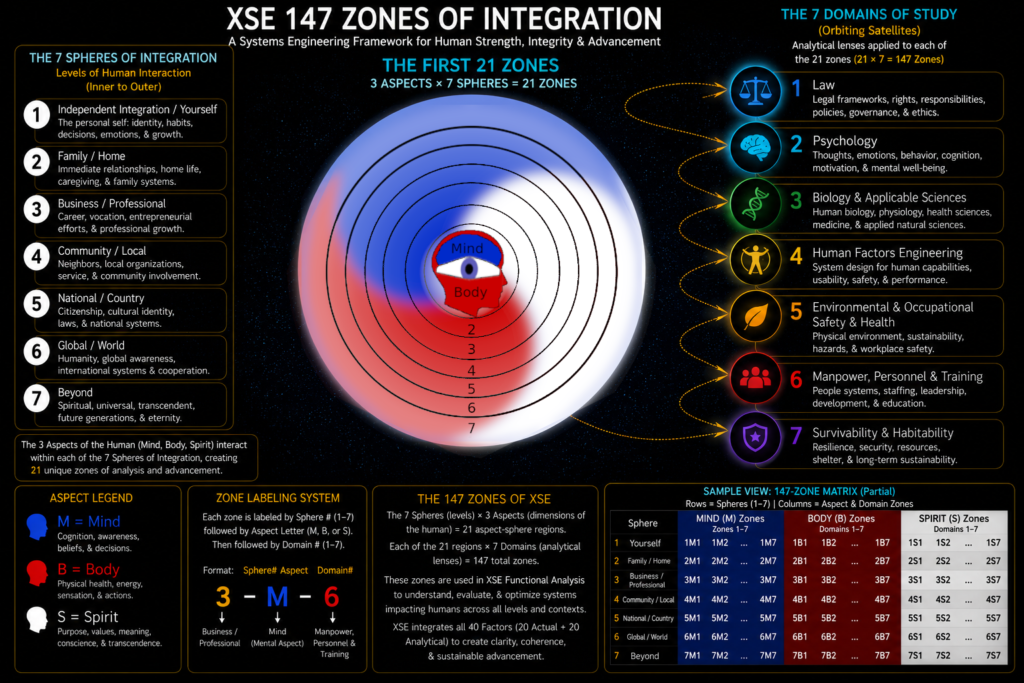
Within the XSE framework, the 147 Zones represent the multidimensional functional-analysis zones created through the interaction of:
- the 7 Spheres of Integration,
- the 3 Aspects of the Human,
- and the 7 Domains of Study.
The complete structure is mathematically represented as:
7 Spheres × 3 Aspects × 7 Domains = 147 Zones
These 147 Zones function within XSE as:
- multidimensional investigative regions,
- functional-analysis zones,
- recursive systems-interaction regions,
- and trajectory-analysis structures
through which human systems may be evaluated across multiple dimensions simultaneously.
The 7 Spheres of Integration
Within XSE, the 7 Spheres of Integration represent progressively expanding layers of human interaction and systems influence. These are numerically labeled as:
| Sphere # | Sphere |
|---|---|
| 1 | Independent Integration / Yourself |
| 2 | Family / Home |
| 3 | Business / Professional |
| 4 | Local / Community |
| 5 | National / Country |
| 6 | World / Global |
| 7 | Beyond |
These Spheres represent progressively expanding operational environments through which the human system interacts with:
- relationships,
- institutions,
- environments,
- technologies,
- societies,
- and broader systems realities.
Within XSE visual models, the 7 Spheres of Integration are typically displayed concentrically and divided according to the 3 Aspects of the Human.
The 3 Aspects of the Human
Within XSE, each Sphere is divided into the 3 Aspects of the Human:
These three Aspects represent the integrated dimensions of human existence within the XSE framework. Thus every Sphere contains:
- a Mind region,
- a Body region,
- and a Spirit region.
When the 7 Spheres are multiplied by the 3 Aspects, this creates 21 separate Aspect-Sphere plotting regions.
The 21 Aspect-Sphere Plotting Regions
Within XSE, each of the 21 regions is labeled using:
- the Sphere number,
followed by: - the Aspect letter.
For example:
| Label | Meaning |
|---|---|
| 1M | Independent Integration – Mind |
| 1B | Independent Integration – Body |
| 1S | Independent Integration – Spirit |
| 3M | Business/Professional – Mind |
| 5B | National/Country – Body |
| 7S | Beyond – Spirit |
These 21 labeled regions form the primary plotting structure within XSE functional analysis. However these 21 regions are not yet the full 147 Zones. They serve as the foundational multidimensional interaction grid.
The 7 Domains of Study
Within XSE, each of the 21 Aspect-Sphere regions is further analyzed through the 7 Domains of Study. The Domains are numerically labeled as:
| Domain # | Domain |
|---|---|
| 1 | Law |
| 2 | Psychology |
| 3 | Biology & Applicable Sciences |
| 4 | Human Factors Engineering |
| 5 | Environmental & Occupational Safety & Health |
| 6 | Manpower, Personnel & Training |
| 7 | Survivability & Habitability |
Within XSE visual architecture, these Domains are often represented as orbiting satellites applied analytically to the 21 Aspect-Sphere regions.
The Domains function as:
- investigative lenses,
- analytical perspectives,
- systems-engineering viewpoints,
- and functional-analysis frameworks
through which the zones are evaluated.
The Full 147-Zone Labeling Structure
Within XSE, each zone is fully specified by:
Sphere Number + Aspect Letter + Domain Number
For example:
| Label | Meaning |
|---|---|
| 3M6 | Business/Professional Sphere → Mind Aspect → Manpower, Personnel & Training |
| 2S2 | Family/Home Sphere → Spirit Aspect → Psychology |
| 5B5 | National/Country Sphere → Body Aspect → Environmental & Occupational Safety & Health |
| 7M4 | Beyond Sphere → Mind Aspect → Human Factors Engineering |
Thus:
the notation:
3M6
specifically identifies:
- Sphere 3 = Business / Professional
- M = Mind
- Domain 6 = Manpower, Personnel & Training
This allows highly precise multidimensional systems analysis within the XSE framework.
Functional Purpose of the 147 Zones
Within XSE, the 147 Zones function as the primary multidimensional functional-analysis architecture. They allow XSE to investigate:
- trajectory development,
- systems conditioning,
- integration,
- disintegration,
- environmental influence,
- operational coherence,
- resilience,
- Gateway interaction,
- attentional conditioning,
- systems constraints,
- recursive propagation,
- and multidimensional human systems interaction.
Because each zone contains:
- a specific Sphere,
- a specific Aspect,
- and a specific analytical Domain,
the framework allows highly detailed systems-engineering evaluation across interconnected dimensions of reality.
The 147 Zones as a Derived Dynamic
Within XSE, the 147 Zones are classified as a Derived Dynamic because they emerge through recursive interaction among foundational XSE factors rather than existing as isolated foundational primitives themselves. The 147 Zones are derived through:
- the interaction of the 7 Spheres,
- the 3 Aspects,
- and the 7 Domains,
which together create recursive multidimensional investigative interaction zones. Thus the 147 Zones are not static compartments. Rather, they function as: - recursive systems-analysis regions,
- trajectory-influence regions,
- operational interaction zones,
- and multidimensional investigative structures
within the broader XSE architecture.
Final XSE Perspective
Within the XSE framework, the 147 Zones represent the multidimensional functional-analysis structure created by applying the:
- 7 Domains of Study
to each of the: - 21 Aspect-Sphere plotting regions
formed through interaction among the: - 7 Spheres of Integration
and: - 3 Aspects of the Human.
The complete labeling system uses: Sphere Number + Aspect Letter + Domain Number, thereby producing 147 precisely identifiable multidimensional investigative zones through which XSE analyzes:
- trajectory,
- conditioning,
- systems influence,
- operational coherence,
- integration,
- disintegration,
- resilience,
- and recursive human systems interaction across interconnected dimensions of reality.
Note: Even though not every zone will apply to every SOI, it is beneficial in analysis to brainstorm “how could it apply?” This not only provides for an excellent mental workout in the field of critical and creative thinking, but likewise, it is often the introduction to a new view or realization that otherwise would not have slipped past the systems engineer without their awareness.
The 147 Zones Explained from a Systems View

The 147 Zones are one of the most powerful analytical tools in XSE. Think of them as a full-spectrum coordinate system for analyzing any human-centered system—your life, a business, a decision, or even a moment.
The Core Formula
At its simplest, the 147 Zones come from this structure
7 Spheres × 3 Aspects × 7 Domains = 147 Zones
Let’s break that down so you can actually use it.
1. The 3 Aspects of the Human (Inner System)
These are always present:
- Mind (M) – thoughts, perception, cognition
- Body (B) – physical actions, biology, performance
- Spirit (S) – purpose, values, meaning
In XSE terms: this is your core system of interest
2. The 7 Spheres of Integration (Where Life Happens)
These represent where your system interacts:
- Self / Independent (You)
- Family / Home
- Business / Professional
- Community / Local
- National
- Global
- Beyond (Cyber / future / unknown)
These define context layers of your life/system.
3. The 7 Domains of Study (How You Analyze It)
These are the lenses you apply:
- Law
- Psychology
- Biology & Sciences
- Human Factors Engineering
- Environmental & Occupational Health
- Manpower, Personnel & Training
- Survivability & Habitability
These define how you examine a situation
Putting It Together
Each “zone” is a specific coordinate like:
3M6
This means:
- 3 = Business/Professional Sphere
- M = Mind
- 6 = Manpower, Personnel, Training
So you’re analyzing:
How the mental aspect of people is affected in a business context through training and personnel systems.
This is not abstract—it’s actionable systems thinking.
Why 147 Zones Matter (XSE Perspective)
The 147 Zones give you:
1. Total Awareness Coverage
Instead of guessing, you can systematically scan:
- What am I missing?
- Where are blind spots?
2. Structured Critical Thinking
It forces:
- Cross-domain thinking
- Creative problem solving
- Non-obvious connections
Even if a zone seems irrelevant, exploring it can unlock insights you would’ve otherwise missed
3. Feedback Loop Expansion (XSE Lens)
In XSE terms:
- Each zone = a feedback node
- The full 147 = complete system observability
This directly ties to:
- X Axis → system analysis
- Y Axis → life cycle stage
- Z Axis → sources/resources
Real Example (Applied XSE Thinking)
Let’s say you’re improving your health.
Most people think:
- Diet
- Exercise
XSE says:
- What about 2S1? (Family–Spirit–Law) → beliefs around food rules
- What about 1M2? (Self–Mind–Psychology) → habits and triggers
- What about 1B3? (Self–Body–Biology) → actual metabolic response
Now you’re not guessing—you’re engineering the system.
XSE Insight (High-Level)
The 147 Zones are essentially:
A multi-dimensional map of human reality
that allows you to move from reaction → precision
They connect directly to:
- The 40 Factors of XSE
- The Training Triangle (Mind–Body–Spirit)
- Vantage Point expansion
Important Framing (Professional Scope)
This framework is:
- Educational
- Strategic
- Systems-based
It is not medical, psychological, or legal advice—rather, a way to structure thinking and decision-making.
Final Takeaway
The 147 Zones are not just a concept—they are a navigation system.
If you don’t know where you are in the 147…
you’re operating partially blind.
If you do know…
you can begin engineering outcomes with precision, integrity, and awareness.
Multi-directional domain analysis with Vantage Point shifting

1. The Core Principle
The Domains of Study are not one-way lenses.
They are meant to be used:
Bi-directionally (at minimum)
Multi-directionally (at mastery level)
Meaning:
Direction 1:
How is this domain influencing me?
Direction 2:
How am I influencing this domain (and others within it)?
2. First Layer: “From Inside the Sphere Looking Out”
You are standing at:
Sphere 1 — Yourself (Independent Integration)
Now you look outward to a domain (satellite), for example:
Psychology
You ask:
Influence ON Me
- How is psychology shaping:
- My thoughts?
- My habits?
- My emotional patterns?
Influence BY Me
- How am I:
- Affecting others psychologically?
- Reinforcing or disrupting patterns?
- Contributing to environments (positive or negative)?
XSE Insight
This alone already creates:
Feedback loop awareness
You are no longer passive—you are:
- Affected by systems
- AND actively shaping them
3. Second Layer: “Standing on the Satellite Looking Back”
Now we shift vantage point.
You mentally “step onto” the domain itself
You are now standing on:
The Psychology Satellite
And you look back at yourself (center sphere).
What Changes?
You are no longer asking:
“How does psychology affect me?”
You are asking:
“If I were psychology… how would I evaluate this human system?”
Example (Psychology Domain View)
From the satellite:
- This individual shows:
- Pattern X
- Bias Y
- Behavior loop Z
- Their:
- Inputs (Z axis) may be distorted
- Thinking (X axis) may be inconsistent
- Actions (Y axis) may not align
This is objective system observation
XSE Insight
This creates:
Detachment + clarity
You are no longer:
- Inside the emotion
- Inside the bias
You are:
Analyzing the system as an engineer
4. Multi-Directional Awareness (Full Use)
Now combine both directions:
Loop:
- Inside yourself → observe domain influence
- Move to domain → observe yourself as system
- Return to center → integrate insight
This creates:
Closed-loop systems awareness
Which is required for:
- Accurate perception
- True correction
- Movement toward +++
5. Applying This to Improvement
Now we bring in intentional change (Y Axis).
Step 1: Identify Current State
From BOTH vantage points:
- Where am I misaligned?
- Which axis is dropping?
- Which domain is most influencing this?
Step 2: Define Desired State (+++ Direction)
Ask:
- What would this look like if:
- My thinking = +X
- My actions = +Y
- My sources = +Z
Step 3: Set Domain-Specific Goals
Example using Manpower / Training (Domain 6):
From Center:
- I need better skills / structure
From Satellite:
- This system lacks:
- Training consistency
- Skill progression
- feedback loops
Goal:
Implement structured learning + repetition + feedback
6. The “Vantage Point Drill” (Practical Tool)
You can literally practice this.
3-Step Drill
1. CENTER (You)
- What’s happening in me?
2. SATELLITE (Domain)
- How would this domain analyze me?
3. RETURN (Integration)
- What must change to move toward +++?
7. Why This Matters (Deep XSE Truth)
Without this skill:
- You are trapped inside your own system
- You confuse:
- Feeling = truth
- Habit = correctness
With this skill:
You gain true Vantage Point
Which is one of the highest assets in XSE.
8. Connection to the +++ Infinity Direction
This is critical:
You cannot move toward infinite +++ truth
if you cannot accurately see your current position
The domains allow you to:
- Reduce distortion (Z axis)
- Improve thinking (X axis)
- Correct action (Y axis)
Final XSE Insight
The domains are not just subjects…
They are positions you can stand on to see reality from different truths.
And mastery is:
The ability to move between center and satellite perspectives fluidly, without losing alignment
Condensed
- From center → “How is this affecting me?”
- From satellite → “What is actually happening to this system?”
- From integration → “What must I change to move toward +++?”
The 147 Zones are all within the 20 Actual Factors

The 20 Actual Factors are the real, observable components that exist in any human-centered system.
They are not theories—they are the things that are actually there, influencing outcomes whether you notice them or not.
1. The 3 Aspects of the Human (Core System)
These are always present and always interacting:
- Mind
- Body
- Spirit
XSE Insight:
You never analyze a system involving humans without all three—ignoring one creates distortion.
2. The 3 Gateways (Input / Output Interfaces)
These are how the system exchanges information and influence:
Think of these as:
- What you consume
- What you express
- What you allow in/out
3. The 7 Spheres of Integration (Where Systems Interact)
These define the layers of your life/system environment:
- Individual (Self / Independent Integration – X)
- Family / Home
- Professional / Business
- Community / Local
- National / Country
- Global / World
- Cyber / Beyond
XSE Insight:
Problems often occur when actions in one sphere conflict with another.
4. The 7 Domains of Study (How Systems Are Examined)
These are the real-world disciplines impacting the system:
- Law
- Psychology
- Biology & Applicable Sciences
- Human Factors Engineering
- Environmental & Occupational Safety & Health
- Manpower, Personnel & Training
- Survivability & Habitability
These are not just perspectives—they are forces shaping outcomes.
How the 20 Actual Factors Work Together
In XSE, these 20 factors form the “reality layer” of any system.
You can think of it like this:
- Aspects (3) → Who you are
- Gateways (3) → How you interact
- Spheres (7) → Where it happens
- Domains (7) → What influences it
XSE Systems Insight
The 20 Actual Factors are what the 147 Zones are built on.
- 7 Spheres × 3 Aspects × 7 Domains = 147 Zones
- Gateways regulate flow between zones
So:
The 20 Actual Factors = the structure of reality
The 147 Zones = the mapping system of that reality
Practical Example (Quick Application)
Let’s say you’re improving discipline:
- Mind (Aspect) → beliefs about effort
- Mind Gateway → what content you consume
- Sphere: Professional → work habits
- Domain: Psychology → behavior patterns
Now you’re not just “trying harder”— you’re engineering the system of discipline.
Important Note
This framework is for Education, Systems thinking, and Strategic self-development, It is not a substitute for licensed medical, psychological, or legal advice.
Final Takeaway
The 20 Actual Factors are the reality you are operating in—whether you’re aware of them or not.
Mastery in XSE begins when you:
- See all 20
- Track their interactions
- Align them with integrity