
The Key to Empowerment - Unlocking Astronomical Potential

The XSE Key — Detachment, Humility, and the Beginning of Empowerment
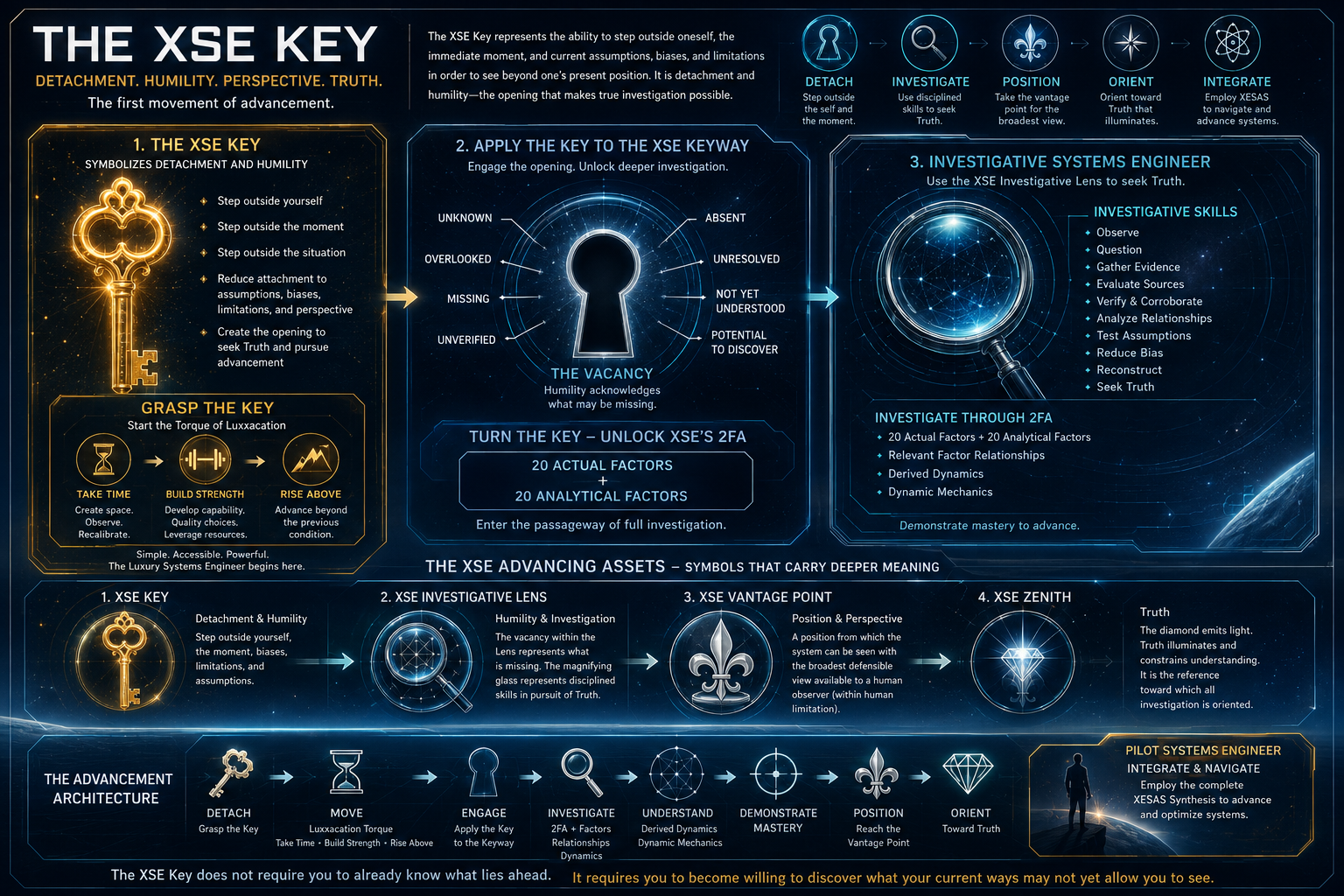
The XSE Key symbolizes deliberate detachment and humility: the capacity to step outside one’s presently occupied mental, emotional, temporal, and situational reference frame, look beyond the immediate moment, reduce the influence of bias and attachment where reasonably possible, and reconsider the System of Interest from perspectives not unnecessarily confined to one’s current position. By loosening the limitations imposed by an overly narrow viewpoint, the Key may help the Systems Engineer recognize possibilities, Sources, Resources, relationships, choices, and Trajectories that might otherwise remain unseen—beginning the ascent toward XSE’s broader astronomical perspective.
Within XSE, “astronomical” refers to breadth of perspective and potentially large—but reality-bounded—possibilities, not unlimited human capability.
The XSE Key is the first operational Advancing Asset encountered in XSE’s developmental progression and is associated with the first Advancing Position, the Luxury Systems Engineer. It represents the initial perspective-shifting capability used to begin XSE advancement and, in this sense, serves as the Key to Empowerment.
This operational sequencing should not be confused with the formal numbering of XSE’s 40 Factors, in which the XSE Zenith also appears among the Advancing Assets & Positions. The Key is described here as first operationally encountered because it initiates the participant’s movement into the advancement process.
Within XSE, empowerment does not mean possessing unlimited control over oneself, other people, circumstances, or complex systems. Rather, it refers to increasing one’s usable capacity to perceive, evaluate, choose, adapt, and act intelligently within the conditions and constraints that actually exist.
Before attempting to strengthen or advance a system, the Systems Engineer must first become capable of looking beyond the immediate position from which that system is presently being experienced.
Every investigation begins from a position. A Systems Engineer approaches a System of Interest (SOI) from a particular point in time, relationship to the system, body of knowledge, experience, assumptions, expectations, emotions, limitations, and set of available Sources and Resources. These conditions can influence what is noticed, how the system is framed, which boundaries are drawn, which questions are asked, how information is interpreted, and which possibilities are even considered.
The XSE Key therefore begins not by immediately changing the SOI, but by expanding the position from which possibilities for understanding, influencing, adapting, or changing it can be perceived and investigated.
Step Outside the Moment
To grasp the XSE Key is to deliberately create analytical and perspectival distance from the immediacy of one’s present position.
The Systems Engineer metaphorically steps back from one’s immediately occupied perspective, situation, and exclusive fixation on the present moment. From this shifted reference frame, the engineer can consider oneself as a participant within the relevant system, examine the SOI within its broader System of Context (SOC), consider perspectives other than one’s own, examine preceding Epochs, evaluate Current Reality, and look ahead toward possible future Trajectories.
Within XSE, the System of Context is an analytical representation of relevant context. It should not be interpreted as a claim that the model encompasses the totality of reality or that everything relevant can necessarily be exhaustively represented through systems analysis.
This broader reference frame allows questions that may be difficult to ask while immersed within the immediate situation:
How did the system arrive here? What am I assuming because of where I presently stand? What might this situation look like from another person’s position? What would become apparent if I examined this from farther away? What information could change my present understanding? Where could the current Trajectory lead? What might I recognize looking backward from a possible future that I cannot easily recognize from inside this moment?
This is not literal removal from oneself or physical time, nor does the XSE Key make a human being perfectly objective.
Instead, the Key represents a deliberate analytical and perspectival maneuver intended to identify and reduce the influence of bias, attachment, immediacy, and unnecessarily restrictive perspectives where reasonably possible.
The objective is to become sufficiently detached from one’s presently occupied position to investigate beyond its unnecessary limitations.
The XSE Key changes the Systems Engineer’s perspective upon Current Reality; it does not make perspective the creator of Current Reality.
Detachment Requires Humility
At the foundation of the XSE Key is humility.
A Systems Engineer cannot responsibly search for what may be missing while beginning with the assumption that nothing is missing. Investigation requires acknowledging the limitations of one’s present knowledge, perception, Sources, Resources, system models, and perspective.
The engineer must be capable of admitting:
I am observing this system from somewhere.
My view is not the entirety of reality.
I do not know everything that may be relevant.
My present understanding may be incomplete.
My assumptions may require revision.
Bias may be influencing what I notice or conclude.
There may be relevant conditions, relationships, Sources, Resources, or perspectives I have not yet discovered.
The XSE Key therefore represents more than open-mindedness. It symbolizes the willingness to detach from unnecessary attachment to one’s current position or interpretation sufficiently to permit reality, evidence, relevant and appropriately authoritative Sources, and other legitimate perspectives to correct, preserve, refine, or expand one’s understanding.
Humility does not mean assuming that one’s present understanding is necessarily wrong.
Where an existing model remains consistent with objective truth and Current Reality, preserving it may be appropriate.
Where stronger evidence or corrected understanding warrants revision, Integrity may require changing it.
In this sense:
Humility precedes investigation, and adaptability to truth supports Integrity.
Grasp the Key: Start the Torque of Luxxacation
The XSE Key is first encountered operationally through Luxxacation, XSE’s intentionally simplified and attractive public-facing top-level synopsis and its conception of a form of luxury centered upon time, Strength, perspective, and intentional development.
Luxxacation makes the foundational advancement motion of XSE accessible without requiring a person to first understand or master the complete XESAS architecture.
Its three Elements are intentionally simple:
Take Time → Build Strength → Rise Above
A person does not need to master XSE’s 40 Factors, Investigative Skills, Derived Dynamics, Dynamic Mechanics, or complete XESAS Synthesis to begin using this introductory framework.
The first operational step is simply to grasp the Key.
Grasping the Key represents becoming willing to step back from immediate self-reference, the immediate situation, and exclusive fixation on the present moment sufficiently to recognize that the present state does not necessarily define the full extent of legitimate future possibility.
That grasp starts the Torque of Luxxacation.
Take Time
Take Time creates analytical space from immediate reaction and supports:
- observation,
- clarification,
- assessment,
- perspective-taking,
- examination of Current Reality,
- consideration of legitimate Desired Results,
- investigation,
- and recalibration.
Build Strength
Build Strength moves from analysis toward implementation. It involves putting appropriately determined choices into operation in ways that may:
- develop Strength,
- preserve Strength,
- protect Strength,
- recover impaired Strength,
- adapt capability,
- redirect capability,
- or otherwise enhance relevant forms of Strength.
This reflects the operational principle expressed through XSE’s Y Axiom:
“The application of optimal choices enhances strength.”
Rise Above
Rise Above represents continued constructive advancement through application, feedback, adaptation, recalibration, and appropriately directed Trajectory.
It does not imply escape from Current Reality or transcendence of legitimate constraints. It represents movement toward a stronger or more appropriately ordered state within the realities, requirements, responsibilities, and possibilities actually present.
This is the first form of empowerment associated with the XSE Key:
Current Reality establishes the actual starting conditions and constraints of the system; it does not necessarily establish the full extent of legitimate future possibility.
By stepping outside the immediate moment long enough to examine where the system has been, where it presently is, and where different choices might contribute to future Trajectories, the Luxury Systems Engineer may begin recognizing pathways for legitimate advancement that were difficult to perceive from within the original position.
Within XSE, this potential is not based upon wishful thinking or an assumption of unlimited human capability.
Potential is investigated and pursued through:
- improved perspective,
- stronger understanding,
- relevant, reliable, and appropriately authoritative Sources,
- adequate Resources,
- critical and creative thinking,
- attention to constraints and obligations,
- feedback,
- and the application of increasingly optimal choices.
Grasping the Key and Applying the Key Are Different Operations
This distinction is fundamental to XSE.
GRASP THE KEY → Start the Torque of Luxxacation.
APPLY THE KEY → Engage the XSE Keyway and enter formal investigation.
A person may grasp the XSE Key and benefit from the accessible framework of Luxxacation without proceeding into formal study or full application of XSE’s deeper systems-engineering architecture.
That accessibility is intentional.
Use of the Key, Strategic Detachment, or Luxxacation at this accessible level should therefore not be confused with full application of XSE methodology.
For those who choose to go deeper, however, the same Key has another function.
It can be applied to the XSE Keyway.
The XSE Keyway: From Detachment to Engagement
The XSE Keyway represents the conceptual interface between the accessible Luxxacation level and XSE’s deeper investigative architecture.
The relationship between Key and Keyway deliberately draws upon an engineering metaphor. In mechanical systems, a properly fitted key engaging a corresponding keyway can enable torque transmission between components.
XSE uses this relationship symbolically, not as a claim that human cognition, investigation, or development is mechanically equivalent to a keyed rotating system.
Within XSE:
The Key facilitates detachment.
The Keyway provides engagement.
Their engagement carries the Torque forward into investigation.
This produces an important principle:
Detach in order to re-engage more intelligently.
XSE does not advocate permanent detachment from oneself, one’s responsibilities, relationships, embodiment, or Current Reality.
The perspective shift serves a purpose: to enable the Systems Engineer to re-engage the SOI from a less unnecessarily confined and better-informed position.
The Vacancy Within the Investigative Lens
The XSE Keyway carries another important symbolic meaning.
It appears as negative space within the XSE Investigative Lens.
The vacancy represents one of the most important acknowledgements an investigator can make:
Something may be missing.
The missing element might involve:
- knowledge,
- evidence,
- a Source,
- a Resource,
- an overlooked Factor,
- an unexplained Output,
- a stakeholder perspective,
- an untested assumption,
- a hidden relationship,
- a missing Epoch,
- or something the investigator does not yet know to look for.
The vacancy therefore continues the humility introduced by the Key.
An investigator must be willing to ask not only:
What do I see?
but also:
What don’t I see?
What don’t I know?
What should be here?
What might be missing?
What have I overlooked?
What could change my present conclusion?
The Keyway is therefore also intended to represent a restricted view through a small opening. It represents engagement with the vacancy—the acknowledgment that the present understanding may not yet be complete.
When the XSE Key is applied to the Keyway, the formal XSE investigative process is opened, within which both components of XSE’s 2FA must be applied:
20 Actual Factors + 20 Analytical Factors
The engagement itself does not constitute 2FA.
Rather, it symbolizes the transition into the investigative process in which XSE’s 2FA is actually used.
Entering Formal XSE Investigation
Application of the Key to the Keyway marks the transition from the accessible top-level synopsis of Luxxacation into XSE’s deeper investigative architecture.
The individual advances into the learning and investigative phase associated with the second Advancing Position:
Investigative Systems Engineer
At this stage, the formal Advancing Asset is Investigative Skills, represented symbolically and organized through the XSE Investigative Lens.
The Lens symbolizes disciplined investigative capabilities used to seek increasingly reliable understanding of the SOI, including:
- observation,
- questioning,
- evidence gathering,
- documentation,
- Source evaluation,
- verification,
- corroboration,
- reconstruction,
- hypothesis testing,
- contradiction analysis,
- relationship analysis,
- bias mitigation,
- and other relevant investigative competencies.
The Investigative Systems Engineer then progresses through XSE’s 2FA:
20 Actual Factors + 20 Analytical Factors
Both sets must be appropriately applied in order to claim that XSE methods were applied.
Comprehensive application of all 40 Factors constitutes the framework’s full 40-Factor investigative process.
The investigation does not stop with identifying individual Factors. It extends into relevant relationships among them, including Derived Dynamics and Dynamic Mechanics—progressing from identifying what is present toward examining:
- what emerges from Factor relationships,
- what Dynamics appear,
- how those Dynamics interact,
- and how their operation may affect the SOI and its Trajectory.
Only through investigation, integration, appropriate application, and demonstrated integrated competence does the Investigative Systems Engineer progress beyond this stage.
Why XSE’s Advancing Assets Use Symbols
XSE’s Advancing Assets are intentionally represented through symbols because each Asset carries considerably more meaning than its name alone can efficiently communicate.
Each symbol serves as a compact conceptual interface to a deeper collection of functions, relationships, principles, and stages within XSE.
Together, the symbols help tell the story of advancement.
The XSE Key — Detachment & Humility
The XSE Key symbolizes the capacity to step back from immediate self-reference, the immediate situation and moment, existing assumptions, biases, attachments, and unnecessarily restrictive perspectives.
Its instruction is:
Detach sufficiently from immediate assumptions, biases, attachments, and unnecessarily restrictive perspectives to investigate beyond where you presently stand.
Investigative Skills & the XSE Investigative Lens — Humility, Investigation & the Search for Truth
Investigative Skills constitute the formal Advancing Asset associated with the Investigative Systems Engineer.
The XSE Investigative Lens symbolically represents and organizes their application.
Its lens imagery represents the ability to:
- focus,
- examine,
- question,
- verify,
- compare,
- reconstruct,
- investigate,
- and broaden consideration.
At the same time, the vacant XSE Keyway formed through its negative space preserves the humility introduced by the Key.
The Lens therefore integrates two essential ideas:
acknowledge what you lack
and
investigate what you do not yet understand.
Its instruction is:
Look closely. Look broadly. Question what appears obvious. Acknowledge what is absent. Seek objective truth.
The XSE Vantage Point — Position & Perspective
Following demonstrated integrated competence in the investigative architecture, the Investigative Systems Engineer progresses to Pilot Systems Engineer and reaches the XSE Vantage Point.
The Vantage Point symbolizes the advanced analytical position from which the Pilot seeks the clearest, broadest, and most comprehensive defensible view reasonably available within human limitations.
It is represented by a fleur-de-lis functioning symbolically as a position or seat, rather than as a throne.
From this position, the Pilot may survey:
- the SOI,
- its System of Context,
- the Systems Engineer’s relationship to those systems,
- relevant interconnected systems,
- Epochs and Trajectories,
- Sources and Resources,
- relationships and Dynamics,
- and other appropriately established or exploratory considerations relevant to the investigation.
Where concepts such as the Fourth Dimension are formally defined within XSE and relevant to the investigation, they may be considered within their defined scope. Their inclusion should not be interpreted as establishing scientific, metaphysical, or other claims beyond what the relevant evidence and XSE definition support.
The Vantage Point does not imply omniscience, perfect objectivity, or exhaustive comprehension.
Its instruction is:
Take the position from which the larger system can be examined more comprehensively.
The XSE Zenith — Truth
Embedded within the Vantage Point is the XSE Zenith, symbolized by a diamond emitting light.
The Zenith represents Truth.
Its placement is important.
Reaching the Vantage Point does not make the Pilot the source of Truth, confer unlimited knowledge, eliminate human limitations, or make an XSE model equivalent to reality itself.
Instead, objective truth remains the orienting reference against which observations, Sources, models, assumptions, analyses, choices, and conclusions must continue to be tested.
The Zenith symbolizes continued orientation toward objective truth; it does not imply that XSE, the Pilot, or any systems model possesses or exhaustively comprehends Truth.
Its instruction is:
Orient toward Truth.
From Empowerment to Astronomical Potential
The XSE Key is therefore both an instrument of Strategic Detachment and the first operational Advancing Asset encountered in the XSE advancement sequence.
At the accessible Luxxacation level, grasping the Key enables a person to step outside the unnecessary limitations of the immediate position, begin the Torque of:
Take Time → Build Strength → Rise Above
and recognize that the system may contain legitimate pathways for advancement that cannot easily be perceived while remaining confined to the present view.
For those who choose to proceed deeper, the Key is applied to the XSE Keyway, opening formal investigation in which the 20 Actual Factors and 20 Analytical Factors—the two components of XSE’s 2FA—must be applied.
What begins as a simple act of stepping outside the immediate moment can then progress into disciplined investigation of the 40 Factors, their relationships, Derived Dynamics, and Dynamic Mechanics.
Through demonstrated integrated competence, the Investigative Systems Engineer may eventually progress to Pilot Systems Engineer and assume the XSE Vantage Point.
It is there that the word astronomical reaches its fullest meaning within this XSE architecture.
The Vantage Point represents an effort to obtain the broadest, clearest, and most integrated defensible perspective reasonably available to the Pilot within human limitations—looking across the SOI, its System of Context, relevant interconnected systems, Epochs and Trajectories, Sources and Resources, Factors, relationships, and applicable considerations while remaining oriented toward the XSE Zenith: Truth.
The System of Context and XSE’s other models remain analytical representations. They do not imply that every relevant reality can necessarily be exhaustively modeled, measured, comprehended, or controlled.
The Key therefore does not promise unlimited human capability, perfect objectivity, limitless control, automatic achievement, or unlimited future possibility.
Its empowerment is more disciplined:
The XSE Key helps prevent the Systems Engineer’s present position from unnecessarily becoming the boundary of the system’s perceived legitimate potential.
The complete movement can be summarized as:
GRASP THE KEY — DETACH
Step back from immediate self-reference, situation, moment, bias, attachment, and unnecessarily narrow perspective.
↓
LUXXACATION — MOVE
Take Time → Build Strength → Rise Above.
↓
APPLY THE KEY TO THE KEYWAY — ENGAGE
Acknowledge the vacancy and enter formal investigation.
↓
XSE 2FA + INVESTIGATIVE SKILLS / INVESTIGATIVE LENS — INVESTIGATE
Apply the Actual and Analytical Factors using disciplined Investigative Skills.
↓
DERIVED DYNAMICS + DYNAMIC MECHANICS — UNDERSTAND
Investigate relevant Factor relationships, resulting Dynamics, and their operation.
↓
DEMONSTRATED INTEGRATED COMPETENCE — ADVANCE
↓
XSE VANTAGE POINT — POSITION
Assume the broader Pilot analytical perspective.
↓
XSE ZENITH — ORIENT
Keep Truth as the orienting reference.
↓
PILOT SYSTEMS ENGINEER — INTEGRATE & NAVIGATE
Skillfully employ the complete XESAS Synthesis within its appropriate scope and the limits of Current Reality.
In its simplest public-facing form, however, the message of the XSE Key remains intentionally uncomplicated:
Grasp the Key. Step back from the moment. Get unstuck from unnecessarily restrictive perspectives. Look farther. Then investigate what legitimate advancement is actually possible within Current Reality.
Don't let yourself limit your own system
A System of Interest (SOI) can be constrained not only by deficiencies within the system itself, but also by limitations in the perspective, knowledge, assumptions, Sources, Resources, decisions, and capabilities of a person who sustains or significantly influences it.
Within XSE, the individual is understood as the Sustaining Systems Engineer of their own human System of Interest and may also occupy an important role within other Systems of Interest. This creates an important systems-engineering consideration:
The Systems Engineer is not necessarily outside the system being engineered. The engineer may be an influential part of the system—and therefore part of what must continually be examined, strengthened, and advanced.
A Sustaining Systems Engineer who remains confined to a single perspective, outdated assumptions, habitual methods, incomplete information, or unrecognized biases can unintentionally constrain the SOI. When the person responsible for observing, evaluating, choosing, adapting, or sustaining the system cannot see beyond their present position, the range of possibilities they can recognize may become unnecessarily narrow.
This is where the XSE Key becomes important.
Step Back From Your Present Perspective to See More of the System
The Key calls upon the Systems Engineer to metaphorically step back from one’s presently occupied perspective, the immediacy of the situation, and exclusive fixation on the present moment.
From that deliberately detached position, look back.
Look at yourself as part of the system.
Look at the SOI.
Look at the larger System of Context (SOC).
Look backward across the Epochs that contributed to Current Reality and forward toward the Trajectories that could emerge from present conditions and future choices.
Then ask:
What might I be unable to see from where I currently stand?
What assumptions am I carrying into this system?
What biases may be influencing my interpretation?
What do I not yet know?
Which Sources or Resources am I missing?
What methods have I continued simply because they are familiar?
Where might my own assumptions, knowledge gaps, biases, methods, or avoidable limitations be unnecessarily constraining the SOI?
What could become possible if I changed my position, understanding, choices, or approach?
This requires humility.
The objective is not to criticize oneself or assume that every system problem originates with the individual. Nor does XSE suggest that a person can completely eliminate human bias or limitation. Instead, the Key requires enough humility to recognize that the observer’s current understanding is not identical to the entirety of Current Reality.
You may be part of what needs to change.
You may also be part of what is already strong.
The purpose of investigation is to determine which is which.
Don’t Confuse Your Model With Reality
Systems Engineers rely upon models to understand systems. Human beings do something similar continuously: we construct understandings of ourselves, other people, situations, causes, risks, opportunities, and expected outcomes from the information available to us.
But a model is a representation of reality, not reality itself.
When new and more reliable information contradicts an existing understanding, integrity requires willingness to examine and, when warranted, update the model rather than distort the evidence to preserve the model.
This is one of the most important functions represented by the XSE Key.
Become detached enough from what you currently think you know to permit Truth to correct what you think you know.
That principle connects the Key directly to XSE’s larger architecture and particularly to the Alpha Axiom: “Integrity is founded on Truth.”
Changing perspective can change what the Systems Engineer perceives, understands, and ultimately does; it does not make perspective the creator of Current Reality.
The goal is not endless doubt. It is appropriate confidence that remains responsive to better evidence.
A Systems-Engineering Discipline of Adaptation
Although the XSE Key is an XSE-specific Advancing Asset, several capabilities represented by it have parallels across established fields of study. These include cognitive flexibility, metacognitive awareness, bias recognition and mitigation, assumption examination, perspective shifting, model updating, feedback-driven adaptation, and adaptive learning.
Within systems engineering specifically, related practices can be found in problem framing and reframing, stakeholder-perspective analysis, assumption management, boundary examination, lifecycle thinking, model validation, feedback, iteration, and resistance to premature solution fixation.
XSE does not claim to have originated these individual practices.
Its distinctive architecture is to synthesize their underlying function into a named Advancing Asset—the XSE Key—and deliberately position that Asset at the beginning of advancement.
The Systems Engineer first changes or expands the Vantage Point from which the system is being considered.
Then the engineer can more effectively consider changing the system.
The Key Makes Adaptation Possible—It Does Not Determine the Answer
This distinction is crucial.
The Key does not tell the Systems Engineer what conclusion to reach. It does not guarantee that a new idea is better than an old one, that change is always preferable to stability, or that every existing method should be abandoned.
Sometimes investigation will reveal that the existing design, understanding, model, process, Source, boundary, or decision remains sound.
In that case, integrity may require preserving it.
The purpose of the Key is therefore not change for the sake of change.
It is to prevent attachment to the current state from determining the answer before investigation has occurred.
Detach → Examine → Investigate → Update when warranted → Preserve when warranted → Advance according to objective truth, what is genuinely good, legitimate obligations, Current Reality, and what the responsibly established evidence supports.
The Key to Empowerment
This is why the XSE Key can appropriately be described as a Key to Empowerment.
Empowerment within this framework does not mean control over everything affecting the system. Complex systems contain constraints, uncertainties, dependencies, external conditions, and other variables that may remain outside an individual’s control.
The more realistic form of empowerment is increasing the ability to observe accurately, learn, reconsider, choose, adapt, strengthen, and respond intelligently within Current Reality.
A person who cannot reconsider their current model has limited capacity to learn from contradictory feedback.
A system that cannot respond to relevant feedback has limited capacity to adapt.
And a Sustaining Systems Engineer who refuses to look beyond their present position can inadvertently become a constraint upon the very system they are attempting to advance.
The XSE Key is intended to interrupt that condition.
The Key is not the answer.
The Key is the humility and detachment necessary to become capable of discovering a better-supported answer.
Grasp the Key and begin the Torque of Luxxacation: Take Time, Build Strength, Rise Above.
And when you are prepared to investigate beyond the accessible surface of XSE, apply that Key to the XSE Keyway.
What you don’t know becomes an opening rather than an obstacle.
And that is where investigation begins.
Strategic Detachment

Strategic Detachment
Strategic Detachment is the intentional creation of sufficient analytical and perspectival distance from one’s immediate physical, mental, emotional, and situational experience to examine the System of Interest from a broader reference frame.
Within XSE, grasping the XSE Key symbolizes this deliberate maneuver: step outside the limitations of the immediate perspective and immediate moment—not literally, but analytically and perspectivally—so that proximity, bias, attachment, habitual thinking, and immediate pressures are less likely to unnecessarily constrain what can be perceived, investigated, or chosen.
Within XSE, Strategic Detachment refers to deliberate perspective-taking and analytical distancing; it does not refer to dissociation, depersonalization, withdrawal from reality, or literal separation from oneself.
Strategic Detachment is neither avoidance nor indifference. It does not require suppressing emotions, ignoring physical conditions, abandoning responsibilities, or pretending that the Systems Engineer can become perfectly objective. Instead, it asks the individual to temporarily shift from being only immersed within an experience to also becoming an observer of the experience, one’s present perspective, and one’s position within the larger System of Context.
The objective is simple:
Create enough distance to see more clearly, enough humility to acknowledge what may be missing or misunderstood, and enough freedom from unnecessary domination by immediate influences to make better-informed choices.
Strategic Detachment may improve the conditions for analysis, but it does not by itself establish objective understanding, Integrity, or an optimal choice. It is a perspective-enhancing maneuver that supports further investigation, evaluation, and responsible action.
Within XSE, Strategic Detachment can be considered through three interconnected practical lenses:
Situational Detachment
Mental Detachment
Emotional Detachment
These dimensions are practical perspective-taking lenses within Strategic Detachment and should not be confused with XSE’s three formal Aspects of the Human—Mind, Body, and Spirit.
1. Situational Detachment — Step Back From the Immediate Position
Situational Detachment within XSE is best understood as broadening the reference frame rather than literally separating from the body or situation.
The Systems Engineer deliberately expands consideration beyond the immediate physical and situational position, examining the scene from additional perspectives without pretending to become literally external to the situation or perfectly objective.
Instead of asking only:
“What am I experiencing right now?”
the Systems Engineer may also ask:
What is happening throughout the larger system?
Where am I positioned within it?
What environmental conditions are influencing me?
What would another observer notice?
What happened before this moment?
What relationships or conditions am I overlooking?
Where might the present Trajectory lead?
What changes if I examine this from another Vantage Point?
Physical sensations, environmental conditions, fatigue, comfort, discomfort, time pressure, proximity, Resource limitations, and other elements of Current Reality are not discarded. They become additional system information to examine rather than remaining unexamined influences upon perception and action.
This broader reference frame may create greater capacity to identify an appropriate next action rather than merely continuing the most immediate, familiar, or emotionally compelling response.
2. Mental Detachment — Step Outside the Current Model
Mental Detachment involves loosening unnecessary attachment to existing:
assumptions,
interpretations,
expectations,
habits of thought,
preferred conclusions,
familiar explanations,
and preconceived notions.
The objective is not to erase previous knowledge or create a perfectly “blank mind.” Past experience, established knowledge, expertise, and prior analysis may contain valuable information.
Rather, the Systems Engineer becomes willing to re-examine the present mental model against Current Reality.
Questions may include:
What am I assuming?
What evidence supports that assumption?
What evidence challenges it?
What have I accepted primarily because it is familiar?
Which biases could be influencing my analysis?
What Source am I relying upon?
How authoritative or appropriate is that Source for this question?
What information am I missing?
What alternative explanations should be considered?
What would cause me to update my conclusion?
Mental Detachment therefore creates room for:
creative thinking,
model correction,
improved sourcing,
comparative analysis,
investigation,
and discovery.
The Systems Engineer does not abandon knowledge. Rather, the Systems Engineer remains sufficiently humble and reality-responsive to allow stronger evidence, more appropriate Sources, corrected understanding, or Current Reality to refine or overturn an existing conclusion or system model when warranted.
This adaptability is especially important because maintaining Integrity may sometimes require correction rather than consistency with a previously held position.
3. Emotional Detachment — Step Outside the Immediate Emotional Pull
Emotions are legitimate human experiences and may provide important information about the individual, relationships, conditions, priorities, threats, attachments, and the broader system.
Strategic Emotional Detachment therefore does not mean becoming emotionless, suppressing emotion, denying attachment, or treating affection, concern, grief, fear, anger, or desire as inherently undesirable.
Instead, the Systems Engineer creates enough perspective to observe emotional influence without automatically allowing the immediate emotional state to govern the analysis or next choice.
Fear, excitement, frustration, attachment, disappointment, urgency, pride, anger, hope, or strong desire can influence how:
risks are interpreted,
Sources are evaluated,
alternatives are considered,
consequences are weighted,
and Desired Results are prioritized.
Strategic Detachment creates room to ask:
What am I feeling?
What may be contributing to this emotional response?
What information might this emotion be providing?
Is this emotion influencing what I want to be true?
Am I over-weighting or under-weighting a particular risk or outcome?
Would I reach the same conclusion from a calmer or more distant perspective?
What choice remains best supported when considered against objective truth, what is genuinely good, legitimate obligations, Current Reality, the larger System of Context, and longer-term Trajectory?
The objective is therefore improved awareness and responsible regulation of emotional influence in support of deliberate choice—not emotional elimination.
Detach to Re-Engage More Intelligently
These practical lenses of Strategic Detachment—situational, mental, and emotional—work together because the human Systems Engineer operates as an integrated person.
Within XSE, the formal Aspects of Mind, Body, and Spirit, together with environmental conditions, cognition, emotion, Sources, Resources, relationships, experience, responsibilities, conditioning, and surrounding context, may all affect observation, interpretation, judgment, and choice.
Strategic Detachment creates temporary analytical distance from immediate influences so that they can themselves become subjects of examination rather than remaining unexamined influences upon perception, analysis, and choice.
This distinction is important:
Strategic Detachment changes the Systems Engineer’s perspective upon Current Reality; it does not change Current Reality merely by changing perspective.
A new viewpoint can reveal information, assumptions, relationships, risks, or possibilities that were previously overlooked. But a different perspective does not make facts disappear, legitimate obligations cease to exist, or a preferred interpretation become true.
Strategic Detachment therefore remains bounded by objective truth and Current Reality.
Strategic Detachment and the Y Axiom
The XSE Key connects particularly strongly to the Y Axiom:
“The application of optimal choices enhances strength.”
An optimal choice cannot be guaranteed simply by stepping back.
However, Strategic Detachment may improve the conditions under which:
alternatives are identified,
Sources are examined,
assumptions are challenged,
risks are evaluated,
consequences are considered,
legitimate Desired Results are clarified,
and available choices are compared.
Within XSE, an optimal choice remains bounded by:
objective truth,
what is genuinely good,
Integrity,
legitimate obligations,
Current Reality,
relevant requirements,
legitimate Desired Results,
Sources,
Resources,
risks,
constraints,
and whole-system consequences.
The Key therefore does not remove the Systems Engineer from reality.
It is intended to improve the position from which the Systems Engineer re-engages with Current Reality and acts within it.
From Detachment to Investigation
At the accessible level of Luxxacation, grasping the XSE Key initiates the Torque:
Take Time → Build Strength → Rise Above
Through Take Time, the individual may use Strategic Detachment to step outside the unnecessary limitations of the immediate viewpoint, broaden perspective, examine Current Reality, and consider a stronger and more appropriately ordered course of action.
Strategic Detachment, however, is only the beginning.
For those advancing into fuller XSE investigation, the XSE Key is subsequently applied to the XSE Keyway.
Here, detachment becomes investigation.
The humility required to say:
“My present perspective may be incomplete.”
encounters the vacancy represented by the Keyway:
“Something relevant may exist here that I do not yet know, understand, or adequately account for.”
The Key engages the Keyway, opening the deeper XSE investigative process through the Investigative Lens.
Within that investigation, both the 20 Actual Factors and the 20 Analytical Factors—the two components of XSE’s “2FA” or Two-Factor Authentication—must be applied in order to claim that XSE methods were applied.
The Investigative Systems Engineer therefore progresses through the relevant:
Actual Factors,
Analytical Factors,
relationships,
Derived Dynamics,
Dynamic Mechanics,
Sources,
Resources,
Current Reality,
and system feedback
rather than assuming that Strategic Detachment alone has produced complete understanding.
Strategic Detachment begins the change in perspective.
Investigation tests, expands, and corrects that perspective.
Strategic Detachment and the XSE Vantage Point
Only following the required investigation and demonstrated integrated competence within the XSE framework does the engineer progress toward the XSE Vantage Point associated with the Pilot Systems Engineer.
That distinction is crucial.
The XSE Key does not automatically provide comprehensive knowledge, perfect objectivity, or an all-encompassing view.
Rather:
The Key provides a structured means of developing the humility, perspective, and analytical distance necessary to investigate beyond unnecessary limitations of the present viewpoint.
The XSE Vantage Point therefore should not be understood as omniscience or a position from which every relevant reality can necessarily be completely observed, modeled, understood, or controlled.
It represents an advanced XSE analytical position developed through disciplined investigation, integration, feedback, and appropriate use of the framework.
Strategic Detachment Is Not Escape
Strategic Detachment is therefore not an escape from Current Reality or the System of Context.
It is an intentional maneuver for examining:
oneself,
one’s present perspective,
one’s assumptions,
one’s influences,
one’s emotional and situational conditions,
and one’s position within relevant context
more accurately.
Its purpose is to reduce unnecessary constraint from proximity, bias, attachment, habitual interpretation, and immediate pressure while expanding the field of responsible investigation.
Strategic Detachment does not attempt to make the Systems Engineer indifferent to reality.
It seeks to make the Systems Engineer more capable of re-engaging with reality with greater perspective, better questions, more appropriate humility, stronger analysis, and better-informed choices.
Step outside the immediate perspective—not to escape the moment, but to investigate what the moment may be preventing you from seeing.
A key to empowerment

Grasping the XSE Key and strategically stepping back from the immediate moment can create an important form of empowerment: greater practical opportunity to deliberate and choose one’s response rather than allowing the most immediate physical condition, mental assumption, emotional influence, or situational pressure to unnecessarily dominate it.
Within XSE, this does not mean escaping physical reality, eliminating emotion, becoming perfectly objective, or gaining unlimited control. It means creating sufficient analytical and perspectival distance to observe oneself within the larger system, identify and reduce the influence of bias and attachment where reasonably possible, consider a broader range of information and alternatives, and deliberately choose how to proceed.
In this sense, the greater practical freedom facilitated by the XSE Key is not freedom from reality.
It is greater freedom to respond intelligently within reality.
1. Greater Clarity
Strategic Detachment creates additional analytical space among immediate conditions or Inputs, observation, interpretation, deliberation, and subsequent choice or action.
Instead of allowing discomfort, urgency, assumptions, expectations, strong emotions, or an immediately preferred Desired Result to dominate the analysis, the Systems Engineer can pause long enough to examine what is actually occurring.
The question shifts from:
“What do I immediately think, feel, or want?”
to:
“What does Current Reality indicate, and what else should I consider before choosing?”
This does not guarantee objectivity, but it can create better conditions for critical thinking, Source evaluation, bias mitigation, and informed decision-making.
2. A Broader Reference Frame
The XSE Key empowers the individual to step back from exclusive fixation on this position, this situation, and this moment.
From there, the Systems Engineer can expand the frame:
Past Epochs → Current Reality → Future Trajectories
Immediate Perspective → System of Interest → System of Context → Relevant Interconnected Systems
An immediate choice can then be considered against longer-term consequences, larger system relationships, competing Desired Results, and the direction in which the system appears to be traveling.
Changing perspective can expand what the Systems Engineer perceives and considers; it does not change Current Reality merely by changing perspective.
This is an early preparation for the much more comprehensive perspective eventually associated with the XSE Vantage Point—but grasping the Key itself does not confer that mastery.
3. Greater Capacity to Identify and Mitigate Bias and Preconception
Humans cannot guarantee complete freedom from bias. Nevertheless, becoming aware that one’s present perspective is limited creates an opportunity to identify, challenge, and reduce the influence of bias.
The XSE Key asks the Systems Engineer to become willing to leave behind a favored interpretation when better evidence warrants doing so.
That requires humility:
What if I am wrong?
What am I missing?
What have I assumed?
What Source could verify this?
What evidence would change my conclusion?
The person may become less constrained by unnecessary attachment to a previously held interpretation and better positioned to allow understanding to be corrected toward objective truth and Current Reality.
4. Improved Focus and Prioritization
Strategic Detachment can also help distinguish what is immediately demanding attention from what is actually important to the system.
Complex systems contain competing signals, demands, emotions, opportunities, risks, and Desired Results. Not everything deserves equal priority.
By stepping outside the immediate situation, the Systems Engineer can reconsider:
What matters most? What is noise? What is urgent? What is important? What affects relevant forms of Strength? What serves only a short-sighted or illegitimate Desired Result? What choice is most appropriately aligned with objective truth, what is genuinely good, legitimate obligations, Current Reality, and constructive Trajectory?
The Key can therefore help redirect attention toward the Factors, Sources, Resources, and decisions most relevant to legitimate and constructive advancement.
5. Greater Adaptability and Resilience
Strategic Detachment may support adaptability and resilience by creating greater room to receive feedback, update the system model, reconsider the plan, and select another course when Current Reality warrants it.
A system that cannot respond appropriately to changing conditions has limited adaptive capability.
The same general principle applies to the Sustaining Systems Engineer.
When an individual becomes excessively attached to a particular expectation, method, interpretation, or outcome, unexpected feedback may become more difficult to incorporate constructively. Strategic Detachment creates greater room to reconsider what is happening and adapt the response when warranted.
Within this XSE usage, resilience does not mean remaining unaffected by adversity. It refers to maintaining or recovering sufficient relevant capability to adapt and continue operating purposefully under changing conditions.
6. Greater Agency Through Deliberate Choice
Perhaps the most important empowerment associated with the XSE Key is the increased opportunity to place deliberate choice between condition and action.
A person cannot choose every condition entering or affecting the human system, and meaningful choice may sometimes be substantially constrained by Current Reality.
An individual cannot control every person, event, physical limitation, emotion, environmental variable, external system, or circumstance.
But where meaningful choice does exist, Strategic Detachment may help the individual recognize and exercise it more deliberately.
That directly supports XSE’s Y Axiom:
“The application of optimal choices enhances strength.”
The Key does not identify the optimal choice automatically. Instead, it may help establish better conditions for finding one:
- analytical distance,
- humility,
- broader perspective,
- investigation,
- stronger Sources,
- critical thinking,
- and openness to updating the model.
Within XSE, an optimal choice must still be evaluated in accordance with objective truth, what is genuinely good, Integrity, legitimate obligations, Current Reality, legitimate Desired Results, constraints, risks, Sources, Resources, and whole-system consequences.
Empowerment Is Not Unlimited Control
This distinction is important within XSE.
Empowerment is not omnipotence.
The Systems Engineer remains subject to reality, constraints, uncertainty, dependencies, physical conditions, incomplete knowledge, other people’s agency, and larger systems beyond individual control.
Within this context, XSE uses empowerment to describe an increase in usable capability or agency within the realities and constraints actually present—not unlimited control over those realities.
The more accurately the Systems Engineer can observe, the more honestly limitations can be acknowledged, the more effectively relevant conditions can be investigated, and the more deliberately viable alternatives can be considered and chosen, the greater the person’s capacity to influence the system constructively where influence is actually possible.
The XSE Key therefore represents a particular kind of freedom:
Freedom from being unnecessarily constrained by the immediacy of one’s present position.
Step back from the immediate moment.
Observe yourself within the larger system.
Identify, challenge, and reduce the influence of bias and unnecessary attachment as reasonably possible.
Look backward. Look outward. Look forward.
Then re-engage with Current Reality and choose deliberately, in accordance with objective truth, what is genuinely good, legitimate obligations, and constructive Trajectory.
That is the empowerment associated with grasping the XSE Key—and it is what allows the Torque of Luxxacation to begin:
Take Time → Build Strength → Rise Above.
For those who choose to advance beyond this accessible level, the next question becomes:
What happens when the Key is no longer simply grasped—but applied to the XSE Keyway?
Guard yourself from attachments that may set you up for failure

Human beings naturally form affections, attachments, commitments, preferences, expectations, and bonds with people, places, possessions, ideas, identities, methods, goals, and Desired Results. Many of these can contribute substantially to meaning, stability, responsibility, motivation, belonging, and relevant forms of system Strength.
XSE does not treat affection, attachment, commitment, dependency, or interdependence as inherently weak or undesirable.
The systems-engineering concern arises when an attachment becomes sufficiently influential that it significantly impairs the Sustaining Systems Engineer’s ability to evaluate the System of Interest accurately, respond appropriately to feedback, reconsider assumptions, fulfill legitimate obligations, or make appropriately optimal choices as Current Reality changes.
In other words:
Do not become so attached to what you want, expect, possess, prefer, or have previously believed that you lose the ability to see what is actually true.
This is another reason for grasping the XSE Key. Strategic Detachment creates enough temporary analytical and perspectival distance to examine not only the object of an affection or attachment, but also the influence that affection or attachment is exerting upon the Sustaining Systems Engineer, the System of Interest, and relevant aspects of the System of Context.
The goal is not detachment from caring.
It is sufficient detachment from the immediate pull of attachment to support clearer evaluation, truthful investigation, and responsible choice.
Strategic Detachment does not itself establish objectivity or guarantee an optimal choice. Rather, it can improve the conditions under which attachments, assumptions, dependencies, risks, Sources, Resources, legitimate Desired Results, and Current Reality are examined.
1. Guard Against Attachment to Expected Outcomes
An anticipated outcome can quietly become an assumption.
The stronger the desire for a particular Desired Result, the easier it may become to interpret evidence in ways that support it, discount warning signals, overlook alternatives, or continue investing in a deteriorating or misdirected Trajectory.
The Sustaining Systems Engineer should therefore distinguish between:
What I want to happen
and
What Current Reality indicates is happening.
A Desired Result can provide direction without being permitted to dictate the evidence.
Within XSE, a Desired Result should also not be assumed legitimate merely because it is sincerely desired, emotionally important, technically achievable, or strongly preferred. Desired Results themselves remain subject to evaluation in accordance with objective truth, what is genuinely good, legitimate obligations, Integrity, Current Reality, relevant requirements, and whole-system consequences.
Strategic Detachment creates room to ask:
If I did not already want this outcome, would I interpret the available information the same way?
What evidence supports this Desired Result?
What evidence challenges my assumptions about it?
Is the Desired Result itself legitimate and appropriately ordered?
What would cause me to revise or abandon this Trajectory?
The purpose is not to weaken aspiration. It is to prevent aspiration from replacing investigation.
2. Guard Against Fragile Dependencies
Systems depend upon other systems. Dependency itself is not necessarily a defect; many strong systems are intentionally interdependent.
Human life also includes legitimate dependencies that may be necessary, appropriate, constructive, and unavoidable.
The concern is therefore not dependency itself, but unrecognized, excessive, unstable, inappropriate, or inadequately protected dependency.
The objective is not independence from all dependency. Rather, it is the truthful recognition and responsible management of relevant dependencies and vulnerabilities.
If well-being, performance, security, identity, or a critical system function depends heavily upon a particular:
- person,
- Source,
- Resource,
- position,
- process,
- technology,
- possession,
- institution,
- capability,
- or circumstance,
and that element is unstable or vulnerable, the system may contain a significant point of exposure.
A systems perspective asks:
What am I depending upon?
Is that dependency legitimate and necessary?
How reliable is it?
What happens if it changes or becomes unavailable?
Is there redundancy where redundancy is appropriate?
Are there alternative Sources or Resources?
What consequences follow if this dependency fails?
What mitigation is proportionate and realistically available?
Affection or commitment should not prevent dependency from being evaluated truthfully.
At the same time, responsible analysis should not treat every dependency as something to eliminate. Some dependencies arise from legitimate relationships, responsibilities, limitations, cooperative structures, or necessary interdependence.
The task is to distinguish constructive dependence from unnecessary fragility.
3. Guard Against Fear of Loss Dominating Choice
The possibility of losing something genuinely valuable naturally matters.
Fear, grief, concern, attachment, and uncertainty may all be proportionate responses to the threatened loss of something important. XSE does not treat these reactions as evidence of weakness or lack of Integrity.
The concern arises when fear of loss becomes so influential that it begins disproportionately shaping or dominating choices, interfering with truthful evaluation or appropriate response to Current Reality.
A person may, for example:
- preserve an ineffective method because it is familiar,
- remain committed to an obsolete plan because of previous investment,
- avoid necessary change because uncertainty is difficult,
- ignore important feedback because accepting it threatens something highly valued,
- or continue pursuing a Desired Result after evidence indicates that the Trajectory should be reconsidered.
The XSE Key creates an opportunity to step back from the immediate pull of fear and ask:
Am I protecting something genuinely valuable, resisting a necessary change, or experiencing some combination of both?
The answer should be investigated rather than presumed.
Additional questions may include:
What exactly am I afraid of losing?
Is the loss real, possible, probable, or merely imagined?
What legitimate good or obligation is involved?
What does Current Reality actually require?
Am I protecting the good itself, or only one particular way of possessing or pursuing it?
Strategic Detachment does not make loss unimportant. It creates room for fear and attachment to be considered without allowing them automatically to dominate the analysis.
4. Guard Against Rigidity When Conditions Change
A system designed for one set of conditions may become poorly suited to another.
The same may occur with:
- personal strategies,
- expectations,
- routines,
- professional plans,
- methods,
- roles,
- operating assumptions,
- and relationships with other systems.
Attachment can turn consistency into rigidity when a person continues following a previous course despite meaningful changes in Current Reality.
Strategic Detachment allows the Sustaining Systems Engineer to distinguish between:
the legitimate value, responsibility, or good being protected
and
the particular method previously used to protect or pursue it.
These are not always identical.
Sometimes Integrity requires persistence.
Sometimes Integrity requires adaptation.
Sometimes it requires correction, withdrawal, redesign, changed priorities, or an entirely different Trajectory.
In each case, persistence or adaptation should remain ordered toward objective truth, what is genuinely good, legitimate obligations, Current Reality, and constructive Trajectory.
The purpose of the XSE Key is not to tell the Systems Engineer automatically whether to persist or change. It is to create enough analytical distance to investigate which response is actually warranted.
5. Guard Against Reducing Identity to a Single System Condition
Roles, achievements, possessions, recognition, professional status, appearance, performance, relationships, and other conditions can become deeply significant in how people understand themselves.
These things may legitimately matter.
However, when self-evaluation becomes excessively dependent upon a single changing condition, disruption to that condition may have disproportionately large effects elsewhere in the person’s life and broader system.
XSE’s broader perspective encourages the Sustaining Systems Engineer to consider the whole integrated human person through the interrelated Aspects of Mind, Body, and Spirit across multiple Spheres of Integration, rather than reducing the person to one:
- role,
- achievement,
- possession,
- failure,
- relationship,
- capability,
- limitation,
- or circumstance.
Within XSE, Mind, Body, and Spirit are Aspects of the Human used to examine the integrated person and are not intended as an exhaustive definition of the human person.
The loss, failure, or alteration of one system condition does not provide a complete evaluation of the human person or the entirety of the person’s circumstances, responsibilities, relationships, capacities, or Trajectory.
A failed project is not the entirety of a person.
A changed role is not the entirety of a person.
A lost possession is not the entirety of a person.
A limitation, setback, or disrupted condition may be significant without becoming the total measure through which the person is understood.
6. Guard Against Making Broader Fulfillment Depend Upon a Single Contingent Condition
A particularly fragile system architecture can develop around the proposition:
“I can be fulfilled only if this particular condition occurs.”
This can place an extraordinary amount of perceived value upon a variable that may be uncertain, contingent, changing, or outside the person’s control.
The XSE Key can help expose that architecture.
Questions may include:
Is this genuinely the only acceptable path?
Have I confused one strongly preferred outcome with the entire purpose or direction of my life?
Are there other legitimate relationships, responsibilities, goods, Resources, or avenues through which meaning, purpose, or relevant forms of Strength may be supported?
Are alternative legitimate Desired Results available?
What remains genuinely good and legitimately required if this preferred outcome does not occur?
Am I assigning one contingent condition more system significance than Current Reality warrants?
The point is not to abandon worthwhile aspirations or minimize genuine loss.
It is to prevent a single uncertain outcome from becoming an unnecessarily fragile dependency upon which the person’s broader sense of direction or fulfillment is made to rest.
Using a systems-engineering analogy, XSE seeks to avoid treating one uncertain contingent condition as though it were a single point of failure for the person’s entire sense of direction or fulfillment.
The analogy is not intended to reduce human fulfillment to a mechanical process. Rather, it highlights the vulnerability created when too much system significance is placed upon one unstable or uncontrollable condition.
Affection Should Not Blind Investigation
This is ultimately where the principle connects most strongly to XSE.
The greater an affection or commitment, the more important it may be to examine the relevant conditions clearly rather than less carefully.
Love does not require blindness.
Commitment does not require denial.
Hope does not require ignoring evidence.
Persistence does not require refusing feedback.
Loyalty does not require falsehood.
And Strategic Detachment does not require indifference.
The XSE Key instead asks the Sustaining Systems Engineer to become sufficiently detached from the pull of the preferred conclusion to investigate the actual condition of the System of Interest.
That is an expression of humility:
I care deeply about this—and precisely because I care, I must remain willing to see it truthfully.
Affection itself may be part of what is genuinely good. Strategic Detachment therefore should not be used to rationalize neglect of legitimate commitments, relationships, responsibilities, or appropriate care.
The purpose is not to become less capable of attachment.
It is to become less likely to allow attachment to obscure Current Reality or override legitimate obligations and truthful judgment.
Build Strength Without Becoming Brittle
From a systems-engineering perspective, the objective is not a life without dependencies, attachments, affections, or commitments.
Such a condition would neither be realistic nor necessarily desirable.
The objective is to develop strong relationships, commitments, and dependencies without unnecessary fragility, distortion, or loss of truthful self-direction.
Know what you value.
Know what you depend upon.
Distinguish legitimate dependency from avoidable vulnerability.
Recognize which dependencies are stable and which require mitigation.
Recognize what is within your influence and what is not.
Monitor changing conditions.
Maintain appropriate Resources, alternatives, and contingencies where warranted.
Remain willing to update the system model when Current Reality no longer matches what was expected.
And remain capable of distinguishing the good being pursued from the particular method, condition, or Desired Result through which you hoped to obtain it.
This is another expression of the Torque of Luxxacation:
Take Time — step outside the immediate pull of attachment, examine assumptions, and assess Current Reality.
Build Strength — evaluate dependencies, Sources, Resources, vulnerabilities, alternatives, responsibilities, and available choices.
Rise Above — act in accordance with objective truth, what is genuinely good, legitimate obligations, Integrity, and constructive Trajectory rather than allowing immediate attachment or fear to dominate the response.
The XSE Key does not ask you to stop caring.
It asks you to care without surrendering your ability to see.
And when an affection, attachment, expectation, dependency, or Desired Result begins obscuring Current Reality:
grasp the Key, step back from the immediate moment, investigate again, and re-engage with reality more deliberately.
Grasp the Key

Step Outside the Moment Before You Decide Within It
To grasp the XSE Key is to intentionally interrupt immersion in the immediate moment and temporarily shift perspective beyond one’s presently occupied position. Rather than allowing the urgency of the situation, physical state, current emotions, existing assumptions, preferred outcomes, or established ways of thinking to unnecessarily dominate what comes next, create enough distance to observe yourself and the situation as parts of a larger system.
You do not need to empty your mind, eliminate emotion, ignore physical conditions, or literally step outside your body or time. Those conditions remain part of Current Reality and may contain important information.
The objective is Strategic Detachment: step back from their immediate influence sufficiently to see beyond them, examine them more clearly, and consider how they may be affecting perception, judgment, and choice.
The XSE Key provides a simple symbolic cue for doing exactly that.
1. Pause — Take Time
Before reacting, interrupt the immediate feedback loop long enough to examine what is occurring.
Recognize that you are currently inside the situation you are attempting to evaluate. Notice your:
physical condition,
thoughts,
emotions,
expectations,
pressures,
attachments,
fears,
assumptions,
and Desired Results
without immediately allowing any one of them to dominate your next action.
This does not mean that immediate conditions are irrelevant. In some circumstances—especially emergencies—immediate information may be highly important. The objective is to prevent immediacy alone from unnecessarily governing the decision when meaningful deliberation is possible.
If helpful, physically imagine the XSE Key in your hand.
Its purpose is not mystical. The visualization provides a tangible symbol for an intentional analytical and perspectival maneuver:
I can step back from my present position before deciding what to do from within it.
This is Take Time, and it begins the Torque of Luxxacation.
2. Detach — Step Back From Your Present Perspective
Now metaphorically step back from your presently occupied perspective.
Imagine observing yourself, the situation, and the SOI from a position sufficiently removed from the immediate experience that you can see yourself as a participant within the larger system—affected by its conditions while also capable, where meaningful agency exists, of influencing parts of it through choice and action.
Ask:
What would I notice if I were not standing exactly where I am standing now?
Temporarily loosen unnecessary attachment to what you presently:
want,
fear,
expect,
assume,
prefer,
or believe you already understand about the matter under investigation.
This is where humility enters the operation of the Key:
My perspective is real, but it is not the whole of reality.
The objective is not to erase yourself from the analysis.
It is to prevent your present viewpoint from unconsciously becoming the boundary of the analysis.
Strategic Detachment therefore does not ask the Systems Engineer to become indifferent, detached from legitimate responsibilities, or falsely neutral. It asks for enough analytical distance to investigate what the immediate perspective may not presently reveal.
3. Expand the Temporal Perspective — Look Beyond the Present Moment
Expand the reference frame beyond right now.
Look backward:
What preceding Epochs contributed to Current Reality?
Look at the present:
What can presently be established as true about the system?
Then look forward:
If nothing changes, where does the present Trajectory appear to lead?
And:
What alternative Trajectories might different choices contribute to, given the other Factors and conditions affecting the system?
Different choices may influence Trajectory, but they do not independently determine outcomes. The system remains affected by Inputs, Outputs, Sources, Resources, relationships, constraints, environmental conditions, other people’s agency, feedback, and other relevant Factors.
You can also imagine looking backward from a possible future:
If this situation had already played out, what might I wish I had recognized, questioned, investigated, or chosen while I still had the opportunity?
You have not literally left time.
You have simply stopped allowing the present instant to be your only temporal reference point.
4. Challenge Bias — Reduce Its Influence Where Possible
Now deliberately challenge what you brought into the situation.
Ask:
What am I assuming?
What do I want to be true?
What am I afraid might be true?
What conclusion have I already become attached to?
Am I protecting an old method or interpretation primarily because it is familiar or mine?
What evidence would cause me to change my mind?
Whose perspective have I not considered?
What Source could provide more reliable or authoritative information?
What information might contradict my preferred conclusion?
The objective is to identify, challenge, and reduce the influence of biases and unnecessary preconceptions to the greatest extent reasonably possible, while retaining the humility to recognize that no human observer can guarantee perfect freedom from bias.
Do not merely exchange one bias for another.
Become willing to investigate.
Strategic Detachment may help the Systems Engineer become less constrained by unnecessary attachment to a previously held interpretation and better positioned to allow understanding to be corrected toward objective truth and Current Reality.
Within XSE, such correction is not a failure of consistency. When stronger evidence or corrected understanding warrants change, adaptability to truth may itself support Integrity.
5. Expand — See the Bigger System
Move farther outward.
Look beyond the immediate perspective to the System of Interest (SOI).
Then examine the SOI within its System of Context (SOC).
Consider other:
people,
systems,
relationships,
Sources,
Resources,
requirements,
constraints,
environments,
dependencies,
risks,
consequences,
responsibilities,
and timeframes
that may alter your understanding of the situation.
Ask one of the most important questions represented by the Key:
What might exist beyond the limits of my present view?
This is where detachment can become empowering.
You are increasing the field from which relevant information, alternatives, relationships, risks, and possible courses of action may be recognized.
The purpose is not to assume that expanding the frame produces complete understanding. It creates a better position from which investigation can continue.
6. Re-Engage — Choose From the Better-Informed Position
Strategic Detachment is not the destination.
Re-engage with Current Reality.
Bring back whatever the broader perspective revealed.
Reconsider:
available alternatives,
consequences,
Sources,
Resources,
requirements,
constraints,
legitimate Desired Results,
risks,
responsibilities,
system relationships,
and relevant Trajectories.
Then determine what choice appears most appropriate in accordance with:
objective truth,
what is genuinely good,
legitimate obligations,
Integrity,
Current Reality,
legitimate Desired Results,
and what can responsibly be established from the available evidence and analysis.
This connects grasping the Key directly to XSE’s Y Axiom:
“The application of optimal choices enhances strength.”
The Key does not guarantee that the Systems Engineer will identify the optimal choice.
It helps improve the conditions under which an optimal choice can be sought through:
analytical distance,
humility,
broader perspective,
stronger Sources,
critical thinking,
creative thinking,
investigation,
and openness to correcting the system model.
Determining an appropriately supported course prepares the Systems Engineer for Build Strength.
Putting the appropriately determined choice into operation is where the Y Axiom becomes operational and Build Strength begins.
The effects of that application then generate additional conditions, Outputs, and feedback that can inform further observation, recalibration, adaptation, and constructive advancement through Rise Above.
Together:
Take Time → Build Strength → Rise Above
The Torque of Luxxacation is underway.
A Simple Way to Remember It
Grasping the XSE Key can be reduced to six actions:
PAUSE — Do not allow immediacy alone to make the decision for you.
DETACH — Step back from your presently occupied perspective.
LOOK BEYOND — Expand your temporal perspective beyond the present moment.
CHALLENGE — Identify and reduce the influence of bias, assumption, pride, and unnecessary attachment where reasonably possible.
EXPAND — Examine the larger system, its relationships, and possible Trajectories.
RE-ENGAGE — Re-engage with Current Reality and choose deliberately.
The entire maneuver may occur during extended reflection when circumstances permit.
With practice, it may also become a much faster analytical checkpoint before an important decision when sufficient time and meaningful choice are available.
Strategic Detachment should not interfere with necessary immediate action in situations where delay itself would create greater risk. The purpose is not hesitation for its own sake, but better-directed deliberation when deliberation is appropriate.
Grasp Before You Apply
At this stage, you are only grasping the XSE Key.
That distinction matters.
A person does not need to know XSE’s complete 40 Factors, Derived Dynamics, Dynamic Mechanics, or XESAS Synthesis in order to use this accessible Luxxacation-level perspective practice.
The Key is intentionally designed to provide an immediate entry point:
Step back from the immediate perspective. See farther. Investigate more clearly. Choose more deliberately.
However, use of the XSE Key, Strategic Detachment, or the Torque of Luxxacation at this accessible level does not by itself constitute full application of XSE.
Within XSE, both:
the 20 Actual Factors, and
the 20 Analytical Factors
must be applied—the framework’s 2FA, or Two-Factor Authentication—in order to claim that XSE methods were fully applied.
The accessible use of the Key may support better perspective, stronger questioning, and more deliberate choice without requiring the individual to perform the complete XSE investigative process.
If that is all a person wishes to take from XSE, the Key and the Torque of Luxxacation can remain useful at this level.
But the Key has been designed to fit something.
For the person who wants to move beyond the accessible level and into formal XSE investigation, the next step is no longer merely to grasp the Key.
It is to apply the XSE Key to the XSE Keyway.
When the Key engages the vacancy within the Investigative Lens, Strategic Detachment transitions into a more rigorous investigative process involving XSE’s Actual and Analytical Factors, Sources, Resources, relationships, feedback, Derived Dynamics, Dynamic Mechanics, and other relevant elements of the framework.
The question then changes from:
“Can I step back from the limits of what I presently see?”
to:
“Am I prepared to rigorously investigate what I cannot yet see?”
The Key does not provide complete understanding.
It provides the humility, perspective, and analytical distance necessary to begin investigating beyond the unnecessary limits of the present view.
...and follow through with your optimal choices.

Grasp the XSE Key to Strengthen Optimal Choice
Supporting XSE’s Y Axiom: “The application of optimal choices enhances strength.”
Mental Strategic Detachment — Detachment from Mental Preconceptions
Within XSE, Mental Strategic Detachment means becoming willing to step back from unnecessary attachment to the mental model through which you are currently interpreting the matter under investigation.
Every Systems Engineer enters an investigation with existing knowledge, experiences, assumptions, expectations, preferences, and established ways of interpreting information. These can be valuable and may provide important context, expertise, and insight—but they can also unnecessarily constrain analysis when they are mistaken for the entirety of Current Reality.
Grasping the XSE Key calls for the humility to temporarily loosen unnecessary attachment to what you presently think you understand about the matter under investigation so that assumptions can be examined, biases can be challenged, Sources can be evaluated, and the mental model can be preserved, refined, or updated when stronger information or corrected understanding warrants it.
This does not mean discarding knowledge, experience, principles, established truths, or sound judgment. Nor does it suggest that a person can become perfectly unbiased or objective. Instead, the objective is to prevent an existing mental model, interpretation, or assumption from unnecessarily constraining what you are willing to perceive, investigate, question, or reconsider.
Step Outside the Current Model
When approaching an important situation, decision, or System of Interest, ask:
- What am I assuming to be true?
- What evidence actually supports that assumption?
- What is established, what is inferred, and what am I presently assuming about the matter under investigation?
- What do I want to be true—and could that preference be influencing my interpretation?
- What information would challenge my present conclusion?
- What Source or Resource could improve my understanding?
- Whose perspective or relevant system interaction have I not considered?
- What would cause me to update my mental model?
- Am I defending a method because it remains strong—or simply because it is familiar, comfortable, or mine?
- What might I discover if I stopped requiring the answer to fit my preferred or pre-existing interpretation of the matter under investigation?
This is where Strategic Detachment becomes investigative readiness.
Instead of requiring reality to conform to an existing model, the Systems Engineer becomes willing to test the model against Current Reality.
What Mental Strategic Detachment Can Strengthen
Perspective: Stepping back from unnecessary attachment to the current interpretation can expand the reference frame and reveal Factors, relationships, alternatives, and viewpoints that were previously obscured.
Clarity: Distinguishing observation, evidence, inference, assumption, expectation, preference, and uncertainty can improve analytical clarity and reduce confusion about what is actually known.
Bias Awareness: Recognizing that the present perspective may contain limitations creates an opportunity to identify, challenge, and reduce the influence of bias rather than unknowingly allowing it to shape the analysis.
Source Evaluation: Strategic Detachment can create greater readiness to examine whether the Sources being used are relevant, reliable, and appropriately authoritative for the matter under investigation.
Model Updating: Stronger evidence, more relevant and appropriately authoritative Sources, or corrected understanding can be incorporated into the system model rather than rejected merely because they conflict with a previous interpretation or conclusion.
Adaptability: When Current Reality changes, the Systems Engineer can reconsider or revise the model used to understand the system rather than forcing new conditions into an obsolete framework.
Agency: Greater awareness of the influences shaping interpretation may create greater opportunity to deliberate and choose rather than simply continuing established patterns of thought or action.
The XSE Principle
The goal of Mental Strategic Detachment is not to eliminate all preconceptions.
It is to become sufficiently detached from unnecessary attachment to them that relevant assumptions, interpretations, and models can be investigated.
Your present understanding of the System of Interest is a model of the system—not the system itself.
Within XSE, a system model is an analytical representation intended to support understanding. It should not be mistaken for an exhaustive representation of the System of Interest, its System of Context, or reality itself.
When stronger evidence, more relevant and appropriately authoritative Sources, corrected reasoning, or Current Reality reveals that the model is incomplete or inaccurate, intellectual humility permits appropriate correction.
This does not require abandoning what remains sound.
Where an existing conclusion continues to correspond with objective truth and Current Reality, Integrity may require preserving it.
Where correction is warranted, Integrity may require changing it.
In this sense, adaptability to truth is part of Integrity. The goal is not novelty, flexibility for its own sake, or endless skepticism. The goal is to remain sufficiently free from unnecessary attachment to a prior model that the model can be retained when sound, refined when incomplete, and corrected when wrong.
Grasp the Key. Step back from unnecessary attachment to your present interpretation. Examine what you may be assuming. Seek stronger and appropriately authoritative Sources. Let Current Reality test the model—and preserve, refine, or update it according to what objective truth, Current Reality, legitimate obligations, and the available evidence warrant.
This is Mental Strategic Detachment: not abandoning the mind, but creating sufficient analytical and perspectival distance to investigate beyond the unnecessary boundaries of its present model.
Physical & Situational Strategic Detachment — Detachment from Physical and Situational Constraints
Within XSE, Physical and Situational Strategic Detachment means creating sufficient analytical and perspectival distance from one’s immediate physical condition, location, environment, and surrounding circumstances to examine how those conditions are influencing perception, judgment, available alternatives, and choice without denying or attempting to escape the realities themselves.
Physical and Situational Strategic Detachment is a practical perspective-taking lens within Strategic Detachment and should not be confused with Body, one of XSE’s three formal Aspects of the Human.
Every Sustaining Systems Engineer operates within physical reality and a particular situational context.
Bodily condition, environment, location, available Resources, time, fatigue, comfort, discomfort, capabilities, limitations, accessibility, hazards, dependencies, responsibilities, and surrounding conditions can all materially affect how a System of Interest is experienced, understood, and navigated.
These conditions are real.
They may contain important system information, create genuine constraints, establish requirements, reveal vulnerabilities, affect available choices, or require an appropriate response.
Grasping the XSE Key does not mean ignoring, denying, minimizing, or literally escaping those realities.
Instead, Strategic Detachment asks the Sustaining Systems Engineer to metaphorically step back from the immediately occupied position long enough to observe the person as a participant within the larger system while also examining the physical conditions, surrounding environment, and situational configuration affecting the SOI.
The objective is not to become free from physical reality.
It is to become less unnecessarily confined by the perspective produced from experiencing reality from only one immediate position within it.
Step Back From the Immediate Position
Imagine temporarily broadening the observational position from which the System of Interest is being considered.
Instead of evaluating the system exclusively through what is physically or situationally most immediate, step back analytically and examine the larger configuration.
Ask:
- Where am I positioned within this system?
- How is my present physical condition influencing what I perceive, prioritize, prefer, or avoid?
- Which environmental or situational conditions are affecting the SOI?
- What constraints are presently established, and which have merely been assumed?
- Which limitations must be respected?
- Which conditions may be accommodated, mitigated, strengthened around, redesigned, or responsibly changed?
- What requirements or legitimate obligations arise from the conditions that actually exist?
- What Sources or Resources exist outside my immediate field of attention?
- What would another observer notice from a different physical or situational position?
- What does the system look like at a larger scale?
- What may appear unavailable, impractical, or impossible partly because I am evaluating the system only from its present configuration?
- What remains realistically and legitimately possible within the constraints that actually exist?
This distinction is important within XSE:
A real constraint should be respected as part of Current Reality. Where further investigation is appropriate, its nature, duration, implications, requirements, and possibilities for accommodation or mitigation should be examined before additional limitations are assumed.
Strategic Detachment does not presume that every constraint can or should be removed.
Some constraints are temporary.
Some may be mitigated.
Some may require adaptation.
Some may establish legitimate boundaries that should be respected.
The task is to determine which condition is actually present and what response it appropriately requires.
Treat Bodily and Environmental Conditions as Relevant System Information
Bodily and environmental conditions should not simply be overridden.
The body is not an inconvenience to be analytically discarded, and the surrounding environment is not merely background.
Bodily and situational conditions may provide information that is directly relevant to responsible analysis and choice.
Fatigue may affect present capability and may indicate a need to reconsider load, timing, pacing, or recovery.
Pain can be relevant information that should not simply be ignored and, where appropriate, may warrant evaluation by a qualified healthcare professional.
Environmental hazards may require protective or immediate action.
Resource limitations may materially constrain viable alternatives.
Time, location, accessibility, capability, physical limitation, environmental exposure, and other conditions may affect what can responsibly be attempted.
Some physical or situational realities may also establish real duties, risks, requirements, or limits that should not be disregarded merely because another outcome is preferred.
Strategic Detachment therefore allows the Sustaining Systems Engineer to observe physical and situational influences without automatically allowing either the first reaction they produce or the desire to overcome them to dominate the response.
Instead of assuming:
“This condition is present, therefore my immediate reaction must determine what happens next,”
the Sustaining Systems Engineer can ask:
“This condition is part of Current Reality. What does it indicate? How significant is it? What requirements or constraints does it establish? What additional information is needed? And how should it appropriately influence the larger system decision?”
The condition is neither ignored nor automatically given control of the entire analysis.
It is accurately incorporated into the system picture according to its actual significance.
Distinguish Real Constraints From Assumed Constraints
One of the most useful functions of Physical and Situational Strategic Detachment is distinguishing between:
what Current Reality actually constrains
and
what the present configuration merely makes difficult to imagine otherwise.
A limitation may be real without being permanent.
A present configuration may be difficult without being necessary.
A Resource may presently be unavailable without being universally unavailable.
A method may no longer be viable while the underlying legitimate Desired Result remains attainable through another approach.
Conversely, something may be strongly desired without being physically possible, responsibly available, or legitimately achievable under the conditions that actually exist.
Strategic Detachment therefore requires realism in both directions.
Do not unnecessarily impose limitations that Current Reality does not establish.
But do not deny limitations merely because they interfere with a preferred outcome.
The objective is to understand what is actually constrained, what remains possible, and what responsible adaptation may be available.
What Physical & Situational Strategic Detachment Can Strengthen
Perspective: Stepping back from the immediately occupied position can reveal environmental conditions, system boundaries, relationships, dependencies, requirements, Resources, and alternatives that were difficult to recognize while immersed in the situation.
Constraint Analysis: Distinguishing established constraints from assumed constraints can help prevent unnecessary limitations from being built into the system model while preserving respect for limits that are actually present.
Resource Awareness: A broader reference frame can reveal Sources, Resources, capabilities, relationships, accommodations, or alternative configurations that are not visible from the immediate position.
Risk Awareness: Analytical and perspectival distance from the immediately occupied position may help the Sustaining Systems Engineer identify hazards, vulnerabilities, dependencies, limitations, and consequences that immediacy may obscure.
Adaptability: When physical, environmental, or situational conditions change, the Sustaining Systems Engineer can reconsider the configuration rather than automatically assuming that the original method remains the only viable one.
Resilience: Recognizing real constraints while continuing to investigate legitimate alternatives may support adaptation, accommodation, redundancy, recovery, and continued purposeful operation under changing conditions.
Longer-Range Decision-Making: Stepping back from immediate comfort, discomfort, convenience, urgency, scarcity, or material attraction may create greater room to evaluate a choice against objective truth, what is genuinely good, legitimate obligations, Integrity, Current Reality, the larger SOI, and relevant future Trajectories.
Agency: Where meaningful choice actually exists, a broader perspective may reveal additional legitimate courses of action without pretending that every physical or situational condition is controllable.
Look Beyond the Immediate Configuration
Physical and material conditions can exert powerful influence precisely because they are immediately present.
Comfort can encourage remaining where you are.
Discomfort can encourage leaving too quickly.
Convenience can make one alternative appear stronger than it is.
Urgency can narrow the field of attention.
Scarcity can reduce perceived options.
Possessions, environments, routines, appearances, locations, and familiar configurations can become sufficiently important that preserving the present arrangement begins to override consideration of the larger system.
The XSE Key asks the Sustaining Systems Engineer to temporarily loosen unnecessary attachment to the immediate configuration and ask:
If this immediate physical, material, or situational condition were exerting less influence upon my perspective, what additional information, Resources, alternatives, requirements, or relationships might I recognize?
This does not require rejecting material goods, comfort, stability, familiar environments, possessions, or worthwhile Resources.
These may be genuinely valuable and may contribute substantially to relevant forms of system Strength.
Nor does Strategic Detachment require assuming that change is preferable simply because change is possible.
The relevant question is whether the present configuration remains appropriately aligned with:
- objective truth,
- what is genuinely good,
- legitimate obligations,
- Integrity,
- Current Reality,
- legitimate Desired Results,
- relevant requirements,
- available Sources and Resources,
- risks,
- constraints,
- and whole-system consequences.
Sometimes the sound response is to preserve the existing configuration.
Sometimes it is to accommodate a limitation.
Sometimes it is to mitigate a vulnerability.
Sometimes it is to redesign the approach.
Sometimes a real boundary must simply be respected.
Strategic Detachment creates additional perspective from which to investigate which response is actually warranted.
The XSE Principle
Physical and Situational Strategic Detachment is ultimately a reference-frame maneuver within Current Reality.
You remain embodied.
You remain situated.
You remain within physical reality.
Real conditions remain real.
Real constraints remain real.
Legitimate obligations remain legitimate.
The XSE Key does not make the body, environment, or circumstances disappear.
It helps prevent the immediacy of the presently occupied physical and situational position from unnecessarily becoming the boundary of the analysis.
Your analytical perspective can expand beyond the exact location, condition, configuration, or immediate experience from which investigation began while continuing to respect what Current Reality actually establishes.
Grasp the Key. Step back from the immediate position. Observe yourself as a participant within the larger system. Examine the bodily, environmental, and situational conditions affecting the SOI. Distinguish established constraints from assumed ones. Respect the limits that are real. Investigate overlooked Sources, Resources, risks, requirements, and alternative configurations. Then re-engage with Current Reality and act according to what objective truth, what is genuinely good, legitimate obligations, Integrity, and the responsibly established system picture warrant.
This is Physical and Situational Strategic Detachment: not escaping embodiment, circumstances, or the conditions affecting the system, but creating sufficient analytical and perspectival distance from the immediately occupied position to understand, evaluate, and navigate those conditions more truthfully and deliberately while remaining responsive to Current Reality.
Emotional Strategic Detachment — Detachment from Emotional Affections
Within XSE, Emotional Strategic Detachment means creating sufficient analytical and perspectival distance from the immediate pull of an emotion, affection, attachment, fear, or Desired Result to examine its influence before allowing it to unnecessarily dominate interpretation or choice.
Emotions and affections are meaningful parts of human experience. They can communicate values, concerns, attachments, motivations, perceived threats, hopes, needs, and responses to Current Reality. Strong relationships and appropriate emotional bonds can also contribute substantially to human flourishing and relevant forms of system Strength.
Grasping the XSE Key does not require becoming emotionless, suppressing feelings, abandoning healthy attachments, or treating emotion as irrelevant, inherently defective, or something to be eliminated.
Within XSE, Emotional Strategic Detachment refers to temporary perspective-taking and responsible regulation of emotional influence—not emotional suppression, dissociation, indifference, or withdrawal from healthy relationships, legitimate commitments, or responsibilities.
Instead, Strategic Detachment asks the Sustaining Systems Engineer to recognize:
I can experience an emotion without automatically allowing that emotion to dominate my interpretation of Current Reality or my next choice.
The objective is not to stop caring.
It is to care without surrendering the ability to see clearly, investigate truthfully, deliberate responsibly, and choose in accordance with what is actually warranted.
Step Back From the Immediate Emotional Pull
When emotion is strong, metaphorically step back from the immediate experience and observe yourself as part of the larger system.
Ask:
- What am I feeling right now?
- What might this emotion be communicating?
- What am I strongly attached to preserving, obtaining, avoiding, or proving?
- What Desired Result do I want—and how strongly do I want it?
- Could that desire be influencing how I interpret the available information?
- What am I afraid of losing?
- Am I resisting evidence because accepting it would be painful, disappointing, inconvenient, or contrary to what I presently want?
- Would I interpret these same facts differently if I were less emotionally invested in the outcome?
- What would this situation look like from another person’s perspective?
- What choice appears most appropriately supported when the larger system, longer Trajectory, objective truth, what is genuinely good, legitimate obligations, Integrity, and Current Reality are considered together?
The emotion is not discarded.
It becomes part of the investigation.
Treat Emotion as System Information
Within XSE, an emotional response can be approached as meaningful system information worthy of consideration, rather than either an unquestionable command or irrelevant noise.
Fear may draw attention to perceived risk.
Frustration may indicate an unresolved obstacle, conflict, or unmet expectation.
Excitement may reveal an opportunity or valued Desired Result.
Attachment may reveal what is deeply important to the individual.
Disappointment may reveal a gap between expectation and Current Reality.
Grief may reveal the loss of something genuinely valued.
Anger may draw attention to a perceived injury, injustice, threat, or frustration.
An emotion may provide information about the person’s present perception, valuation, attachment, concern, or response, but its presence alone does not verify the accuracy of the interpretation associated with it.
An emotional signal therefore does not, by itself, establish the complete condition of the system, determine what is objectively true, establish what is genuinely good, or identify the optimal response.
The Sustaining Systems Engineer can therefore ask:
What information might this emotion contain—and what additional evidence, Sources, perspective, or analysis do I need before deciding how it should influence my response?
This preserves the significance of emotion while integrating its interpretation and influence into broader systems analysis and deliberate choice.
Distinguish Affection From Evidence
The stronger an affection or attachment becomes, the more difficult it can sometimes be to distinguish what is true from what one deeply wants to be true.
This is particularly important when evaluating:
- people,
- relationships,
- goals,
- identities,
- possessions,
- professional aspirations,
- familiar methods,
- previous decisions,
- commitments,
- expectations,
- or highly valued Desired Results.
Strategic Detachment introduces a critical distinction:
My affection for something establishes that it matters to me. It does not, by itself, establish what is true about it or what response is objectively warranted.
Humility requires remaining willing to investigate even what we strongly value.
This does not diminish genuine affection.
In some circumstances, clearer investigation may protect what is genuinely valuable by preventing denial, distorted expectations, avoidable dependencies, poor judgment, or attachment to a preferred interpretation from weakening the larger system.
What Emotional Strategic Detachment Can Strengthen
Emotional Regulation: Creating analytical distance between feeling and action may provide greater opportunity to recognize and regulate emotional influence and select a deliberate response rather than reacting automatically to an immediate emotional state.
Clarity: Recognizing emotional influence can help distinguish observation, evidence, interpretation, inference, emotional preference, and uncertainty, while also separating Current Reality from a strongly Desired Result.
Bias Awareness: Emotional investment can influence attention, memory, risk perception, interpretation, and preference. Acknowledging that possibility creates an opportunity to investigate and reduce inappropriate distortion where reasonably possible.
Longer-Range Perspective: Stepping back from the immediate emotional moment allows present feelings to be considered alongside preceding Epochs, larger system relationships, legitimate obligations, Current Reality, and possible future Trajectories.
Adaptability: When circumstances change or an anticipated outcome does not occur, reducing unnecessary attachment to a single expected result may create greater room to reassess the system, update the model, and identify viable alternatives.
Resilience: Strategic Detachment may support the ability to remain engaged with Current Reality, reconsider the plan, regulate the response, and continue operating purposefully when conditions are difficult, painful, or disappointing.
Deliberate Choice: Emotional information can be integrated with evidence, Sources, Resources, constraints, legitimate obligations, values, consequences, Current Reality, and alternative courses of action before a choice is made.
Affection Without Blindness
XSE does not suggest that strength requires becoming indifferent.
Quite the opposite:
The things that matter most may deserve the clearest and most truthful investigation.
Care without refusing evidence.
Hope without requiring a preferred outcome to become reality.
Commit without becoming blind to changing conditions.
Persevere without confusing persistence with rigidity.
Experience emotion without requiring emotion to govern the decision.
Strategic Detachment creates sufficient distance to ask:
Am I choosing this because objective truth, what is genuinely good, legitimate obligations, Integrity, Current Reality, and the larger system support it—or because my present emotional state is making every alternative difficult to consider?
That question can be especially important when a strong affection, fear, expectation, attachment, or Desired Result begins narrowing the field of perceived alternatives.
Affection itself may be part of what is genuinely good. Emotional Strategic Detachment should therefore never be used to rationalize neglect of healthy relationships, legitimate commitments, responsibilities, appropriate care, or morally relevant obligations.
The purpose is not to become less capable of affection.
It is to become less likely to allow an immediate emotional condition or unnecessary attachment to obscure Current Reality, distort judgment, or override legitimate obligations and deliberate choice.
The XSE Principle
Emotional Strategic Detachment is not separation from one’s humanity.
It is the deliberate effort to recognize, evaluate, and appropriately regulate the influence an immediate emotional condition exerts upon system interpretation and choice.
The XSE Key asks the Sustaining Systems Engineer to step back from the emotional moment sufficiently to observe both the emotion and the object of the emotion within the larger system.
Then investigate.
What is the emotion communicating?
What does the available evidence indicate about Current Reality?
Where do the emotion and the available evidence appear to agree?
Where might interpretation be incomplete or distorted?
What Sources and Resources are needed?
What legitimate obligations or genuine goods are involved?
What are the likely Trajectories?
And what choice appears most appropriately supported when the available system picture is considered in accordance with objective truth, what is genuinely good, legitimate obligations, Integrity, Current Reality, and the evidence that can responsibly be established?
Grasp the Key. Feel without becoming unnecessarily confined by the feeling. Care without becoming blind. Observe the emotional signal, investigate Current Reality, expand the reference frame, and then choose deliberately according to what objective truth, what is genuinely good, legitimate obligations, Integrity, Current Reality, and the responsibly established evidence warrant.
This is Emotional Strategic Detachment: not freedom from emotion, but greater practical capacity to recognize, regulate, and integrate emotional influence within deliberate judgment and choice.
Unlock the Path Toward the Astronomical XSE Vantage Point

The XSE Key is the first Advancing Asset and the symbolic starting instrument in the progression toward the XSE Vantage Point. It does not instantly provide the Vantage Point or complete systems understanding. Instead, it establishes an essential prerequisite for reaching it: the humility and Strategic Detachment required to step back from one’s presently occupied perspective and become willing to investigate beyond the limits of the current view.
At the accessible level of Luxxacation, the Key is grasped to initiate the Torque of Take Time → Build Strength → Rise Above. For those progressing into full XSE investigation, the Key is subsequently applied to the XSE Keyway, unlocking XSE’s 2FA investigative passageway.
The Investigative Systems Engineer must then learn to employ disciplined Investigative Skills while comprehensively studying and applying XSE’s 40 Factors, their relevant relationships, Derived Dynamics, and Dynamic Mechanics. Following demonstrated integrated competence, the Investigative Systems Engineer graduates to Pilot Systems Engineer and assumes the XSE Vantage Point, where the complete XESAS Synthesis can be integrated from XSE’s broader astronomical perspective.
XSE Key Feature Aspects
Association With Advancement
A key traditionally represents access to something that could not otherwise be entered or operated. Within XSE, the Key symbolizes the ability to unlock oneself from unnecessary confinement to the present way, position, assumption, bias, unnecessarily restrictive perspective, or moment so that additional possibilities for advancement can be considered.
Its first movement is therefore not necessarily forward.
It is outward.
Step back from the immediate position. Look back at yourself and the SOI. Expand the reference frame. Then determine where advancement may actually lie.
The Key consequently becomes the first symbolic Asset in the progression toward XSE’s much broader Vantage Point.
Symbol of Humility and Awareness
Grasping the XSE Key represents an intentional acknowledgement:
My present view is not the entirety of reality, and something relevant may exist beyond what I presently perceive or understand.
That acknowledgement requires humility.
The Systems Engineer becomes willing to question assumptions, recognize limitations in present knowledge, identify possible bias, consider other perspectives, seek stronger Sources and Resources, and permit better evidence to update the current mental model.
The Key therefore does not symbolize knowing more.
It begins by symbolizing the willingness to acknowledge that there may be more to know.
Catalyst for Strategic Detachment
The Key serves as a symbolic trigger for Strategic Detachment.
When the Key is grasped, the Systems Engineer deliberately creates analytical distance from the immediate physical/situational position, current mental model, and immediate emotional pull.
This does not mean ignoring physical reality, suppressing emotion, abandoning knowledge, or eliminating attachment. Rather, these conditions can themselves become observable system information instead of remaining unnoticed influences upon the analysis.
The operative maneuver is:
Step back from the immediate influence sufficiently to examine the influence itself.
Detachment therefore prepares the Systems Engineer for more disciplined re-engagement with Current Reality.
Reference-Frame Shift
Rather than literal “disembodiment,” the XSE Key represents a metaphorical shift in observational position.
The Systems Engineer imagines stepping back from the immediate perspective sufficiently to observe:
Self → SOI → System of Context → Interconnected Systems
The temporal reference frame can likewise expand:
Preceding Epochs → Current Reality → Possible Future Trajectories
This allows the engineer to ask not merely “What is happening to me right now?” but:
Where am I within this system?
What preceded this condition?
What larger systems are influencing it?
What am I unable to see from my current position?
Where does the present Trajectory appear to lead?
What might become apparent from another vantage point?
The person has not literally left the body, system, or time. The analytical frame has expanded.
Empowerment Through Increased Choice
The XSE Key symbolizes empowerment because Strategic Detachment can increase the opportunity to choose deliberately rather than merely continue automatically.
The person cannot control every system variable. Nor does grasping the Key guarantee an optimal decision. Instead, it can improve the conditions under which alternatives are recognized, Sources are evaluated, assumptions are challenged, consequences are considered, and choices are made.
This connects the Key directly to XSE’s Y Axiom:
“The application of optimal choices enhances strength.”
The Key therefore represents freedom not from Current Reality, but greater freedom to perceive and choose intelligently within it.
Expanded Temporal Perspective
The Key also encourages the Systems Engineer to loosen exclusive fixation upon the present instant.
Current Reality exists within a larger lifecycle. Present conditions have antecedents, and present choices can contribute to future consequences.
Strategic Detachment therefore permits the engineer to mentally move across the system’s temporal frame—examining previous Epochs, present conditions, and possible future Trajectories.
A particularly powerful maneuver is to imagine looking backward from a possible future:
If this Trajectory had already played out, what might I wish I had recognized, investigated, questioned, protected, changed, or chosen while I still had the opportunity?
This is not literal timelessness or foreknowledge. It is temporal perspective-taking used to improve lifecycle awareness and present decision-making.
At the eventual XSE Vantage Point, this expanded temporal perspective contributes to XSE’s broader exploration of established and exploratory concepts associated with the Fourth Dimension.
Instrument for Reflection and Recalibration
The XSE Key is intentionally conceptual.
It requires no physical equipment and can be mentally recalled whenever a person recognizes the need to interrupt immediacy, reconsider a position, challenge an assumption, or examine a decision from a broader reference frame.
In its simplest form, grasping the Key means remembering:
Pause. Step back. Look again.
It can therefore function as a recurring mental checkpoint for reflection, recalibration, and deliberate choice.
Personal Symbolism
Because the XSE Key is conceptual, an individual may imagine its physical appearance differently. Its size, material, weight, temperature, complexity, or other visual characteristics can vary without changing its defined function within XSE.
The symbolism remains constant:
The Key represents Strategic Detachment, humility, perspective shifting, and readiness for advancement.
Its personal visualization may make the concept memorable, but the function of the Key—not the imagined appearance—is what defines the Advancing Asset.
The Key Opens the Way—It Does Not Skip the Passage
This distinction is fundamental to XSE’s advancement architecture.
The XSE Vantage Point is not reached simply by imagining oneself there.
The progression is intentional:
GRASP THE XSE KEY
Strategic Detachment + Humility
↓
START THE TORQUE OF LUXXACATION
Take Time → Build Strength → Rise Above
↓
APPLY THE KEY TO THE XSE KEYWAY
Engage the vacancy: acknowledge what remains unknown
↓
UNLOCK XSE’S 2FA PASSAGEWAY
20 Actual Factors + 20 Analytical Factors
↓
EMPLOY THE INVESTIGATIVE LENS
Develop and demonstrate disciplined Investigative Skills
↓
INVESTIGATE RELATIONSHIPS, DERIVED DYNAMICS & DYNAMIC MECHANICS
Move from identifying system elements toward understanding their interactions and operation
↓
DEMONSTRATE INTEGRATED COMPETENCE
↓
GRADUATE TO PILOT SYSTEMS ENGINEER
↓
ASSUME THE XSE VANTAGE POINT
Integrate the complete XESAS Synthesis from the broader astronomical perspective
↓
ORIENT TOWARD THE XSE ZENITH
Truth remains the reference
The Key therefore possesses an important dual function within XSE:
GRASP IT to begin advancement.
APPLY IT to enter investigation.
What begins as the accessible act of stepping back from the immediate moment through Luxxacation eventually becomes something much more rigorous: a progression through investigation, integration, and demonstrated integrated competence.
The XSE Key does not transport the Systems Engineer directly to an unlimited or omniscient perspective. Instead, it opens the way toward the broadest, clearest, and most integrated defensible perspective the Pilot can construct within human limitations.
The Key begins the journey by asking for something deceptively simple:
Be humble enough to step back from where you presently stand.
Then investigate what becomes visible from there.