
Defining the Boundless Mind

The term “mind” can refer to several interconnected aspects of cognition and consciousness. Here’s a breakdown of its key components:
Consciousness: The state of being aware of one’s surroundings, thoughts, sensations, and emotions. Consciousness allows individuals to perceive and interact with the world around them.
Cognition: The mental processes involved in acquiring, processing, and organizing information. This includes activities such as perception, memory, reasoning, problem-solving, decision-making, and language comprehension.
Emotions: Subjective feelings and affective states that accompany one’s thoughts and experiences. Emotions play a crucial role in shaping behavior, motivation, social interactions, and overall well-being.
Personality: The unique and relatively stable pattern of thoughts, feelings, and behaviors that characterize an individual. Personality encompasses traits such as openness, conscientiousness, extraversion, agreeableness, and neuroticism.
Subconscious and Unconscious: Aspects of the mind that operate below the level of conscious awareness. The subconscious includes mental processes and information that are accessible with effort or under certain conditions, while the unconscious refers to deeper layers of mental activity that are not readily accessible to conscious awareness.
Overall, the mind is a complex and multifaceted aspect of human experience, encompassing conscious and unconscious processes, cognitive functions, emotional states, and individual personality characteristics.
So What is the Mind?
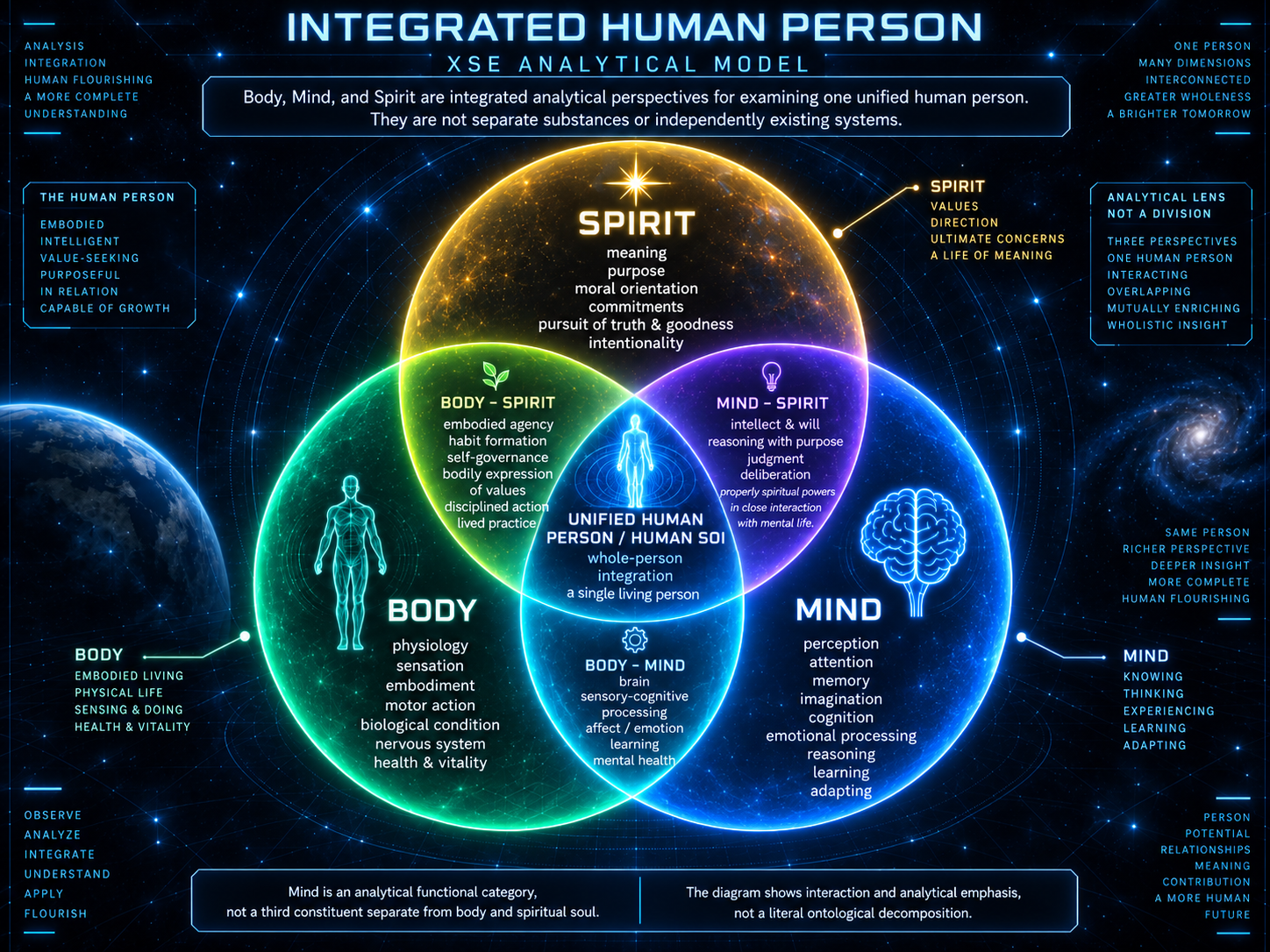
In XSE, Mind, Body, and Spirit are the three formal Human Aspects among XSE’s 20 Actual Factors. They are used as integrated analytical perspectives for examining one unified human person; they are not three separate substances, natures, or independently existing systems, nor are they themselves members of XSE’s 20 Analytical Factors.
The human person is a profound unity of corporeal body and spiritual soul. Mind is used by XSE as a functional category for examining cognitive and psychological operations of the embodied person, not as a third constituent separate from body and soul.
Mind
In XSE, Mind is the Human Aspect used to examine cognitive and psychological operations of the human person, including attention, perception, memory, imagination, understanding, reasoning, judgment, learning, and related mental processes.
Mind is not a separate substance alongside Body and Spirit.
Intellectual activity belongs to the unified human person and proceeds through the spiritual power of intellect, while many cognitive and psychological operations also involve the person’s sensory, bodily, neurological, emotional, and experiential life.
Within XSE, Mind is therefore an Actual Factor used as an analytical perspective for examining mental and cognitive functioning without implying that the human person’s intellectual or psychological life can be exhaustively reduced to biological processes or to a systems model.
Spirit
In XSE, the Spirit Aspect refers to the human person considered in relation to the spiritual soul and its properly spiritual capacities, orientation, and activity.
The human spiritual soul is the immaterial, rational, and immortal principle of life of the person and is the form of the body, such that body and soul constitute one human nature and one human person.
Through the spiritual powers of intellect and will, the human person is capable of knowing truth, recognizing and choosing the good, acting freely, and directing action toward a proper end. Human beings are naturally ordered toward truth and goodness, yet intellect, will, desires, habits, and conduct can become disordered.
Reason, reflection, education, disciplined formation, and moral development can assist natural human growth, correction, and the development of virtue. XSE addresses these natural dimensions of human development and does not claim to explain or produce supernatural life or perfection.
Within XSE, the Spirit Aspect is therefore an Actual Factor used as an analytical perspective on the person’s spiritual and orientational life, not an exhaustive model or mechanistic explanation of the soul.
Body
In XSE, Body refers to the corporeal and biological reality of the human person.
The human body is not merely an instrument, container, or machine occupied by the soul, but an integral dimension of the one human person and shares in the dignity proper to that person.
Animated by the spiritual soul, through the body the human person senses, acts, communicates, and interacts corporeally with the material world.
Bodily health, limitations, capacities, habits, environment, injury, fatigue, and other physical conditions can therefore influence the functioning and development of the whole person.
Within XSE, Body is therefore an Actual Factor used as an analytical perspective for examining the corporeal and biological conditions of the human SOI without reducing the person to biology, physical capability, performance, or bodily state.
Formal XSE classification: Mind, Body, and Spirit are Actual Factors.
Analytical use: they function as integrated Human Aspects through which XSE examines the unified human person.
Human ontology: one human person constituted in the unity of body and spiritual soul.
XSE analysis: Mind, Body, and Spirit provide distinct but integrated perspectives without claiming to exhaustively define or explain the human person.
Systems Understanding of the Mind

The Mind Aspect
The Mind Aspect concerns the cognitive, psychological, emotional, experiential, representational, learning, and information-processing activity of the unified human person. It includes processes such as perception, attention, memory, imagination, learning, emotion, mental representation, information processing, and related processes involved in reasoning and decision-making.
Within XSE’s formal taxonomy, Mind is one of the three Human Aspects—Mind, Body, and Spirit—among XSE’s 20 Actual Factors. It is used as an analytical functional category for examining cognitive and psychological activity, not as a separate substance, independently existing system, or third constituent of the human person.
Within XSE, Mind is not equated with the properly spiritual powers of intellect and will, although mental and psychological processes interact closely with both in ordinary human activity.
The processes examined through the Mind Aspect are deeply embodied and closely related to neurological development, bodily condition, environment, experience, relationships, and learning. At the same time, XSE does not reduce the whole of human knowing, judgment, choice, or agency to neural activity, psychological processing, or information processing alone.
Cognitive and Psychological Functioning
The Mind Aspect examines how the person:
receives and interprets sensory and internal information;
directs and sustains attention;
forms, retains, and retrieves memories;
imagines possibilities and mentally represents situations;
learns from experience;
experiences and processes emotion;
recognizes patterns;
anticipates possible outcomes;
and participates in reasoning, judgment, and decision-making.
These processes do not operate in isolation. They interact continuously with bodily condition, environment, relationships, habits, prior experience, beliefs, commitments, and the person’s broader orientation.
Emotion is examined through the Mind Aspect insofar as it involves psychological and experiential functioning, while recognizing that emotional life also has important bodily and whole-person dimensions.
Mind, Intellect, and Will
XSE distinguishes the Mind Aspect from the properly spiritual powers of intellect and will.
The human person understands intelligible truth, forms rational judgments, and reasons through the intellect. The person deliberately chooses perceived goods through the will.
Within XSE, these properly spiritual powers are not reduced to psychological processing, emotion, preference, neurological executive function, or computational activity.
Nevertheless, the ordinary exercise of intellect and will occurs in close interaction with perception, attention, memory, imagination, emotion, learned associations, bodily condition, and neurological functioning.
The whole human person therefore understands, judges, chooses, and acts. XSE uses Mind, Body, and Spirit as integrated analytical perspectives for examining different dimensions of that unified activity.
Systems Interpretation
From a systems-analysis standpoint, the Mind Aspect examines how cognitive and psychological processes contribute to the person’s ongoing interpretation of Current Reality.
Relevant functions may include:
receiving and filtering information;
allocating attention;
organizing experience;
forming and updating mental models;
retaining and recalling information;
comparing present conditions with previous experience;
anticipating possibilities;
detecting patterns and inconsistencies;
adapting through learning;
and participating in the evaluation of possible courses of action.
Within XSE, this systems language does not mean that the mind is a computational controller, software layer, or internal operator directing the body. It is a way of analyzing the cognitive and psychological activity of the embodied human person.
Mental Condition and Human Functioning
Mental and psychological functioning may be affected by factors such as stress, trauma, illness, neurological conditions, sleep, fatigue, learned patterns, environmental influences, relationships, misinformation, habits, and emotional states.
These conditions may influence attention, memory, interpretation, emotional regulation, learning, reasoning, behavior, or decision-making.
Within XSE, these conditions are not automatically interpreted as evidence of moral failure, spiritual disorder, or lack of Integrity.
Likewise, psychological comfort or internal consistency does not necessarily establish that a person’s beliefs or judgments are true. A person may feel confident while mistaken or experience significant internal conflict while recognizing or acting upon something true and genuinely good.
XSE therefore treats mental states and patterns as important evidence for investigation rather than automatic verdicts concerning truth, morality, or spiritual condition.
XSE uses psychological and mental-health-related considerations for educational and systems-analysis purposes. It does not diagnose or treat mental disorders, provide psychotherapy, or replace individualized evaluation or treatment by appropriately licensed mental-health or healthcare professionals.
Learning, Adaptation, and Mental Models
The Mind Aspect is highly relevant to learning and adaptation.
Through experience, education, observation, reflection, practice, and feedback, the person can develop and revise mental models of reality. These models can influence expectations, attention, interpretation, emotional responses, and behavior.
Mental models may become increasingly accurate and useful, or they may contain error, bias, incomplete information, false assumptions, or maladaptive patterns.
Within XSE, effective mental development therefore requires more than internal consistency. It requires continued comparison between one’s understanding and Current Reality, relevant evidence, objective truth, and what is genuinely good.
Adaptability to stronger evidence and correction of inaccurate models may therefore strengthen the person’s capacity for sound judgment and constructive action.
XSE Interpretation
Within XSE, the Mind Aspect provides a disciplined analytical perspective on the cognitive, psychological, emotional, experiential, representational, learning, and information-processing activity of the one human person.
Mind is not the soul, not the intellect, not the will, and not an independent system positioned between Body and Spirit.
Rather, it is an analytical perspective through which XSE examines mental and psychological processes that interact with bodily life and with the properly spiritual powers of intellect and will.
Thus, the whole human person perceives, understands, judges, chooses, acts, learns, and develops, while the Mind Aspect helps XSE examine the cognitive and psychological processes involved in that unified human activity.
The Origin of the Mind

Origin and Development of the Mind Aspect
Within XSE, the Mind Aspect does not originate as a separate substance or system. Rather, it is an analytical perspective applied to the cognitive, psychological, emotional, experiential, representational, learning, and information-processing activity of the unified human person.
Within XSE’s formal taxonomy, Mind is one of the three Human Aspects—Mind, Body, and Spirit—among XSE’s 20 Actual Factors. Its developmental application does not make Mind a separate system, substance, or third constituent of the human person.
The biological structures involved in the ordinary expression of cognitive and psychological functioning develop progressively across human development. Early formation of the nervous system begins during the third week after fertilization, when the embryonic ectoderm forms the neural plate at approximately day 18. The neural plate subsequently folds to form the neural tube, from which the brain and spinal cord progressively develop.
As neural development continues, increasingly complex structures and networks participate in the emergence and maturation of sensation, perception, attention, memory, emotion, learning, imagination, behavioral regulation, and other cognitive and psychological functions. These capacities continue to develop and change throughout infancy, childhood, adolescence, adulthood, aging, and changing bodily conditions.
XSE does not conclude from this neurological development that the human person or spiritual soul emerges from increasing neural complexity. Nor does XSE treat Mind as an immaterial organizing principle directing the body. The spiritual soul is the substantial form of the body, while Mind is an analytical category used to examine cognitive and psychological functioning within the embodied human person.
The ordinary exercise and expression of human cognition occur in close dependence upon bodily and neurological conditions. At the same time, XSE does not reduce rational understanding, judgment, deliberate choice, or human agency to neural computation or psychological processing alone.
Through the properly spiritual powers of intellect and will, the human person understands intelligible truth and deliberately chooses perceived goods, while these powers ordinarily operate in close interaction with perception, memory, imagination, attention, emotion, learned associations, bodily condition, and neurological functioning.
Within XSE, the Mind Aspect applies across the human life cycle, even though particular cognitive and psychological functions are not equally developed or actively expressed at every stage. The absence, immaturity, impairment, or temporary inactivity of a particular mental capacity does not imply the existence of a different human organism or a lesser human nature.
Thus, within XSE, the origin and development of the Mind Aspect refers not to the creation of a separate “mind system,” but to the progressive development and expression of the cognitive and psychological functioning of the same embodied human person, examined in interaction with the Body and Spirit Aspects while preserving the distinctions among them.
The importance of striving for good mental health

Mental Health and Whole-Person Functioning
Mental health is an important dimension of human functioning and can significantly affect the person’s broader well-being and Trajectory. Within XSE, however, mental health is not treated as the whole of human well-being, a measure of human worth, or a direct indicator of moral or spiritual condition.
Mental and psychological functioning interacts with bodily condition, relationships, environment, behavior, cognitive processes, habits, responsibilities, meaning, purpose, and the person’s exercise of agency. These relationships are often bidirectional and context-dependent rather than simple one-way causes.
A person may experience significant psychological distress or mental disorder while retaining inherent dignity, meaningful relationships, spiritual depth, purpose, and substantial areas of Strength and Integrity. Questions concerning moral responsibility are evaluated according to the person’s actual knowledge, freedom, intention, condition, and circumstances rather than inferred from diagnosis alone.
Conversely, psychological comfort, confidence, or emotional stability does not by itself establish that a person’s beliefs, judgments, choices, or conduct are true or genuinely good.
Within XSE, mental health is therefore examined as one important area of functioning considered through the Mind Aspect and within whole-person analysis, while remaining in interaction with the Body and Spirit Aspects and other relevant Factors.
Emotional Functioning and Resilience
Mental health is closely associated with emotional functioning, including the person’s ability to recognize, experience, regulate, and respond to emotion.
Healthy psychological functioning may support capacities such as coping with stress, emotional regulation, adaptation, recovery following difficulty, and continued engagement with responsibilities and relationships.
Within XSE, mental health is not defined as the continual experience of positive emotion or the absence of sadness, fear, anger, grief, or distress. Difficult emotions may be appropriate responses to loss, danger, injustice, failure, uncertainty, or other realities.
Emotional resilience therefore does not require the elimination of distress. It involves the capacity to experience and respond to emotion in ways that remain increasingly compatible with reality, responsibilities, relationships, and constructive action.
Contemporary understandings of mental health commonly recognize that mental health involves more than the absence of mental disorder and is not equivalent to uninterrupted happiness or ideal functioning. See Galderisi et al. (2015), “Toward a New Definition of Mental Health.”
Galderisi et al. (2015) — PubMed
Relationships and Social Functioning
Mental health and social relationships can influence one another.
Supportive relationships, meaningful social connection, belonging, and appropriate assistance may contribute to psychological well-being and resilience. Conversely, isolation, chronic interpersonal conflict, mistreatment, loss, instability, or lack of support may contribute to psychological distress.
Mental-health conditions may also affect the person’s ability to communicate, maintain relationships, participate socially, interpret interpersonal situations, regulate emotion, or remain engaged with others.
Within XSE, these relationships are understood as interactive rather than strictly causal in one direction. Difficulty in relationships does not automatically establish psychological disorder, and psychological disorder does not imply an inability to form meaningful, loving, or responsible relationships.
Research examining social ties and mental health has documented important relationships among social networks, social support, psychological well-being, stress, depression, and anxiety. See Kawachi & Berkman (2001), “Social Ties and Mental Health.”
Kawachi & Berkman (2001) — PubMed
Physical Health and the Body Aspect
Mental and physical health also interact substantially.
Psychological stress, depression, anxiety, trauma-related symptoms, behavioral patterns, sleep disturbance, substance use, and other mental-health-related conditions may interact with bodily processes and health-related behaviors.
At the same time, physical illness, pain, disability, neurological conditions, hormonal changes, sleep disruption, injury, medication effects, fatigue, and other bodily conditions may affect mood, cognition, attention, motivation, behavior, and psychological well-being.
XSE therefore treats many mental and physical health relationships as bidirectional and cross-Aspect. The World Health Organization similarly recognizes that mental and physical health conditions can affect one another and may function as precursors, consequences, or products of interactive effects.
WHO — Mental and Physical Health Comorbidities
A physical symptom is not automatically attributed to psychological causes, just as psychological distress is not automatically reduced to bodily dysfunction. Appropriate investigation requires attention to the relevant evidence, circumstances, Human Aspects, and professional domains.
Cognitive Functioning
Mental-health conditions may also interact with cognitive functioning.
Depending on the individual and condition, psychological distress or disorder may affect attention, concentration, working memory, motivation, interpretation, learning, cognitive flexibility, problem-solving, and decision-making.
These effects vary considerably among individuals and are not treated as universal consequences of mental-health difficulty.
Likewise, cognitive difficulties may themselves contribute to psychological strain, frustration, uncertainty, impaired functioning, or difficulty meeting responsibilities.
Within XSE, cognitive performance is therefore examined in context rather than used as a simple measure of mental health, Intelligence, moral responsibility, or personal worth.
Mental Health and the Spirit Aspect
Mental and psychological conditions may affect the circumstances in which the person engages questions of meaning, purpose, hope, commitment, moral judgment, responsibility, truth, and spiritual or religious life.
For example, depression, anxiety, trauma, severe stress, cognitive disturbance, or other psychological difficulties may affect concentration, motivation, emotional experience, religious practice, reflection, perceived connectedness, or the person’s experience of meaning and hope.
Conversely, meaning, purpose, stable commitments, supportive communities, religious or spiritual practices, and particular ways of interpreting suffering or adversity may interact with psychological coping and reported well-being.
Within XSE, these relationships are interpreted cautiously and in context.
XSE does not infer from psychological well-being that a person is spiritually healthy, nor from psychological distress that a person is spiritually disordered. Difficulty experiencing peace, hope, consolation, motivation, or emotional connectedness does not by itself demonstrate a defect in the Spirit Aspect.
Empirical research concerning spirituality, religion, meaning, purpose, or spiritual well-being examines observable behavior, psychological measures, reported experience, neurobiological correlates, and associated outcomes. Such research does not experimentally detect, measure, or establish the condition of the spiritual soul itself.
A systematic review by Rosmarin and colleagues illustrates both the empirical study of relationships among spirituality, religion, mental health, and neurobiology and the continuing limitations of that evidence.
Rosmarin et al. (2022) — PubMed
Mental Health, Truth, and Integrity
Good mental functioning can support a person’s ability to attend carefully, learn, interpret evidence, regulate behavior, maintain relationships, and fulfill responsibilities.
However, mental health and Integrity are not identical.
A psychologically comfortable person may hold mistaken beliefs, rationalize harmful conduct, or remain confidently oriented toward something false. A psychologically distressed person may nevertheless recognize truth, act courageously, maintain sound commitments, and pursue what is genuinely good.
For this reason, XSE does not define psychological comfort, emotional stability, internal consistency, or subjective well-being as proof of truth or Integrity.
Mental health may support the person’s functioning, but objective truth remains the standard by which beliefs are evaluated, and what is genuinely good remains relevant to the evaluation of choices and conduct.
Supporting Mental Health
Factors commonly relevant to supporting mental health and psychological functioning may include, depending upon the person and circumstances:
adequate sleep and nutrition;
appropriate physical activity;
healthy relationships and social support;
constructive coping strategies;
reduction of harmful environmental or behavioral conditions;
opportunities for meaningful activity and responsibility;
accurate information and education;
appropriate stress-management practices;
development of useful habits and skills;
and professional psychological, psychiatric, neurological, or medical care when appropriate.
The appropriate response depends upon the person, circumstances, causes, severity, risks, and relevant professional considerations.
Within XSE, no single practice or intervention is assumed to produce psychological health for every individual.
XSE uses psychological and mental-health-related considerations for educational and systems-analysis purposes. It does not diagnose or treat mental disorders, provide psychotherapy, prescribe medication, or replace individualized evaluation or treatment by appropriately licensed mental-health or healthcare professionals.
XSE Interpretation
Within XSE, mental health is an important area of the person’s cognitive, psychological, emotional, relational, behavioral, and experiential functioning, but it is neither the entirety of human health nor the measure of the person’s dignity, moral worth, spiritual condition, or Integrity.
Mental-health conditions may interact with conditions examined through the Body and Spirit Aspects, as well as relationships, environment, behavior, responsibilities, and other XSE Factors. These interactions may influence the person’s ability to understand Current Reality, pursue goals, fulfill responsibilities, adapt to difficulty, maintain relationships, and continue along a constructive Trajectory.
XSE therefore neither idealizes mental health nor reduces human difficulty to psychological dysfunction. Rather, it examines mental and psychological functioning as one important area of functioning within the unified human person, requiring appropriate evidence, context, professional boundaries, and integration with the other relevant Human Aspects and Factors.
Mental health can contribute importantly to human flourishing, but psychological comfort is not the highest standard. XSE ultimately seeks accurate orientation to reality, sound functioning, responsible freedom, Integrity, and constructive Advancement of the whole person.
The mind affects the body and spirit

The Interconnection of Mind, Body, and Spirit
Within XSE, Mind, Body, and Spirit are distinct but integrated analytical perspectives on one unified human person. Within XSE’s formal taxonomy, they are the three Human Aspects among XSE’s 20 Actual Factors. They are not three independently existing substances, systems, or components that communicate with one another as separate agents.
The human person exists in the profound unity of body and spiritual soul, while the Mind Aspect provides an analytical perspective on the person’s cognitive, psychological, emotional, experiential, representational, learning, and information-processing activity.
Observable human functioning exhibits extensive interaction among bodily conditions, neurological processes, cognition, emotion, behavior, relationships, meaning, purpose, commitments, and religious or spiritual life. These relationships may be reciprocal, indirect, context-dependent, or mediated through multiple Factors.
Empirical science can investigate many of these observable and self-reported relationships. It can examine physiology, brain activity, cognition, emotion, behavior, health outcomes, religious or spiritual practices, perceived meaning, purpose, coping, and reported spiritual well-being. It does not, through those measurements alone, experimentally detect or establish the spiritual soul or reduce the human person to measurable processes.
Body–Mind Interaction
The relationship between bodily condition and mental or psychological functioning is well established.
The brain and nervous system participate centrally in sensation, perception, attention, memory, emotion, learning, behavioral regulation, and many other processes examined through the Mind Aspect. At the same time, neurological functioning occurs within a living organism whose nervous, endocrine, immune, cardiovascular, digestive, metabolic, and other physiological processes interact continuously.
Physical conditions such as sleep disruption, pain, illness, injury, neurological disorders, hormonal changes, nutrition, medication effects, fatigue, physical activity, and chronic stress may affect cognition, mood, attention, memory, motivation, or behavior.
Mental and psychological conditions may likewise interact with physical health through behavior, stress physiology, sleep, activity, substance use, adherence to appropriately prescribed or recommended care, social functioning, and other pathways.
The World Health Organization recognizes that mental and physical health conditions can affect one another and may function as precursors, consequences, or products of interactive effects.
WHO — Mental Health and Physical Health Comorbidities
Within XSE, these relationships support analysis across the Body and Mind Aspects without implying that either Aspect represents an independently operating system.
Stress, Emotion, and Bodily Functioning
Psychological stress and emotional states may be accompanied by measurable physiological responses involving autonomic activity, endocrine signaling, sleep, cardiovascular activity, muscle tension, gastrointestinal functioning, immune processes, and other bodily conditions.
Within XSE, these relationships are not interpreted simplistically.
A bodily symptom does not automatically establish a psychological cause, and psychological distress is not automatically attributed to bodily dysfunction. Similar symptoms may arise through many different pathways, and causal determination may require appropriate medical, psychological, or other professional investigation.
Bodily and psychological observations therefore serve as evidence for investigation rather than automatic explanations of one another.
Mind–Body Practices
Practices involving attention, breathing, movement, meditation, or related forms of self-regulation may be associated with measurable psychological or neurological changes in some individuals and circumstances.
Hölzel et al. (2011), “Mindfulness Practice Leads to Increases in Regional Brain Gray Matter Density,” reported changes in regional gray-matter concentration following an eight-week Mindfulness-Based Stress Reduction program. Increases were identified in regions including the left hippocampus, posterior cingulate cortex, temporoparietal junction, and cerebellum; the authors associated these regions with functions including learning and memory, emotion regulation, self-referential processing, and perspective taking.
Kilpatrick et al. (2011), “Impact of Mindfulness-Based Stress Reduction Training on Intrinsic Brain Connectivity,” reported MBSR-related differences in intrinsic functional connectivity among healthy women, particularly involving auditory, visual, attentional, sensory-processing, and self-referential networks.
Kilpatrick et al. (2011) — PubMed
A broader review by Tang, Hölzel, and Posner (2015), “The Neuroscience of Mindfulness Meditation,” discusses research involving attention regulation, emotion regulation, and self-awareness, while emphasizing significant methodological limitations in the literature.
Tang, Hölzel & Posner (2015) — Nature Reviews Neuroscience
Such findings can provide evidence concerning neural and psychological adaptation. They do not constitute proof of spiritual transformation, moral improvement, greater Integrity, or measurable change in the spiritual soul.
A measurable change in brain structure, activity, or connectivity is a neurological finding. Its broader philosophical, moral, or spiritual significance requires separate evaluation.
Mind–Spirit Interaction
The Mind and Spirit Aspects also overlap analytically in important ways.
Mental and psychological processes such as attention, memory, imagination, emotional experience, learned associations, perception, and mental representation can influence the circumstances in which the human person reasons, forms judgments, considers meaning, evaluates commitments, and makes deliberate choices.
Within XSE, the properly spiritual powers of intellect and will are not reduced to those psychological processes.
Through intellect, the human person apprehends intelligible realities, understands truth, forms rational judgments, and reasons about meanings, principles, causes, and goods. Through will, the person deliberately chooses perceived goods.
The ordinary exercise of these spiritual powers occurs in close interaction with mental and bodily conditions. Fatigue may make sustained attention difficult. Trauma may affect memory or emotional response. Depression may affect motivation or perceived hope. Anxiety may influence attention or interpretation.
None of these conditions, by itself, establishes what the person ultimately judges to be true or good, nor does any such condition directly reveal the state of the spiritual soul.
Meaning, Purpose, Religion, and Psychological Well-Being
Empirical research can investigate relationships among meaning, purpose, religious or spiritual beliefs and practices, coping, psychological distress, and reported well-being.
Rosmarin et al. (2022), “The Neuroscience of Spirituality, Religion, and Mental Health: A Systematic Review and Synthesis,” reviewed research examining spirituality or religion, mental health, and neurobiology together. The authors identified a developing evidence base while concluding that relationships across these domains remain incompletely understood and require further rigorous study.
Rosmarin et al. (2022) — PubMed
Coelho-Júnior et al. (2022), “Religiosity/Spirituality and Mental Health in Older Adults: A Systematic Review and Meta-Analysis of Observational Studies,” examined adults aged 60 and older. The review reported associations between measures of religiosity or spirituality and outcomes including depressive and anxiety symptoms, life satisfaction, meaning in life, social relationships, and psychological well-being.
Because the evidence concerns a defined population and is primarily observational, it is interpreted as evidence of association rather than proof of a universal causal relationship.
Coelho-Júnior et al. (2022) — PubMed
Within XSE, such findings may help illuminate how meaning, purpose, beliefs, practices, communities, commitments, and interpretations of adversity interact with psychological life.
They do not experimentally establish the existence, nature, activity, or condition of the spiritual soul.
Body–Spirit Interaction
The Body and Spirit Aspects are also related within the life of the unified person.
Human beings exercise intellect and will as embodied persons. Bodily conditions therefore form part of the circumstances in which the person reflects, chooses, fulfills responsibilities, develops habits, participates in relationships, pursues meaning and purpose, and engages in religious or spiritual practices.
Sleep deprivation, severe pain, illness, neurological impairment, fatigue, disability, hormonal disturbance, injury, medication effects, or other bodily conditions may alter the circumstances under which the person attends, reflects, communicates, acts, or maintains particular practices.
This does not mean that bodily condition determines spiritual worth or the condition of the soul.
Likewise, deliberate judgments, commitments, purposes, habits, and choices may influence bodily Trajectory through behavior. Decisions concerning sleep, nutrition, physical activity, substance use, appropriate medical care, discipline, work, risk, or other behaviors can have bodily consequences.
These relationships involve the whole embodied person, not a spiritual controller issuing commands to a bodily machine.
Emotion Across the Human Aspects
Emotion illustrates the importance of distinguishing the Human Aspects without isolating them.
Emotion can involve:
bodily responses and physiological changes;
neurological and cognitive processing;
subjective psychological experience;
attention, memory, and interpretation;
behavioral expression;
relationships and environmental context;
and the person’s judgments, commitments, and responses to perceived goods, threats, losses, or responsibilities.
XSE examines emotion principally through the Mind Aspect insofar as it concerns psychological and experiential functioning, while recognizing its substantial bodily and whole-person dimensions.
Within XSE, an emotional experience is not automatically interpreted as a direct spiritual signal.
Guilt does not by itself prove moral guilt. Peace does not by itself prove innocence. Fear does not necessarily indicate cowardice. Psychological comfort does not establish truth.
Emotions provide meaningful information, but their interpretation requires context, evidence, sound judgment, and appropriate distinctions.
Whole-Person Stress and Adversity
Stress, trauma, grief, illness, conflict, loss, and adversity may be associated with effects observable across multiple Human Aspects and Factors.
A person experiencing severe stress may simultaneously encounter:
physiological arousal or fatigue;
disrupted sleep;
changes in attention or memory;
emotional distress;
altered behavior;
relational strain;
questions of meaning or purpose;
difficulty maintaining commitments or practices;
and challenges involving judgment, responsibility, or adaptation.
XSE does not assume that all of these effects share a single cause.
Psychological or bodily symptoms are not automatically interpreted as evidence of spiritual disorder, just as spiritual struggle is not automatically reduced to psychological pathology.
Appropriate analysis requires investigation of the actual evidence, relevant Sources, circumstances, Factors, and professional domains involved.
XSE uses biological, psychological, spiritual-life, and health-related information for educational and systems-analysis purposes. It does not diagnose or treat medical or mental-health conditions, provide psychotherapy, prescribe treatment or medication, or replace individualized evaluation or care by appropriately licensed professionals.
Integration Without Reduction
The interrelationship among Mind, Body, and Spirit does not mean that all phenomena can be collapsed into one explanatory level.
Biology provides indispensable knowledge concerning bodily structures and processes.
Psychology and neuroscience provide important knowledge concerning cognition, emotion, behavior, experience, and neurological functioning.
Philosophical anthropology addresses questions concerning the nature of the human person, intellect, will, rationality, freedom, meaning, and the spiritual soul that are not settled merely by measuring neural, physiological, behavioral, or psychological variables.
Appropriate theological Sources may address additional questions that empirical science or systems engineering is not competent to establish independently.
Within XSE, these domains are integrated without reduction.
XSE does not reduce the person to biology, psychology, behavior, data, or computation. Nor does it invoke spiritual explanation as a substitute for appropriate biological, psychological, social, environmental, medical, or other professional investigation.
XSE Interpretation
Within XSE, Mind, Body, and Spirit are the three formal Human Aspects among the 20 Actual Factors and provide distinct but integrated analytical perspectives on the one human person.
The Body Aspect examines the person’s corporeal and biological reality.
The Mind Aspect examines cognitive, psychological, emotional, experiential, representational, learning, and information-processing activity.
The Spirit Aspect examines the person in relation to the spiritual soul and its properly spiritual powers, especially intellect and will, together with moral orientation, meaning, purpose, commitments, and orientation toward objective truth and what is genuinely good.
These Aspects may be analytically distinguished, but the person who senses, perceives, understands, judges, chooses, acts, suffers, relates, learns, develops, and flourishes is one unified human person.
Empirical research can illuminate many observable relationships among bodily health, psychological functioning, behavior, meaning, purpose, religious or spiritual practices, and reported well-being. It does not experimentally establish or measure the spiritual soul itself.
XSE uses the interconnection of Mind, Body, and Spirit to support a more complete understanding of the human SOI while preserving both the unity of the human person and the legitimate limits of each method of investigation.
The objective is not to divide the person into three systems, but to examine one person from three integrated perspectives so that important realities are neither confused nor overlooked.
The affects of physical activity on the mind

Physical Activity, Brain Health, and Cognitive Function
Physical activity is an important contributor to bodily and brain health and is associated with beneficial cognitive outcomes across multiple stages of life. Research has identified relationships between physical activity and aspects of memory, processing speed, executive functioning, academic achievement, cognitive aging, and risk of cognitive impairment, although the magnitude and nature of these effects vary by population, type and amount of activity, health condition, and cognitive domain.
A review conducted for the 2018 Physical Activity Guidelines for Americans found moderate evidence from randomized controlled trials associating moderate-to-vigorous physical activity with improvements in cognition, including academic achievement and neuropsychological measures of processing speed, memory, and executive function. The review also found strong evidence that acute bouts of moderate-to-vigorous activity can produce temporary post-exercise cognitive benefits and that greater amounts of physical activity are associated with reduced risk of later cognitive impairment.
Erickson et al. (2019) — Physical Activity, Cognition, and Brain Outcomes
Within XSE, these findings illustrate an important Body–Mind interaction: bodily activity and physical condition may influence neurological and cognitive functioning without implying that cognition is reducible to bodily processes alone.
Neurotrophic and Neuroplastic Processes
One proposed pathway through which physical activity may support brain function involves neurotrophic signaling, including brain-derived neurotrophic factor (BDNF).
BDNF participates in neuronal survival and differentiation and has important roles in synaptic plasticity, learning, and memory.
Reviews and meta-analyses of human and experimental research indicate that acute exercise, and under some conditions repeated exercise training, can influence circulating BDNF and BDNF-related signaling. For example, a meta-analysis of randomized controlled trials in healthy participants reported increases in circulating BDNF following both acute and longer-term physical exercise, while also identifying substantial variation across study conditions.
Exercise and Circulating BDNF — 2022 Meta-Analysis
These findings require careful interpretation. Measurements of BDNF in blood are not equivalent to direct measurement of BDNF activity within particular brain regions, and findings can vary according to factors such as exercise intensity, biological sample type, sampling timing, participant characteristics, and study design.
Within XSE, BDNF is treated as one plausible and evidence-supported pathway involved in exercise-related neural adaptation, rather than as a single explanation for cognitive improvement.
Structural and Functional Brain Adaptation
Physical activity has also been associated with differences or changes in brain structure and function.
Research reviewed by Erickson and colleagues identifies evidence that physical activity can influence both cognitive and brain outcomes. Proposed and observed pathways include synaptic plasticity, trophic-factor signaling, vascular adaptation, functional-network changes, and structural brain differences.
Some research has specifically examined the hippocampus because of its important role in memory and learning. In a randomized controlled trial involving 120 older adults, Erickson and colleagues reported that one year of aerobic exercise training was associated with increased anterior hippocampal volume and improvements in spatial memory.
Erickson et al. (2011) — Exercise Training Increases Size of Hippocampus and Improves Memory
Experimental research also identifies mechanisms involving angiogenesis and neurogenesis, particularly in animal models. Claims concerning adult human hippocampal neurogenesis require greater caution because its extent, measurement, and persistence across adulthood remain subjects of scientific debate and methodological investigation.
Adult Human Hippocampal Neurogenesis — Current Review
Accordingly, XSE does not present neurogenesis as a universally demonstrated human mechanism explaining the cognitive benefits of exercise.
The broader evidence supports the conclusion that physical activity can be associated with multiple forms of neural and vascular adaptation that may contribute to brain and cognitive health.
Cardiovascular and Cerebrovascular Support
Physical activity can improve cardiovascular fitness and vascular function, which may in turn support brain health.
The brain depends upon adequate circulation and the ability of cerebral blood vessels to respond to changing metabolic demands. Research has therefore examined brain perfusion and cerebrovascular reserve as possible pathways linking physical fitness with cognitive functioning.
Davenport and colleagues reviewed evidence suggesting that better physical fitness in later life is positively associated with cognitive functioning and that differences in brain perfusion and the responsiveness of cerebral blood vessels may partly contribute to this relationship.
Davenport et al. (2012) — Cerebrovascular Reserve: The Link Between Fitness and Cognitive Function?
Subsequent intervention research has also reported improvements in cognition and measures of cerebrovascular regulation following aerobic exercise in older adults.
Guadagni et al. (2020) — Aerobic Exercise, Cognition, and Cerebrovascular Regulation
This evidence does not establish a simple universal sequence in which exercise automatically increases cerebral blood flow and thereby improves cognition.
Within XSE, cardiovascular and cerebrovascular functioning are understood as important potential pathways within a larger network of interacting biological mechanisms.
Physical Activity Across the Body and Mind Aspects
Physical activity may affect more than isolated cognitive-test performance.
Depending upon the person and circumstances, regular movement and exercise may interact with:
cardiovascular and metabolic health;
sleep;
mood and emotional functioning;
stress regulation;
neurological functioning;
attention and concentration;
learning and memory;
mobility and physical capacity;
social participation;
and the person’s ability to carry out responsibilities and purposeful activity.
These effects are not identical for every individual.
Within XSE, physical activity is not treated as a universal treatment for cognitive, neurological, psychological, or medical conditions.
Age, disability, illness, injury, medication, physical capacity, environment, personal history, and other Factors may substantially affect what forms and levels of physical activity are appropriate.
XSE uses physical-activity and health-related information for educational and systems-analysis purposes. This material does not provide individualized medical or rehabilitation exercise prescription or replace guidance from appropriately qualified fitness, medical, or rehabilitation professionals, as applicable to the person’s circumstances.
Religious or Spiritual Practices, Resilience, and Mental Health
Research also examines relationships among religious or spiritual beliefs and practices, meaning, purpose, coping, resilience, and mental-health outcomes.
A systematic review and meta-analysis by Schwalm and colleagues included 34 observational studies and reported a moderate positive correlation between measures of spirituality or religiosity and resilience. Because the included studies were observational, the result supports an association rather than proof that spirituality or religion directly causes resilience.
Schwalm et al. (2022) — Spirituality/Religiosity and Resilience
Research has also examined specifically defined religious or spiritual interventions in mental-health care. Gonçalves and colleagues reviewed randomized controlled trials and found benefits for some measured outcomes, with the clearest pooled findings involving anxiety symptoms. The authors also emphasized substantial diversity in interventions and outcomes and the need for further research.
Gonçalves et al. (2015) — Religious and Spiritual Interventions in Mental Health Care
These findings do not establish that all “spiritually uplifting activities” improve mental health. Effects may depend upon the person, practice, belief, community, circumstances, intervention, and outcome being studied.
Within XSE, empirical findings concerning religion or spirituality may help illuminate relationships among meaning, purpose, practices, commitments, coping, resilience, and reported psychological well-being.
They do not experimentally establish spiritual development, moral improvement, greater Integrity, or a measurable change in the spiritual soul.
Integration Without Reduction
Physical activity provides a clear example of interaction among the Human Aspects without collapsing them into one another.
A bodily activity such as exercise may influence physiological and neurological conditions associated with cognitive and psychological functioning. It may also interact with behavior, relationships, habits, responsibilities, and the person’s broader Trajectory.
These effects do not mean that physical activity directly produces truth, moral virtue, spiritual development, or Integrity.
Likewise, a religious or spiritual practice may have measurable psychological, neurological, physiological, or behavioral correlates without those measurements exhausting its meaning or demonstrating the condition of the spiritual soul.
Within XSE, these relationships are understood through integration without reduction:
Bodily conditions can influence mental functioning; mental and psychological conditions can influence bodily functioning; and meaning, purpose, commitments, and religious or spiritual life may interact with both. Yet the one human person cannot be adequately reduced to any single mechanism, measurement, or Human Aspect.
XSE Interpretation
Within XSE, physical activity is principally examined through the Body Aspect, while its cognitive, emotional, behavioral, and experiential effects may also be examined through the Mind Aspect and other relevant Factors.
The evidence supports the conclusion that physical activity can contribute to brain health, cognitive functioning, adaptation, and broader bodily well-being, while the degree and form of benefit vary across persons, populations, conditions, and circumstances.
XSE does not treat exercise as a universal optimization mechanism or proof of whole-person flourishing, nor does it independently prescribe exercise as medical or rehabilitative treatment.
Rather, physical activity is one potentially important condition within the broader configuration of the human SOI.
Similarly, research concerning religious or spiritual practices can inform analysis of reported psychological outcomes, coping, resilience, meaning, and behavior without converting empirical measurement into a judgment concerning the spiritual soul.
The objective is not to infer the condition of the whole person from one bodily, psychological, or spiritual-life variable, but to understand how relevant conditions interact within the unified human person and influence Current Reality and Trajectory.
The affects of spiritually uplifting experiences on the mind

Religious and Spiritual Practices, Mindfulness, Coping, and Psychological Well-Being
Research has examined relationships among religious or spiritual beliefs and practices, mindfulness-based interventions, meaning, purpose, coping, resilience, psychological distress, and reported well-being.
Within XSE, these areas are distinguished carefully.
Mindfulness and meditation are not automatically spiritual practices. They may be used in religious, spiritual, clinical, contemplative, or secular settings.
Likewise, prayer, worship, religious services, sacramental life, and other explicitly religious practices are not treated as interchangeable with mindfulness or meditation, because their meaning, object, purpose, and theological significance may differ substantially.
Empirical research can investigate observable behavior, reported experience, psychological outcomes, physiological measures, and aspects of coping or resilience associated with these practices.
It does not experimentally establish spiritual development, moral improvement, greater Integrity, or the condition of the spiritual soul.
Mindfulness-Based Practices and Stress
Mindfulness-based interventions have been studied for their potential relationships with psychological distress, stress response, attention, emotional regulation, and coping.
In a randomized study, Astin (1997) examined an eight-week mindfulness meditation intervention and reported reductions in overall psychological symptoms, increased sense of control, and higher scores on a measure of spiritual experiences among participants receiving the intervention.
Astin (1997) — Stress Reduction Through Mindfulness Meditation
These findings support a cautious conclusion that structured mindfulness training may affect psychological functioning in some individuals and circumstances. They do not establish that mindfulness universally reduces stress, prevents mental disorder, or produces spiritual growth.
A practice that is beneficial or well tolerated for one person is not assumed to be appropriate, beneficial, or without adverse effects for every person.
Research has also examined physiological stress markers. A more recent meta-analysis of stress-management interventions reported effects on cortisol-related outcomes, with mindfulness and meditation included among the intervention categories studied. Results nevertheless varied according to intervention type, study design, population, and method of cortisol measurement.
Stress-Management Interventions and Cortisol — Meta-Analysis
Within XSE, such findings may inform analysis of Mind–Body interaction without treating physiological change as proof of spiritual benefit.
Coping, Psychological Distress, and Empathy
Mindfulness-based stress-reduction programs have also been studied in relation to coping and emotional functioning.
Shapiro, Schwartz, and Bonner (1998) evaluated an eight-week meditation-based stress-reduction intervention among medical and premedical students. Participants receiving the intervention reported reductions in anxiety and psychological distress together with increases in empathy and scores on a measure of spiritual experiences.
Shapiro, Schwartz & Bonner (1998) — Effects of Mindfulness-Based Stress Reduction
Because this study involved a specific student population and intervention, its findings do not establish that all mindfulness or spiritual practices produce the same effects.
The evidence supports the more limited conclusion that structured contemplative or mindfulness-based interventions may be associated with particular psychological outcomes in some populations, while the magnitude, durability, appropriateness, and generalizability of those effects vary.
Chronic Pain, Self-Perception, and Coping
Mindfulness-based interventions have also been investigated in populations experiencing chronic pain.
In a study of chronic-pain patients, Kabat-Zinn, Lipworth, and Burney (1985) reported improvements in several pain-related and psychological measures following a structured mindfulness meditation program, including reductions in reported pain and psychological distress and increases in activity and self-esteem.
Kabat-Zinn, Lipworth & Burney (1985) — Mindfulness Meditation and Chronic Pain
These findings support the conclusion that structured mindfulness-based approaches may be associated with changes in reported pain, distress, coping, and related functioning in some individuals and circumstances.
They do not establish that mindfulness universally improves self-esteem, produces life purpose, resolves the underlying medical causes of pain, or is appropriate for every person experiencing pain.
Religious or Spiritual Practices and Mental-Health Outcomes
Research has separately examined explicitly religious or spiritual interventions in relation to mental-health outcomes.
A systematic review and meta-analysis by Gonçalves et al. (2015) examined randomized controlled trials of religious and spiritual interventions in mental-health care. The review reported benefits for some measured outcomes, with the clearest pooled effects involving anxiety symptoms, while also emphasizing substantial diversity among interventions, populations, and outcomes.
Gonçalves et al. (2015) — Religious and Spiritual Interventions in Mental Health Care
This evidence does not establish that all religious or spiritual practices improve mental health. Effects may vary according to belief, practice, community, personal history, clinical condition, cultural context, circumstances, and the specific outcome being measured.
Within XSE, religious or spiritual practices are examined in relation to both their observable effects and the appropriate philosophical or theological Sources relevant to their meaning and truth claims.
Spirituality, Religiosity, and Resilience
Observational research has also examined associations between spirituality or religiosity and resilience.
A systematic review and meta-analysis by Schwalm et al. (2022) included 34 observational studies and reported a moderate positive correlation between measures of spirituality or religiosity and resilience.
Schwalm et al. (2022) — Spirituality/Religiosity and Resilience
Because these studies were observational, the findings support an association rather than proof that spirituality or religion directly causes resilience.
The relationship may involve multiple pathways, including meaning, interpretation of adversity, community support, personal commitments, behavioral practices, coping style, and other contextual Factors.
Within XSE, an observed association with resilience is not treated as empirical proof that a particular religious or spiritual belief is true or that a person’s spiritual condition has been scientifically measured.
Social Support and Community
Some religious, spiritual, contemplative, or mindfulness-based activities occur within groups or communities and may therefore involve opportunities for social connection, shared practice, belonging, encouragement, or practical support.
These social dimensions may themselves be relevant to psychological well-being.
Within XSE, social support is not assumed to be inherent in every spiritual or contemplative practice, and group participation is not assumed to produce healthy relationships or beneficial psychological outcomes.
The effects of community participation depend upon the actual quality of relationships, beliefs, practices, authority structures, responsibilities, and circumstances involved.
Social support is therefore examined as a relevant Factor in its own right rather than automatically attributed to the spiritual or contemplative practice itself.
Meaning, Purpose, and Psychological Well-Being
Religious or spiritual beliefs and practices may also interact with a person’s experience of meaning, purpose, hope, identity, commitment, suffering, mortality, responsibility, and belonging.
These themes can influence how a person interprets adversity and may interact with coping and psychological well-being.
At the same time, a subjective sense of meaning or purpose does not automatically establish that the underlying belief or interpretation is true.
A person may derive psychological comfort from a mistaken belief, just as a person may experience distress while confronting something true and genuinely important.
Within XSE, psychological benefit and spiritual truth are distinct questions.
Psychological Benefit Is Not a Truth Test
This distinction is essential.
A practice may reduce anxiety, improve concentration, increase perceived control, strengthen social connection, or produce a subjective sense of peace without thereby establishing that its underlying worldview, spiritual claims, or moral assumptions are true.
Likewise, a practice may be difficult, emotionally demanding, or temporarily distressing without therefore being harmful or false.
Within XSE, the following inference is rejected:
“This practice makes me feel better, therefore it is spiritually true or morally good.”
Psychological outcomes are legitimate evidence concerning psychological functioning. They are not sufficient evidence for determining spiritual truth, moral goodness, or the condition of the soul.
Questions concerning truth, morality, and spiritual reality require evaluation using the appropriate Sources, methods, and standards of judgment.
Professional and Scope Boundaries
Research concerning mindfulness, coping, chronic pain, psychological distress, mental-health interventions, religious or spiritual practices, and related health outcomes may be useful for educational and systems-analysis purposes.
Within XSE, such information remains subject to appropriate professional boundaries.
XSE uses information concerning mindfulness, coping, psychological well-being, religious or spiritual practices, and health-related outcomes for educational and systems-analysis purposes. It does not diagnose or treat mental-health or medical conditions, provide psychotherapy or pain treatment, prescribe clinical interventions, or replace individualized evaluation or care by appropriately licensed healthcare or mental-health professionals.
When a person is experiencing significant psychological distress, chronic pain, mental-health symptoms, medical concerns, or other conditions requiring individualized assessment, evaluation by appropriately qualified professionals may be appropriate according to the nature of the concern.
Integration Without Conflation
Within XSE, research concerning mindfulness, meditation, prayer, religious participation, spiritual practices, meaning, purpose, coping, and resilience can inform whole-person analysis.
These categories are not collapsed into one another.
Mindfulness-based practices may be examined primarily for their cognitive, emotional, behavioral, experiential, and physiological effects.
Religious or spiritual practices may also involve questions of belief, worship, meaning, commitment, moral orientation, and relationship to spiritual realities—questions that cannot be reduced to psychological outcomes.
Community participation may contribute social and relational effects that are examined separately.
Meaning and purpose may influence coping and behavior without themselves serving as proof of truth.
Likewise, a measured psychological or physiological response does not by itself determine the moral, philosophical, or spiritual significance of the practice associated with it.
XSE Interpretation
Within XSE, these practices may interact with conditions examined through the Mind, Body, and Spirit Aspects, as well as with relationships, environment, behavior, habits, commitments, and other relevant Factors.
Research supports the conclusion that some mindfulness-based and specifically defined religious or spiritual interventions may be associated with beneficial psychological outcomes in particular populations and circumstances.
It does not establish that all such practices are beneficial, that psychological improvement demonstrates spiritual development, that subjective spiritual experience proves spiritual truth, or that measurable mental-health effects reveal the condition of the spiritual soul.
XSE therefore approaches these areas through integration without conflation: psychological effects are examined psychologically, physiological effects biologically, social effects relationally, and spiritual claims through the appropriate philosophical and theological Sources.
A practice may affect how a person feels, copes, attends, or interprets experience. Whether the beliefs or claims associated with that practice are true, and whether the practice itself is genuinely good, spiritually sound, or conducive to Integrity, are further questions that cannot be settled by psychological benefit alone.
An issue encountered in life: Cognitive Dissonance

Cognitive Dissonance, Conflict, and Integrity
Cognitive dissonance refers to an aversive psychological state associated with perceived inconsistency among relevant cognitions, such as beliefs, attitudes, commitments, knowledge of one’s own behavior, or newly encountered information.
The theory was developed by Leon Festinger in the 1950s and proposes that perceived inconsistency can motivate efforts to reduce or resolve the resulting tension. A person may respond by changing behavior, revising a belief or attitude, reinterpreting information, minimizing the importance of the inconsistency, avoiding conflicting evidence, or rationalizing the situation.
Within XSE, cognitive dissonance is treated as evidence of perceived inconsistency, not as proof that a particular belief, behavior, or judgment is true or false.
A person may reduce dissonance by correcting an error—but may also reduce it by rationalizing what is false or wrong.
Psychological consistency is not the same as Integrity.
Psychological and Physiological Arousal
Research has found that cognitive dissonance can be accompanied by measurable psychological and physiological arousal under particular experimental conditions.
In experiments examining counterattitudinal behavior, Croyle and Cooper (1983) reported greater nonspecific skin-conductance responses among participants in conditions designed to produce greater dissonance. These findings supported the interpretation that dissonance can involve physiological arousal.
Croyle & Cooper (1983) — Dissonance Arousal: Physiological Evidence
Such findings provide evidence of a Mind–Body correlate of cognitive dissonance. They do not, however, establish that dissonance directly causes chronic disease, long-term stress-related illness, or other specific physical-health outcomes.
A physiological response indicates that psychological conflict may be accompanied by bodily arousal in some circumstances. Its broader health significance depends upon duration, intensity, context, individual condition, and many other Factors.
Neural Correlates and Attitude Change
Neuroscientific research has also examined brain activity associated with cognitive dissonance and subsequent attitude change.
Van Veen et al. (2009) reported activation involving the dorsal anterior cingulate cortex and anterior insula during experimentally induced dissonance. Activity in these regions predicted the degree of subsequent attitude change.
Van Veen et al. (2009) — Neural Activity Predicts Attitude Change in Cognitive Dissonance
These findings help identify neural processes associated with conflict detection, aversive experience, and subsequent psychological adjustment.
They do not establish which belief or action involved in the conflict is true, morally correct, or spiritually sound.
A brain response to inconsistency is a neurological and psychological finding, not a truth detector.
Dissonance, Behavior, and Belief
Cognitive dissonance may arise when a person’s behavior appears inconsistent with beliefs, commitments, expectations, or self-understanding.
For example, a person may:
act contrary to a professed value;
encounter evidence that conflicts with an existing belief;
recognize inconsistency between stated commitments and actual behavior;
hold competing beliefs or obligations that appear difficult to reconcile;
or experience conflict among social pressure, personal desire, and prior judgment.
The resulting dissonance does not by itself identify which cognition should change.
A person may need to:
correct mistaken behavior;
revise an inaccurate belief;
distinguish apparently conflicting obligations;
reconsider an interpretation;
obtain better evidence;
acknowledge wrongdoing;
or recognize that the original sense of conflict was based upon incomplete or mistaken assumptions.
XSE therefore treats dissonance as a prompt for investigation, not as an automatic verdict.
Dissonance, Moral Commitments, and Religious or Spiritual Beliefs
Cognitive dissonance can also occur when the conflicting cognitions concern moral judgments, religious beliefs, spiritual commitments, values, or practices.
For example, a person may recognize a conflict between conduct and a professed moral commitment, encounter evidence challenging a religious interpretation, or experience tension between competing beliefs about what ought to be done.
Possible responses may include:
honest examination;
correction of conduct;
revision of a mistaken belief;
deeper clarification of a commitment;
reinterpretation;
minimization;
avoidance;
selective attention to evidence;
or rationalization.
Cognitive dissonance theory can help describe the psychological dynamics of perceived inconsistency, including attempts to restore consistency.
It does not experimentally establish the truth of a religious belief, the moral quality of an action, the state of the spiritual soul, or the correctness of a person’s conscience.
Questions concerning those matters require appropriate philosophical, moral, theological, and evidentiary Sources.
Cognitive Dissonance Is Not Conscience
Within XSE, cognitive dissonance is not equated with conscience.
Cognitive dissonance is a psychological phenomenon involving perceived inconsistency among cognitions.
Conscience concerns the person’s practical moral judgment concerning a concrete act—what the person judges ought or ought not to be done.
The two may sometimes occur together, but they are not identical.
A person may experience intense dissonance without being morally guilty. A person may also act wrongly while experiencing little apparent psychological conflict, particularly after repeated rationalization, habituation, reinterpretation, or desensitization.
Accordingly:
Dissonance does not prove moral guilt, and the absence of dissonance does not prove innocence.
Likewise, feelings of guilt, peace, anxiety, relief, or internal consistency are not treated as direct measurements of moral or spiritual condition.
Rationalization and Resistance to Correction
One of the most important implications of cognitive dissonance for XSE is that the drive for psychological consistency can support either correction or rationalization.
When evidence, conduct, and belief conflict, a person may respond constructively by acknowledging the inconsistency, seeking stronger evidence, correcting behavior, or revising a mistaken judgment.
The person may also reduce discomfort by:
minimizing the importance of the contradiction;
selectively attending to favorable evidence;
dismissing inconvenient information;
changing the interpretation of past behavior;
constructing justifications;
shifting responsibility;
or redefining the relevant standard.
Such responses can restore a degree of psychological consistency without bringing the person into greater alignment with reality.
For this reason, XSE distinguishes dissonance reduction from truth-oriented correction.
Psychological consistency can be achieved through rationalization. Integrity requires reconciliation with truth.
Dissonance and the Human Aspects
Cognitive dissonance is examined principally through the Mind Aspect because it concerns cognition, interpretation, psychological conflict, emotion, and behavioral adjustment.
It may nevertheless interact with conditions examined through the Body Aspect, including physiological arousal and other bodily responses that may accompany psychological conflict.
It may also intersect analytically with the Spirit Aspect when the conflict concerns intellect, will, moral judgment, commitments, meaning, purpose, or orientation toward truth and what is genuinely good.
These relationships do not represent three independent systems producing dissonance between one another.
The whole human person experiences the conflict, forms judgments, makes choices, acts, and responds to perceived inconsistency.
Investigating Cognitive Dissonance in XSE
When cognitive dissonance is identified, XSE does not treat the disappearance of discomfort as the primary objective.
Instead, relevant questions include:
What exactly is inconsistent?
Which beliefs, behaviors, commitments, or interpretations are in conflict?
What evidence supports each position?
Is any relevant information incomplete, false, or misunderstood?
Is the person changing belief because of stronger evidence or primarily to reduce discomfort?
Is behavior inconsistent with a sound judgment?
Could social pressure, fear, desire, habit, or self-interest be influencing interpretation?
Is rationalization occurring?
What appropriate Sources bear on the factual, moral, philosophical, or spiritual question?
What correction would bring belief and conduct into closer alignment with Current Reality, objective truth, and what is genuinely good?
These questions transform cognitive dissonance from a symptom merely to be suppressed into a potentially useful signal for disciplined investigation.
Professional and Scope Boundaries
Within XSE, cognitive dissonance is treated as a psychological concept and is not used to diagnose mental illness or pathology, or by itself to determine moral guilt, spiritual disorder, deception, or wrongdoing.
Persistent anxiety, distress, intrusive thoughts, impaired functioning, trauma-related symptoms, or other serious psychological concerns may require individualized evaluation by appropriately qualified professionals.
XSE uses concepts from cognitive and psychological research for educational and systems-analysis purposes. It does not diagnose mental-health conditions, determine clinical causation, provide psychotherapy, or replace individualized evaluation or treatment by appropriately licensed professionals.
XSE Interpretation
Within XSE, cognitive dissonance is best understood as potential evidence of perceived inconsistency requiring investigation.
Its presence does not reveal which side of the conflict is true.
A person may experience dissonance because conduct conflicts with a sound judgment, because an existing belief is mistaken and stronger evidence is challenging it, because competing commitments have been misunderstood, because external pressures are creating conflict, or because several Factors are operating simultaneously.
The objective is not simply to eliminate psychological discomfort or restore subjective consistency.
It is to determine whether the underlying inconsistency is best resolved by correcting belief, changing conduct, revising an interpretation, obtaining stronger evidence, clarifying commitments, or addressing another relevant source of conflict.
A person can reduce or resolve cognitive dissonance by correcting an error—or by rationalizing it. Psychological consistency can be achieved through rationalization. Integrity requires reconciliation with truth.
What do you do when faced with evidence contrary to what you believed to be true?

Resolving Cognitive Dissonance: Truth-Oriented Correction and Rationalization
Cognitive dissonance is a common human psychological phenomenon that can arise when relevant beliefs, judgments, commitments, behaviors, or newly encountered information are experienced as inconsistent.
The resulting discomfort can motivate efforts to restore consistency. However, the mere reduction of dissonance does not establish that the underlying conflict has been resolved correctly.
Within XSE, the important question is not simply:
“How can this discomfort be reduced?”
but rather:
“What, if anything, should be corrected so that belief, judgment, commitment, and conduct become more accurately aligned with Current Reality, objective truth, and what is genuinely good?”
A person may reduce or resolve dissonance through honest correction, but may also reduce it through reinterpretation, minimization, selective attention, avoidance, or rationalization.
Both truth-oriented correction and rationalization can reduce dissonance. Only further investigation can determine whether the resulting resolution is better aligned with reality.
Within XSE, the terms “truth-oriented resolution” and “consistency-oriented rationalization” are analytical distinctions used to examine how a person responds to perceived inconsistency. They are not diagnostic categories or replacements for established cognitive-dissonance theory.
Truth-Oriented Resolution
Within XSE, truth-oriented resolution refers to responding to perceived inconsistency by investigating the conflict and attempting to correct what is actually mistaken.
This may require:
reconsidering an inaccurate belief;
changing behavior that conflicts with a sound judgment;
obtaining stronger evidence;
distinguishing apparently conflicting obligations;
correcting a false assumption;
clarifying an ambiguous commitment;
acknowledging wrongdoing;
revising an interpretation;
or recognizing that the original perception of contradiction was itself mistaken.
Truth-oriented resolution does not mean automatically changing one’s beliefs whenever discomfort arises.
Sometimes the person’s existing judgment is sound and the behavior requires correction. In other situations, the existing belief may be inaccurate and stronger evidence may require a change in judgment. In still other cases, the apparent inconsistency may diminish or disappear once the relevant concepts, obligations, evidence, or circumstances are better understood.
The governing principle is not psychological comfort but correspondence with reality.
Dissonance Does Not Automatically Produce Truth-Seeking
Cognitive-dissonance theory does not establish that people naturally respond to inconsistency by seeking objective truth.
Research instead indicates that people may reduce dissonance through a variety of psychological processes, some of which can influence interpretation, perception, attitude, or behavior.
For example, Balcetis and Dunning (2007) reported that motivational states associated with cognitive dissonance influenced perception of aspects of the physical environment. Their findings illustrate that motivation to resolve psychological conflict does not necessarily produce more neutral or accurate perception.
Balcetis & Dunning (2007) — Cognitive Dissonance and Perception
Within XSE, this supports an important caution:
The desire to resolve inconsistency does not guarantee more accurate orientation to reality.
Dissonance-Based Behavior Change
Cognitive dissonance has also been deliberately used in interventions intended to influence behavior.
A systematic review by Freijy and Kothe (2013) examined dissonance-based interventions targeting non-clinical health behaviors. Many of the included studies reported changes in at least one measured behavior, attitude, or intention, although methodological limitations and risk of bias were common.
Freijy & Kothe (2013) — Dissonance-Based Interventions for Health Behaviour Change
These findings show that dissonance can sometimes be used as part of a process associated with behavioral or attitudinal change.
They do not establish that the resulting change necessarily represents greater truth, improved psychological health, moral improvement, or greater Integrity.
Behavior change and truth-oriented correction are not identical.
Consistency-Oriented Rationalization
Within XSE, consistency-oriented rationalization refers to responses that reduce perceived inconsistency primarily by making the existing position psychologically easier to maintain rather than by adequately investigating what is actually mistaken.
This can include:
minimizing the importance of the contradiction;
reinterpreting inconvenient evidence;
selectively attending to information that supports the preferred conclusion;
avoiding conflicting information;
changing attitudes after the fact to justify prior behavior;
shifting responsibility;
redefining the relevant standard;
or constructing explanations that make an existing position easier to preserve.
Such processes may reduce discomfort without improving the accuracy of the person’s understanding.
Within XSE, this is especially important because successful rationalization can feel psychologically resolving.
The disappearance of tension does not establish that the underlying contradiction was truthfully resolved.
Psychological Discomfort Is Not the Standard of Resolution
Research by Elliot and Devine (1994) supports the understanding of cognitive dissonance as involving psychological discomfort. Their experimental work found that conditions designed to create dissonance produced measurable discomfort and that this discomfort decreased after participants were able to engage in a dissonance-reduction process.
Elliot & Devine (1994) — On the Motivational Nature of Cognitive Dissonance
Within XSE, reduction in discomfort does not establish correction of error.
A person may become psychologically more comfortable because:
a mistaken belief has been corrected;
harmful behavior has been changed;
an apparent contradiction has been properly resolved;
or a false or harmful position has been successfully rationalized.
The psychological outcome may appear similar while the epistemic or moral quality of the resolution differs substantially.
Feeling resolved does not prove that the conflict was resolved rightly.
Action, Conflict, and Dissonance Reduction
The action-based model of cognitive dissonance, developed by Harmon-Jones and colleagues, proposes that inconsistency may be especially aversive when conflicting cognitions interfere with effective action. Dissonance reduction may therefore help facilitate commitment to a course of action.
Harmon-Jones & Harmon-Jones (2008) — The Action-Based Model of Cognitive Dissonance
This perspective helps explain why people may be strongly motivated to settle internal conflict.
However, effective commitment to action does not by itself establish that the chosen action is true, prudent, moral, or genuinely good.
Within XSE:
Decisiveness is not the same as correctness, and psychological commitment is not the same as Integrity.
Truth-Oriented Resolution vs. Rationalization
XSE distinguishes two different analytical orientations that may appear when a person responds to cognitive dissonance.
Truth-oriented resolution asks:
What exactly is inconsistent?
Which belief, judgment, behavior, or interpretation is mistaken?
What does the strongest available evidence support?
Is the underlying standard itself sound?
Does conduct need correction?
Is new evidence genuinely stronger than the evidence supporting the existing belief?
What relevant Sources should be consulted?
What change would produce greater alignment with objective truth and what is genuinely good?
Consistency-oriented rationalization instead asks, implicitly or explicitly:
How can this contradiction be made less uncomfortable?
How can the current behavior or belief be justified?
Which evidence can be discounted?
How can the standard be reinterpreted?
How can responsibility be shifted?
What explanation permits the preferred conclusion to remain intact?
These categories describe different orientations toward the conflict. In actual situations, a person’s response may contain elements of both and may require careful investigation.
Within XSE, they are used as analytical distinctions rather than automatic labels assigned to a person.
Mental Health and Psychological Functioning
Cognitive dissonance can involve genuine psychological discomfort, but XSE does not infer that truth-oriented resolution automatically improves mental health or that rationalization automatically causes anxiety, depression, or mental disorder.
The available cognitive-dissonance research does not establish such a simple clinical contrast.
A person’s psychological condition may be influenced by many interacting Factors, including health, trauma, environment, relationships, habits, stress, neurological conditions, social pressures, and previous experiences.
Likewise, confronting an important truth may temporarily increase distress rather than reduce it.
Psychological comfort is therefore not the final standard for evaluating how dissonance has been resolved.
A difficult truth may initially increase discomfort, while a successful rationalization may initially reduce it.
Dissonance, Conscience, and Moral Responsibility
Truth-oriented resolution is not equivalent to simply following whichever position produces the strongest feeling of guilt or peace.
Within XSE, cognitive dissonance is not conscience.
Conscience concerns the person’s practical moral judgment concerning a concrete act—what the person judges ought or ought not to be done. Cognitive dissonance concerns perceived inconsistency among relevant cognitions.
Accordingly:
discomfort does not prove guilt;
relief does not prove innocence;
internal consistency does not prove moral correctness;
and continued conflict does not prove that a person is resisting truth.
Moral evaluation requires appropriate attention to truth, knowledge, freedom, intention, circumstances, responsibility, and the relevant moral Sources.
Psychological states may provide relevant information, but they do not by themselves settle moral judgment.
Investigating Resolution in XSE
When dissonance decreases, XSE does not treat the person’s feeling of resolution as sufficient evidence that the conflict was resolved correctly.
Relevant questions include:
What changed?
Did belief change, behavior change, or interpretation change?
What evidence produced the change?
Was stronger evidence accepted or inconvenient evidence dismissed?
Was conduct corrected or merely justified?
Did the person become more accurately oriented to Current Reality?
Was the relevant moral or factual standard preserved, corrected, or redefined?
Did the resolution depend upon rationalization, avoidance, or selective interpretation?
What would an independent review of the evidence conclude?
Does the resulting position better correspond to objective truth and what is genuinely good?
These questions shift the focus from successful discomfort reduction to the quality of the resolution.
Professional and Scope Boundaries
Within XSE, cognitive dissonance and rationalization are treated as psychological concepts and are not used to diagnose mental illness or pathology, determine deception, establish moral guilt, or assign spiritual disorder.
Persistent distress, intrusive thoughts, impaired functioning, trauma-related symptoms, severe anxiety, depression, or other mental-health concerns may require individualized assessment by appropriately qualified professionals.
XSE uses cognitive-dissonance research for educational and systems-analysis purposes. It does not diagnose mental-health conditions, provide psychotherapy, determine clinical causation, or replace individualized evaluation or treatment by appropriately licensed professionals.
XSE Interpretation
Within XSE, resolving cognitive dissonance is not primarily about restoring comfort.
It involves determining whether a perceived contradiction points to an error in belief, interpretation, commitment, behavior, evidence, or understanding and then identifying what actually requires correction.
Dissonance reduction is psychologically descriptive.
Truth-oriented correction is epistemic and, where relevant, moral.
The two are distinct.
A person may experience greater comfort because the conflict has been honestly resolved—or because the conflict has been successfully rationalized.
Accordingly:
Feeling resolved does not establish that the conflict was resolved rightly.
And ultimately:
Psychological consistency can be achieved through rationalization. Integrity requires reconciliation with truth.
Food for the mind

Nutrition, Brain Health, and Cognitive Function
Nutrition is an important contributor to bodily and neurological functioning and can influence conditions relevant to cognition across the human life cycle. Adequate nutrition supports normal brain development and function, while research also examines whether particular dietary patterns are associated with memory, executive functioning, cognitive aging, dementia risk, and other cognitive outcomes.
Within XSE, nutrition is examined principally through the Body Aspect, while its neurological, cognitive, emotional, and behavioral effects may also be relevant to the Mind Aspect and other Factors.
These relationships illustrate Body–Mind interaction without implying that cognition can be reduced to diet or that nutritional quality determines Intelligence, Integrity, moral worth, or whole-person flourishing.
Nutrients, Neural Function, and Synaptic Plasticity
Dietary factors participate in metabolic and signaling pathways relevant to neuronal function, synaptic plasticity, energy metabolism, inflammation, and other processes important to brain function.
A widely cited review by Gómez-Pinilla (2008) discusses evidence that nutrients and dietary factors can influence molecular systems involved in neuronal function and plasticity, including pathways relevant to learning and memory.
Gómez-Pinilla (2008) — Brain Foods: The Effects of Nutrients on Brain Function
These findings support the conclusion that nutritional status can influence biological conditions relevant to cognition.
They do not establish that individual nutrients reliably or directly produce better cognitive performance. Nutritional effects depend upon the person’s overall diet, nutritional status, age, health, genetics, environment, and many other Factors.
Mediterranean-Style Dietary Patterns and Cognition
Mediterranean-style dietary patterns have been studied extensively in relation to cardiovascular health, cognitive aging, and dementia risk.
These patterns generally emphasize foods such as vegetables, fruits, legumes, whole grains, nuts, olive oil, and fish, while limiting some highly processed foods and other dietary components.
In an observational study of older adults at elevated cardiovascular risk, Valls-Pedret et al. (2012) reported associations between consumption of certain Mediterranean-diet foods, urinary polyphenol concentrations, and performance on some cognitive measures.
Valls-Pedret et al. (2012) — Polyphenol-Rich Foods and Cognitive Function
Because this evidence was observational, it does not establish that polyphenols, antioxidants, or the individual foods studied themselves caused better cognition.
Later randomized evidence from the PREDIMED trial also suggested that Mediterranean-diet interventions supplemented with extra-virgin olive oil or nuts may be associated with more favorable cognitive outcomes in older adults at high cardiovascular risk.
Valls-Pedret et al. (2015) — Mediterranean Diet and Age-Related Cognitive Decline
Taken together, the evidence indicates that Mediterranean-style dietary patterns may support cognitive health in some populations, while the observed effects cannot be reduced to a single food, nutrient, antioxidant, or biological mechanism.
The MIND Diet and Cognitive Aging
The MIND diet combines elements of Mediterranean and DASH (Dietary Approaches to Stop Hypertension) dietary patterns and emphasizes foods such as leafy green vegetables, berries, nuts, whole grains, legumes, fish, poultry, and olive oil.
Observational research has associated greater adherence to the MIND diet with slower cognitive decline or lower dementia risk in some populations.
For example, Thomas et al. (2022) reported that greater MIND-diet adherence was associated with lower risk of dementia and Alzheimer disease in an observational cohort and, within an MRI subsample, with measures consistent with preserved white-matter microstructure. The study did not find a significant association with gray-matter volumes.
Thomas et al. (2022) — MIND Diet, Dementia Risk, and Brain Structure
Because this study was observational, it cannot establish that the diet itself caused the observed differences.
Importantly, a 2023 randomized controlled trial involving 604 older adults compared a calorie-restricted MIND diet with a calorie-restricted control diet over three years. Cognitive performance improved in both groups, but investigators found no statistically significant difference in cognition or brain MRI outcomes between the MIND-diet and control groups.
Barnes et al. (2023) — Trial of the MIND Diet for Prevention of Cognitive Decline
Within XSE, observational associations and randomized evidence are distinguished clearly.
The current evidence does not establish the MIND diet as a proven method for preventing dementia or producing superior cognitive performance.
Plant Foods, Antioxidants, and Cognitive Research
Plant foods contain numerous compounds that may interact with biological pathways relevant to brain and vascular health, including vitamins, minerals, fiber, polyphenols, and other bioactive compounds.
Research has examined whether antioxidant-rich plant foods may influence cognitive outcomes.
A systematic review of studies involving antioxidant-rich plant foods found promising findings in some cognitive domains but also substantial heterogeneity among study designs, foods, populations, and outcomes.
Antioxidant-Rich Plant Foods and Cognitive Function — Systematic Review
The findings do not support a simple conclusion that consuming antioxidants directly prevents neurodegeneration or improves cognition.
The effects of whole foods may involve multiple interacting nutritional and biological pathways, and antioxidant activity alone does not provide a sufficient explanation for observed outcomes.
Within XSE, broad categories such as “functional foods” are interpreted cautiously unless the specific food, population, intervention, mechanism, and outcome are clearly defined.
Nutrition and Cognitive Development
Adequate nutrition is especially important during periods of growth and neurological development.
Deficiencies in particular nutrients can adversely affect processes involved in brain development, energy metabolism, neurotransmission, myelination, and cognitive functioning.
A review by Bryan et al. (2004) examined evidence concerning nutrition and cognitive development in school-aged children, including the roles of nutrients such as iodine, iron, folate, zinc, vitamin B12, and omega-3 fatty acids.
Bryan et al. (2004) — Nutrients for Cognitive Development in School-Aged Children
The strength of evidence differs considerably among nutrients and populations. Evidence is stronger for some consequences of undernutrition or deficiency than for claims that supplementation improves cognition when a deficiency is absent.
The broader evidence supports the importance of nutritional sufficiency for normal growth, bodily functioning, and neurological development, while deficiencies or severe nutritional imbalance may interfere with these processes.
Dietary Patterns Matter More Than Single “Brain Foods”
Research concerning nutrition and cognition is often simplified into claims about particular “brain foods,” supplements, antioxidants, fats, vitamins, or other isolated nutrients.
Such simplification can be misleading.
The effects of nutrition occur within the context of the person’s:
overall dietary pattern;
energy intake;
nutrient status;
age and developmental stage;
physical activity;
sleep;
medical conditions;
medication use;
genetics;
social and economic environment;
cultural food practices;
and other interacting Factors.
A nutrient that is essential in insufficient quantities does not necessarily produce increasing benefit when consumed in greater amounts.
Likewise, an association between a food and a favorable outcome does not automatically establish that the food itself caused the outcome.
Within XSE, nutrition is therefore evaluated in relation to dietary pattern, context, evidence quality, and individual condition rather than through isolated claims about particular foods or nutrients.
Nutrition Across the Body and Mind Aspects
Nutrition provides another clear example of interaction between the Body and Mind Aspects.
Nutritional status can affect biological conditions relevant to:
brain development;
energy metabolism;
cardiovascular and cerebrovascular function;
sleep;
fatigue;
mood;
concentration;
attention;
memory;
neurological functioning;
and the person’s ability to participate in work, relationships, learning, and other activities.
At the same time, mental and psychological conditions may influence eating behavior through appetite, motivation, habit, stress, cognition, emotion, access, routine, and decision-making.
These relationships can therefore be bidirectional and context-dependent.
Within XSE, poor dietary intake is not automatically interpreted as evidence of weak character, lack of discipline, psychological disorder, or moral failure.
Likewise, adherence to a particular diet is not treated as evidence of Integrity, Intelligence, spiritual health, or personal worth.
Nutrition and Cognitive Decline
Diet is one of many Factors studied in relation to cognitive aging and dementia risk.
Observational research frequently reports associations between healthier dietary patterns and more favorable cognitive outcomes, but dementia and cognitive decline are multifactorial phenomena influenced by age, genetics, cardiovascular health, education, neurological disease, physical activity, sleep, social conditions, smoking, alcohol use, and many other variables.
Nutrition may therefore contribute to conditions associated with risk modification without providing a guarantee of prevention.
Within XSE, dietary patterns are not treated as guaranteed methods for preventing dementia or preserving cognition.
The evidence supports the more limited conclusion:
Dietary patterns may contribute to conditions associated with cognitive health, but nutrition is only one Factor within a much broader set of influences on cognitive aging and dementia risk.
Professional and Scope Boundaries
Nutritional needs can vary substantially according to age, pregnancy, illness, disability, medication use, metabolic conditions, allergies, eating disorders, activity level, cultural practices, and other circumstances.
XSE uses nutrition and health information for educational and systems-analysis purposes. It does not diagnose nutritional deficiencies, eating disorders, or medical conditions; provide medical nutrition therapy; or replace individualized evaluation or care from appropriately qualified and, where applicable, licensed healthcare or nutrition professionals.
General educational discussion of nutrition is not an individualized dietary prescription. When significant nutritional, medical, metabolic, developmental, or eating-related concerns are present, individualized assessment by an appropriately qualified professional may be appropriate.
XSE Interpretation
Within XSE, nutrition is principally examined through the Body Aspect because food provides material substrates necessary for metabolism, growth, repair, physiological regulation, and neurological functioning.
Its effects may also be examined through the Mind Aspect when nutritional conditions interact with cognition, emotion, attention, learning, behavior, or psychological functioning.
The evidence supports nutrition as an important contributor to normal brain development, neurological function, bodily health, and cognitive health, while also demonstrating substantial variability among individuals, dietary patterns, populations, and outcomes.
XSE does not treat nutrition as a universal cognitive optimization mechanism, a guaranteed method of disease prevention, or a simple collection of “brain foods.”
Rather, nutrition is one important condition within the broader configuration of the human SOI.
A nutritious dietary pattern can support the biological conditions in which cognition occurs, but food does not by itself produce truth, sound judgment, Intelligence, Integrity, or whole-person flourishing.
Within XSE, nutrition is understood in proper context—as one potentially important contributor to bodily and cognitive functioning within the unified human person and the person’s broader Current Reality and Trajectory.
And a good mental workout

Critical Thinking, Creative Thinking, and Cognitive Skill Development
Critical thinking and creative thinking are related but distinguishable cognitive competencies that can contribute to learning, problem-solving, interpretation, idea generation, judgment, and adaptation.
Within XSE, these capacities are examined principally through the Mind Aspect, while recognizing that the whole human person reasons, judges, chooses, creates, and acts.
Critical thinking, creative thinking, Intelligence, and general cognitive ability are related but not interchangeable. A person may possess substantial cognitive ability while reasoning poorly about evidence, and a creative idea may be novel without being true, feasible, prudent, useful, or genuinely good.
Research indicates that both critical and creative thinking can be developed through appropriate instruction and practice, although measured effects vary according to population, educational context, intervention, task, and outcome.
Critical and Creative Thinking as Related but Distinct Capacities
Critical thinking commonly involves capacities such as:
evaluating evidence;
identifying assumptions;
distinguishing stronger from weaker arguments;
recognizing inconsistencies;
considering alternative explanations;
detecting possible bias or error;
evaluating Sources;
and forming judgments proportionate to the available evidence.
Creative thinking commonly involves capacities such as:
generating multiple possibilities;
forming novel associations;
considering alternative approaches;
reframing problems;
producing original ideas;
exploring unusual but potentially useful solutions;
and adapting existing concepts to new situations.
The two can interact productively without being reduced to one another.
Wechsler et al. (2018) examined creative and critical thinking among university students and found evidence supporting their treatment as distinct but moderately related constructs.
Wechsler et al. (2018) — Creative and Critical Thinking: Independent or Overlapping Components?
Within XSE, this distinction is important because generating possibilities and evaluating possibilities are different cognitive activities.
Creative thinking expands the space of possibilities. Critical thinking helps evaluate which possibilities deserve acceptance, rejection, refinement, or further investigation.
Critical Thinking and Learning Outcomes
Research has examined relationships among critical thinking, creative thinking, and educational outcomes.
Siburian et al. (2019) reported significant correlations among critical thinking, creative thinking, and cognitive learning outcomes in biology-education students.
Because the study was correlational, it does not establish that critical or creative thinking practice directly caused the observed learning outcomes. The findings nevertheless support the view that these forms of thinking can be meaningfully related to how students engage with, organize, and apply learned material. More broadly, a meta-analysis of critical-thinking instruction covering hundreds of effect sizes found an overall positive effect of instructional approaches designed to develop critical-thinking skills, while also identifying substantial variation among interventions and contexts.
Critical Thinking Instruction — Meta-Analysis
This evidence supports the conclusion that critical-thinking skills can be developed through structured educational approaches rather than being treated solely as fixed traits.
Critical Thinking, Cognitive Biases, and Rationality
Critical thinking overlaps with, but is not identical to, the ability to recognize and avoid common reasoning errors.
West, Toplak, and Stanovich (2008) examined performance on heuristics-and-biases tasks alongside more traditional measures of critical thinking. Performance on the two types of measures was moderately related, while important differences remained.
West, Toplak & Stanovich (2008) — Heuristics and Biases as Measures of Critical Thinking
Their findings support an important distinction:
General cognitive ability, critical thinking, and resistance to cognitive bias are related but not identical.
Within XSE, Intelligence or extensive knowledge does not by itself guarantee accurate judgment.
A person may reason efficiently from poor assumptions, selectively evaluate evidence, rationalize preferred conclusions, or fail to recognize predictable biases. Critical thinking therefore involves more than processing information. It requires examination of the quality of evidence, assumptions, inference, Sources, and judgment.
Creative Thinking and Cognitive Load
Research has also examined how beliefs about one’s creative abilities interact with task performance.
Redifer, Bae, and Zhao (2021) found that higher creative self-efficacy was associated with lower perceived cognitive load during divergent-thinking tasks, while greater cognitive load was associated with poorer creative performance.
Redifer, Bae & Zhao (2021) — Creative Self-Efficacy, Cognitive Load, and Performance
These findings concern specific relationships among self-perception, task demands, cognitive load, feedback, and creative performance. They do not establish that greater confidence automatically improves cognition or produces better ideas.
Within XSE:
Confidence may influence performance, but confidence does not establish correctness, truth, or quality.
Teaching Critical and Creative Thinking Together
Educational research has also explored the combined cultivation of critical and creative thinking.
Chang et al. (2015) examined instructional approaches integrating critical and creative thinking in educational settings and reported findings consistent with the view that the two forms of thinking can be developed in complementary ways.
Chang et al. (2015) — Critical and Creative Thinking in Educational Activities
Instructional quality, task design, feedback, prior knowledge, motivation, environment, and other Factors can influence the resulting outcomes.
The evidence supports treating critical and creative thinking as complementary cognitive competencies that can be intentionally developed together.
Development of Creative-Thinking Skills
Research on creativity training indicates that creative performance can improve under some structured training conditions.
Earlier meta-analytic work reported positive effects for creativity-training programs, particularly when interventions emphasized cognitive strategies, realistic exercises, and practice.
Creativity Training — Meta-Analysis
More recent analyses have raised concerns regarding publication bias, methodological weaknesses, and possible overestimation of training effects within portions of the creativity-training literature.
Creativity Training and Publication Bias — Reanalysis
Taken together, the evidence indicates that creative-thinking skills can be developed through some forms of practice and instruction, while the magnitude and generalizability of those effects vary and remain subject to the quality of the underlying evidence.
Critical Thinking Is Not Mere Skepticism
Within XSE, critical thinking is not equivalent to reflexive doubt, cynicism, argumentativeness, or rejection of authority.
A person can question everything and still reason poorly.
Likewise, accepting information from a trustworthy Source is not inherently uncritical when there are sound reasons for judging that Source reliable within its legitimate domain.
Critical thinking involves disciplined evaluation of:
evidence;
assumptions;
definitions;
Sources;
causal claims;
inference;
uncertainty;
competing explanations;
relevant expertise;
and the limits of one’s own knowledge.
Its purpose is not merely to generate doubt.
Its purpose is to strengthen the person’s ability to distinguish what is better supported from what is less well supported and to revise judgment when stronger evidence requires it.
Creative Thinking Is Not Mere Novelty
Creative thinking is likewise not equivalent to novelty for its own sake.
An idea may be original while also being:
false;
impractical;
unsafe;
internally contradictory;
morally disordered;
inconsistent with requirements;
unsupported by evidence;
or poorly suited to the actual problem.
Within XSE, creativity is valuable when it helps generate new possibilities, interpretations, designs, hypotheses, strategies, or solutions that can then be examined against Current Reality and the relevant constraints.
Novelty expands possibility; evaluation determines whether the possibility is worth pursuing.
Truth, Creativity, and Critical Judgment
Critical and creative thinking function most effectively when neither is treated as sufficient by itself.
Creative thinking without critical evaluation can generate numerous possibilities without adequately distinguishing strong possibilities from weak ones.
Critical thinking without sufficient creativity can become constrained by existing assumptions, overlook alternative explanations, or fail to generate new approaches.
Within XSE, the two therefore operate complementarily.
Creative thinking asks:
What else could be true?
What other explanations are possible?
What different approach could be attempted?
What assumptions can be reconsidered?
What new configuration might solve the problem?
Critical thinking asks:
What does the evidence actually support?
Which assumptions are justified?
What alternatives have been overlooked?
What biases may be influencing judgment?
What are the relevant constraints?
Is the reasoning valid?
What evidence would challenge or falsify this conclusion?
Is the proposed solution feasible, prudent, and consistent with the relevant requirements?
Together, these capacities support more disciplined investigation of Current Reality and possible future states.
Critical and Creative Thinking Are Not Truth Guarantees
Neither critical nor creative thinking guarantees correct conclusions.
A highly skilled thinker may still:
begin from false information;
misunderstand evidence;
overlook relevant variables;
possess unrecognized biases;
rationalize a preferred conclusion;
lack necessary expertise;
or make errors in judgment.
Groups of intelligent or highly educated people may likewise reinforce mistaken assumptions.
Within XSE, cognitive sophistication does not replace evidence, reliable Sources, verification, humility, correction, and continued investigation.
Thinking skill improves the process of inquiry; it does not make the thinker infallible.
Cognitive Engagement and Mental Sharpness
Critical and creative activities can provide cognitively demanding experiences and opportunities to practice particular thinking skills.
The research discussed above, however, concerns primarily critical-thinking performance, creative-thinking performance, learning, bias resistance, cognitive load, and educational outcomes. It does not establish that critical or creative-thinking activities alone prevent age-related cognitive decline, dementia, or neurological disease.
Cognitive functioning across the life cycle is influenced by many interacting Factors, including education, cognitive engagement, physical activity, cardiovascular health, sleep, neurological condition, nutrition, relationships, social participation, environment, and other conditions.
Within XSE, puzzles, creative exercises, critical-thinking activities, and similar forms of cognitive engagement are therefore examined for the particular skills and functions they may develop or exercise, rather than treated as guaranteed methods of preserving cognition.
XSE Interpretation
Within XSE, critical and creative thinking are important cognitive competencies examined principally through the Mind Aspect and may also support XSE’s Investigative Skills.
Critical thinking supports examination of evidence, assumptions, reasoning, Sources, contradictions, uncertainty, and competing explanations.
Creative thinking supports generation of possibilities, hypotheses, alternative interpretations, strategies, configurations, and solutions.
They are complementary but distinct.
Strong thinking is therefore not defined merely by skepticism, Intelligence, confidence, originality, speed, or the quantity of ideas produced.
It involves the disciplined capacity to generate possibilities, investigate evidence, detect error, revise mental models, tolerate uncertainty, consider alternatives, and correct judgments when stronger evidence requires it.
Critical thinking is not valuable merely because it produces skepticism, and creative thinking is not valuable merely because it produces novelty. Critical thinking supports more accurate evaluation of evidence and reasoning, while creative thinking helps generate useful possibilities. Both remain subject to Current Reality, objective truth, relevant constraints, and what is genuinely good.
Ultimately:
The objective is not simply to think more, but to think more accurately, more creatively, and more responsibly in service of truth, sound judgment, constructive action, and Integrity.
When the mind starts to fail...

When the brain starts to fail, whether due to age-related cognitive decline, neurodegenerative diseases, brain injuries, or other neurological conditions, a person’s life can be negatively impacted in dramatic and serious ways. Here are some of the significant ways in which cognitive impairment or decline can affect an individual’s life:
Impaired Cognitive Function: Cognitive decline can lead to difficulties with memory, attention, concentration, problem-solving, decision-making, and other cognitive functions. This can result in challenges with everyday tasks such as managing finances, following instructions, organizing activities, and maintaining personal hygiene.
Reduced Independence: As cognitive abilities decline, individuals may become increasingly dependent on others for assistance with daily activities and self-care tasks. This loss of independence can be emotionally distressing and may lead to feelings of frustration, helplessness, and loss of dignity.
Impact on Relationships: Cognitive decline can strain relationships with family members, friends, and caregivers. Communication difficulties, personality changes, and behavioral symptoms associated with cognitive impairment can create tension, conflict, and misunderstandings in interpersonal relationships.
Social Isolation: Cognitive decline can contribute to social withdrawal and isolation, as individuals may feel embarrassed or ashamed of their cognitive deficits. They may also struggle to participate in social activities or maintain meaningful social connections, leading to feelings of loneliness and depression.
Financial Consequences: Cognitive impairment can have significant financial implications, including decreased earning potential, increased healthcare expenses, and the need for long-term care services. Managing finances, paying bills, and making sound financial decisions may become challenging or impossible as cognitive abilities decline.
Safety Risks: Cognitive decline can increase the risk of accidents, falls, medication errors, and other safety hazards. Individuals may have difficulty recognizing dangerous situations, remembering to take necessary precautions, or responding appropriately in emergencies, putting their health and well-being at risk.
Emotional and Psychological Impact: Coping with cognitive decline can take a toll on an individual’s emotional and psychological well-being. They may experience feelings of sadness, anxiety, frustration, and grief as they grapple with the loss of cognitive function and the changes in their abilities and independence.
In summary, when the brain starts to fail, a person’s life can be profoundly impacted in multiple ways, affecting their cognitive abilities, independence, relationships, social engagement, financial stability, safety, and emotional well-being. Early detection, diagnosis, and appropriate interventions are essential for managing cognitive decline and mitigating its negative consequences, allowing individuals to maintain quality of life and dignity for as long as possible.
Take care of your mind and it will help take care of you