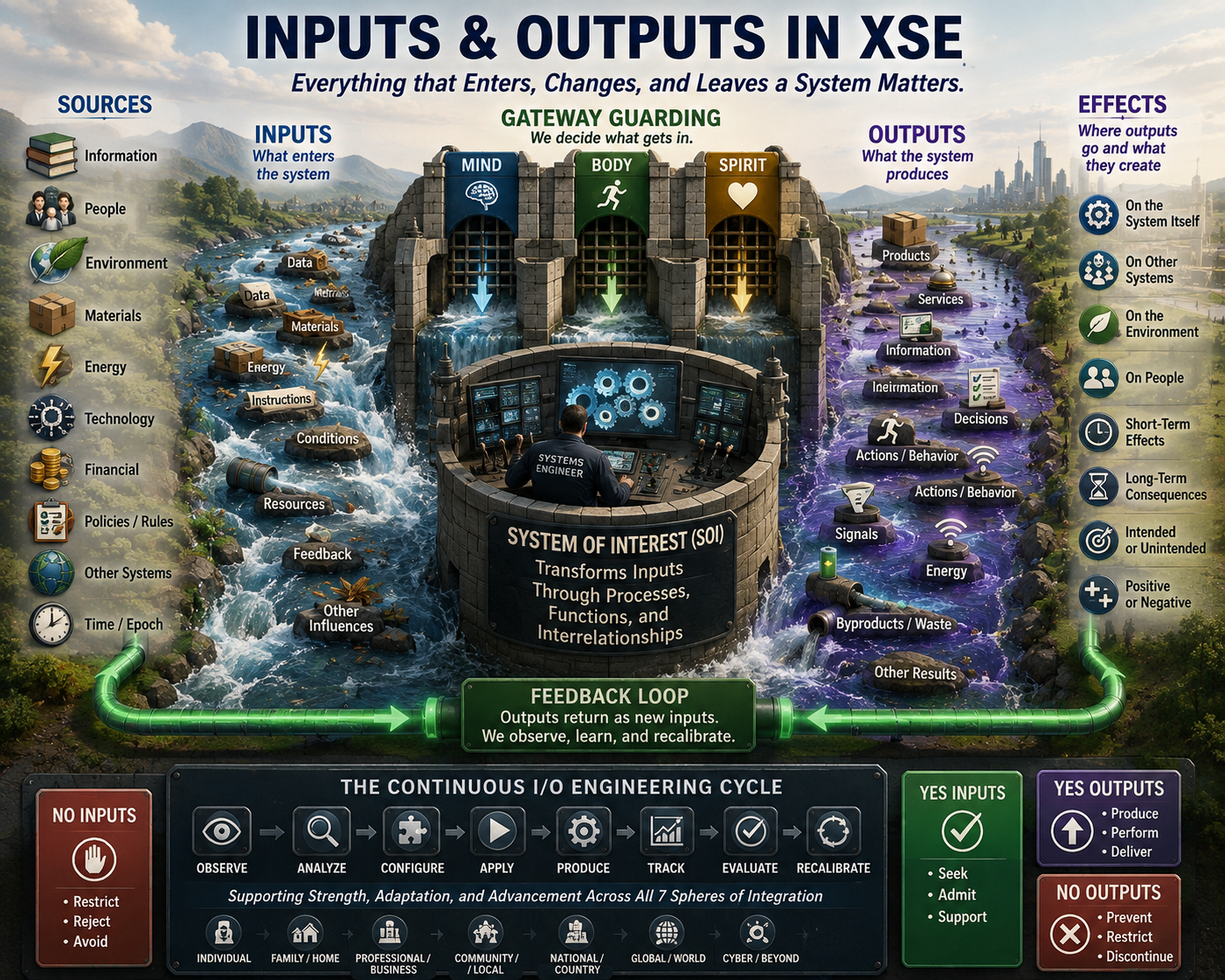
What difference do outputs make?
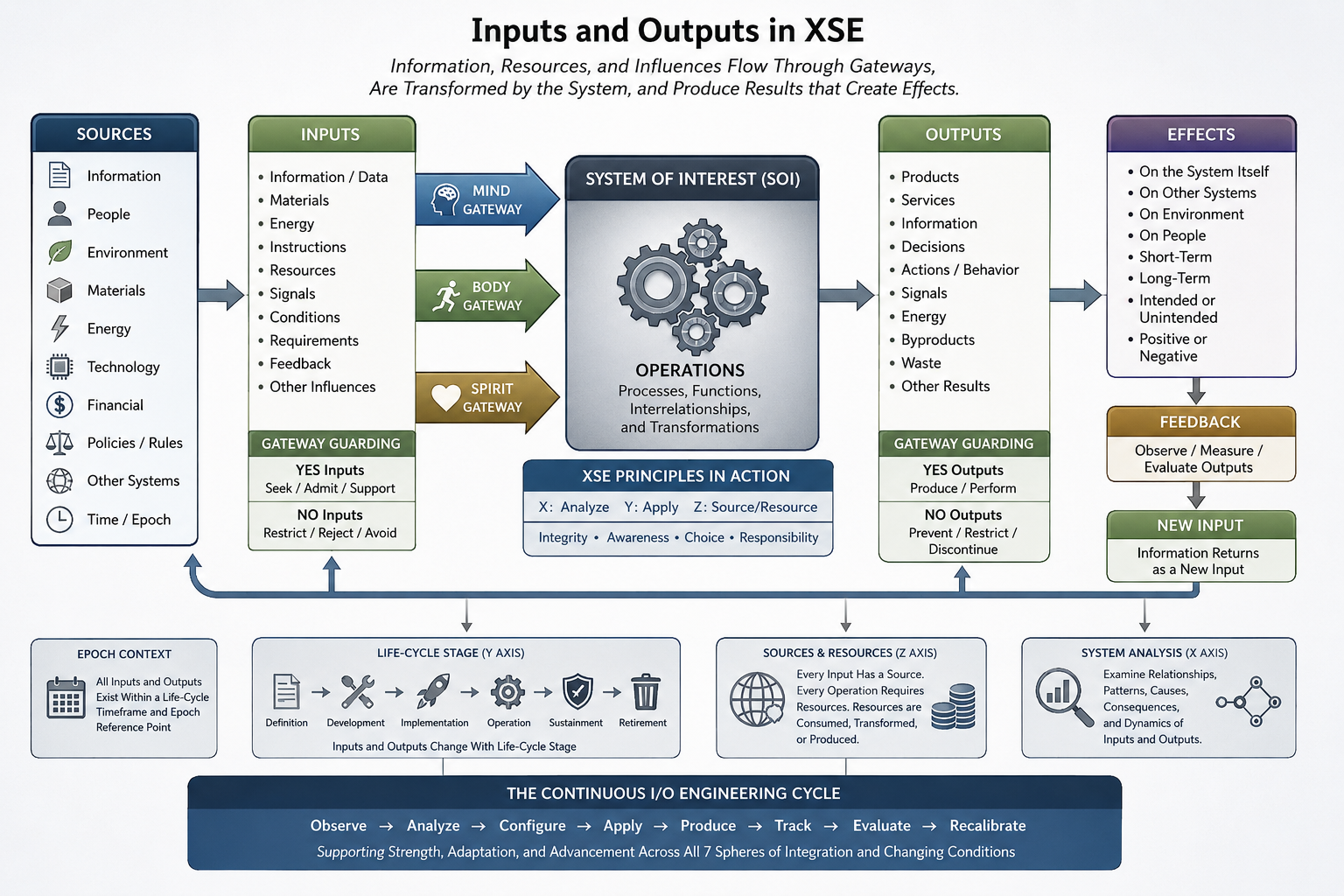
Within Independent Integration Systems Engineering (XSE), Inputs and Outputs (I/O) are fundamental to understanding how a System of Interest (SOI) interacts with itself, other systems, and its environment.
An Input is something that enters, is received by, acts upon, or is introduced into a system or subsystem and may influence its state, operation, capability, behavior, or subsequent Outputs.
An Output is something that leaves, is produced by, expressed from, transferred by, or results from the operation of a system or subsystem and may influence the system itself, another system, or the surrounding environment.
At the simplest level:
Input → System → Output
However, XSE treats this relationship as dynamic rather than merely linear. Outputs can become new Inputs, feedback can modify subsequent operation, systems interact with other systems, and the effects of an Input may unfold across multiple time horizons and life-cycle-defined Epochs.
A more complete representation is:
Source → Input → Gateway → System Operation → Output → Effect → Feedback → New Input → Recalibration
Understanding these relationships helps the Systems Engineer examine what is entering the system, what the system is doing with it, what the system is producing, and what those Outputs are progressively creating.
What Is an Input?
An Input is anything entering or acting upon the SOI that becomes relevant to its operation or condition.
Depending upon the system, Inputs may include:
- information and data;
- materials;
- energy;
- Resources;
- instructions;
- signals;
- environmental conditions;
- technology;
- components;
- financial resources;
- services;
- communications;
- requirements;
- feedback;
- actions of other systems;
- or other Forces and influences affecting system operation.
An Input does not have to be a physical object.
A temperature change can be an Input to a mechanical system. Data can be an Input to software. A requirement can become an Input to an engineering process. Information can become an Input to human analysis.
The appropriate definition therefore depends upon the system boundary and SOI being analyzed.
What Is an Output?
An Output is something produced, transmitted, expressed, discharged, transferred, or otherwise resulting from system operation.
Depending upon the SOI, Outputs may include:
- products;
- services;
- information;
- decisions;
- actions;
- behaviors;
- signals;
- energy;
- waste;
- communications;
- system states;
- environmental effects;
- completed work;
- errors;
- byproducts;
- or other results of system operation.
Outputs may be intended or unintended, beneficial or detrimental, expected or unexpected.
This distinction is important within XSE because:
What a system intends to produce and what it actually produces are not necessarily the same.
Actual Outputs provide evidence about how the system is really operating.
Inputs and Outputs Depend Upon the System Boundary
Something is not inherently an Input or Output in isolation. Its classification depends upon where the system boundary is drawn.
For one system:
A = Output
while for another:
A = Input
For example, information produced by one subsystem may become an Input to another subsystem.
Thus:
System A → Output → Input → System B
Likewise, an Output may leave a system, interact with the environment, and later return as a new Input.
This is one reason clearly defining the SOI and its boundaries is essential before evaluating Inputs and Outputs.
Inputs, Outputs, and the Human System
When the human person is the SOI, XSE considers Inputs and Outputs in relation to the integrated Mind, Body, and Spirit.
The person continually encounters information, physical conditions, relationships, environments, Resources, technologies, experiences, responsibilities, opportunities, and other influences.
Likewise, the person continually generates Outputs through decisions, communications, actions, behaviors, work, interactions, and other forms of participation within surrounding systems.
XSE therefore does not conceptualize the human as an isolated system.
The human is simultaneously an independent integrated system and a participant within progressively larger systems.
This creates continuous exchanges:
Environment → Human Inputs
Human → Environmental Outputs
Other People → Human Inputs
Human → Outputs Affecting Other People
Human Output → Consequence → Feedback → New Human Input
These relationships can extend outward through XSE’s 7 Spheres of Integration.
The Three Gateways
XSE’s Mind Gateway, Body Gateway, and Spirit Gateway provide interfaces through which relevant Inputs and Outputs can be examined when the human person is involved in the system.
Mind Gateway
The Mind Gateway concerns information and other influences entering or leaving through cognitive and informational processes.
Potential Inputs might include information, education, observations, communications, media, instructions, evidence, ideas, or feedback.
Potential Outputs might include reasoning, decisions, communications, plans, created information, and other expressions arising through mental operation.
Body Gateway
The Body Gateway concerns physical interaction between the human system and its environment.
Potential Inputs can include food, water, physical environments, loads, sensory conditions, equipment, movement demands, rest opportunities, and other physical interactions.
Potential Outputs can include physical actions, movement, work, energy expenditure, interaction with objects or environments, and other observable bodily activity.
Spirit Gateway
Within XSE’s framework, the Spirit Gateway concerns relevant Inputs and Outputs associated with the spiritual and volitional dimension of the human person, including matters involving character, principles, purpose, commitment, responsibility, and the exercise of Freedom and self-command.
These categories are analytical constructs within XSE and should not be interpreted as medical or psychological classifications.
Gateway Guarding
The existence of Inputs creates an important systems-engineering question:
Should every available Input be admitted into the system?
Clearly, the answer for most engineered systems is no.
Systems commonly employ filters, interfaces, permissions, specifications, tolerances, barriers, quality controls, authentication, and other mechanisms to regulate what enters and leaves them.
XSE applies a related principle through Gateway Guarding.
Gateway Guarding establishes four basic operational specifications:
YES Inputs — What should be deliberately sought, admitted, or supported?
NO Inputs — What should be restricted, rejected, avoided, or otherwise prevented from entering where appropriate?
YES Outputs — What should the system deliberately produce or perform?
NO Outputs — What should the system deliberately restrict, discontinue, or prevent itself from producing?
This creates the basic structure:
| Input | Output | |
|---|---|---|
| YES | Seek / Admit | Produce / Perform |
| NO | Restrict / Reject | Prevent / Discontinue |
These specifications should not be arbitrary. They are engineered in relation to Current Reality, Desired Results, CREATE Goals, Integrity, requirements, Sources, Resources, constraints, system effects, and available evidence.
Inputs Are Not Automatically Good or Bad
XSE should avoid categorizing every Input as universally strengthening or weakening.
The effect of an Input depends upon factors such as:
SOI + Source + Quantity + Quality + Timing + Duration + Gateway + Configuration + Environment + Life-Cycle Stage + Interaction with Other Inputs
An Input that is useful in one system may be inappropriate in another.
Likewise, an Input that strengthens a system at one quantity or operating condition may weaken it under another.
The Systems Engineer therefore asks not merely:
Is this Input good?
but:
What does this Input do within this particular system, under these particular conditions, in relation to the intended Results?
Sources Are Not the Same as Inputs
The distinction between a Source and an Input is especially important within XESAS.
A Source concerns the origin from which something comes.
An Input is what actually enters or acts upon the system.
Thus:
Source → Produces/Supplies → Input → Enters SOI
For example, a database may be the Source, while particular information obtained from it becomes the Input used in analysis.
A supplier may be the Source, while a component supplied to the system becomes an Input or Resource, depending upon the analytical context.
This relationship directly connects Inputs with the Z Axiom and Z Axis:
Where did this Input come from, and how authentic, reliable, appropriate, and ultimate is its Source?
Resources Are Not Necessarily Inputs
Similarly, a Resource is not automatically an Input.
A Resource may be available to the system without presently entering a particular process.
For example:
Available Resource → Selected for Use → Applied as Input → System Operation
Resources therefore concern available capability or utility, while Inputs concern what is actually introduced into or acting upon the system within the particular analysis.
This distinction helps prevent XESAS from collapsing Sources, Resources, and Inputs into a single category.
Inputs and the X Axiom
The X Axiom—“Using critical & creative thinking augments intelligence”— is highly relevant to Inputs because the quality of analysis depends partly upon the information entering the analytical process.
Critical thinking can help evaluate:
- authenticity;
- relevance;
- assumptions;
- evidence;
- limitations;
- inconsistencies;
- bias;
- context;
- alternative interpretations.
Creative thinking can expand the analytical field by identifying additional Inputs, relationships, alternatives, explanations, and possible configurations that may otherwise remain unseen.
Thus:
Inputs → Critical & Creative Analysis → Improved System Understanding
However, strong analytical technique cannot guarantee correct conclusions when critical information is absent or materially false. This is one reason the X and Z dimensions operate synergistically.
Inputs, Outputs, and the Y Axiom
The Y Axiom—“The application of optimal choices enhances strength”— brings Inputs and Outputs into actual system operation.
An optimal choice may involve deliberately:
admitting an Input;
rejecting an Input;
acquiring a Resource;
changing an Input;
producing an Output;
preventing an Output;
or modifying how the system transforms Inputs into Outputs.
This creates an operational relationship:
Analysis → Choice → Application → Input/System Configuration → Operation → Output
The resulting Output then provides evidence concerning whether the choice actually produced its intended effect.
Outputs as Evidence of Current Reality
Outputs are particularly valuable because they reveal something about actual system operation.
Intentions describe what the system meant to do.
Plans describe what the system expected to do.
Requirements describe what the system should do.
Outputs help reveal what the system actually did.
Accordingly:
Intended Output ≠ Actual Output
Where meaningful and measurable, comparison between the two can reveal:
Alignment | Deviation | Error | Progress | Deterioration | Unexpected Effects | Emerging Conditions
This makes Outputs important to Target Tracking and feedback-based recalibration.
Feedback: When Outputs Become Inputs
One of the most important I/O relationships occurs when information about an Output returns to the system as a new Input.
This is feedback.
Conceptually:
Input → System → Output
↓
Observe Output
↓
Feedback Input
↓
Analyze
↓
Recalibrate System
↓
New Output
This creates the basis for adaptive regulation.
A system that cannot observe relevant Outputs may continue operating under the assumption that its configuration is working even when actual results differ substantially from intended Results.
XSE therefore uses feedback to compare what was intended with what actually occurred.
Feedback Loops and Derived Dynamics
Outputs can also become Inputs in ways that create reinforcing or balancing system dynamics.
For example:
Strengthening Input → Improved Capability → Better Output → Positive Feedback → Additional Resources → Further Capability
may create a reinforcing advancement dynamic.
Conversely:
Weakening Input → Reduced Capability → Poorer Output → Resource Loss → Reduced Ability to Correct → Further Weakening
may contribute to a reinforcing Fallout dynamic.
Other feedback mechanisms may counteract change and stabilize the system.
The important XSE principle is that:
An Output should not always be treated as the end of a process. It may become the beginning of the next system interaction.
This is one way Inputs and Outputs contribute to XSE’s Derived Dynamics.
Cascading Inputs and Outputs
Because systems contain subsystems and exist within larger systems, a single Output can propagate across multiple system boundaries.
Conceptually:
System A Output → System B Input
↓
System B Output → System C Input
↓
System C Output → Environmental Effect
↓
Environmental Change → New Input to System A
This is particularly important when examining XSE’s 7 Spheres of Integration.
An Output originating with an individual may influence the Family/Home sphere, Professional/Business sphere, Community/Local sphere, or potentially broader systems.
Likewise, Outputs generated by larger systems can become powerful Inputs affecting individuals.
This is why XSE examines integration rather than isolated optimization.
Immediate and Delayed Outputs
Not every Output or consequence appears immediately.
An Input may produce:
Immediate Outputs — effects observable during or shortly after application.
Intermediate Outputs — effects that emerge after repeated operation or interaction.
Long-Range Outputs — effects that become apparent only across later life-cycle conditions or Epochs.
This distinction is important because an Input that produces a desirable immediate Output may contribute to an undesirable longer-range condition—or vice versa.
XSE therefore considers both Current Reality and Trajectory.
The Systems Engineer asks:
What is this producing now?
and:
If this Input–Output pattern continues, what is it progressively likely to produce?
Intended, Unintended, and Emergent Outputs
Outputs can also be classified according to their relationship with system intent.
Intended Outputs
Results deliberately engineered or expected from system operation.
Unintended Outputs
Results that occur but were not deliberately sought.
Emergent Outputs
Results arising from interactions among system elements that may not be attributable to any single component or original design intention.
Complex systems can produce significant emergent effects.
For this reason, XSE does not assume that specifying desirable Inputs and Outputs guarantees the Desired Result.
Actual operation must be observed.
Inputs, Outputs, and Entropy
Inputs are also relevant to XSE’s treatment of entropy and system deterioration.
Many systems require continuing Inputs simply to maintain existing capability.
Maintenance, energy, information, Resources, replacement components, corrective action, learning, adaptation, and other sustaining Inputs may be necessary to counter degrading influences.
Therefore:
No New Strengthening Input ≠ No System Change
A system deprived of necessary sustaining Inputs may progressively deteriorate even though no obviously harmful Input has been introduced.
Conceptually:
Insufficient Sustaining Inputs + Entropic/Degrading Influences → Loss of Capability → Changed Outputs → Deteriorating Trajectory
This is one reason Build Strength includes both developing new Strength and preserving Strength already achieved.
Inputs and Outputs Across Luxxacation
Inputs and Outputs operate throughout all three Elements of Luxxacation.
Take Time
During Take Time, the Systems Engineer examines:
What Inputs are presently entering the system?
What Outputs is it actually producing?
Which recurring I/O patterns are influencing Current Reality and Trajectory?
Which should be preserved, modified, introduced, restricted, or eliminated?
These findings help establish Desired Results, CREATE Goals, Gateway Guarding specifications, Primary Targets, and Target Tracking configurations.
Build Strength
During Build Strength, the engineered configuration enters actual operation.
YES Inputs are deliberately sought where appropriate.
NO Inputs are guarded against.
YES Outputs are deliberately produced.
NO Outputs are restricted.
Resources are applied, choices are implemented, and the system begins producing actual operational evidence.
Rise Above
During Rise Above, reality may differ from the engineered plan.
Unexpected Inputs appear.
Resources change.
Outputs deviate.
Environmental conditions shift.
Feedback reveals new information.
The Systems Engineer therefore uses awareness, feedback, adaptation, and recalibration to maintain or redirect the course without assuming that the original configuration will remain optimal indefinitely.
Thus:
Take Time → Engineer I/O
Build Strength → Operate I/O
Rise Above → Adapt I/O from Feedback and Changing Reality
Inputs and Outputs Within XESAS
Inputs and Outputs interact with all three XESAS coordinate dimensions.
X — System Analysis
What Inputs and Outputs exist? What relationships, patterns, causes, consequences, and feedback dynamics can be identified?
Y — System Life-Cycle Stage
How are actual Inputs and Outputs affecting system Strength, capability, condition, Trajectory, deterioration, recovery, or advancement?
Z — Sources and Resources
Where are Inputs coming from? What Sources produce them? What Resources enable them? What Resources are consumed or produced through system operation?
This produces a multidimensional I/O analysis:
Z: Source/Resource
↓
Input
↓
X: Analysis and System Processing
↓
Y: Application / Operation / Life-Cycle Effect
↓
Output
↓
Feedback
↓
Updated X–Y–Z Conditions
The actual relationship is recursive and multidirectional rather than strictly linear.
Input and Output Optimization Is Not Isolated Optimization
XSE should not attempt to maximize or minimize a particular Input or Output without considering the larger system.
More is not always better.
Less is not always better.
Efficiency alone is not necessarily optimal.
A system can optimize one Output while unintentionally weakening another subsystem or transferring costs into another Sphere of Integration.
Accordingly, XSE evaluates Inputs and Outputs in relation to:
Current Reality
Desired Results
Integrity
System requirements
Mind, Body, and Spirit where humans are involved
Sources and Resources
Constraints
Life-cycle stage
Short- and long-range consequences
Other systems and Spheres of Integration
Actual feedback
This preserves XSE’s whole-system orientation.
Inputs and Outputs as a Continuous Engineering Function
Inputs and Outputs should not be configured once and then assumed to remain optimal.
Systems change.
Environments change.
Sources change.
Resources change.
Requirements change.
Life-cycle conditions change.
Feedback reveals information that was unavailable during initial planning.
An Input that was appropriate during one Epoch may become unnecessary or detrimental during another. An Output that once represented success may become insufficient as requirements evolve.
XSE therefore treats I/O regulation as a continuous systems-engineering function:
Observe → Analyze → Configure → Apply → Produce → Track → Evaluate → Recalibrate
This process allows actual system operation to continually inform subsequent engineering.
The Central XSE I/O Principle
At its core, Inputs and Outputs connect Current Reality, Gateway Guarding, application of choice, feedback, and Trajectory.
The Systems Engineer does not merely ask:
What do I want the system to accomplish?
XSE also asks:
What must enter the system for that Result to become possible?
What should not enter because it could interfere with that Result?
What must the system actually produce?
What Outputs must be prevented or reduced?
Where are those Inputs coming from?
What Resources are required to transform them?
What is the system actually producing in operation?
What do those Outputs become when they enter other systems?
What does the resulting feedback reveal about Current Reality and Trajectory?
This turns Inputs and Outputs from simple system-flow terminology into a central mechanism of Independent Integration.
Within XSE, Inputs are what enter or act upon the System of Interest, while Outputs are what the system produces, expresses, transfers, or causes through its operation. Through Gateways, Sources and Resources, technical application of choice, feedback, and repeated system interaction, Outputs may become subsequent Inputs and generate larger system dynamics. XSE therefore seeks to deliberately engineer and continuously evaluate Inputs and Outputs according to Current Reality, Integrity, Desired Results, system requirements, life-cycle condition, and actual feedback—supporting the development, preservation, adaptation, and responsible application of system Strength across changing conditions and Epochs.
From the Individual to the Larger System—& Back Again

When the human person is the System of Interest (SOI), Inputs and Outputs do not occur in isolation.
A person continually receives Inputs from surrounding systems, processes those Inputs through the integrated Mind, Body, and Spirit, and generates Outputs through communication, choices, actions, behaviors, work, relationships, creation, participation, and other forms of interaction.
Those Outputs can then become Inputs to other people and systems.
This creates one of the fundamental dynamics of human integration within XSE:
Input → Person → Output → Other System → Effect → Subsequent Output → New Input to the Person
The process may continue through multiple systems, creating feedback loops and effects extending far beyond the original interaction.
The Person as Both Receiver and Producer
Every person operates simultaneously as a receiver of Inputs and producer of Outputs.
Inputs may include information, communication, environmental conditions, Resources, opportunities, requirements, technologies, interpersonal interactions, physical conditions, and other influences.
The person then interprets, responds to, transforms, rejects, accepts, or otherwise interacts with those Inputs.
What follows becomes part of the person’s Output into the surrounding world.
For example:
Information Received → Analysis → Decision → Communication → Effect on Another Person
or:
Environmental Condition → Human Response → Action → Change to Environment
or:
Another Person’s Output → Human Input → Response → New Output → Input Back to the Other Person
The human person is therefore not simply acted upon by the surrounding system. The person also acts back upon it.
Outputs Can Travel Through the 7 Spheres of Integration
XSE’s 7 Spheres of Integration provide a useful architecture for understanding how human Outputs can extend beyond the individual.
1. Individual
Outputs first affect the individual system itself.
Choices and actions can alter the person’s own Resources, capabilities, habits, knowledge, responsibilities, environment, subsequent options, and Current Reality.
An Output can therefore become an internal or future Input to the same person.
2. Family / Home
Communication, decisions, responsibilities, work, resource use, organization, cooperation, conflict, care, and other Outputs can affect people and conditions within the home.
Those people and conditions subsequently generate their own Outputs, some of which return to the individual.
3. Professional / Business
A person’s work, decisions, reliability, communication, products, services, leadership, cooperation, errors, innovations, and other Outputs may influence coworkers, customers, organizations, and interconnected systems.
Those systems can respond with additional Outputs such as opportunities, requirements, compensation, feedback, trust, restrictions, responsibilities, or changed working conditions.
4. Community / Local
Individual Outputs may contribute to schools, neighborhoods, organizations, businesses, institutions, public spaces, and other community systems.
Many individual Outputs interacting together can contribute to larger emergent system conditions that no single person independently created.
5. National / Country
Economic participation, professional work, civic activity, technological use, communications, compliance with legitimate requirements, production, consumption, and countless other individual Outputs interact with larger national systems.
The individual’s contribution may be extremely small relative to the entire system, but it remains part of the larger network of system interaction.
6. Global / World
Modern transportation, commerce, communications, supply chains, environmental systems, technology, and international relationships allow some Outputs to cross national boundaries.
Products, ideas, information, innovations, financial activity, communications, and other Outputs can become Inputs to systems far removed from the person who originally produced them.
7. Cyber / Beyond
Digital systems can dramatically alter the range, speed, persistence, replicability, and scale of human Outputs.
A statement made in one physical location can become an Input to thousands or millions of other systems. Software, data, digital media, artificial intelligence, and interconnected technologies can amplify or transform Outputs in ways that would not be possible through immediate physical interaction alone.
Thus, an Output originating with one individual may potentially travel:
Individual → Home → Professional → Community → National → Global → Cyber/Beyond
However, XSE should not assume that every Output travels through every Sphere or produces a significant effect. Magnitude, connectivity, repetition, system architecture, other actors, environmental conditions, and countless additional Factors determine how far an Output actually propagates.
The Ripple Effect Is a Systems Effect
What is sometimes described informally as a “ripple effect” can be understood more precisely within XSE as a sequence of interconnected Inputs, Outputs, transformations, and feedback.
For example:
Person A Output
↓
Becomes Person B Input
↓
Person B Processes the Input
↓
Person B Produces an Output
↓
That Output Becomes an Input to Persons C and D
↓
Additional Outputs and System Effects Develop
The original person does not control this entire chain.
Once an Output enters another independent system, that system processes it according to its own configuration, Current Reality, Sources, Resources, constraints, choices, and surrounding conditions.
Consequently:
An individual can influence a larger system without controlling the larger system.
This distinction is important within XSE.
Outputs Can Come Back Around as Inputs
The effects of a person’s Outputs may also eventually return to that person.
This does not require assuming a universal “law of reciprocity” or that every action inevitably receives an equivalent response.
It is simply a common property of interconnected systems and feedback loops.
For example:
Communication → Another Person’s Interpretation → Their Response → New Input to Original Person
or:
Work Output → Organizational Effect → Performance Feedback → New Opportunities or Requirements → Input to Individual
or:
Repeated Behavior → Effect on Relationship → Changed Relationship Conditions → New Inputs Experienced by the Person
Thus:
Your Output → Their Input → Their Operation → Their Output → Your New Input
The returning Input may resemble the original Output—or it may be substantially transformed.
Reciprocal Effects Are Not Guaranteed to Be Equal
XSE should be careful not to imply:
Positive Output → Positive Return
or:
Negative Output → Negative Return
as an automatic law.
Complex systems do not operate that simply.
A constructive Output may be misunderstood, ignored, opposed, or produce an unintended consequence. A detrimental Output may sometimes appear to produce an immediate advantage. Effects may be delayed, amplified, diminished, redirected, or absorbed by other parts of the system.
Therefore:
Output ≠ Guaranteed Equivalent Return
A more accurate relationship is:
Output → System Interaction → Effects → Additional System Processing → Possible Feedback to Original System
This keeps the model grounded in Current Reality rather than assumed reciprocity.
Outputs Can Change the Environment That Produces Future Inputs
There is an even deeper systems relationship.
Human Outputs do not merely produce isolated responses. Repeated Outputs can sometimes modify the surrounding system itself.
For example, repeated patterns of communication may influence relationship conditions. Repeated work Outputs can affect organizational processes. Repeated community behaviors can influence local conditions. Repeated digital Outputs can contribute to information environments.
This creates:
Person → Outputs → Environment Changes → Changed Environment → New Inputs to Person
The person may therefore eventually operate within conditions that were partially influenced by previous Outputs from themselves and many other interacting systems.
This is a true feedback relationship.
Reinforcing Human Feedback Loops
Under some conditions, Inputs and Outputs can create reinforcing feedback loops.
A strengthening example might conceptually appear as:
Useful Input → Better Understanding → Constructive Choice → Constructive Output → Improved System Interaction → Better Feedback/Resources → New Useful Inputs
A weakening loop might appear as:
Poor Input → Faulty Interpretation → Weakening Choice → Detrimental Output → System Conflict or Resource Loss → More Difficult Inputs → Further Weakening
Neither progression is inevitable.
The purpose of identifying the loop is precisely to create an opportunity for the Systems Engineer to interrupt, strengthen, redirect, or otherwise recalibrate it.
The Importance of Gateway Guarding
This recursive relationship gives Gateway Guarding particular significance.
The person cannot control every Input encountered or every Output produced by surrounding systems. However, where meaningful choice exists, the person may be able to influence:
what Inputs are deliberately sought;
what Inputs are admitted or given continuing access;
what Inputs are restricted;
how Inputs are analyzed before acting upon them;
what Outputs are deliberately produced;
what Outputs are restrained or discontinued;
and how feedback is incorporated into subsequent choices.
The Gateway Guarding structure therefore becomes:
YES Inputs → What should I deliberately seek or admit?
NO Inputs → What should I appropriately restrict or refuse?
YES Outputs → What should I deliberately produce or contribute?
NO Outputs → What should I prevent or discontinue producing?
These decisions help configure the person’s participation within larger systems.
Outputs and Independent Integration
This relationship is particularly important to Independent Integration.
XSE begins with the integrity and integration of the individual, but it does not end there.
A person’s internal system condition affects the Outputs they contribute to surrounding systems, while surrounding systems continually provide Inputs that influence the individual.
Thus:
Independent Integration
↓
Individual System Operation
↓
Human Outputs
↓
Integration with Other Systems
↓
Larger System Effects
↓
Feedback / Returning Inputs
↓
Individual Reassessment and Recalibration
The quality of larger systems therefore cannot be reduced entirely to individual behavior, but neither is the individual’s contribution irrelevant.
The individual remains one interacting system among many.
Responsibility Without Assuming Control
This creates an important XSE distinction between responsibility and control.
A person can take responsibility for Outputs within their meaningful scope of choice without assuming responsibility for every downstream consequence generated by other independent systems.
Likewise, a person can seek to influence surrounding systems constructively without pretending to control them.
The Systems Engineer can therefore ask:
What Inputs am I allowing to influence my system?
What Outputs am I contributing to other systems?
What effects are actually occurring?
Which effects are within my influence, and which are not?
What Outputs from other systems are returning to me as Inputs?
What feedback loops am I participating in?
Which loops should be strengthened, interrupted, guarded against, or recalibrated?
This is more precise than simply attempting to “put positivity into the world.” It is the deliberate examination of human participation within interconnected systems.
From Individual Output to Global Integration
The larger XSE relationship can be represented as:
Mind + Body + Spirit
↓
Human System Operation
↓
Choices and Actions
↓
Outputs
↓
Other People and Systems Receive Those Outputs as Inputs
↓
Family / Home → Professional / Business → Community / Local → National / Country → Global / World → Cyber / Beyond
↓
Secondary Outputs and Emergent Effects
↓
Feedback Through the Larger System
↓
New Inputs Return to the Individual
↓
Observe → Analyze → Choose → Apply → Recalibrate
The system is therefore neither purely inside-out nor purely outside-in.
It is recursive.
Within XSE, the human person continually receives Inputs from larger systems while simultaneously producing Outputs that become Inputs to those systems. Those Outputs can propagate across the 7 Spheres of Integration, interact with other people and systems, generate intended, unintended, and emergent effects, and sometimes return to the individual as new Inputs and feedback. Independent Integration therefore involves not only guarding what enters the human system, but also deliberately considering what the person contributes back into the systems of which they are a part.
Reciprocal Effects in Human Systems

Within XSE, a person’s Outputs can become Inputs to other people and systems. Those systems subsequently process those Inputs and generate Outputs of their own, some of which may eventually return to the original person as new Inputs, environmental conditions, opportunities, constraints, or feedback.
This relationship can be represented simply as:
Person A Output → Person B Input → Person B Processing → Person B Output → Person A and/or Other Systems
In larger systems, the relationship can become considerably more complex:
Individual Output → Other People/Systems → Subsequent Outputs → Wider System Effects → Changed Environment → New Inputs and Feedback
XSE does not propose that this operates as a universal law of reciprocity in which constructive actions necessarily produce equivalent constructive returns or harmful actions necessarily produce equivalent harmful returns. Complex human systems contain independent actors, competing Inputs, environmental conditions, delays, uncertainty, and emergent effects.
Rather, research from several areas of psychology, behavioral economics, evolutionary theory, and social-network research demonstrates that reciprocal and cascading interactions are genuine features of human systems.
Reciprocal Interaction Between the Person, Behavior, and Environment
Albert Bandura’s work on reciprocal determinism provides an important research parallel to the XSE Input–Output framework.
Bandura described human functioning in terms of continuing reciprocal interaction among behavioral, cognitive/personal, and environmental influences. Rather than treating people as merely responding to their environments, this model recognizes that people can also act upon and modify environments that subsequently influence them.
Bandura (1978), “The Self System in Reciprocal Determinism” — American Psychologist
From an XSE perspective, this provides a useful research parallel for:
Environmental Input → Human Processing → Human Output → Environmental Change → New Human Input
XSE extends its own analysis beyond this particular psychological model by examining Inputs and Outputs across the Mind, Body, and Spirit Gateways, system boundaries, Sources and Resources, feedback, and the 7 Spheres of Integration.
Human Behavior Can Be Reciprocal
Behavioral research also demonstrates that people frequently respond to the actions of others in ways influenced by what they previously received.
Cox and Deck examined reciprocal behavior across experimental two-person games and found evidence concerning both positive and negative reciprocity, while also demonstrating the importance of social and decision context.
Cox & Deck (2005), “On the Nature of Reciprocal Motives” — Economic Inquiry
This distinction is important for XSE.
The research does not justify a simplistic equation such as:
Constructive Output = Constructive Output Returned
Instead, it supports a more defensible systems relationship:
Output → Received and Interpreted by Another System → Context-Dependent Response
The recipient remains an independent system. How that person responds depends upon numerous additional Factors.
Cooperation Can Cascade Beyond the Original Interaction
Some human Outputs may influence not only their immediate recipients but also subsequent interactions involving other people.
Fowler and Christakis experimentally studied cooperative behavior in public-goods games and found that cooperative behavior could spread through subsequent interactions. In their experimental network, effects were detected across multiple interactions and up to three degrees of separation.
Fowler & Christakis (2010), “Cooperative Behavior Cascades in Human Social Networks” — Proceedings of the National Academy of Sciences
This provides a particularly useful research parallel to XSE’s concept of cascading Inputs and Outputs:
Person A Output
↓
Person B Input
↓
Person B Subsequent Output
↓
Person C Input
↓
Additional System Effects
An Output therefore does not necessarily terminate with its immediate recipient. Under some conditions, its effects can propagate through subsequent system interactions.
This concept is relevant to XSE’s 7 Spheres of Integration, although the research itself should not be presented as validation of XSE’s particular seven-sphere architecture.
Direct and Indirect Reciprocity
Robert Trivers’s foundational work on reciprocal altruism examined evolutionary conditions under which behavior benefiting another individual could persist when opportunities for reciprocal interaction exist.
Trivers (1971), “The Evolution of Reciprocal Altruism” — The Quarterly Review of Biology
Later research by Martin Nowak and Karl Sigmund examined indirect reciprocity, in which the consequences of one’s behavior need not return directly from the original recipient. Reputation and information about previous behavior can influence how other members of a social system subsequently interact with an individual.
Nowak & Sigmund (2005), “Evolution of Indirect Reciprocity” — Nature
This distinction is especially useful for XSE because feedback does not necessarily follow the simple path:
A → B → A
It may instead follow:
A → B → C → Other Systems → Changed Conditions → A
An individual’s Outputs may therefore contribute to conditions that eventually affect that individual without the effect being a direct repayment from the original recipient.
Outputs Can Help Modify Future Inputs
Taken together, these research traditions support a broader systems observation: people do not merely receive conditions from their environments; their behavior can also contribute to the conditions that they and others subsequently encounter.
Within XSE:
Inputs → Human System → Choices and Outputs → Effects on Other Systems → Responses, Cascades, and Environmental Changes → New Inputs and Feedback
This creates a recursive rather than purely linear relationship.
Repeated Outputs may contribute to changes in relationships, expectations, reputation, cooperation, conflict, available Resources, and other environmental conditions. Those changed conditions may subsequently become Inputs affecting future system operation.
Reciprocity Is Not Guaranteed
These findings should not be interpreted to mean that every Output will return to its producer or that reciprocal effects will be equal, immediate, predictable, or morally proportionate.
Complex human systems contain independent decision-makers, competing Inputs and Outputs, delays, nonlinear effects, unequal influence, uncertainty, Sources and Resources, unintended consequences, and emergent behavior.
Consequently:
Constructive Output ≠ Guaranteed Constructive Return
Detrimental Output ≠ Guaranteed Equivalent Detrimental Return
A more accurate XSE representation is:
Output → System Interaction → Transformation → Additional Outputs and Effects → Possible Direct or Indirect Feedback
Some Outputs may have little detectable downstream effect. Others may be amplified, diminished, redirected, delayed, misunderstood, or transformed through subsequent system interactions.
This is precisely why XSE emphasizes feedback and observation of Current Reality rather than assuming the effects of an Output in advance.
XSE Interpretation: What You Put Into Systems Matters
These studies do not independently establish XSE or prove its axiomatic framework. Rather, they provide established research relevant to mechanisms that XSE examines from its own systems-engineering perspective: reciprocal interaction, environmental feedback, behavioral reciprocity, indirect reciprocity, and cascading social effects.
Within XSE, these mechanisms help explain why Independent Integration cannot be concerned only with what a person receives from surrounding systems. It must also consider what the person contributes to them.
The Systems Engineer can therefore ask:
What Inputs are entering my system?
How am I processing those Inputs?
What Outputs am I producing?
What effects are those Outputs actually having on other systems?
What feedback is returning?
What patterns are developing over repeated interactions?
What should be preserved, strengthened, interrupted, or recalibrated?
This creates an important relationship between Gateway Guarding and the larger Spheres of Integration:
Guard Inputs → Engineer Outputs → Observe Effects → Receive Feedback → Analyze Current Reality → Recalibrate
The objective is not to engineer other people or assume control over complex social outcomes. It is to become more aware of one’s own participation within interconnected systems and to recognize that human beings continually function as both receivers of Inputs and producers of Outputs.
In XSE, what a person puts into a system matters because Outputs do not necessarily end with the person who produces them. They may become Inputs to other people and systems, contribute to subsequent Outputs and larger system dynamics, alter environmental conditions, and sometimes return as direct or indirect feedback. The Systems Engineer therefore considers both sides of the interface: what is entering the system and what the system is contributing back into the world.