
The 7 Advancing Assets and Positions
There are 4 Advancing Assets and 3 Advancing Positions which correlate to the first 3 Advancing Assets in XSE.
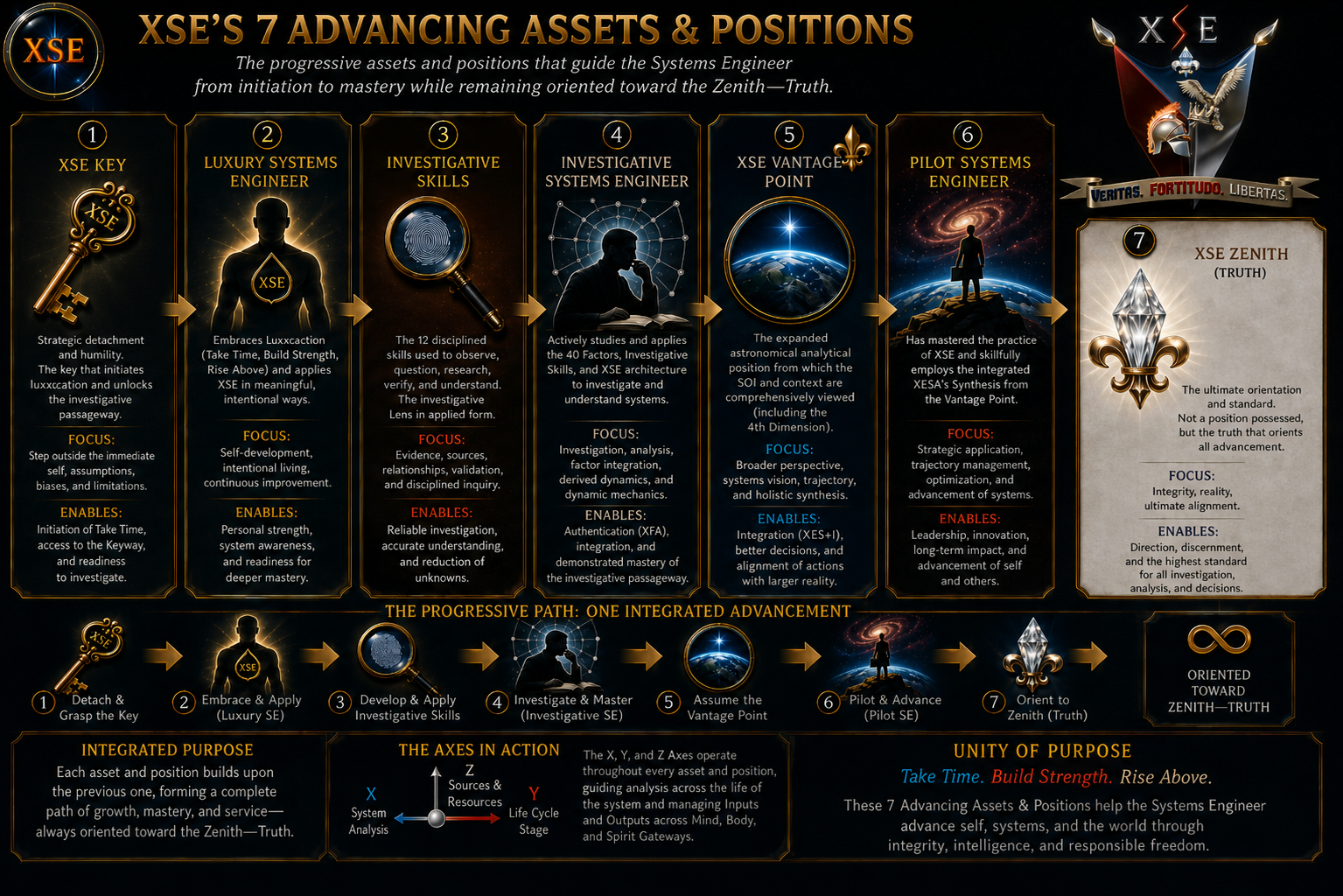
The 7 Advancing Assets & Positions of XSE
XSE’s 7 Advancing Assets & Positions form a progressive architecture consisting of four Advancing Assets and three corresponding Advancing Positions. The three Positions—Luxury Systems Engineer, Investigative Systems Engineer, and Pilot Systems Engineer—represent progressive levels of engagement with XSE, while the four Assets—XSE Key, Investigative Skills, XSE Vantage Point, and XSE Zenith—provide the symbolic capabilities, instruments, positions of perspective, and orienting reference associated with that advancement.
The first Advancing Position, Luxury Systems Engineer, is paired with the XSE Key. Grasping the Key symbolizes Strategic Detachment and humility: stepping outside oneself, the immediate moment, current biases, assumptions, attachments, and perceived limitations sufficiently to consider the system from a broader reference frame. This initiates the Torque of XSE’s accessible top-level synopsis, Luxxacation: Take Time → Build Strength → Rise Above. When deeper XSE study is pursued, the Key is subsequently applied to the XSE Keyway, unlocking entry into XSE’s 2FA investigative passageway.
The second Advancing Position, Investigative Systems Engineer, is paired with Investigative Skills, symbolized by the XSE Investigative Lens. This is XSE’s active learning and investigative position—not yet its position of mastery. The Investigative Systems Engineer develops disciplined Investigative Skills while progressing through XSE’s 2FA: the 20 Actual and 20 Analytical Factors, and then deeper into relevant Factor relationships, Derived Dynamics, and Dynamic Mechanics. The meaningful vacancy of the XSE Keyway within the Investigative Lens reinforces the humility required to recognize what remains unknown, while the Lens represents the disciplined investigation used to pursue increasingly supportable understanding. When sufficient integration and mastery of the required investigative architecture are demonstrated, the Investigative Systems Engineer graduates to the third and highest attainable XSE Position: Pilot Systems Engineer.
The Pilot Systems Engineer is paired with the XSE Vantage Point. Having completed the investigative passageway, the Pilot is positioned to integrate and skillfully employ the complete XESAS Synthesis from XSE’s broader astronomical perspective. The Vantage Point represents the clearest and most comprehensive defensible view of the SOI and its larger context that the Pilot can construct within human limitations—including consideration of the Systems Engineer, SOI, System of Context, interconnected systems, Sources and Resources, relevant Epochs and Trajectories, and appropriate established or exploratory considerations associated with the Fourth Dimension. The Vantage Point does not represent omniscience; it represents the advanced position from which the Pilot continues to investigate, integrate, evaluate, and navigate the system while remaining aware of the limits of human knowledge and perception.
The fourth Advancing Asset, the XSE Zenith, stands apart from the three paired Assets because it is not paired with a humanly attainable Advancing Position. The Zenith symbolizes Truth, represented within XSE as a diamond emitting light and embedded within the Vantage Point. Its placement communicates an essential distinction: the Pilot may become increasingly well-positioned to seek, recognize, and conform understanding to Truth, but the Pilot does not become Truth, possess exhaustive knowledge of reality, or attain an unlimited perspective. Truth remains the orienting reference against which Sources, observations, models, assumptions, analyses, and conclusions must continually be tested.
The advancement architecture can therefore be summarized as:
XSE KEY ↔ LUXURY SYSTEMS ENGINEER
Detach & Initiate — Grasp the Key and start the Torque of Luxxacation.↓
XSE KEYWAY → INVESTIGATIVE PASSAGEWAY
Engage — Apply the Key, acknowledge the vacancy, and enter deeper XSE investigation.
↓
INVESTIGATIVE SKILLS / LENS ↔ INVESTIGATIVE SYSTEMS ENGINEER
Learn & Investigate — Develop Investigative Skills; authenticate the 40 Factors through XSE’s 2FA; investigate Factor relationships, Derived Dynamics, and Dynamic Mechanics.↓
DEMONSTRATED MASTERY
↓
XSE VANTAGE POINT ↔ PILOT SYSTEMS ENGINEER
Integrate & Navigate — Employ the complete XESAS Synthesis from the broader astronomical position.↓ / THROUGHOUT
XSE ZENITH = TRUTH
Orient — Truth remains the reference toward which XSE investigation and understanding are directed; it is an Advancing Asset, not a fourth human Position.
The 4 Advancing Assets of XSE
Asset #1: The XSE Key

XSE Key
The XSE Key is the first Advancing Asset of Independent Integration Systems Engineering (XSE), paired with the first Advancing Position, the Luxury Systems Engineer. It symbolizes Strategic Detachment and humility: the capacity to metaphorically step outside oneself, the immediate situation and moment, and the influence of current assumptions, biases, attachments, preconceptions, and perceived limitations sufficiently to examine the System of Interest (SOI) from a broader reference frame.
Grasping the XSE Key initiates the Torque of Luxxacation—Take Time, Build Strength, Rise Above—providing XSE’s accessible entry point for advancement and strengthening the conditions for applying the Y Axiom: “The application of optimal choices enhances strength.” Through this process, the Key encourages perspective shifting, model updating, self-examination, adaptability, and deliberate choice without implying freedom from physical reality, emotion, uncertainty, or human limitation.
When deeper XSE study is pursued, the Key is applied to the XSE Keyway, the meaningful vacancy within the Investigative Lens, to unlock entry into XSE’s 2FA investigative passageway. There, the Investigative Systems Engineer progresses into disciplined investigation of the 20 Actual and 20 Analytical Factors, their relationships, Derived Dynamics, and Dynamic Mechanics, ultimately working toward the demonstrated mastery required to graduate to Pilot Systems Engineer and assume the XSE Vantage Point.
Asset #2: Investigative Skills

The Investigative Skills are the second Advancing Asset of Independent Integration Systems Engineering (XSE), paired with the transitional position of Investigative Systems Engineer and symbolized by the XSE Investigative Lens. They are the disciplined competencies used to pursue increasingly supportable understanding of a System of Interest through systems investigation, perceptual calibration, evidence and Source evaluation, and contextual understanding.
For purposes of XSE investigative training, these competencies are organized into 12 core areas:
- Observation & Situational Awareness — carefully observing system conditions, changes, Inputs, Outputs, interfaces, anomalies, environmental influences, and meaningful absences while distinguishing observation from interpretation.
- Investigative Questioning & Interviewing — using disciplined, non-leading inquiry to obtain, clarify, sequence, and test information while distinguishing direct knowledge, recollection, interpretation, inference, assumption, secondhand information, and uncertainty.
- Evidence Recognition & Documentation — identifying information capable of supporting or challenging conclusions and maintaining traceability between evidence, reasoning, and developing findings.
- Verification & Corroboration — testing important claims, seeking appropriate independent support, examining contradictions, and determining what would increase or decrease confidence in a conclusion.
- Source Evaluation & Research — tracing information toward original Sources and evaluating provenance, relevance, authority, context, currency, limitations, and what a Source can legitimately establish.
- Timeline & Epoch Reconstruction — reconstructing relevant conditions, events, decisions, Inputs, Outputs, feedback, and changes across time to understand how Current Reality developed.
- Hypothesis Development & Testing — generating multiple plausible explanations, identifying their expected evidence, testing competing hypotheses, and remaining willing to revise or reject them.
- Contradiction & Inconsistency Analysis — identifying and investigating conflicts among Sources, observations, timelines, Factors, expected and actual Outputs, assumptions, and developing explanations.
- Pattern, Relationship & Link Analysis — examining dependencies, interfaces, recurring sequences, feedback patterns, anomalies, and relationships among Factors while guarding against unsupported pattern recognition or causal conclusions.
- Investigative Reporting & Developing XESAS Integration — organizing findings within the developing XESAS Synthesis while clearly distinguishing established information, evidence-supported inference, working hypotheses, uncertainty, and unresolved questions.
- Bias Control & Analytical Discipline — examining the investigation itself for confirmation bias, anchoring, premature closure, selective evidence, overconfidence, attachment to preferred conclusions, and other influences that can distort understanding.
- Legal, Ethical & Scope Awareness — conducting investigation within applicable legal, ethical, privacy, authorization, safety, information-handling, and professional-scope boundaries.
These 12 competencies are not additional XSE Factors and do not create another authentication layer. Instead, they develop the investigative capability required to examine XSE’s existing architecture. Within the Investigative Lens, the XSE Keyway represents the meaningful vacancy of what remains unknown, missing, unverified, or insufficiently understood. Applying the XSE Key to the Keyway symbolically opens the deeper investigative passageway, where the Investigative Systems Engineer employs the Lens across XSE’s 2FA—the 20 Actual and 20 Analytical Factors—and progresses into Factor relationships, Derived Dynamics, Dynamic Mechanics, and developing XESAS integration.
The Investigative Systems Engineer occupies this position while these Investigative Skills and the applicable XSE architecture are being learned, practiced, integrated, and demonstrated. Upon sufficient demonstrated mastery, the individual graduates to Pilot Systems Engineer and assumes the XSE Vantage Point. The Investigative Skills are not left behind; they become part of the Pilot’s continuing operating capability, supporting continued investigation, verification, model updating, and XESAS integration while remaining oriented toward the XSE Zenith: Truth.
XSE Investigative Skills are educational systems-analysis, research, and reasoning competencies. They do not confer law-enforcement authority, private-investigator licensure, forensic credentials, medical or mental-health qualifications, legal authority, or authorization to perform regulated activities reserved to appropriately qualified professionals.
Asset #3: The XSE Vantage Point

XSE Vantage Point
The XSE Vantage Point is the third Advancing Asset of Independent Integration Systems Engineering (XSE), paired with the third and highest humanly attainable Advancing Position, Pilot Systems Engineer. It represents the astronomical conceptual position from which the Pilot seeks the broadest, clearest, most integrated, and defensible perspective available within human limitations upon the System of Interest (SOI) and its larger context.
The Vantage Point is assumed following demonstrated mastery of the investigative passageway, including Investigative Skills, XSE’s 2FA (20 Actual and 20 Analytical Factors), Factor relationships, Derived Dynamics, Dynamic Mechanics, and their integration within the XESAS Synthesis. From this position, the Pilot moves across levels of analytical resolution—examining details, Factors, relationships, Inputs and Outputs, feedback, Sources and Resources, surrounding systems, preceding Epochs, Current Reality, lifecycle position, and possible Trajectories—to understand not only what exists within a system, but how its parts interact, what those interactions produce, how resulting Dynamics operate, and where the system may be heading.
The Vantage Point also provides the conceptual position for appropriate Fourth-Dimension Exploration, while distinguishing established scientific or mathematical knowledge from philosophical inquiry, metaphor, and speculation. It does not represent omniscience, literal departure from time or space, or freedom from human limitations. Rather, it represents the Pilot’s advanced ability to adjust perspective, integrate the XESAS Synthesis, continually recalibrate understanding as evidence changes, and navigate the SOI accordingly.
The XSE Zenith—Truth—remains the orienting reference embedded within the Vantage Point: the Pilot seeks increasingly accurate correspondence with Current Reality while recognizing that no human perspective constitutes exhaustive possession of Truth.
Asset #4: Truth (The Zenith)

Seeking the ultimate truth is of paramount importance because truth forms the foundation of a meaningful, fulfilling, and morally grounded life. It connects us to reality, enables personal growth, fosters authentic relationships, and aligns us with eternal purpose. Without truth, our beliefs, decisions, and actions risk being misguided, leading to harm, disillusionment, or stagnation. Here’s why seeking ultimate truth is essential:
1. Truth Anchors Us in Reality
- Why It’s Important: Truth provides a reliable foundation for understanding the world and our place in it. Without it, we become vulnerable to deception, confusion, and chaos.
- Impact: Knowing and living in truth allows us to navigate life with clarity and purpose. It helps us avoid the pitfalls of falsehoods that lead to unnecessary suffering or misguided actions.
2. Truth Sets Us Free
- Why It’s Important: As Jesus said, “The truth will set you free” (John 8:32). Truth liberates us from the bondage of ignorance, fear, and lies that distort our perception of reality.
- Impact: Seeking truth leads to genuine freedom—freedom to live authentically, make informed choices, and escape the chains of guilt, shame, or manipulation.
3. Truth Provides Purpose and Direction
- Why It’s Important: Without truth, our lives risk being aimless or misdirected. Ultimate truth reveals our origin, purpose, and destiny, giving meaning to our existence.
- Impact: By aligning with truth, we live intentionally, making choices that reflect our values, fulfill our purpose, and contribute to the greater good.
4. Truth Strengthens Faith, Hope, and Love
- Why It’s Important: Faith, hope, and love are only as strong as the truth on which they are based. Rooting these virtues in ultimate truth ensures their integrity and transformative power.
- Impact: Truth-based faith is steadfast, truth-based hope is enduring, and truth-based love is pure and selfless, leading to lives of greater resilience, joy, and fulfillment.
5. Truth Aligns Us with God
- Why It’s Important: Ultimate truth is found in God, who is the source of all creation, wisdom, and morality. Knowing the truth about God aligns our lives with His purpose and will.
- Impact: Seeking truth leads to a deeper relationship with God, fostering trust, obedience, and a life of peace and spiritual fulfillment.
6. Truth Fosters Authentic Relationships
- Why It’s Important: Relationships built on falsehoods are fragile and ultimately harmful. Truth enables honesty, trust, and mutual understanding.
- Impact: Seeking and living in truth creates strong, genuine connections with others, promoting unity, reconciliation, and love.
7. Truth Protects Against Deception
- Why It’s Important: In a world filled with competing narratives, misinformation, and manipulation, the pursuit of truth equips us to discern what is real and reject what is false.
- Impact: Seeking truth guards against being led astray by harmful ideologies, deceptive leaders, or self-destructive choices.
8. Truth Transforms and Liberates the Soul
- Why It’s Important: Truth illuminates areas of our lives that need growth, healing, or change. It reveals our flaws while also showing the path to redemption and improvement.
- Impact: By embracing truth, we undergo personal transformation, becoming more aligned with goodness, wisdom, and love.
9. Truth Endures
- Why It’s Important: Trends, opinions, and even earthly achievements are fleeting, but truth is eternal. Anchoring ourselves in truth gives us stability and hope that transcend temporal challenges.
- Impact: Living in alignment with ultimate truth ensures that our efforts and values endure, even in the face of adversity or change.
10. Truth Is the Foundation of Morality
- Why It’s Important: Ethical decisions and moral actions depend on an understanding of what is true about human nature, relationships, and the consequences of our actions.
- Impact: Seeking ultimate truth helps us discern right from wrong, fostering justice, compassion, and responsibility in how we live and interact with others.
The Consequences of Avoiding Truth
- Disillusionment: Living in falsehood leads to eventual disappointment and loss of trust in oneself and others.
- Harm: Believing lies can result in personal, relational, or societal harm, as decisions are made on faulty foundations.
- Missed Potential: Without truth, we miss opportunities for growth, healing, and alignment with our ultimate purpose.
How to Seek Ultimate Truth
- Cultivate Humility: Be open to the possibility that some of your current beliefs may be incomplete or incorrect.
- Engage in Honest Inquiry: Seek knowledge through reason, experience, and the study of sacred and philosophical truths.
- Rely on Reliable Sources: Look to God’s Word, trustworthy mentors, and authentic teachings that stand the test of time.
- Pray and Reflect: Ask for wisdom and discernment, trusting that God reveals truth to those who earnestly seek it (Matthew 7:7).
- Live with Integrity: Practice truth in your actions and relationships, as living authentically fosters deeper understanding.
In Summary
Seeking ultimate truth is vital because it aligns us with reality, provides purpose, and empowers virtues like faith, hope, and love. It liberates us from deception, transforms our lives, and draws us closer to God, the source of all truth. Truth is not just an abstract ideal—it is the foundation of a life well-lived, and its pursuit is essential for personal, spiritual, and societal flourishing.
The Connection Between Truth and Optimism

Optimism, often described as “seeing the glass half full,” is more closely aligned with reality than pessimism (“seeing the glass half empty”) because it focuses on what is actually present rather than dwelling on what is absent or imagined. Here’s why the optimistic view deals with reality more effectively:
1. Optimism Focuses on What Is Real
- Half Full: The water in the glass is objectively present and can be seen, measured, and utilized. It represents tangible resources, opportunities, or blessings.
- Half Empty: The absence of water is speculative and irrelevant to immediate utility. Focusing on what “isn’t there” emphasizes loss or lack without basis in actionable reality.
By acknowledging what exists, optimism aligns with reality, while pessimism speculates on an imagined state of “what could or should have been.”
2. Pessimism Implies Unprovable Assumptions
- Optimistic View: “The glass has water in it, which can be used or appreciated.”
- Pessimistic View: “The glass doesn’t have enough water, and it should.” This assumes a subjective standard of what the glass “should” contain, an idea often rooted in expectations rather than evidence.
Pessimism, therefore, shifts focus to hypothetical scenarios that are neither provable nor necessarily true, detaching from the tangible, present reality.
3. Optimism Acknowledges the Full Reality
- Half Full: Optimism recognizes both the water in the lower half and the air in the upper half as parts of the whole. The glass contains two valuable elements—water for hydration and air for life.
- Half Empty: Pessimism dismisses the air and fixates on the perceived lack of water, ignoring the presence of both elements and their importance.
Optimism embraces the entire reality, appreciating what is present rather than lamenting what isn’t.
4. Pessimism Can Distort Perception
- Pessimistic Bias: Seeing the glass as “half empty” emphasizes dissatisfaction and lack, which can lead to distorted judgments about reality. It often interprets situations more negatively than they actually are.
- Optimistic Clarity: “Half full” focuses on what can be done with the resources available, providing a clearer and more balanced perspective.
Optimism is more reality-based because it evaluates the situation with a constructive, forward-thinking lens, while pessimism often leans on negative assumptions that may not reflect the truth.
5. Optimism is Proactive and Solution-Oriented
- Half Full: Optimists see opportunities in the water that is present and think creatively about how to use it. They focus on solutions, growth, and gratitude.
- Half Empty: Pessimists dwell on the absence of water, which fosters a mindset of defeat or helplessness rather than action.
Focusing on the positive aspects of reality motivates proactive steps to improve or make the most of a situation.
6. Optimism Recognizes the Value of the Present Moment
- Optimist: “I have water now, and it is enough to meet my needs or provide for someone else.”
- Pessimist: “I don’t have enough water, and this situation is unsatisfactory compared to what I want.”
Optimism appreciates the reality of the moment, recognizing the value in what is available now, rather than dwelling on hypothetical or unreachable scenarios.
7. Reality Includes Potential, Not Just Current Lack
- Half Full: The water represents what is present, while the air in the glass can symbolize untapped potential or space for growth.
- Half Empty: Fixating on the “missing water” negates the idea that the glass can be refilled or that air also has value.
Optimism reflects the reality that life is dynamic and adaptable, while pessimism locks focus on a static sense of inadequacy.
8. The Role of Gratitude
- Optimism: By acknowledging the water and the air, optimism cultivates gratitude for what is available, which is rooted in the reality of the present.
- Pessimism: Dwelling on what isn’t present fosters ingratitude, often leading to dissatisfaction and a warped view of the situation.
Gratitude helps maintain a realistic and positive perspective, grounded in what is truly there.
Conclusion
Optimism, or “seeing the glass half full,” is more aligned with reality because:
- It focuses on what exists rather than dwelling on speculation.
- It appreciates the full context, including air in the top of the glass.
- It recognizes value in the present while being open to potential.
- It inspires action and gratitude, both of which are rooted in reality.
In contrast, pessimism often fixates on imagined deficiencies, creating a distorted, less actionable view of the world. Optimism doesn’t deny challenges but builds on the truth of what is present, enabling individuals to move forward with clarity and purpose.
The 3 Advancing Positions of XSE
The 3 Advancing Positions of XSE correlate to the first 3 Advancing Assets of XSE
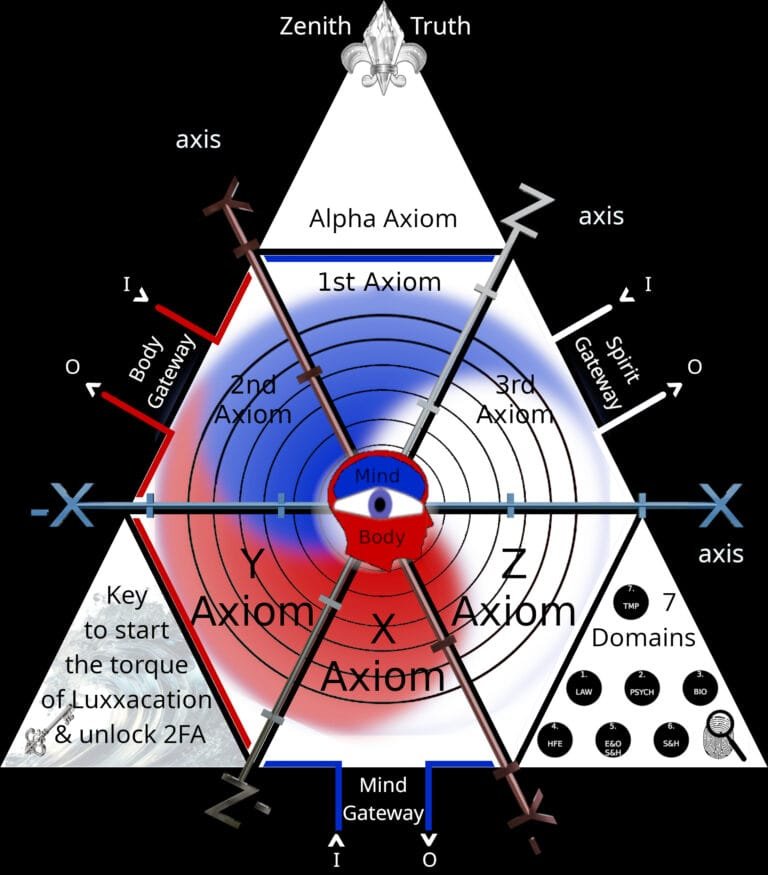
The Diagram below shows the Alpha Axiom: “Integrity is founded on truth” at the top of the XSE Peak, therefore positioning Truth at the Zenith (marked with the diamond at the top of the peak). At the foundation are the irrefutable axioms that appeal logically to common sense, in particular, the X, Y, & Z Axioms (see below). The diagram below shows the intentional hierarchy of then the 1st-3rd Axioms above the X,Y, and Z Axioms. Ascending to the Zenith can only be achieved through seeking truth, as depicted on the peak with the Alpha Axiom “Integrity is founded on truth.” The journey to the zenith of the XSE Peak is approached by first grasping the XSE Key, to start the “Torque” of XSE and for complete XSE functional analysis, both the 7 spheres of integration and the 7 domains of study must be taken into account as inputs and outputs passing through the Gateways of the system.
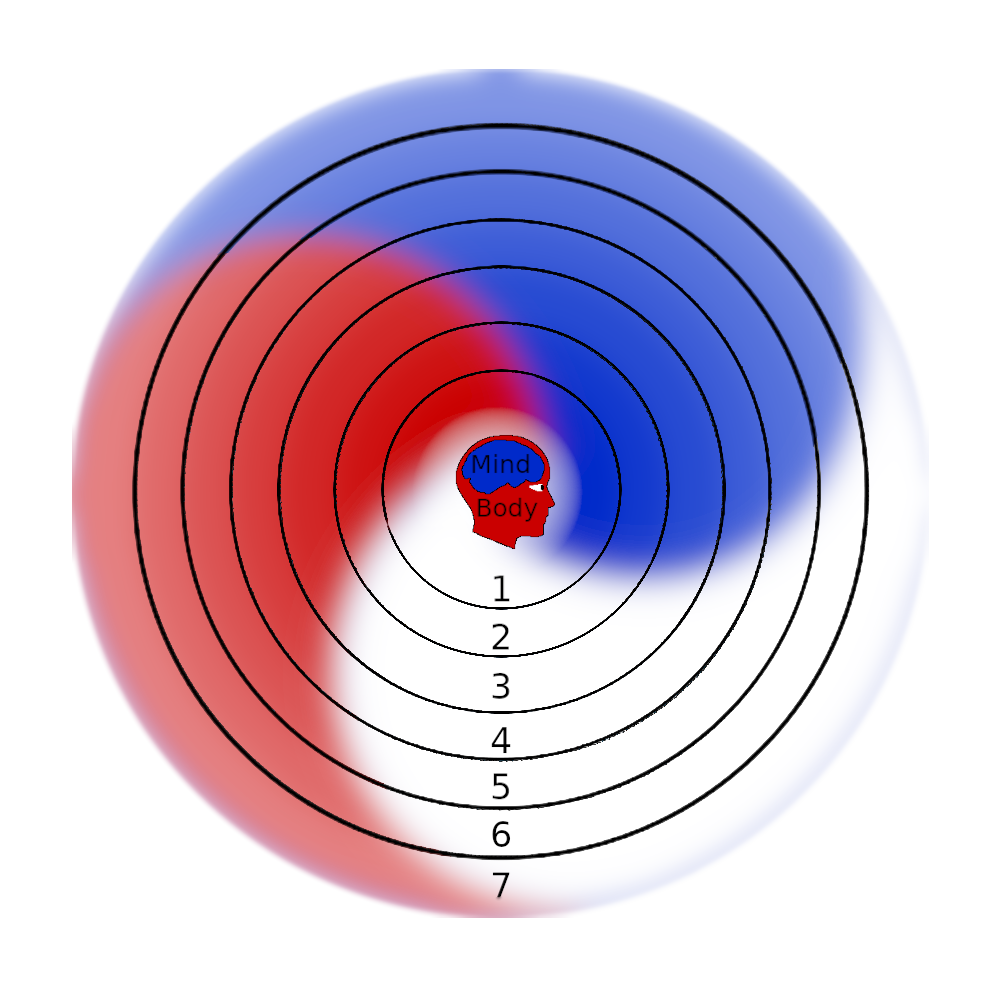
Above: the 3 aspects of the human are shown color coded (blue is for the mind, red is for the body, white is for the spirit) and are carried throughout the Seven Spheres of Integration (shown as rings around the individual in the center), from: 1. Independent Integration (X), 2. Family/ home, 3. Business/ Professional, 4. Community/ local, 5. National, 6. Global, & 7. Beyond. For analysis, plot the system on the X, Y, and Z axis, and evaluate the influence related to each sphere as inputs and outputs passing through the 3 Gateways.

The X Axiom (Using critical and creative thinking augments intelligence) correlates to the 1st mathematical dimension and 1st element of Luxxacation (“torquing” motion): “Take Time” and to the First Axiom (True and optimal intelligence is founded on integrity), which correlates to the X Axis (measuring system analysis), shown in blue (for the mind) above.
o o o o o o o Above: The 7 domains of study are depicted as 7 satellites revolving around the SOI and 7 Spheres as shown below in the XSE Framework 3-D Model. For complete XSE functional analysis, each of the 7 domain’s influences must be evaluated as inputs and outputs of the 3 Gateways of the 3 Aspects (Mind, Body, and Spirit) of the system.

The Y Axiom (The application of optimal choices enhances strength) correlates to the 2nd mathematical dimension and 2nd element of Luxxacation (“torquing” motion): “Build Strength” and to the Second Axiom (True and optimal strength is founded on integrity), which is derived from the Y Axis (for plotting actual stage of system life cycle), shown in red (for the body) above.

The Z Axiom states that “Seeking authentic & ultimate sources maximizes freedom” is correlated to the third dimension and 3rd element of Luxxacation (XSE’s “torque”): “Rise Above” & the 3rd Axiom (True & optimal freedom is founded on integrity), which is based on the Z Axis (rating of sources) shown white for the spirit above.
The Advancing Assets of XSE, namely: 1. The XSE Key (used to unlock XSE’s 2FA and turn on the “torque” of XSE’s Luxxacation), 2. Investigative Skills (used to pass through XSE’s 2FA in order to enter the XSE Vantage Point), & 3. The XSE Vantage Point (used to gain all-encompassing and astronomical view of systems and explore the 4th dimension) are also markers of where a person is in the knowledge and application or practice of Independent Integration Systems Engineering. Grasping the XSE Key correlates to the Position of XSE’s Luxury Systems Engineer. Investigative Skills are the 2nd advancing asset and correlate to the Position of XSE’s Investigative Systems Engineer, signifying a stage of questioning, learning and applying the factors used in XSE, and seeking science-based facts and ultimately, the truth. The Advancing Assets of XSE are retained and built-upon, therefore, as one enters the Vantage Point, they maintain and still leverage the first two Advancing Assets for their benefit, but now are able to operate from the vantage point, which not only provides an all-encompassing and astronomical view of systems, but likewise also positions the individual as an XSE Pilot Systems Engineer, having passed through XSE’s 2FA, and skilled in exploration of the 4th dimension and set on a path of seeking and finding the Zenith of XSE: Truth.
XSE's First Position of Advancement: Luxury Systems Engineer

The concept of a “Luxury Systems Engineer” using XSE at the top-level synopsis (Luxxacation) can be understood as someone who applies the principles of Independent Integration Systems Engineering to redefine and craft their life, work, and environment in a way that aligns with lasting happiness, joy, and fulfillment. Here’s how this idea unfolds:
Luxxacation: The Simplest and Most Basic Overview of XSE
- Luxxacation represents the fundamental principle of XSE: integrating luxury and systems thinking into a holistic, human-centric approach to life and innovation.
- At its core, Luxxacation isn’t about material excess but about aligning one’s systems (whether personal, professional, or societal) with purpose, efficiency, and lasting value. It’s the fusion of what works well, what feels right, and what serves the greater good.
- For an individual, this means creating a personal “system” that integrates the Three Elements of XSE:
- Take Time: Reflect on what truly matters, identifying values and desires.
- Build Strength: Fortify both internal (mental, emotional, physical) and external (social, financial, professional) systems to support a meaningful life.
- Rise Above: Transcend limiting beliefs, behaviors, or external expectations to focus on what fosters true joy and fulfillment.
The XSE Key: Metaphorical Key to Detachment
- The XSE Key is a metaphorical tool that enables an individual to detach from outdated ways, attachments, or mindsets that no longer serve them. Detachment here is not about rejection or avoidance, but about liberating oneself to explore new possibilities and reimagine life on their terms.
- This detachment fosters a state of mental freedom, allowing one to:
- Question ingrained habits or societal norms.
- Embrace critical thinking to evaluate what contributes to genuine happiness.
- Open up to creative solutions and opportunities that were previously overlooked.
Becoming a Luxury Systems Engineer
A Luxury Systems Engineer is someone who applies the principles of Luxxacation and the XSE Key to design their own systems of life, work, and relationships in a way that creates lasting joy and fulfillment. Here’s how:
Detaching to Advance:
- By utilizing the XSE Key, they free themselves from rigid definitions of success, luxury, or happiness that are externally imposed.
- They explore what luxury means personally—be it more time, meaningful relationships, sustainable living, or creative freedom.
Engineering Their Own Luxury:
- With a clear mind and open heart, they design systems that reflect their values and aspirations:
- Time management systems that prioritize rest and creativity.
- Professional paths that align with passion and purpose.
- Environments that are aesthetically pleasing and functional, supporting well-being.
- With a clear mind and open heart, they design systems that reflect their values and aspirations:
Innovating Through Detachment:
- Detachment encourages them to think outside conventional boundaries, allowing for radical innovation in both personal and professional domains.
- They view challenges as opportunities to craft new solutions that align with their vision of a luxurious, fulfilling life.
Cultivating Lasting Happiness and Joy:
- Instead of pursuing fleeting pleasures, they focus on sustainable practices that enhance their overall quality of life.
- They balance their systems to create harmony among mind, body, and spirit, which is the ultimate form of “luxury.”
Key Takeaways
- A Luxury Systems Engineer is not someone who merely works with material luxuries, but someone who applies XSE principles to integrate purpose, efficiency, and innovation into their life and environment.
- They use the XSE Key to detach from unproductive habits, outdated beliefs, or societal pressures, creating space for new ideas and possibilities.
- By embracing Luxxacation, they achieve a balance of comfort, creativity, and sustainability, engineering their unique definition of lasting happiness and joy.
In essence, a Luxury Systems Engineer embodies the transformative power of XSE at its most basic and profound level, crafting a life that is both meaningful and fulfilling, while inspiring others to do the same.
XSE's 2nd Advancing Position: Investigative Systems Engineer

The Investigative Systems Engineer is the second Advancing Position within XSE, paired with the Investigative Skills Advancing Asset. This position represents the transition from learning how to step beyond an immediate perspective into the systematic investigation of the System of Interest (SOI) through XSE’s complete 2FA.
At this stage, the Systems Engineer is actively studying and learning to integrate XSE’s 20 Actual Factors and 20 Analytical Factors, investigating not only what exists within and around the SOI, but also how those Factors interact, what they produce, and how their relationships affect the system’s condition and Trajectory.
1. From Perspective to Investigation
The XSE Key provides the initial means of detaching from habitual assumptions, immediate circumstances, and limited perspectives. The Investigative Systems Engineer advances from this foundation by turning that expanded perspective into disciplined inquiry.
The central question shifts from simply:
What am I looking at?
toward:
What is actually happening within this system, why is it happening, what is producing it, and what evidence supports that conclusion?
The Investigative Systems Engineer therefore learns to question assumptions, seek authentic Sources, identify missing information, examine relationships, compare perspectives, and distinguish what is known from what is inferred or remains unknown.
2. Investigating XSE’s 40 Factors
The core work of the Investigative Systems Engineer is the study and application of XSE’s 2FA—the 20 Actual Factors and 20 Analytical Factors.
The Actual Factors direct attention toward relevant elements of reality, including Mind, Body, Spirit; the Gateways; Spheres of Integration; and Domains of Study.
The Analytical Factors provide the XSE architecture through which those Actual Factors are investigated, including the X, Y, and Z Axes; Take Time, Build Strength, and Rise Above; the Advancing Assets and Positions; and the seven Axioms.
The objective is not merely to memorize the Factors. The Investigative Systems Engineer learns to recognize them within actual systems, determine their relevance, investigate their relationships, and integrate their findings into the developing XESAS Synthesis.
3. From Factors to Derived Dynamics
As investigation progresses, the Systems Engineer discovers that identifying Factors alone is insufficient.
Factors interact.
Those interactions can generate effects, patterns, dependencies, reinforcement, resistance, vulnerabilities, feedback, cascading consequences, and other behaviors within the system. The Investigative Systems Engineer therefore progresses into the study of Derived Dynamics—what emerges or develops from the relationships and interactions among relevant elements of the system.
This moves the investigation beyond:
What Factors are present?
to:
What are these Factors producing together?
4. Understanding Dynamic Mechanics
The investigation then extends into Dynamic Mechanics: examining how the identified dynamics operate, propagate, interact, and affect the SOI.
The Investigative Systems Engineer seeks to understand not only what is occurring, but the mechanisms and relationships through which it occurs.
Inputs and Outputs, Sources and Resources, feedback, system interfaces, Current Reality, life-cycle condition, Trajectory, surrounding systems, and other applicable XSE considerations become increasingly integrated into the investigation.
The developing progression becomes:
Identify the Factors → Investigate their relationships → Recognize Derived Dynamics → Understand their Dynamic Mechanics → Integrate the findings into the XESAS Synthesis.
5. The Investigative Identity
The title Investigative Systems Engineer reflects the defining work of this stage: investigation in pursuit of increasingly accurate system understanding.
The Investigative Systems Engineer does not accept surface appearances as sufficient, assume that correlation establishes causation, or fill unknowns with convenient conclusions. They seek better Sources, examine evidence, test assumptions, investigate what lies beneath the immediately observable representation, and continually update the Synthesis as new information becomes available.
Critical and creative thinking work together throughout this process: creative thinking expands what might need to be investigated, while critical thinking evaluates what the available evidence can actually support.
6. From Investigator to Pilot
The Investigative Systems Engineer is ultimately preparing for the next Advancing Position.
As the engineer progresses through all 40 Factors of XSE, learns to integrate both sides of XSE’s 2FA, and masters the applicable Derived Dynamics, Dynamic Mechanics, and their integration within the complete XESAS Synthesis, investigation develops into comprehensive systems mastery.
At that point, the Investigative Systems Engineer “graduates” to the third Advancing Position: XSE Pilot Systems Engineer, paired with the XSE Vantage Point.
The distinction is important:
The Investigative Systems Engineer is mastering how to investigate and integrate the system. The Pilot Systems Engineer has mastered that investigative architecture sufficiently to employ the XESAS Synthesis as a whole from the XSE Vantage Point and navigate the system accordingly.
In this way, the Investigative Systems Engineer represents the critical middle stage of XSE advancement—moving from opening perspective with the XSE Key, through rigorous investigation of Factors, relationships, Derived Dynamics, and Dynamic Mechanics, toward the integrated mastery required to take the position of Pilot Systems Engineer.
XSE's 3rd Advancing Position: Pilot Systems Engineer

The Pilot Systems Engineer is the third and highest Advancing Position within XSE, paired with the XSE Vantage Point. Reaching this position signifies demonstrated integrated competence in XSE as a systems-engineering methodology rather than familiarity with its individual components alone.
A Pilot Systems Engineer has successfully demonstrated integration of XSE’s complete 2FA, including all 20 Actual Factors and 20 Analytical Factors, along with the Derived Dynamics and Dynamic Mechanics, and is prepared to skillfully employ the complete XESAS Synthesis from the XSE Vantage Point.
1. Mastery and Integration of XSE
Pilot status represents the ability to bring the components of XSE together as a functioning whole. Rather than examining individual Factors in isolation, the Pilot investigates their relationships, interactions, Inputs and Outputs, feedback, Sources and Resources, life-cycle conditions, Trajectory, and effects across the system.
This includes integrating:
the 40 Factors of XSE and complete 2FA;
the X, Y, and Z Axes and corresponding Axioms;
the Alpha, First, Second, and Third Axioms;
Derived Dynamics, which emerge from relationships and interactions within the system;
Dynamic Mechanics, through which those dynamics operate and influence system behavior;
relevant feedback loops, Inputs and Outputs, Current Reality, Epochs, life-cycle position, and Trajectory;
the appropriate Sources, Resources, Domains of Study, and surrounding systems; and
Fourth-Dimension Exploration where it is relevant to the SOI.
The Pilot’s objective is not merely to collect more information, but to synthesize what is relevant into a coherent understanding of the System of Interest.
Pilot status therefore reflects demonstrated competence in integrating and applying these elements rather than mere completion or familiarity with them.
2. Piloting Rather Than Controlling
The aviation metaphor is intentional.
A skilled aircraft pilot does not control the atmosphere, gravity, weather, mechanical reality, or every event encountered during flight. The pilot instead develops awareness, uses reliable instrumentation and information, monitors changing conditions, makes informed adjustments, and responds within the limits of what can actually be controlled.
The Pilot Systems Engineer approaches an SOI similarly.
XSE does not promise complete control over a person, organization, environment, or future. The Pilot distinguishes between what can be influenced, what must be adapted to, what requires further investigation, and what lies outside the Pilot’s control.
Piloting means navigating reality—not commanding reality.
The Pilot therefore adapts the system model to reality rather than attempting to force reality to conform to the model.
Pilot status represents a level of XSE integration and competence, not inherent authority over persons, organizations, or Systems of Interest.
3. Navigating Through Feedback
Systems do not remain fixed. Conditions change, Inputs enter, Outputs create effects, feedback returns, relationships shift, and systems may deteriorate when necessary maintenance, replenishment, adaptation, or sustaining action is absent.
The Pilot therefore operates iteratively:
Observe → Analyze → Synthesize → Choose → Apply → Monitor → Receive Feedback → Reassess → Adjust
Derived Dynamics and Dynamic Mechanics are especially important at this level because the Pilot must understand not only what Factors are present, but also what their interactions are producing and how those effects are being generated, transmitted, reinforced, resisted, or altered throughout the system.
The XESAS Synthesis is consequently updated as reality changes.
4. Critical Thinking, Choice, and Sourcing
The Pilot integrates XSE’s three coordinate Axes and corresponding Axioms in practice.
Through the X Axiom, critical and creative thinking augment intelligence. Through the Y Axiom, the application of optimal choices enhances strength. Through the Z Axiom, seeking authentic and ultimate Sources maximizes freedom.
These operate upon XSE’s deeper axiomatic foundation: integrity is founded on truth, and true and optimal intelligence, strength, and freedom are founded on integrity.
The Pilot therefore seeks not merely clever solutions, but solutions and decisions that can withstand increasingly rigorous examination of their truth, integrity, consequences, Sources, and effects upon the larger system.
5. From the XSE Vantage Point
The Pilot Systems Engineer operates from the XSE Vantage Point, seeking the broadest defensible perspective upon the SOI while retaining the ability to descend into the details when necessary.
From this position, the Pilot can examine:
detail ↔ component ↔ relationship ↔ system ↔ surrounding systems ↔ larger context
The Pilot also considers previous Epochs, Current Reality, developing Trajectory, possible future conditions, and relevant Fourth-Dimension questions without conflating established fact, measurement, mathematical representation, scientific findings, models, inference, hypothesis, metaphor, or speculation.
The goal is the widest defensible understanding that the available evidence permits.
6. The Meaning of “Soaring”
Within XSE, soaring does not mean escaping constraints or becoming immune to turbulence. It represents developing sufficient systems awareness, skill, adaptability, and integrity to navigate complexity without being unnecessarily controlled by every changing condition encountered.
Like flight itself, freedom exists alongside constraints.
The Pilot seeks to recognize reality accurately, maintain orientation, make increasingly well-founded and appropriately optimal choices, respond intelligently to feedback, and adjust Trajectory when conditions warrant it.
The Pilot Systems Engineer represents the highest Advancing Position within XSE: an individual who has demonstrated integrated competence in XSE’s complete 2FA, Derived Dynamics, Dynamic Mechanics, and the integrated XESAS Synthesis, and who employs them from the XSE Vantage Point to investigate, navigate, sustain, and advance Systems of Interest with critical and creative intelligence, adaptive strength, authentic sourcing, feedback, recalibration, and integrity.
For human-centered applications, Pilot Systems Engineer is an internal XSE educational and systems-development designation. It does not constitute professional licensure, certification by a regulated engineering body, or authorization to practice engineering, medicine, psychology, law, or any other regulated profession.