
Engineers know the limitations of three dimensions

Looking Beyond Three Spatial Dimensions
When we speak of the familiar first three spatial dimensions, we generally mean length, width, and height. These dimensions allow us to describe an object’s spatial extent, position, shape, and geometry. However, a three-dimensional spatial description alone does not provide a complete description of the object—or of the larger system in which it exists.
Consider what cannot be determined from length, width, and height alone:
- Mass, Weight, and Density: Two objects can have identical external dimensions while differing substantially in mass, weight, density, composition, and internal structure. Spatial dimensions describe physical extent, but they do not by themselves establish these other properties.
- Motion and Trajectory: An object’s three-dimensional position at a single moment does not tell us how it is moving. Understanding motion requires additional information concerning position across time, velocity, acceleration, direction, and the forces influencing its Trajectory.
- Energy and System State: The dimensions of an object alone do not reveal its kinetic, potential, thermal, chemical, or other forms of energy. Objects occupying similar regions of space can exist in substantially different physical states.
- Forces, Strength, and Stability: Spatial dimensions alone cannot establish how an object will respond to gravity, loading, pressure, impact, temperature, or other forces and environmental conditions. Material composition, internal structure, constraints, loading conditions, and other variables can substantially affect strength and stability.
- Change, Performance, and Endurance: A static three-dimensional representation cannot, by itself, tell us how a system will perform, deteriorate, adapt, deform, fail, or persist over time. Understanding these characteristics requires information extending beyond the object’s immediate geometry.
The important point is not that each of these properties constitutes another dimension. Rather, they demonstrate a fundamental limitation of any representation based solely upon the three familiar spatial dimensions: what can be seen or measured spatially is not necessarily the entirety of what is relevant to understanding the system.
This limitation opens an important question for systems analysis:
What might become apparent when the System of Interest is examined through dimensions, variables, relationships, and perspectives that are not represented by an ordinary three-dimensional view?
The concept of the Fourth Dimension provides one avenue for exploring that question. Mathematics, physics, philosophy, and other fields have approached dimensionality in different ways—from four-dimensional and higher-dimensional mathematical spaces, to relativistic spacetime, to philosophical questions concerning time, persistence, perception, and reality.
XSE does not attempt to replace these established fields with its own definition of the Fourth Dimension. Instead, it investigates their relevant insights and asks whether a defensible dimensional perspective can reveal something about the System of Interest that is not already adequately represented within the XESAS Synthesis.
In this way, exploration of the Fourth Dimension serves a specific purpose within XSE: to challenge the Systems Engineer to look beyond the apparent completeness of the existing representation and test whether another legitimate dimensional perspective reveals something that has not yet been accounted for.
Understanding the Fourth Dimension
For purposes of exploration within XSE, concepts associated with the Fourth Dimension are organized through four broad, potentially overlapping lenses: Spatial, Temporal, Mathematical, and Philosophical/Metaphorical. These are not presented as four scientifically established or mutually exclusive categories of the Fourth Dimension, but as an organizational structure for examining the different ways dimensionality has been understood, modeled, and explored.
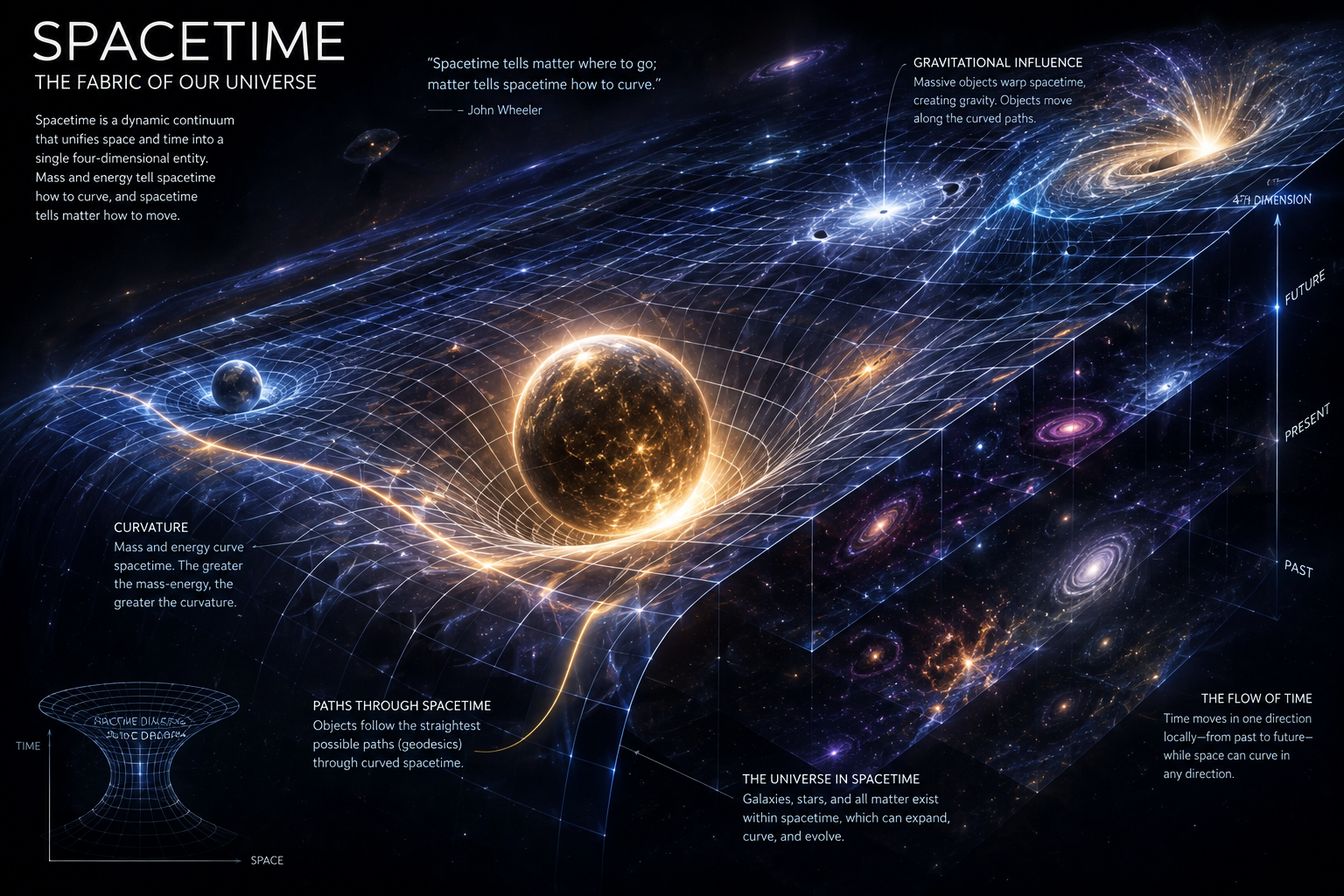
The meaning of the Fourth Dimension depends upon the context in which the term is used. Mathematics, physics, philosophy, and other areas of inquiry have approached dimensionality in different ways. For purposes of exploration within XSE, these concepts can be organized through four broad and potentially overlapping lenses: Spatial, Temporal, Mathematical, and Philosophical/Metaphorical. These are XSE organizational lenses rather than four universally established or mutually exclusive categories of the Fourth Dimension.
- Spatial: A fourth spatial dimension extends the familiar three spatial dimensions of length, width, and height by an additional independent spatial direction. Although four-dimensional and higher-dimensional spaces can be rigorously represented mathematically, a fourth spatial dimension is not part of ordinary human spatial perception.
- Temporal: Modern relativity describes physical events within four-dimensional spacetime, using three spatial coordinates and one temporal coordinate. Time is therefore part of a four-dimensional physical framework, although the temporal dimension is not simply equivalent to another ordinary spatial direction.
- Mathematical: Mathematics is not restricted to three or four dimensions. A dimension can represent an independent coordinate, parameter, or degree of freedom within a mathematical structure, allowing spaces and systems involving four, five, or many more dimensions to be rigorously modeled and analyzed.
- Philosophical/Metaphorical: Dimensional concepts have also been explored philosophically and used metaphorically to examine questions involving time, persistence, perception, existence, perspective, and realities or relationships that may not be apparent from an ordinary three-dimensional view. These interpretations should be distinguished from established mathematical models and empirically supported physical theories.
These perspectives can overlap and interact. A mathematical model may represent spatial dimensions; relativistic spacetime combines spatial and temporal coordinates; and philosophical inquiry may examine implications of concepts originating in mathematics or physics.
Within XSE, the purpose is not to combine these distinct meanings into a new definition of the Fourth Dimension. Rather, XSE investigates them according to their appropriate fields and considers whether any provide a relevant perspective that extends what is already captured within the XESAS Synthesis.
There's scientific evidence of the 4th dimension, but not 5th, 6th, 7th...

Four-Dimensional Spacetime vs. Additional Dimensions
It is important to distinguish four-dimensional spacetime as used in established physics from theories proposing additional physical dimensions beyond those ordinarily represented in spacetime.
In modern relativity, physical events are described within four-dimensional spacetime, consisting of three spatial coordinates and one temporal coordinate. This framework is supported by extensive experimental and observational evidence, including measurements of relativistic time dilation and gravitational effects predicted by relativity. Time is therefore appropriately understood as the temporal dimension of spacetime, rather than simply as another spatial direction.
Physics and mathematics also permit investigation of higher-dimensional spaces. Mathematics can rigorously describe spaces containing four, five, or arbitrarily many dimensions without requiring those dimensions to physically exist. Mathematical dimensionality should therefore be distinguished from claims about the dimensional structure of the physical universe.
Certain areas of theoretical physics propose additional spatial dimensions beyond the three ordinarily experienced. Examples include Kaluza–Klein theories and various formulations of string theory. Depending upon the theory, proposed additional dimensions may be compactified or otherwise inaccessible at presently observable scales.
These additional physical dimensions remain theoretical. Their mathematical usefulness within a theory does not, by itself, demonstrate that corresponding physical dimensions exist in nature, and there is currently no generally accepted direct empirical confirmation of additional spatial dimensions beyond the established four-dimensional spacetime description.
This distinction is important within XSE:
Established knowledge, mathematically valid possibilities, theoretical physical models, philosophical propositions, and metaphorical interpretations should not be assigned the same evidentiary status.
XSE may investigate each when relevant to a System of Interest, but it does so according to the evidence, Sources, and standards appropriate to the Domain of Study. Fourth-Dimension Exploration is intended to expand inquiry without confusing what is established with what remains theoretical, philosophical, conceptual, or unknown.
Why a Systems Engineer should consider the 4th dimension

Why Fourth-Dimension Exploration Matters in Systems Engineering
Systems engineering requires more than understanding the immediately visible components of a System of Interest (SOI). A Systems Engineer must continually question whether the representation being used is sufficiently comprehensive to describe the reality of the system.
Within XSE, much of this “big-picture” analysis is already accomplished through the XESAS Synthesis. Time, life-cycle development, Current Reality, Trajectory, Inputs and Outputs, Sources and Resources, interconnected systems, feedback, Derived Dynamics, Dynamic Mechanics, and other relevant conditions are systematically considered through the existing XSE architecture.
Fourth-Dimension Exploration is therefore not used to duplicate these functions. Instead, it provides an additional challenge to the completed or developing Synthesis:
Is there a legitimate dimensional perspective that reveals something about the SOI that the existing representation has not adequately captured?
Several possibilities make this question valuable:
- Testing the Limits of Representation: Every systems model is a representation of reality rather than reality itself. Fourth-Dimension Exploration encourages the Systems Engineer to consider whether the SOI has been represented from too limited a dimensional perspective and whether important properties, relationships, or system states remain obscured.
- Higher-Dimensional Mathematical Analysis: Some systems require more variables, coordinates, degrees of freedom, or state dimensions than can conveniently be represented in an ordinary three-dimensional model. Higher-dimensional mathematics may expose relationships or patterns that become difficult to recognize in simpler representations.
- Projection and Perspective: Higher-dimensional geometry demonstrates mathematically how lower-dimensional projections or cross-sections can provide incomplete representations of higher-dimensional structures. This supplies a valuable analytical analogy for systems engineering: what appears to be the entire system from one perspective may actually be only a partial representation of it.
- Physical Spacetime Considerations: For SOIs in which relativistic effects, synchronization, motion, gravity, astronomical distances, or other spacetime relationships are technically relevant, established four-dimensional physics may contribute information that must be incorporated into the engineering analysis.
- Investigation of Additional Dimensions: Certain mathematical and theoretical-physics frameworks investigate dimensions beyond familiar four-dimensional spacetime. When legitimately relevant to an SOI, these theories may be investigated according to their actual evidentiary status without treating theoretical possibilities as established physical facts.
- Philosophical and Conceptual Exploration: Established philosophical questions concerning time, persistence, change, perception, dimensionality, and representation can challenge assumptions about how a system is being understood. Conceptual higher-dimensional thinking may likewise stimulate critical and creative thinking, provided metaphorical exploration remains distinguished from scientific or mathematical claims.
- Discovery of What the Synthesis May Have Missed: Perhaps most importantly, Fourth-Dimension Exploration gives the Pilot Systems Engineer permission to question the apparent completeness of the analysis itself. If another defensible dimensional perspective reveals a missing variable, relationship, state, scale, or limitation, that discovery can be investigated through appropriate Sources and Domains of Study and incorporated back into the XESAS Synthesis.
From the XSE Vantage Point
This exploration is particularly appropriate from the XSE Vantage Point. Having developed the capacity to step beyond an immediate perspective through the XSE Key and progressed toward integrated application of XESAS, the Pilot Systems Engineer can survey the SOI and ask not only what the Synthesis reveals, but also what its current representation might still prevent the engineer from seeing.
The Fourth Dimension therefore does not provide the “big picture” by itself. XESAS develops the big picture; the XSE Vantage Point provides the position from which it can be surveyed; and Fourth-Dimension Exploration challenges the Pilot to determine whether that picture is dimensionally incomplete.
This distinction is fundamental:
Fourth-Dimension Exploration does not assume that something is missing. It ensures that the Systems Engineer has asked whether something is missing.
When another dimensional perspective contributes nothing relevant beyond the existing XESAS Synthesis, no additional interpretation needs to be imposed. When it does reveal something significant, that information becomes another opportunity to refine the Synthesis and improve understanding of the SOI.
Step Outside the Moment
The XSE Vantage Point is an astronomical analytical perspective from which the Pilot Systems Engineer seeks the broadest reasonably attainable view of the System of Interest, including consideration of relevant Fourth-Dimension perspectives and anything they may reveal beyond the existing XESAS Synthesis.

A skilled Systems Engineer applies the strongest critical and creative thinking reasonably available, seeking to identify what might otherwise be overlooked. The objective is not omniscience or the elimination of every possible mistake, but a sufficiently thorough analysis that important Factors, consequences, risks, opportunities, and perspectives are not neglected simply because they were difficult to see from the immediate position.
From the XSE Vantage Point, the Pilot Systems Engineer deliberately steps back from the urgency of Current Reality. Through strategic mental distancing, the Pilot can conceptually step outside of themselves, outside of their present circumstances, and outside of the restrictions of the present moment to examine the SOI from a broader perspective.
Imagine looking back upon the present Epoch after it has already passed.
What would you wish you had noticed?
What information would you wish you had investigated?
What consequence would seem obvious from that later position?
What choice would you wish you had made while the opportunity still existed?
What are you unable to see now because you are standing too close to it?
This is not literal travel outside of time. It is deliberate perspective training. Reality extends beyond one’s immediate experience of the present, and systems continue to develop whether or not the Systems Engineer adequately anticipates their Trajectory.
From this expanded position, the Pilot can also engage in Fourth-Dimension Exploration, considering whether established mathematical, physical, temporal, philosophical, or other defensible dimensional perspectives reveal something that remains inadequately represented within the XESAS Synthesis.
There is also a profoundly practical reason for looking this far.
Time moves in one direction in ordinary human experience. Decisions become history. Opportunities change or disappear. Systems develop, deteriorate, recover, transform, and eventually reach the end of particular life-cycle stages. Human life itself is finite.
Everyone eventually encounters knowledge they did not possess earlier. The challenge for the Systems Engineer is to investigate carefully enough now that avoidable blindness is not discovered only after the opportunity to act has passed.
The XSE Vantage Point therefore asks the Pilot to look at Current Reality almost as though looking back upon it from beyond the present Epoch:
If I could see this system after its present course had fully unfolded, what would I wish I had understood today?
The answer cannot actually be known from the future. But asking the question can expose assumptions, neglected Factors, missing Sources, unexamined risks, alternative Trajectories, and possibilities that the immediacy of the present may conceal.
Step back. Look farther. Examine what you presently believe you know. Investigate what you may not yet know. Then return to Current Reality better prepared to make the choices that can still be made.
How Fourth-Dimension Exploration Can Advance Systems Analysis
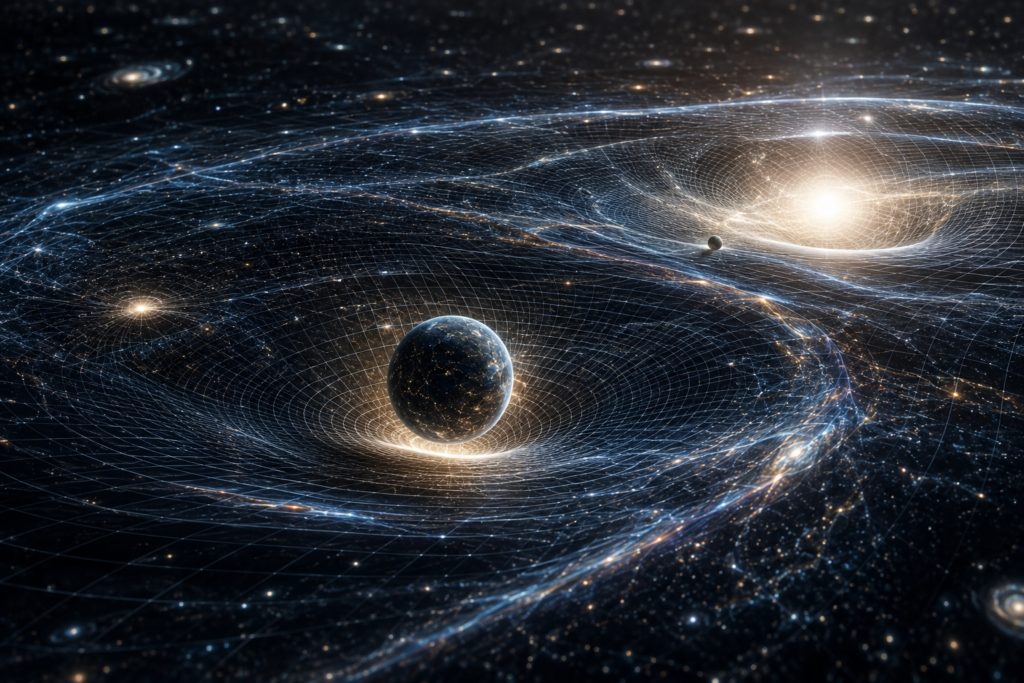
Within XSE, Fourth-Dimension Exploration is not a substitute for the comprehensive analysis already performed through XESAS. Temporal development, life-cycle position, system dynamics, interconnectedness, Sources and Resources, Inputs and Outputs, feedback, Current Reality, Trajectory, and other relevant conditions are already addressed through the XESAS Synthesis.
Instead, Fourth-Dimension Exploration challenges the Pilot Systems Engineer to examine the dimensional adequacy of the representation itself:
Does an established or defensible dimensional perspective reveal something about the System of Interest (SOI) that is not yet adequately represented within the XESAS Synthesis?
This exploration can strengthen systems analysis in several ways:
- Testing the Representation: Every model represents reality without necessarily capturing all of it. Fourth-Dimension Exploration encourages the Pilot to determine whether the existing representation sufficiently describes the SOI or whether relevant properties, relationships, states, or variables remain outside its current dimensional structure.
- Exploring Higher-Dimensional Mathematics: Some systems may be more effectively represented using four or more independent variables, coordinates, degrees of freedom, or state dimensions. When technically appropriate, higher-dimensional mathematics can reveal relationships or patterns that may be difficult to recognize in simpler representations.
- Examining Projections and Cross-Sections: Higher-dimensional geometry demonstrates that a lower-dimensional view can represent only a projection or cross-section of a more complex structure. Applied as an analytical consideration, this prompts the Pilot to ask whether what is being observed is sufficiently representative of the SOI or only one limited view of it.
- Incorporating Relevant Physical Phenomena: For SOIs in which relativistic spacetime or other established dimensional phenomena are technically relevant, the appropriate scientific knowledge can be incorporated into the analysis rather than excluded by an unnecessarily limited representation.
- Investigating Unresolved Dimensional Questions: Relevant theories and philosophical inquiries concerning higher dimensions, space, time, persistence, perception, and dimensionality may also be investigated when appropriate. XSE distinguishes established knowledge from theoretical, philosophical, metaphorical, or speculative propositions and evaluates each according to its appropriate evidentiary status.
- Challenging Hidden Assumptions: Perhaps most importantly, changing the dimensional perspective can expose assumptions about how the system has been represented. The Pilot can ask whether a variable, relationship, scale, state, or perspective has been overlooked simply because the existing model did not make it readily visible.
Fourth-Dimension Exploration therefore does not require the Pilot Systems Engineer to find another dimension, nor does XSE presume that every SOI requires additional dimensional treatment. If further exploration reveals nothing relevant beyond the existing Synthesis, no additional dimensional interpretation needs to be imposed.
If something significant is revealed, it can be investigated through the appropriate Domains of Study, authentic Sources, and available Resources and then integrated back into the XESAS Synthesis.
The process can therefore be understood as:
Develop the XESAS Synthesis → Survey it from the XSE Vantage Point → Test its dimensional completeness → Investigate anything legitimately unresolved → Integrate relevant findings back into the Synthesis
The value of Fourth-Dimension Exploration is not that another dimension must exist within every analysis, but that the Pilot Systems Engineer does not automatically assume that the existing representation captures everything relevant about the reality being modeled.
Exploring a Fourth Spatial Dimension

One established mathematical interpretation of the Fourth Dimension is a fourth spatial dimension: an additional spatial direction independent of, and mathematically orthogonal to, the familiar dimensions of length, width, and height.
Four-dimensional geometry can be studied rigorously through mathematics even though humans ordinarily perceive and physically navigate three spatial dimensions. For the Pilot Systems Engineer, its value within Fourth-Dimension Exploration lies primarily in what higher-dimensional spatial thinking can reveal about representation, perspective, and the limitations of observation.
- Expanding Spatial Reasoning: Considering a fourth spatial dimension challenges the assumption that the spatial structure available to ordinary perception represents every spatial relationship that can be mathematically conceived. Higher-dimensional geometry provides a disciplined way to explore structures beyond intuitive three-dimensional visualization.
- Understanding Projection: A higher-dimensional object can be represented in a lower-dimensional space through projections, just as a three-dimensional object can produce a two-dimensional image or shadow. This provides an important systems insight: what is observable from a particular dimensional perspective may be a reduced representation rather than a complete description of the underlying structure.
- Understanding Cross-Sections: A lower-dimensional observer encountering successive cross-sections of a higher-dimensional object could perceive changing forms without directly observing the complete object responsible for them. For systems analysis, this creates a useful question: Could the system states being observed represent partial cross-sections of a more complex structure or process? This is an analytical analogy unless an actual higher-dimensional physical structure is independently supported by evidence.
- Higher-Dimensional Mathematical Modeling: Some engineering and scientific problems are represented using mathematical spaces containing more than three dimensions. These dimensions may represent variables, states, parameters, or degrees of freedom rather than literal physical directions. Fourth-spatial-dimension exploration can therefore serve as an entry point for understanding how higher-dimensional representations can expose relationships that simpler models may obscure.
- Challenging Intuition: Human intuition develops through experience of ordinary three-dimensional space. Studying four-dimensional geometry demonstrates that what is difficult or impossible to visualize intuitively can nevertheless be mathematically coherent. For the Pilot Systems Engineer, this reinforces the importance of allowing evidence, mathematics, and rigorous analysis—not immediate perception alone—to establish what a model can support.
- Testing the XESAS Representation: From the XSE Vantage Point, the Pilot can ultimately ask whether spatial dimensionality itself presents anything relevant that remains inadequately represented within the XESAS Synthesis. If it does, the appropriate mathematical, scientific, or engineering methods can be investigated and the findings incorporated into the Synthesis. If it does not, no fourth-spatial-dimensional interpretation needs to be imposed.
The Important Distinction
Within XSE, exploration of a fourth spatial dimension does not mean assuming that the SOI physically extends into an accessible fourth spatial direction.
Instead, it recognizes that four-dimensional and higher-dimensional geometry are legitimate mathematical subjects and asks whether their principles, representations, or analytical implications contribute anything relevant to understanding the SOI.
This produces one of the most useful questions within Fourth-Dimension Exploration:
Am I observing the relevant reality of the system—or could what I am observing be only a projection, cross-section, or dimensionally limited representation of something more complex?
The answer must come from appropriate evidence and analysis rather than from the dimensional thought experiment itself.
Exploring the Temporal Dimension

One of the most established scientific treatments associated with the Fourth Dimension comes from modern physics. In relativity, physical events are represented within four-dimensional spacetime, consisting of three spatial coordinates and one temporal coordinate. Space and time are therefore incorporated into a unified physical framework, although the temporal dimension should not simply be understood as another ordinary spatial direction.
This distinction is important within XSE because time is already extensively considered throughout the XESAS Synthesis. Fourth-Dimension Exploration does not need to introduce ordinary temporal analysis into XSE; rather, it asks whether established physical, mathematical, philosophical, or other defensible understandings of time reveal something about the System of Interest (SOI) that XESAS’s existing temporal mechanisms do not adequately represent.
Time Is Already Integrated Throughout XESAS
XESAS examines time through several complementary mechanisms.
The XSE Key, the first Advancing Asset, enables the Systems Engineer to conceptually detach from immediate circumstances, habitual perspectives, and the restrictions imposed by viewing reality only from the present moment. The Systems Engineer can mentally “step outside of themselves and outside of time” to consider the SOI from a broader temporal perspective.
Within XSE, this language describes strategic perspective-taking, not literal departure from physical time or spacetime.
Other XSE mechanisms provide structured temporal analysis. Epochs establish reference points in time. Current Reality establishes the presently observed condition of the system. The Y Axis measures the actual life-cycle stage of the SOI based upon available evidence. Trajectory considers the direction in which the system is developing. Feedback, Derived Dynamics, and Dynamic Mechanics further enable examination of how conditions, interactions, and system behavior change over time.
Consequently, the ordinary questions of what happened, what is happening, what is changing, what life-cycle stage the system occupies, and where its present Trajectory may lead are already substantially addressed within XESAS.
Temporal Fourth-Dimension Exploration begins beyond that foundation.
Spacetime Rather Than Time Alone
Relativity provides a more specific treatment of time than simply acknowledging that systems change.
Physical events occur at locations in both space and time, and relativity describes these events within spacetime. For most systems encountered in ordinary life and engineering, relativistic effects may have little practical consequence. For some SOIs, however—such as satellite navigation, precision timing, high-speed systems, astronomy, or other applications where relativistic effects become significant—the physical structure of spacetime may be directly relevant to system analysis.
In these cases, the Pilot Systems Engineer should rely upon the appropriate established physics rather than treating time merely as a generic progression from past to future.
Reference Frames and Temporal Measurement
Relativity also establishes that measurements of elapsed time and spatial relationships can depend upon physical conditions such as relative motion and gravitation.
This has practical engineering consequences in applications where sufficient precision is required.
It also provides a useful—but separate—systems lesson: the conditions under which an observation is made matter to the interpretation of that observation.
XSE should distinguish these two ideas carefully. A physical reference frame in relativity has a technical scientific meaning. The broader XSE practice of changing one’s analytical perspective is not the same phenomenon and should not be presented as such.
Events, Sequence, and Causality
Temporal analysis can also extend beyond simply placing events in chronological order.
In physical spacetime, causal relationships are constrained: not every event can physically influence every other event. Where such relationships are relevant to the SOI, spacetime analysis can provide information beyond an ordinary timeline.
More generally, systems analysis benefits from distinguishing between sequence and causation. The fact that one event occurs before another does not by itself establish that the first caused the second. Appropriate evidence is required to identify causal relationships.
This distinction can become particularly important when reconstructing system histories, identifying failure mechanisms, evaluating feedback, or determining which events actually altered a system’s Trajectory.
Persistence and Change Through Time
The temporal dimension also raises deeper questions concerning persistence, identity, and change.
At what point does a changing system cease to be meaningfully the same system? Which properties must remain stable for continuity to be maintained? How should the SOI be represented when its components, relationships, functions, environment, or purpose change substantially across Epochs?
Such questions may involve engineering, mathematics, philosophy, or other Domains of Study depending upon the SOI.
XESAS can document and analyze change, while Fourth-Dimension Exploration can prompt the Pilot to investigate whether the nature of persistence through time itself presents an unresolved issue relevant to the Synthesis.
“Outside of Time” and the XSE Vantage Point
The distinction between physical time and XSE perspective-taking becomes especially important at the XSE Vantage Point.
Through the XSE Key and progressively broader application of XSE, the Systems Engineer learns to mentally detach from the dominance of Current Reality. From the Vantage Point, the Pilot Systems Engineer seeks an astronomical perspective from which the SOI can be contemplated across past conditions, Current Reality, possible future developments, alternative Trajectories, and broader relationships.
The Pilot might conceptually look back upon the present Epoch as though it had already passed and ask:
What would become apparent from a later position that is difficult to recognize while standing inside the present moment?
This exercise can expose assumptions, neglected Factors, missing Sources, developing risks, unrealized opportunities, or consequences that immediate circumstances make difficult to perceive.
However, the Pilot does not literally leave time. The XSE Vantage Point is an analytical position, and “stepping outside of time” is an XSE perspective exercise. The temporal dimension of spacetime is a physical concept studied through physics.
The two should not be conflated:
XSE’s “outside of time” perspective expands the Pilot’s analytical viewpoint; the temporal dimension of spacetime describes an established feature of physical models of reality. Fourth-Dimension Exploration allows both to be considered according to their proper meanings.
What Remains to Be Explored?
Because XESAS already accounts extensively for time, temporal Fourth-Dimension Exploration should not simply repeat ordinary life-cycle or longitudinal analysis.
Instead, after the XESAS Synthesis has considered the SOI’s history, Epochs, Current Reality, Y-Axis position, Trajectory, feedback, Derived Dynamics, and Dynamic Mechanics, the Pilot can ask:
Does an established or defensible understanding of time, spacetime, reference frames, temporal measurement, causality, persistence, or another temporal concept reveal something relevant about the SOI that remains inadequately represented within the XESAS Synthesis?
If the answer is yes, the matter can be investigated through the appropriate Domains of Study using authentic Sources and adequate Resources, and relevant findings can be incorporated back into the Synthesis.
If the answer is no, no additional temporal interpretation needs to be imposed.
Purpose of Temporal Fourth-Dimension Exploration
The purpose of this exploration is therefore not simply to remind the Pilot Systems Engineer that time matters. XESAS already establishes that.
Its purpose is to test whether the system’s existing temporal representation is sufficient.
Time may function as a reference, a measurable coordinate, a component of physical spacetime, a condition affecting system development, a basis for causal analysis, or a subject of deeper mathematical and philosophical investigation. Which of these considerations matter depends upon the SOI.
Temporal Fourth-Dimension Exploration keeps these possibilities available without assuming that every possibility applies to every system.
Ultimately, the question is not:
Have we considered time?
XESAS already requires substantial consideration of time.
The more exacting question is:
Have we considered everything about time and temporal reality that is legitimately relevant to this System of Interest—and can we defend that conclusion from the evidence available?
Spacetime & the Fourth Dimension: An Important Distinction
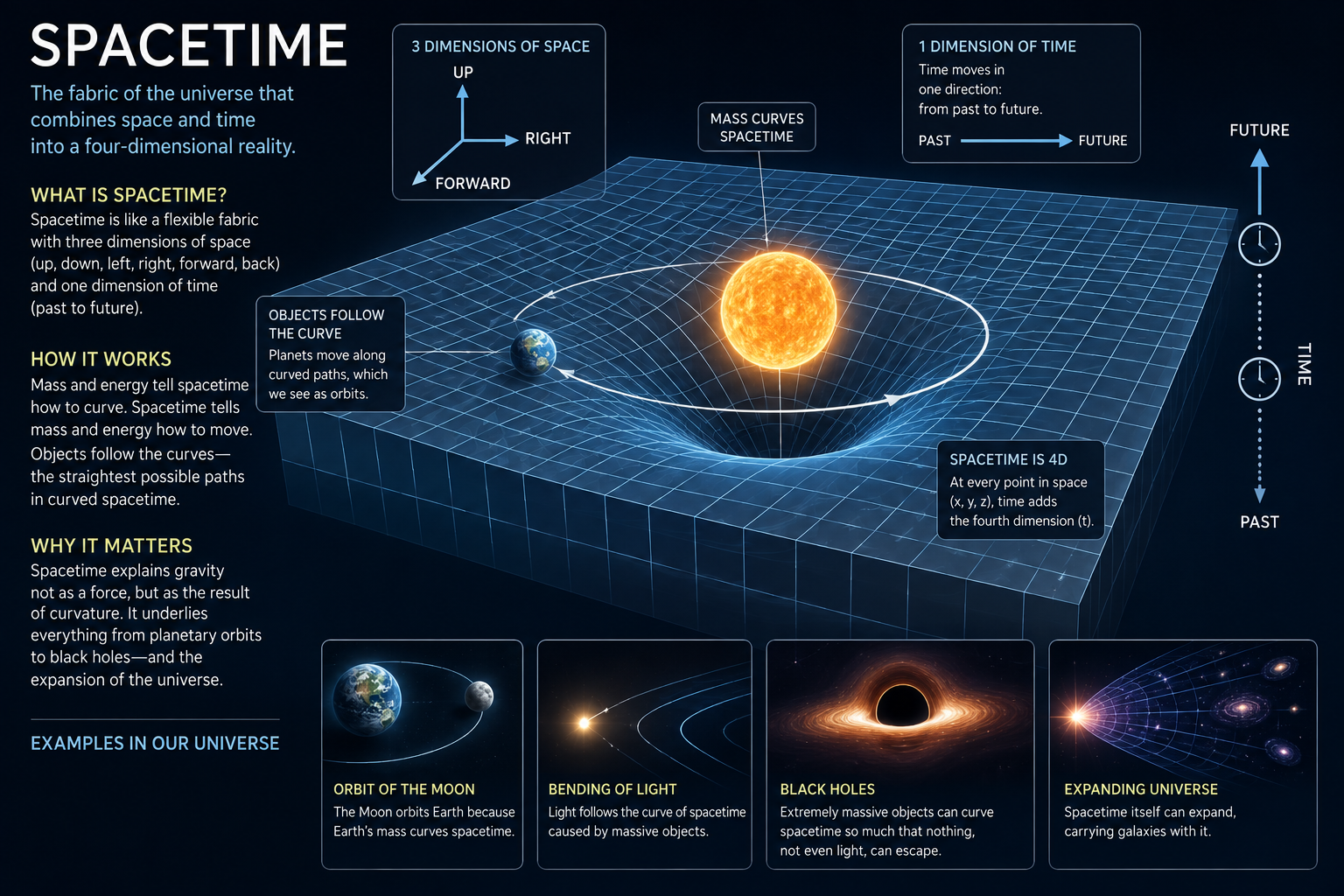
Spacetime and the Fourth Dimension are related concepts, but they are not synonymous. The distinction depends upon what is meant by “fourth dimension.”
- Spacetime: In relativity, spacetime is a four-dimensional framework consisting of three spatial dimensions and one temporal dimension. An event is described by both where it occurs in space and when it occurs in time. Space and time are treated within a unified geometric framework, and their relationships are fundamental to modern descriptions of gravity, motion, and physical events.
- The Temporal Dimension: Because spacetime has three spatial coordinates and one temporal coordinate, time is commonly referred to informally as “the fourth dimension.” More precisely, time is the temporal dimension of four-dimensional spacetime. It is not simply a fourth spatial direction equivalent to length, width, or height.
- A Fourth Spatial Dimension: The phrase “fourth dimension” can also refer to a fourth spatial dimension—an additional independent spatial direction beyond the three familiar spatial dimensions. Four-dimensional spatial geometry is mathematically valid and can be rigorously studied, but this meaning should not be confused with the temporal dimension of relativistic spacetime.
- Higher-Dimensional Mathematics: Mathematics uses dimensionality much more broadly. A mathematical space can have four, five, ten, or arbitrarily many dimensions, depending upon the number of independent coordinates, parameters, or degrees of freedom required by the model. These mathematical dimensions do not necessarily correspond to physical dimensions of the universe.
- Other Uses of “Fourth Dimension”: The term also appears in philosophical, conceptual, and metaphorical discussions involving time, existence, perception, consciousness, or realities beyond ordinary three-dimensional experience. Such uses should be clearly distinguished from the technical meanings of dimensionality in mathematics and physics.
The Distinction Within XSE
For Fourth-Dimension Exploration, XSE therefore does not treat “spacetime,” “time,” “a fourth spatial dimension,” and “higher-dimensional space” as interchangeable terms.
Instead, each is considered according to its appropriate meaning and evidentiary status.
Spacetime is an established four-dimensional physical framework containing three spatial dimensions and one temporal dimension. A fourth spatial dimension is a different concept. Higher-dimensional mathematical spaces are broader still. “The Fourth Dimension” is therefore an umbrella expression whose intended meaning must be established from context.
This distinction is especially important within the XESAS Synthesis. If the SOI requires analysis of ordinary change over time, XESAS already contains mechanisms for doing so. If relativistic spacetime is technically relevant, established physics should be applied. If higher-dimensional mathematics contributes to the analysis, the appropriate mathematical framework can be investigated. If a philosophical or metaphorical interpretation is being explored, it should be identified as such rather than presented as physical fact.
In this way, Fourth-Dimension Exploration expands the range of questions available to the Pilot Systems Engineer without collapsing fundamentally different concepts into a single meaning.
Exploring Mathematical Dimensions & Higher-Dimensional Spaces

In mathematics, dimension is not limited to the physical directions of length, width, and height. More broadly, dimensionality can describe the number of independent coordinates, variables, parameters, or degrees of freedom required to represent a point, state, or structure within a mathematical model.
A mathematical space can therefore contain four, five, ten, or many more dimensions without implying that an equivalent number of physical spatial dimensions exists. This distinction is important within XSE because it allows the Pilot Systems Engineer to explore complex, higher-dimensional representations while maintaining a clear distinction between mathematical models and claims about physical reality.
Higher-dimensional mathematics can contribute to systems analysis in several important ways:
- Representing Complex System States:
A System of Interest (SOI) may be influenced by many variables simultaneously. Each relevant variable can potentially be represented as a dimension within an appropriate mathematical model, allowing complex system states to be described without forcing them into an artificially limited three-dimensional representation. - Revealing Multivariable Relationships:
When numerous variables interact, examining them individually may obscure important dependencies, sensitivities, constraints, and patterns. Established mathematical methods—including linear algebra, multivariable calculus, statistics, optimization, and other appropriate techniques—can help analyze these relationships within multidimensional spaces. - Modeling States and Trajectories:
Some systems can be represented within a mathematical state space, where each point corresponds to a possible state of the system. As system conditions change, its development can be represented as a Trajectory through that space. The dimensions of such a model represent selected system variables or degrees of freedom; they do not necessarily represent additional physical dimensions. - Analyzing Multiple Constraints and Objectives:
Systems engineering frequently involves competing requirements, objectives, resources, risks, and constraints. Multidimensional mathematical methods can assist in examining these considerations simultaneously, identifying tradeoffs, feasible regions, sensitivities, and possible solutions without prematurely reducing a complex problem to only one or two variables. - Understanding Projection and Dimensionality Reduction:
Higher-dimensional information often must be reduced, projected, or transformed into fewer dimensions so that it can be visualized, communicated, or analyzed more efficiently. Such reduction can be extremely useful, but it can also conceal information. The Systems Engineer should therefore ask not only what a simplified representation shows, but also what may have been lost in creating it. - Recognizing the Limits of Visualization:
Humans cannot directly visualize arbitrary higher-dimensional spaces in the same manner that we perceive ordinary three-dimensional surroundings. Mathematical projections, cross-sections, graphs, mappings, and other representations can help make higher-dimensional relationships understandable, but these representations should not be mistaken for the complete mathematical structure from which they were derived.
Mathematical Dimensions and Physical Dimensions
A critical distinction must therefore be maintained:
A dimension within a mathematical model does not necessarily correspond to an additional dimension of physical space.
For example, a model requiring twelve independent variables may be represented mathematically within a twelve-dimensional space. This does not establish that the SOI physically occupies twelve spatial dimensions. It means that twelve dimensions are being used mathematically to represent the selected characteristics of the system.
This distinction allows XSE to investigate higher-dimensional mathematics rigorously without converting mathematical abstraction into unsupported claims about the physical structure of reality.
Application Within XESAS
XESAS already approaches Systems of Interest multidimensionally through its Factors, Axes, relationships, Sources and Resources, Inputs and Outputs, feedback, Derived Dynamics, Dynamic Mechanics, and other elements of the Synthesis. Higher-dimensional mathematics does not replace this architecture.
Instead, mathematical dimensionality can provide an additional formal means of representing relationships identified through the analysis when the nature and complexity of the SOI warrant it.
From the XSE Vantage Point, the Pilot Systems Engineer can therefore ask:
Would a higher-dimensional mathematical representation reveal relationships, system states, constraints, patterns, or interactions that are not adequately represented within the existing XESAS Synthesis?
If so, appropriate mathematical methods can be investigated and applied. If the existing representation sufficiently captures what is relevant to the SOI, additional dimensions should not be introduced merely to make the analysis appear more sophisticated.
Testing the Mathematical Representation
Higher-dimensional mathematics reinforces an important principle of Fourth-Dimension Exploration: a model of reality is not identical to the reality being modeled.
Every model necessarily selects, organizes, and represents particular information. Simplification may be necessary and useful, but the Systems Engineer should remain aware that reducing a complex system to a diagram, coordinate, score, graph, equation, or lower-dimensional visualization can potentially obscure relevant information.
Mathematical Fourth-Dimension Exploration therefore asks:
Does the dimensional structure of the model adequately represent the variables and relationships that matter to the SOI, or has the chosen representation simplified something consequential out of view?
The purpose is not to pursue higher dimensions simply because they are mathematically possible. Rather, it is to use the level of mathematical dimensionality justified by the System of Interest, available evidence, and analytical purpose.
Within XSE, this makes higher-dimensional mathematics another means of testing the completeness of the XESAS Synthesis—helping the Pilot Systems Engineer determine whether the existing model adequately represents the system or whether a more sophisticated mathematical representation may reveal something that has not yet been seen.
The Metaphorical Fourth Dimension
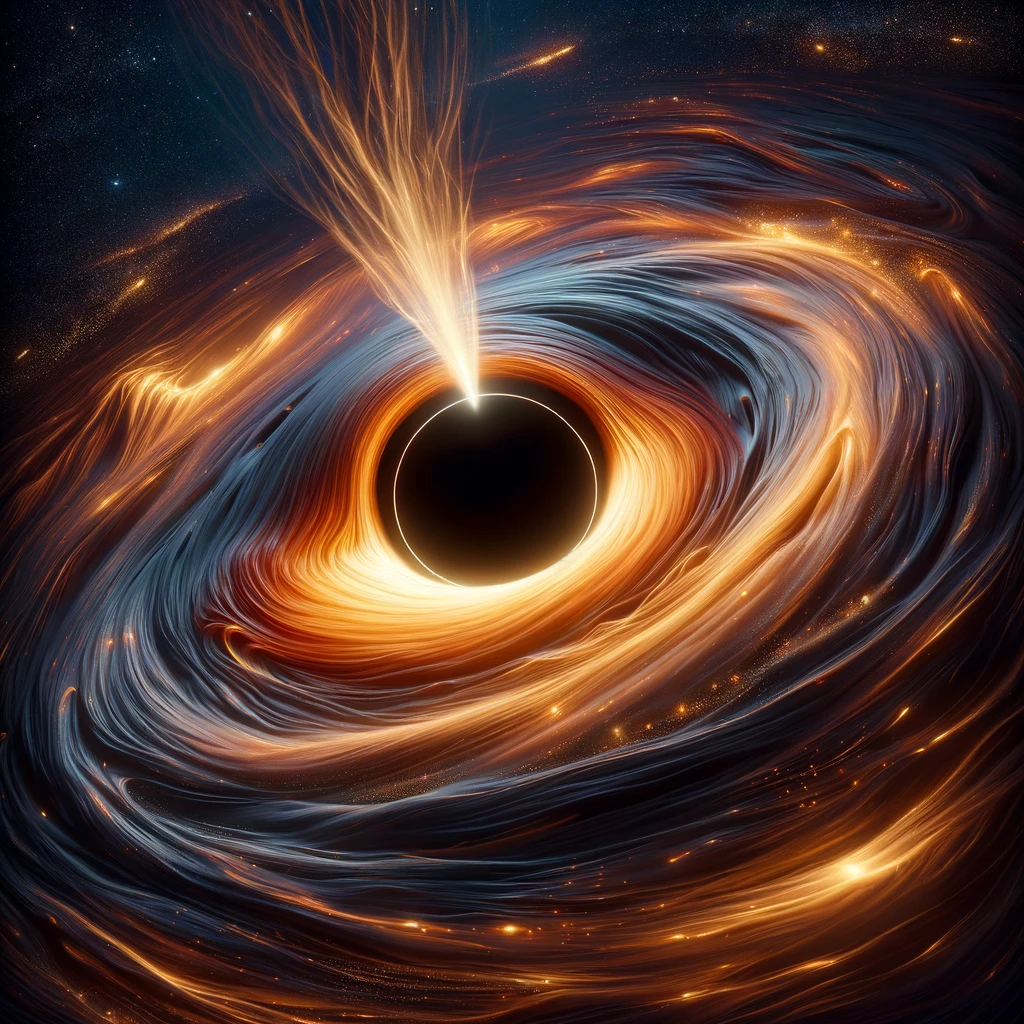
Exploring Philosophical and Metaphorical Interpretations
Beyond its formal meanings in mathematics and physics, the Fourth Dimension has also appeared in philosophical inquiry, literature, art, spirituality, and metaphorical descriptions of reality, perception, time, existence, and perspectives beyond ordinary human experience.
These interpretations occupy a different epistemic category from mathematical dimensionality or experimentally supported physical theories. Within XSE, they should therefore not be treated as scientific evidence merely because they employ dimensional language.
Their potential value lies elsewhere: they can challenge assumptions, expand perspective, generate questions, and stimulate critical and creative thinking about aspects of a System of Interest (SOI) that may be difficult to recognize from a conventional representation.
How Philosophical and Metaphorical Exploration Can Contribute
- Challenging the Limits of Perspective:
Human observation is necessarily limited by position, perception, knowledge, experience, and available information. Philosophical and metaphorical dimensional thinking can encourage the Pilot Systems Engineer to ask whether what appears obvious from one perspective would appear differently from another. This complements the XSE Vantage Point by challenging the analyst to examine the limitations of the viewpoint from which the SOI is being observed. - Generating New Questions:
A metaphor does not have to be literally true to expose a useful question. Concepts such as seeing “beyond what meets the eye,” viewing something from another dimension, or observing the present from outside its immediate context can prompt investigation into Factors, relationships, assumptions, consequences, or possibilities that have not yet been adequately considered. - Supporting Critical and Creative Thinking:
Unfamiliar conceptual perspectives can disrupt habitual patterns of thought. Used appropriately, metaphorical dimensional thinking can support the X Axiom by encouraging creative generation of possibilities while critical thinking evaluates whether those possibilities withstand evidence, logic, and further investigation. Creativity expands the field of inquiry; critical thinking disciplines it. - Examining Questions of Existence, Persistence, and Perception:
Philosophy has long investigated questions concerning time, identity, change, causality, perception, consciousness, and what it means for something to persist through time. When relevant to the SOI, such questions can expose assumptions embedded within the Synthesis and identify matters requiring further investigation through the appropriate Domain of Study. - Expanding Human-Centered Analysis:
Systems involving people cannot always be adequately understood through physical characteristics or technical performance alone. Meaning, values, intentions, experiences, beliefs, relationships, culture, and human consequences may also affect the system. XESAS already provides mechanisms for examining human Factors; philosophical inquiry may contribute additional questions or perspectives where appropriate. - Encouraging Cross-Disciplinary Investigation:
Dimensional concepts have influenced mathematics, physics, philosophy, literature, visual art, and other areas of human inquiry. Examining how different disciplines use dimensional language can generate useful comparisons and questions, provided their meanings are not improperly combined. A mathematical dimension, a physical dimension, a philosophical proposition, and an artistic metaphor may illuminate one another conceptually while remaining fundamentally different kinds of claims.
Metaphor as a Tool, Not Evidence
This distinction is essential within XSE:
A metaphor can reveal a question; it cannot, by itself, establish the answer.
For example, imagining that an SOI is being viewed from a higher dimension might expose a previously overlooked relationship. That insight can be valuable. However, the usefulness of the thought experiment does not establish that the SOI literally possesses a hidden physical dimension.
Likewise, philosophical or spiritual interpretations involving realities beyond ordinary perception should be identified according to the type of claim being considered. They should not be presented as conclusions of physics or mathematics without appropriate evidence.
This distinction is consistent with XSE’s emphasis on authentic Sources and the pursuit of truth: exploration may remain broad, while conclusions should remain proportionate to the evidence supporting them.
Application From the XSE Vantage Point
From the XSE Vantage Point, the Pilot Systems Engineer can use philosophical and metaphorical perspectives as tools for expanding the field of inquiry.
The question is not:
What metaphor should I believe?
Rather:
Does this perspective cause me to notice a legitimate question, assumption, relationship, possibility, or limitation that has not yet been adequately investigated within the XESAS Synthesis?
If it does, the resulting question can be investigated through the appropriate Factors, Domains of Study, Sources, Resources, and analytical methods.
This creates an important sequence:
Explore broadly → identify the question → investigate critically → evaluate the evidence → integrate only what can be appropriately supported.
Beyond What Meets the Eye
One of the strongest contributions of philosophical and metaphorical Fourth-Dimension Exploration is the reminder that the immediately observable representation of a system should not automatically be assumed to constitute everything relevant about that system.
That does not mean something hidden necessarily exists. It means the Systems Engineer remains willing to investigate the possibility that perspective, perception, representation, or existing knowledge has imposed a limitation on the analysis.
Fourth-Dimension Exploration can therefore encourage the Pilot to look beyond what meets the eye while maintaining the discipline necessary to distinguish observation from interpretation, possibility from probability, metaphor from model, and hypothesis from established fact.
Purpose Within XSE
Philosophical and metaphorical Fourth-Dimension Exploration is therefore not intended to transform metaphor into engineering fact or speculation into scientific evidence. Its purpose is to expand the space of questions available to the Systems Engineer.
Spatial exploration can challenge what the Pilot can see. Temporal exploration can challenge how the Pilot understands the system across time. Mathematical exploration can challenge how the system is represented. Philosophical and metaphorical exploration can challenge the assumptions governing what the Pilot has thought to ask in the first place.
From there, XSE returns to disciplined investigation.
Creative thinking opens possibilities. Critical thinking evaluates them. Authentic Sources and evidence help determine what can defensibly be incorporated into the XESAS Synthesis.
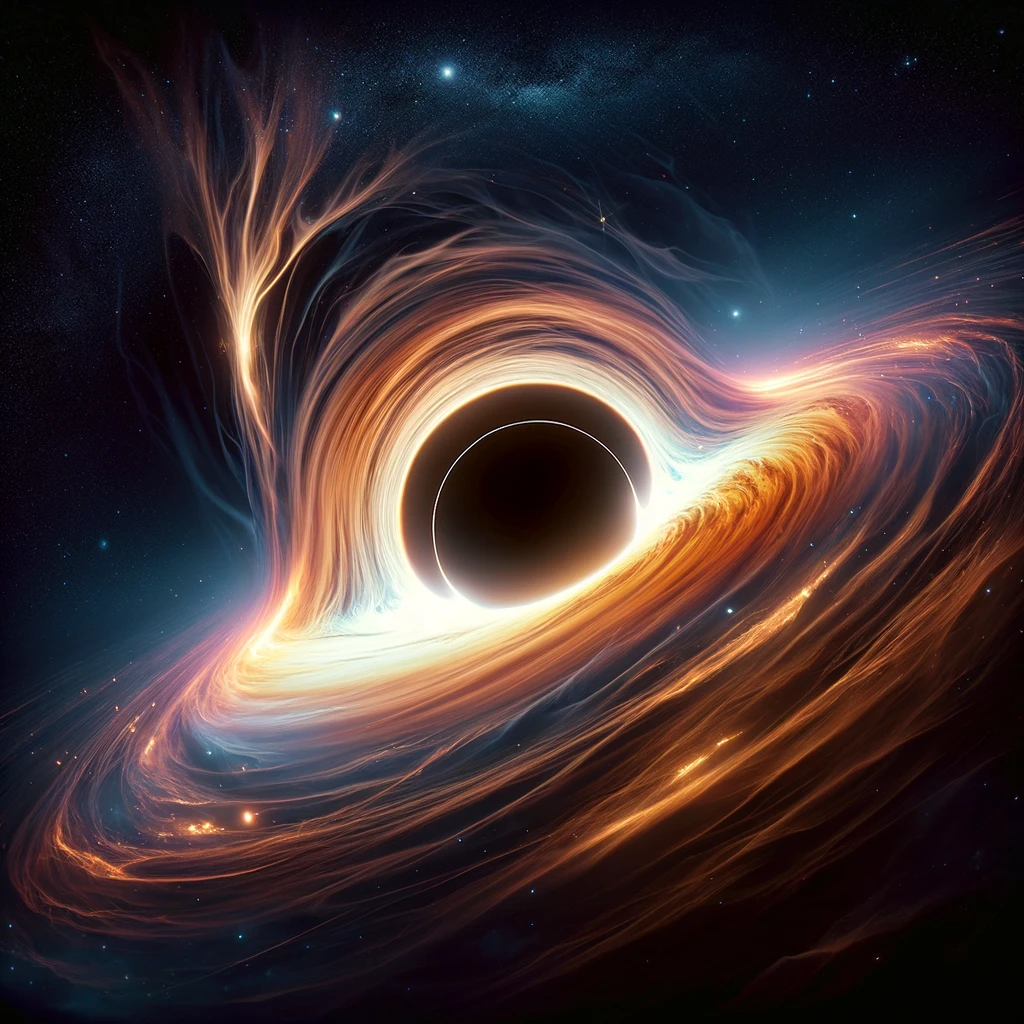
In a metaphorical rather than mathematical or physical sense, the Fourth Dimension can be used to represent an analytical movement beyond what meets the eye—from what is immediately observable toward the underlying properties, structures, relationships, conditions, and dynamics that may not be apparent from the surface.
The metaphor begins with a simple systems insight:
What can be observed from the outside does not necessarily reveal everything that is relevant about what exists within.
Consider a physical object. Its visible three-dimensional form may reveal its length, width, height, shape, surface condition, and other externally observable characteristics. Yet appearance alone may tell us very little about its internal composition, density, structural integrity, internal stresses, defects, temperature distribution, chemical properties, or other conditions affecting how it will actually behave.
These characteristics are not literally a fourth spatial dimension. They remain properties and conditions of the physical system. The Fourth Dimension is being used here strictly as a metaphor for extending investigation beyond the immediately observable representation.
From Surface Observation to Deeper Investigation
For the Systems Engineer, this metaphor creates a valuable analytical progression:
What can I see? → What lies beneath what I can see? → What can I measure or investigate? → What does the evidence establish? → What remains unknown?
A bridge can appear structurally sound while containing deterioration not readily visible from its exterior. A machine can appear operational while internal wear is developing. A computer system can present a simple interface while enormous complexity exists beneath it. An organization can appear successful according to one performance indicator while less-visible weaknesses are developing elsewhere in the system.
The lesson is not that these systems possess a mysterious Fourth Dimension. The lesson is that surface observation is not equivalent to comprehensive system knowledge.
Application to Human-Centered Systems
The same analytical caution applies when the SOI involves people, although the methods and evidentiary limits are different.
Observable behavior, communication, performance, or appearance cannot by themselves establish everything relevant about a person. Knowledge, intentions, experiences, values, relationships, environmental conditions, available Resources, and numerous other Factors may affect the system without being immediately observable.
The Systems Engineer should therefore avoid assuming that an external observation provides complete access to another person’s internal state. Instead, relevant questions can be investigated through appropriate evidence, communication, Sources, Domains of Study, and respect for the limits of what can actually be known.
A Metaphor That Generates Investigation
This is where the “Fourth Dimension” metaphor becomes useful within XSE.
It prompts the Pilot Systems Engineer to ask:
What might be relevant to this SOI that cannot be determined merely from what is immediately visible or presently represented?
That question does not authorize speculation. It initiates investigation.
What appears hidden may become measurable through better instrumentation, discoverable through additional Sources, understandable through another Domain of Study, identifiable through system history, or apparent after examining relationships among the Factors. Other matters may remain uncertain or unknowable with the available evidence—and that limitation should itself be recognized within the analysis.
More Than What Meets the Eye
Within XSE, “more than what meets the eye” can therefore function as a memorable metaphor for resisting superficial analysis.
The Systems Engineer moves beyond appearance without abandoning evidence:
Observe the surface. Question the representation. Investigate beneath it. Distinguish what is known from what is inferred. Seek authentic Sources. Then integrate what can actually be supported into the XESAS Synthesis.
The metaphorical Fourth Dimension does not claim that the “inside” of a system is literally another dimension. It reminds the Pilot Systems Engineer that what is immediately observable may represent only part of what must be understood.

In engineering, what can be observed from the exterior of a System of Interest does not necessarily reveal everything that must be known about it. Surface appearance, shape, and three-dimensional extent provide valuable information, but they do not by themselves establish the complete composition, condition, integrity, capability, or expected behavior of a system.
One of the clearest examples is the material from which a physical object or component is made.
Engineering materials include metals, polymers, ceramics, composites, and many other substances, each possessing properties and characteristics that influence how they behave under particular conditions. Two components can have nearly identical length, width, height, shape, and external appearance while possessing substantially different material properties and therefore behaving very differently when placed into service.
Depending upon the material and application, relevant properties may include strength, stiffness, hardness, ductility, density, toughness, thermal behavior, electrical characteristics, corrosion resistance, fatigue behavior, durability, and other characteristics affecting performance.
These are not additional spatial dimensions. They are properties of the material and system that cannot necessarily be established from its external three-dimensional appearance alone.
What Is Visible Is Not Necessarily What Is Known
An object may appear sound while containing internal defects, deterioration, stresses, weaknesses, or other conditions that are not readily visible. Conversely, something that appears unusual or damaged externally may remain structurally or functionally adequate after appropriate evaluation.
For this reason, an engineer does not simply assume that appearance establishes reality.
Depending upon the SOI and the question being investigated, understanding what lies beyond surface observation may require appropriate inspection, measurement, testing, calculations, material specifications, manufacturing information, engineering standards, historical records, scientific literature, specialized instrumentation, or other reliable Sources and Resources.
The analytical progression therefore moves beyond simply asking:
What can I see?
and continues toward:
What is actually there? What can be measured? What properties matter? What evidence establishes them? What remains uncertain?
This movement from observation to investigation is fundamental to sound systems analysis.
The Interior Is Still Three-Dimensional
This distinction is particularly important within a discussion of the Fourth Dimension.
The interior of a three-dimensional object is not literally its Fourth Dimension. Internal composition, hidden defects, material properties, energy states, and other characteristics do not become additional physical dimensions merely because they cannot be seen from the surface.
Rather, they provide a powerful illustration of a broader principle:
The limits of immediate observation are not necessarily the limits of the reality being observed.
This is where the concept connects to XSE’s metaphorical exploration of More Than What Meets the Eye.
The metaphor does not establish the existence of something hidden. It reminds the Systems Engineer that something relevant may remain outside the present observation or representation and should not be dismissed merely because it is not immediately apparent.
From Hidden Property to Systems Principle
The same principle extends beyond physical materials.
A machine’s exterior does not reveal every condition within its components. A software interface does not display the entire architecture operating behind it. A financial result does not necessarily reveal every process that produced it. An organization’s visible performance does not automatically expose every relationship, vulnerability, resource constraint, or developing risk within the larger system.
Likewise, when the SOI involves people, immediately observable behavior or appearance cannot establish everything relevant about the human system. Appropriate analysis must respect the limits of observation and avoid treating assumptions about another person’s internal state as established facts.
Across different SOIs, the particular investigative methods will vary. The systems-engineering principle remains:
Do not confuse what is readily observable with everything that is relevant to know.
Investigate—Do Not Invent
Looking beyond the surface does not give the Systems Engineer permission to fill unknown spaces with assumptions.
Quite the opposite.
When something relevant is not known, the proper response is to identify the uncertainty and investigate it through appropriate methods.
This distinction is especially important in Fourth-Dimension Exploration. A possibility generated through critical or creative thinking may identify a valuable direction for inquiry, but possibility alone does not establish reality.
The Pilot Systems Engineer should distinguish among:
what is observed → what is measured → what is supported by evidence → what is reasonably inferred → what is theoretical → what is metaphorical → and what remains unknown.
Maintaining these distinctions protects the integrity of the XESAS Synthesis while allowing exploration to remain broad.
More Than What Meets the Eye
From the XSE Vantage Point, the Pilot Systems Engineer can therefore ask:
What relevant facts, properties, relationships, conditions, or dimensions of this SOI might not be apparent from the representation presently available to me?
The answer may require looking beneath a physical surface, examining another Epoch, investigating another Source, applying another Domain of Study, changing the mathematical representation, considering another dimensional perspective, or recognizing that the available evidence is presently insufficient to know.
Fourth-Dimension Exploration does not presume what the answer will be.
It preserves the question.
That is the larger systems-engineering lesson behind More Than What Meets the Eye: a representation can be accurate while still being incomplete, and an observation can be truthful while still revealing only part of what is relevant to the system.
The goal is neither to believe in what cannot be seen nor to dismiss what has not yet been seen. The goal is to investigate far enough, carefully enough, and truthfully enough to determine what the available evidence actually supports.