Think Twice

Think Twice

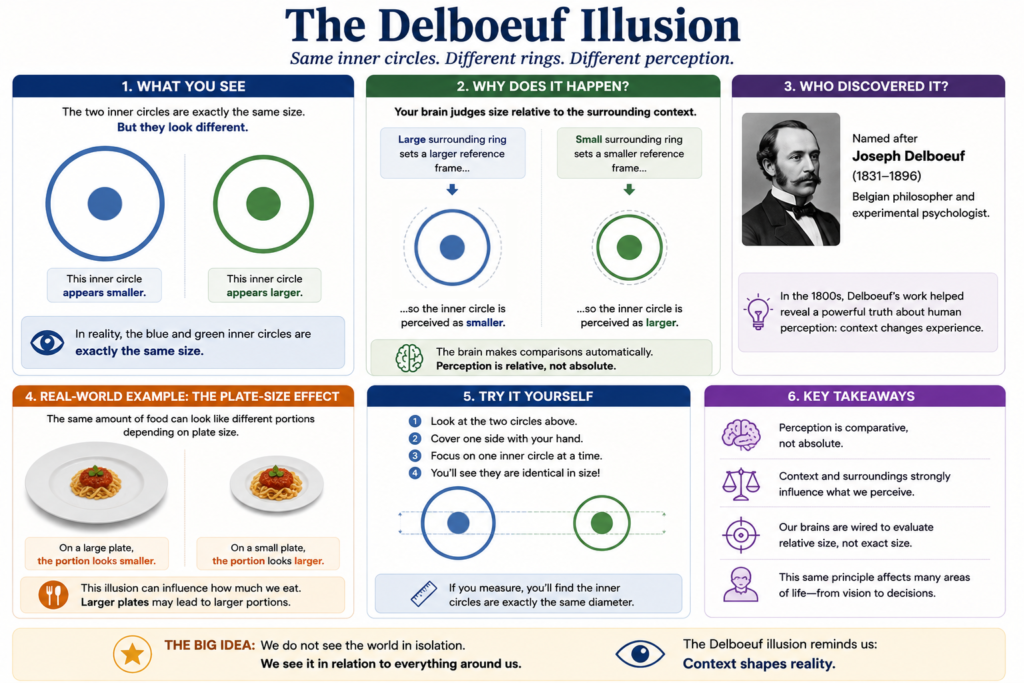
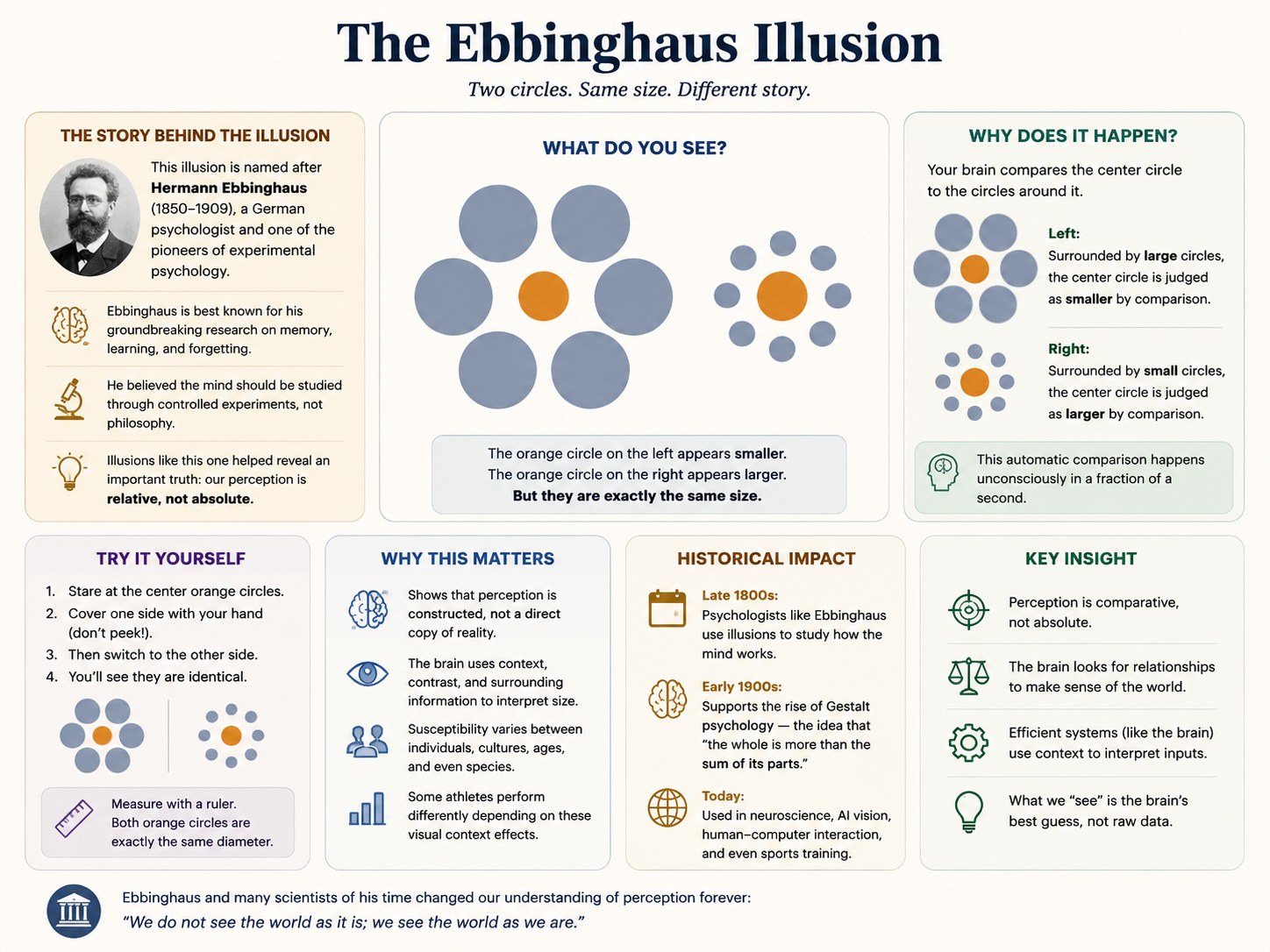
The Ebbinghaus illusion, sometimes called the Titchener circles illusion, is a classic perceptual illusion that demonstrates how strongly the human brain evaluates size comparatively rather than absolutely. In the illusion, two identical central circles are surrounded by circles of different sizes, causing the center circle surrounded by larger circles to appear smaller while the identical center circle surrounded by smaller circles appears larger. Although the two center circles are objectively the exact same size, the visual system automatically judges them relative to their surrounding context, revealing that perception depends heavily on comparison and relational interpretation rather than isolated measurement. Associated with Hermann Ebbinghaus, the illusion became historically important because it provided early evidence that perception is not a passive recording of reality but an active interpretive process shaped by surrounding information and contextual relationships. Psychologically, the illusion demonstrated that the brain continuously organizes and evaluates sensory input comparatively in order to rapidly understand the environment, a strategy that is highly useful for survival but can also produce systematic distortions under specially engineered conditions. The Ebbinghaus illusion became influential in cognitive psychology, neuroscience, visual perception research, and even sports science, where researchers discovered that perceived target size can influence performance in activities such as golf, basketball, and archery. From a systems engineering perspective, the illusion demonstrates that intelligent perceptual systems rely heavily on contextual scaling and probabilistic relational processing rather than exact objective measurement, continuously interpreting objects according to surrounding environmental structure. Ultimately, the Ebbinghaus illusion reveals a profound truth about human cognition and perception: what humans consciously experience as size is deeply shaped by context, comparison, and interpretive processing, reminding us that perception itself is an actively constructed model of reality rather than a purely objective representation of the external world.

Optical illusions such as the Müller-Lyer illusion, Shepard tables illusion, Ebbinghaus illusion, and Munker-White illusion are profoundly important within Independent Integration Systems Engineering (XSE) because they reveal one of the deepest realities about the human system:

Human beings do not perceive reality directly.

They perceive the mind’s interpretation of reality.

Within XSE, this insight becomes foundational to understanding:

At first glance, optical illusions may appear to be little more than entertaining visual tricks. Yet within psychology, neuroscience, cognitive science, systems engineering, and XSE, these illusions represent something far more significant:

They expose the active, interpretive, predictive, and imperfect nature of human perception itself.

For centuries, many people implicitly assumed perception worked similarly to a camera:

  • the eyes captured objective reality,
  • and the brain simply displayed it accurately.

Optical illusions shattered that assumption.

Instead, these phenomena revealed that the human mind continuously:

  • predicts,
  • compares,
  • filters,
  • interprets,
  • fills gaps,
  • constructs meaning,
  • and models reality from incomplete information.

Within XSE, this becomes critically important because the human system operates largely through interpreted models of reality rather than direct access to reality itself.

Thus, illusions become powerful demonstrations of why:

  • systems awareness,
  • investigation,
  • perspective,
  • humility,
  • and truth-seeking

are essential for human flourishing and accurate systems operation.
Optical Illusions and the Mind

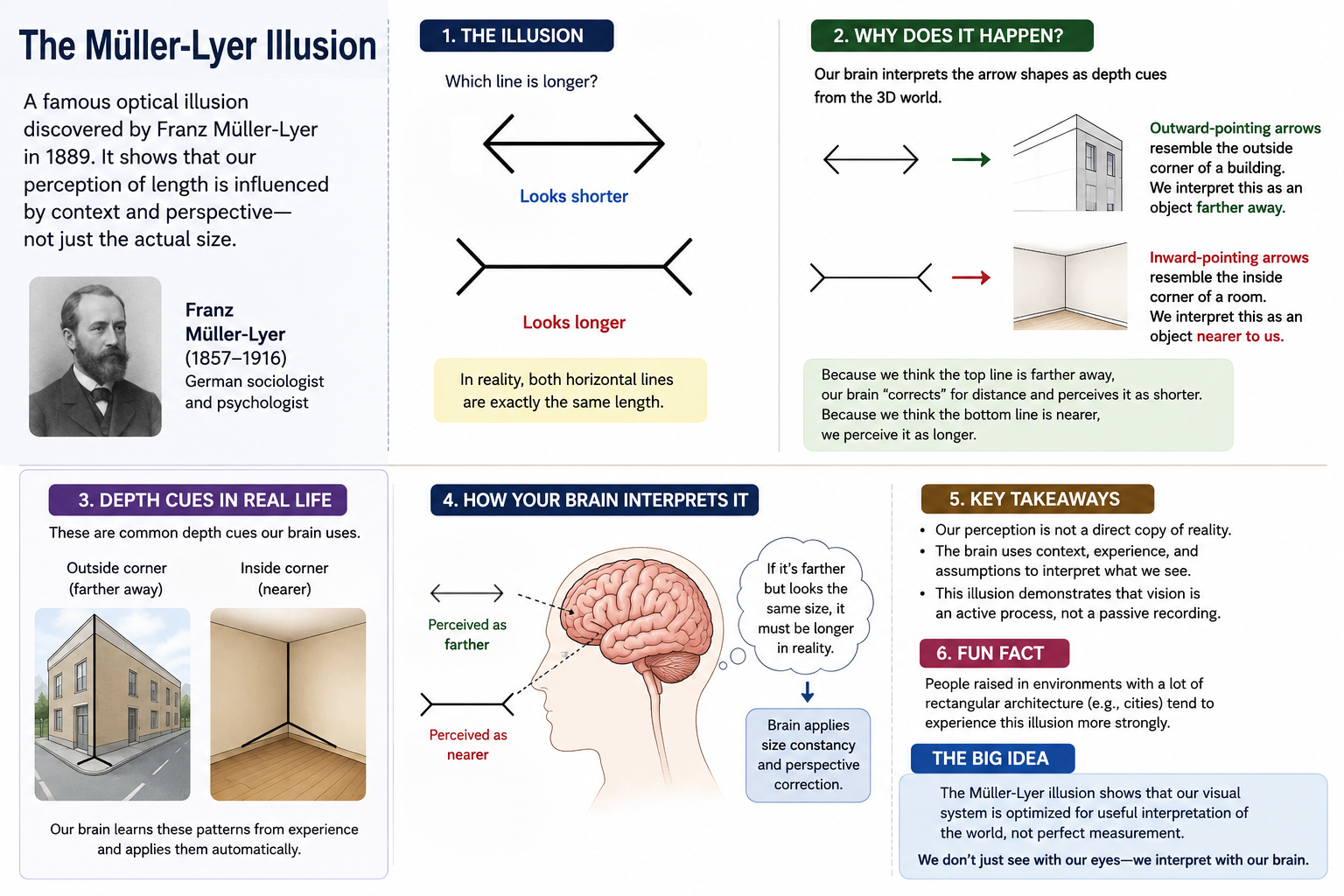
The Müller-Lyer illusion is one of the most famous and historically important optical illusions in psychology because it demonstrates how the human brain actively interprets visual information using assumptions about depth, perspective, and spatial structure rather than simply measuring objective reality directly. First described in 1889 by Franz Carl Müller-Lyer, the illusion typically consists of two identical horizontal lines placed between different arrow-like fins, causing one line to appear significantly longer than the other even though both are exactly the same length. The illusion occurs because the visual system unconsciously interprets the angled fins as perspective and depth cues similar to inside and outside corners found in real-world environments, leading the brain to automatically apply size and distance corrections based on inferred three-dimensional structure. Psychologically, the Müller-Lyer illusion became profoundly important because it revealed that perception is not a passive recording of raw sensory data, but an active constructive process shaped by predictive interpretation, contextual assumptions, and learned environmental experience. The illusion helped support the development of modern cognitive psychology, neuroscience, Gestalt theory, and visual perception research by demonstrating that the brain continuously attempts to infer the most meaningful interpretation of sensory input rather than simply representing exact measurements. Cross-cultural research on the illusion further suggested that perceptual interpretation may be influenced partly by environmental experience, as individuals raised in highly “carpentered” environments with rectangular architecture often experience the illusion more strongly than those from less geometrically structured settings. From a systems engineering perspective, the Müller-Lyer illusion demonstrates that intelligent perceptual systems prioritize efficient environmental interpretation and functional spatial understanding over perfect geometric accuracy, relying on probabilistic inference and predictive modeling to rapidly navigate the world. Ultimately, the Müller-Lyer illusion reveals a profound truth about human cognition: what humans consciously perceive as size and distance is deeply shaped by context, interpretation, and the brain’s internally constructed model of reality rather than by direct objective measurement alone.

Within XSE, the Mind is one of the three foundational aspects of the human system alongside the Body and Spirit.

The mind is not treated as a passive recording device, but as an active cognitive subsystem continuously engaged in:

  • interpretation,
  • prediction,
  • abstraction,
  • prioritization,
  • and environmental modeling.

Optical illusions vividly demonstrate this process.

The Müller-Lyer illusion reveals that the mind automatically infers depth and perspective, even when those inferences distort objective measurement.

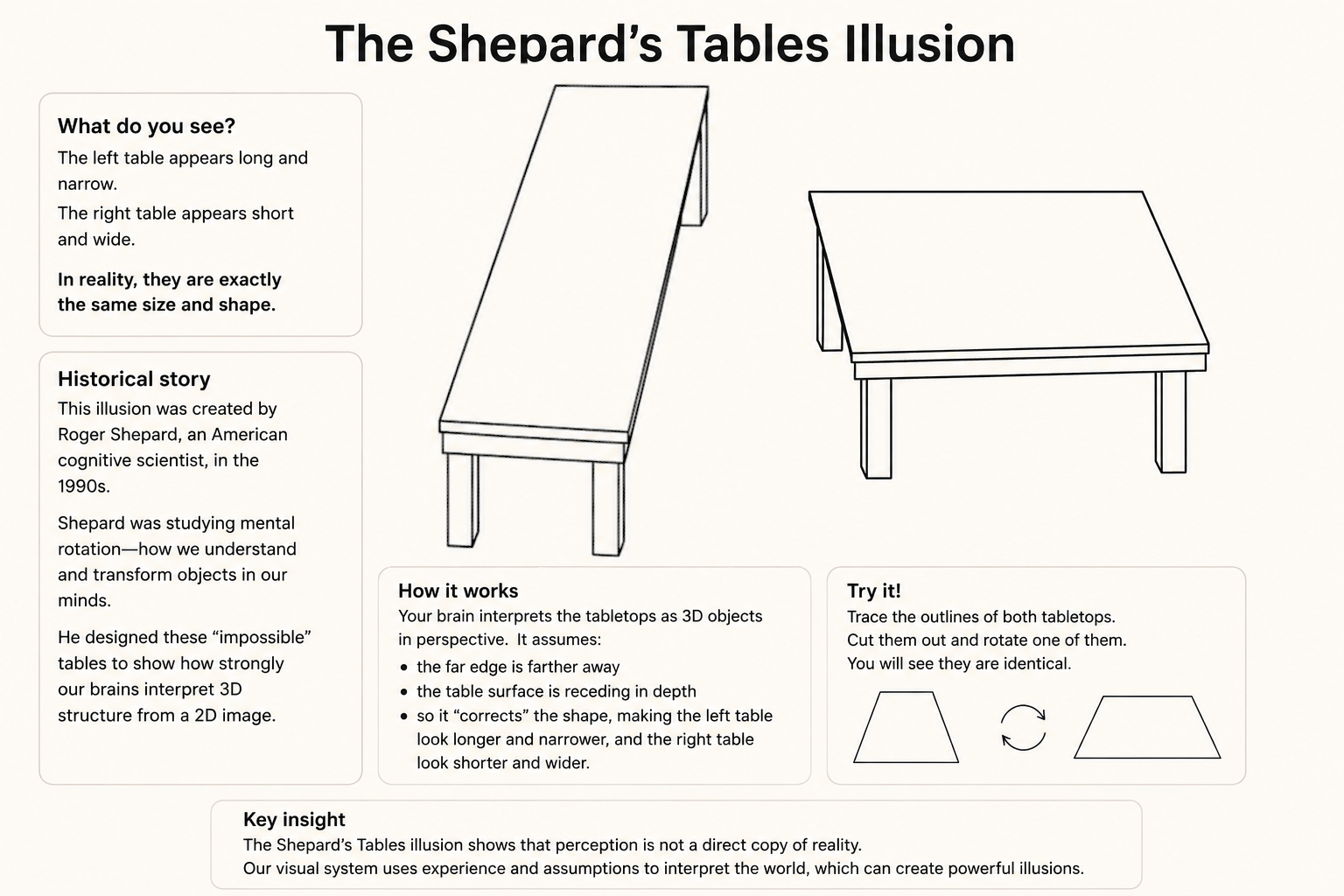
The Shepard tables illusion demonstrates that inferred three-dimensional structure strongly influences perceived shape and proportion.

The Ebbinghaus illusion shows that perception is comparative rather than absolute.

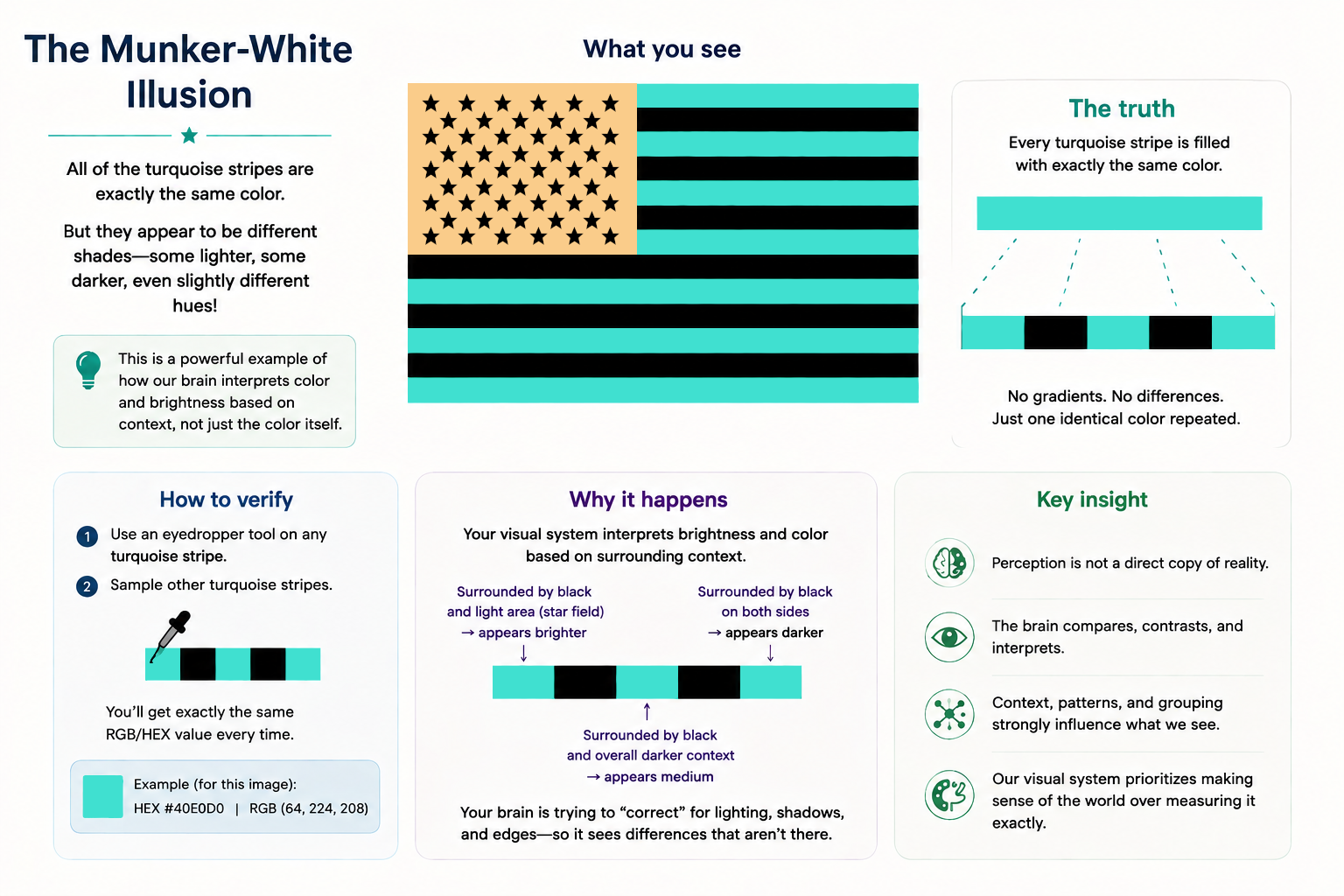
The Munker-White illusion demonstrates that brightness and color perception depend heavily upon surrounding context and perceptual grouping.

Together, these illusions reveal a core XSE principle: Perception is not passive reception.

It is active construction.

This insight aligns deeply with the X Axiom:

“Using critical & creative thinking augments intelligence.”

Because perception itself can distort reality, intelligence requires more than automatic interpretation.
It requires:

  • investigation,
  • reflection,
  • calibration,
  • and critical analysis.

The Mind Gateway & Perceptual Filtering

The Shepard tables illusion is a famous optical illusion created by Roger Shepard that demonstrates how strongly the human brain relies on perspective and three-dimensional interpretation when perceiving shape and size. In the illusion, two tabletops appear dramatically different in dimension and proportion, with one seeming long and narrow while the other appears short and wide, even though the tabletops are actually identical in size and shape and differ only by rotation. The illusion occurs because the visual system automatically interprets the drawings as three-dimensional objects viewed from different angles, causing the brain to unconsciously apply perspective corrections based on inferred depth and orientation. As a result, the brain mentally transforms the shapes according to its assumptions about spatial geometry, overriding the actual two-dimensional measurements present on the page. Psychologically, the Shepard tables illusion became highly significant because it demonstrated that perception is not simply based on raw visual input, but is instead an active constructive process shaped by predictive interpretation, depth inference, and contextual modeling. Even after viewers learn that the tabletops are objectively identical, the illusion often persists, revealing how deeply embedded these spatial interpretation mechanisms are within human cognition. From a systems engineering and neuroscience perspective, the illusion demonstrates that intelligent perceptual systems prioritize functional understanding of environmental structure over exact geometric accuracy, continuously using probabilistic inference and learned assumptions to generate stable models of three-dimensional reality. This insight became important in cognitive science, artificial intelligence, machine vision, and philosophy of perception because it revealed that conscious experience is heavily shaped by internally generated interpretations rather than direct sensory measurement alone. Ultimately, the Shepard tables illusion reveals a profound truth about human perception: what we consciously experience as shape, size, and proportion is deeply influenced by context, perspective, and the brain’s automatic effort to construct meaningful spatial understanding from incomplete visual information.

Within XSE, the Mind Gateway represents the interface through which informational inputs enter and influence the human system.

Optical illusions reveal that this gateway is not perfectly objective.

Inputs are filtered through:

  • prior assumptions,
  • environmental context,
  • neurological heuristics,
  • pattern recognition systems,
  • attentional limitations,
  • and predictive processing mechanisms.

Thus, the human system continuously operates through interpreted reality models rather than purely objective perception.

This becomes profoundly important in the cyber age, where informational environments increasingly shape:

  • beliefs,
  • identity,
  • emotion,
  • attention,
  • and worldview.

Modern systems often exploit perceptual vulnerabilities through:

  • persuasive design,
  • media framing,
  • deepfakes,
  • algorithmic manipulation,
  • outrage amplification,
  • and engineered comparison systems.

Thus, XSE strongly emphasizes intentional systems awareness and cognitive investigation.

Human Factors Engineering & Optical Illusions

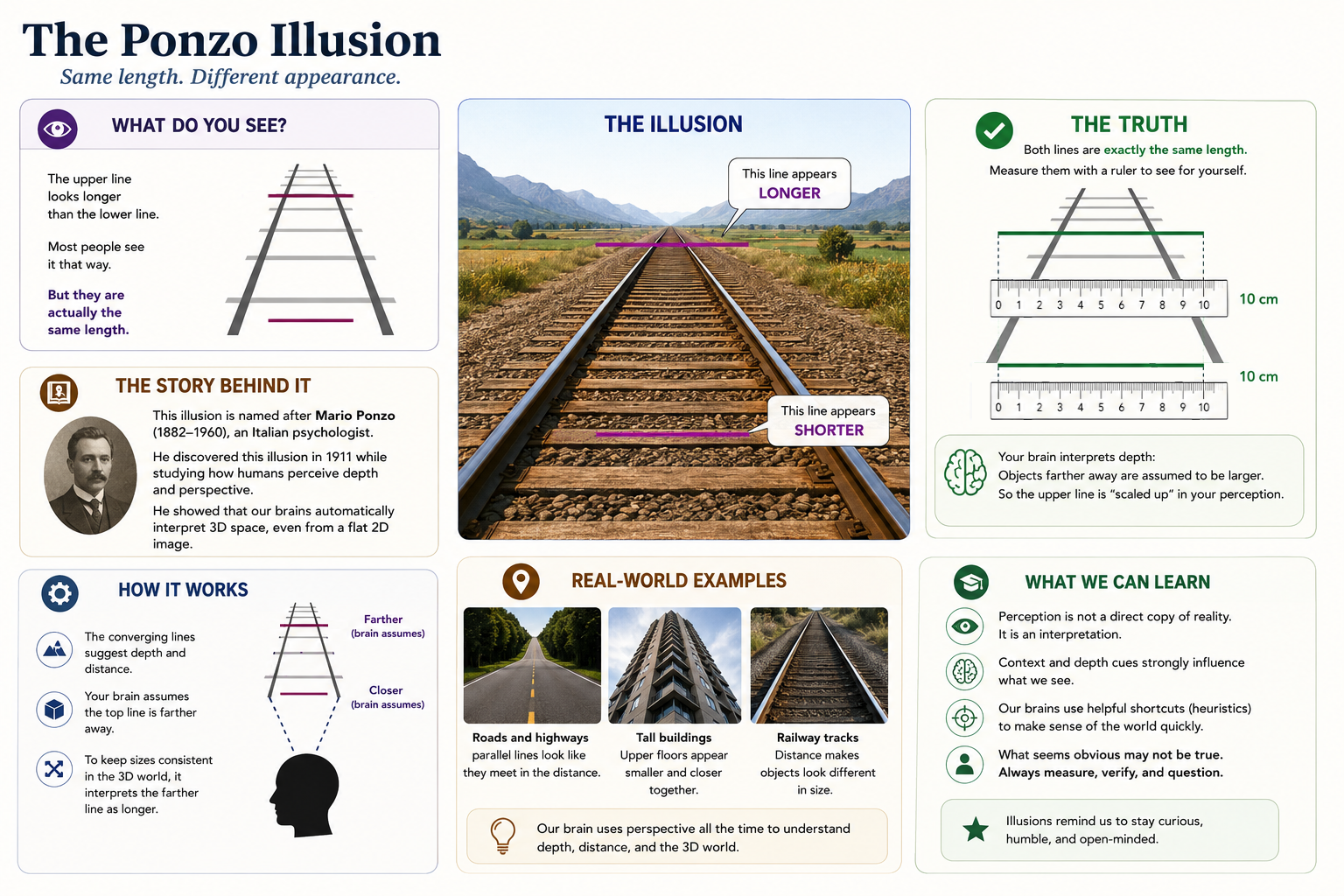
The Ponzo illusion is a classic optical illusion that demonstrates how the human brain interprets size in relation to perceived depth and perspective rather than by objective measurement alone. In the illusion, two identical horizontal lines are placed across converging background lines resembling railroad tracks or a road stretching into the distance, causing the upper line to appear significantly larger than the lower one even though both lines are physically the same length. This occurs because the visual system automatically interprets the converging lines as depth cues, causing the brain to perceive the upper line as being farther away; according to the brain’s built-in assumptions about perspective and size constancy, an object that appears farther away but produces the same retinal image must therefore be physically larger. Psychologically, the Ponzo illusion became highly important because it revealed that perception is not a direct recording of raw sensory information, but an active inferential process in which the brain continuously estimates distance, scale, and spatial relationships in order to construct a coherent understanding of the environment. The illusion demonstrated that human perception relies heavily on predictive interpretation and learned assumptions about three-dimensional space, helping shape modern theories in cognitive psychology, neuroscience, visual cognition, and perceptual processing. From a systems engineering perspective, the Ponzo illusion illustrates how intelligent perceptual systems prioritize functional environmental interpretation over exact geometric accuracy, using contextual depth cues and probabilistic modeling to rapidly infer real-world structure. Although these predictive mechanisms normally help humans navigate space efficiently and accurately, specially engineered images such as the Ponzo illusion expose the assumptions underlying perception by creating situations in which the brain’s automatic interpretations conflict with objective physical measurements. Ultimately, the Ponzo illusion reveals that what humans consciously experience as size is deeply influenced by context, perspective, and inferred spatial relationships, reminding us that perception itself is an actively constructed model of reality rather than a perfectly objective representation of the external world.

Human factors engineering recognizes that human operators are not perfectly objective processors of reality.

Perceptual systems contain:

  • limitations,
  • biases,
  • heuristics,
  • attentional constraints,
  • and interpretation vulnerabilities.

This has enormous implications for:

  • aviation,
  • military systems,
  • interface design,
  • transportation,
  • safety systems,
  • architecture,
  • ergonomics,
  • and human-machine interaction.

For example:

  • pilots may experience spatial disorientation,
  • operators may misinterpret instrument layouts,
  • drivers may misjudge distance and speed,
  • and interface users may overlook critical information due to perceptual grouping effects.

Thus, systems engineering must account for actual human perception rather than idealized assumptions about cognition.

XSE extends this principle beyond technology into human life itself.

Optical Illusions & Investigative Skills

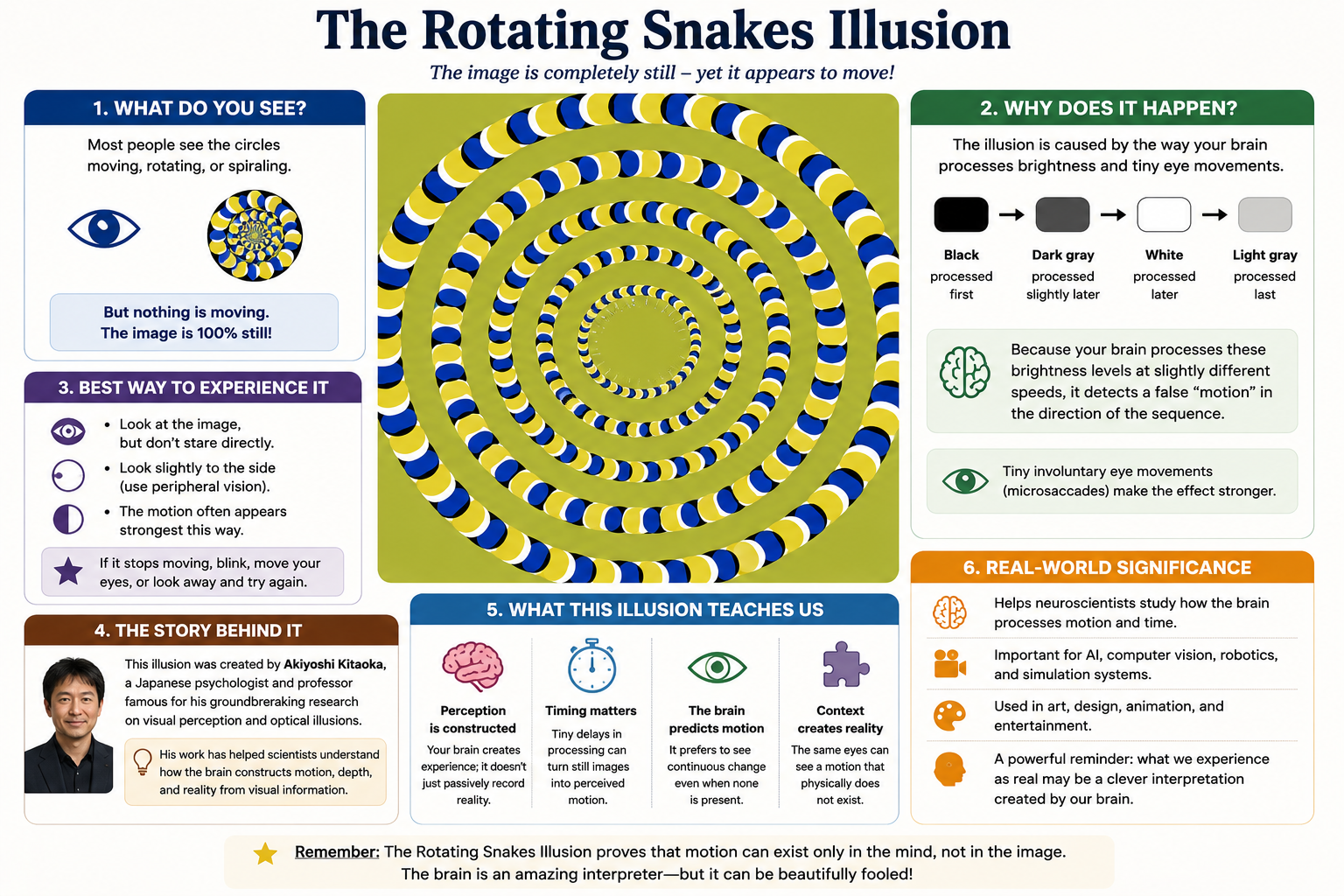
The Rotating snakes illusion is one of the most remarkable demonstrations of how the human brain actively constructs motion from static visual information. Created by Akiyoshi Kitaoka, the illusion consists of carefully arranged repeating patterns of contrasting colors and brightness gradients that appear to rotate, ripple, or drift even though the image itself is completely motionless. This effect occurs because the visual system processes different brightness levels at slightly different speeds while tiny involuntary eye movements, known as Microsaccades, continuously shift the image across the retina. The brain interprets these subtle timing differences and shifting signals as real movement, especially in peripheral vision where motion sensitivity is stronger and visual detail is lower. Psychologically, the illusion is profoundly important because it demonstrates that motion perception is not simply detected directly from the external world but is instead actively generated through predictive and interpretive neural processing. The illusion revealed to neuroscientists that conscious visual experience depends heavily on temporal processing, contrast interpretation, and unconscious biological mechanisms operating beneath awareness. From a systems engineering perspective, the rotating snakes illusion demonstrates that the visual system functions as a dynamic temporal prediction engine rather than a passive camera, continuously integrating brightness, motion cues, eye movements, and contextual information to construct stable perception. This insight has influenced neuroscience, artificial intelligence, robotics, computer vision, and cognitive science by showing that intelligent perception depends on inference and predictive modeling rather than simple recording of sensory data. Ultimately, the rotating snakes illusion reveals a profound truth about human experience: what feels like unquestionable motion may actually be the brain’s internally generated interpretation of carefully arranged visual information, reminding us that perception itself is an active construction of the mind rather than a direct copy of external reality.

Within XSE, optical illusions become valuable training tools for Investigative Skills because they demonstrate operationally that:

appearances are not always identical to reality.

A person may consciously know the Shepard tables are identical in size and shape, yet still perceive them differently.

This reveals that much of cognition operates automatically beneath conscious awareness.

Thus, illusions train:

  • humility,
  • verification,
  • skepticism toward assumptions,
  • perspective expansion,
  • and disciplined investigation.

The Investigative Systems Engineer recognizes:

  • first impressions may be incomplete,
  • perception may distort reality,
  • and systems often contain hidden variables requiring deeper analysis.

This directly supports XSE’s truth-seeking orientation.

Truth & Integrity in XSE

The The dress became one of the most famous demonstrations of perceptual subjectivity in modern history because millions of people looked at the exact same photograph yet genuinely perceived dramatically different colors, with some seeing the dress as blue and black while others saw it as white and gold. Although the actual physical dress was blue and black, the photograph contained highly ambiguous lighting cues that caused different brains to make different assumptions about the illumination of the scene. Some viewers interpreted the image as being under cool bluish shadow and unconsciously subtracted blue light from the image, causing the dress to appear white and gold, while others interpreted the scene as being under warm lighting and mentally discounted yellow tones, leading the dress to appear blue and black. Scientifically, the illusion became enormously important because it demonstrated that perception is not determined solely by raw sensory input, but is instead an active interpretive process shaped by contextual assumptions, predictive modeling, and mechanisms such as Color constancy, which normally help humans perceive stable object colors despite constantly changing lighting conditions. Neuroscientists and psychologists became fascinated by the phenomenon because it provided a large-scale real-world demonstration that two people can sincerely experience different conscious perceptions while viewing identical visual data. From a systems engineering perspective, the illusion demonstrates that intelligent perceptual systems continuously estimate environmental conditions, infer lighting sources, and construct stable interpretations of reality rather than simply recording exact pixel values. Ultimately, The Dress revealed a profound truth about human cognition and perception: what we consciously experience is not merely objective reality itself, but the brain’s best predictive interpretation of reality based on context, assumptions, and incomplete information.

Optical illusions strongly reinforce one of the deepest principles within XSE:

Reality exists independently of perception.

Perception may distort.
Interpretation may fail.
Context may mislead.
Emotion may bias.

But objective reality itself remains unchanged.

Thus, XSE places extraordinary importance on truth-seeking.

The Alpha Axiom states:

“Integrity is founded on truth.”

Within systems engineering, systems cannot operate optimally if based on false assumptions.

An engineer who ignores accurate measurements creates unstable systems.

Likewise, human beings operating from distorted perceptions may:

  • make destructive decisions,
  • pursue false goals,
  • misunderstand themselves,
  • or drift toward unhealthy trajectories.

Thus, optical illusions become symbolic demonstrations of why:

  • investigation,
  • feedback,
  • calibration,
  • humility,
  • and integrity

are essential within XSE.

Context, Comparison, & Human Self-Perception

The Munker-White illusion is a powerful optical illusion that demonstrates how the human brain interprets brightness and color relationally rather than objectively, revealing that perception is deeply shaped by surrounding context and pattern organization. In the illusion, identical colored or gray regions appear dramatically lighter, darker, or even slightly different in hue depending on the stripes or surrounding patterns that intersect them, despite the fact that the regions themselves are physically identical. Unlike simpler contrast illusions, the Munker-White illusion showed scientists that perception is not determined solely by direct neighboring contrast, but also by larger grouping relationships, spatial organization, and the brain’s interpretation of how visual elements belong together within a scene. Psychologically and neuroscientifically, the illusion became highly significant because it demonstrated that the visual system actively constructs brightness and color experience by integrating contextual information, edge relationships, pattern continuity, and perceptual grouping rather than simply measuring raw light intensity. The illusion helped support modern theories of predictive and interpretive perception, revealing that the brain continuously attempts to organize visual input into coherent structures and meaningful environmental models. From a systems engineering perspective, the Munker-White illusion demonstrates that intelligent perceptual systems operate relationally and contextually, evaluating information based on surrounding structure and inferred organization rather than isolated measurements alone. This insight became important in neuroscience, computer vision, artificial intelligence, interface design, and cognitive science because it revealed that intelligent visual interpretation depends heavily on contextual inference and pattern integration. Ultimately, the Munker-White illusion reveals a profound truth about human perception: what we consciously experience as brightness or color is not simply a direct reading of physical reality, but the brain’s actively constructed interpretation of visual relationships, context, and meaning.

The Ebbinghaus illusion demonstrates that perception is relational rather than absolute.

The exact same circle appears larger or smaller depending upon surrounding circles.

Within XSE, this principle extends far beyond vision into human psychology and systems behavior.

People often evaluate themselves comparatively rather than objectively:

  • success relative to peers,
  • attractiveness relative to media standards,
  • wealth relative to society,
  • suffering relative to surrounding expectations.

Thus, environments strongly shape self-perception.

Modern digital systems intensify this effect through constant exposure to:

  • curated lifestyles,
  • filtered images,
  • achievement comparison,
  • and social metrics.

XSE recognizes that these contextual systems can distort:

Thus, systems awareness becomes increasingly necessary for maintaining coherent self-understanding.

Predictive Processing & Systems Engineering

The Phi phenomenon is one of the most historically important discoveries in psychology and neuroscience because it revealed that the human brain can construct the experience of smooth motion from completely still and separate visual images. First studied in 1912 by Max Wertheimer, the phenomenon occurs when stationary lights or images are shown in rapid succession, causing the brain to perceive continuous movement even though no object is actually moving through space. This discovery became foundational to Gestalt Psychology because it demonstrated that perception is not merely the passive assembly of isolated sensory inputs, but an active process in which the mind organizes information into coherent wholes and meaningful experiences. The phi phenomenon ultimately became the basis for movies, animation, television, LED displays, and modern visual media, all of which rely on rapidly changing still frames to create the illusion of fluid motion. Neuroscientifically, the illusion revealed that the visual system continuously integrates information across time, detecting positional changes and interpreting them as motion through predictive and inferential neural processing rather than direct observation alone. From a systems engineering perspective, the phi phenomenon demonstrates that intelligent perceptual systems construct continuity by integrating fragmented data into stable temporal models, allowing the brain to generate coherent experience from incomplete information. Ultimately, the phi phenomenon revealed a profound truth about human perception: what feels like smooth, flowing reality may actually be an internally constructed interpretation generated by the brain’s continuous effort to organize, predict, and make sense of changing sensory patterns.

Modern neuroscience increasingly understands the brain as a predictive engine.

Rather than merely reacting to sensory input, the mind continuously:

  • generates models,
  • predicts outcomes,
  • interprets incomplete information,
  • and updates internal representations based on feedback.

Optical illusions reveal moments where predictive models conflict with objective measurement.

Within XSE, this aligns strongly with systems engineering concepts involving:

  • modeling,
  • feedback loops,
  • prediction,
  • adaptation,
  • and iterative calibration.

Human beings continuously operate through internal models of reality.

Optical Illusions & Entropy

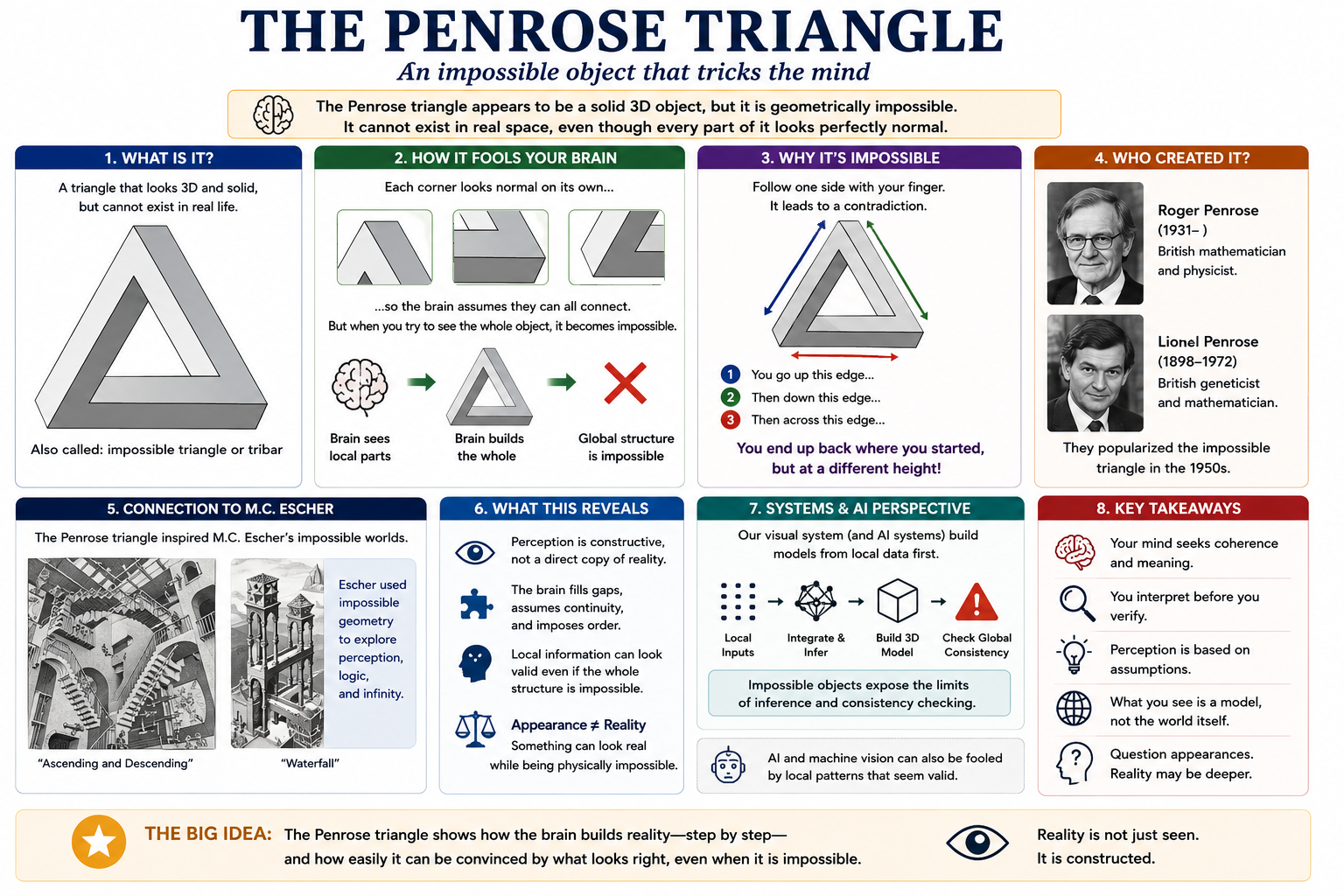
The Penrose triangle, also known as the impossible triangle or tribar, is one of the most fascinating demonstrations of how the human brain actively constructs visual reality rather than merely recording it. At first glance, the object appears to be a perfectly ordinary three-dimensional triangular structure, yet upon closer examination its geometry becomes impossible because the three sides cannot consistently exist together in real physical space. Each individual corner and segment appears locally believable and follows normal perspective rules, but when the brain attempts to unify the entire structure into a coherent whole, hidden contradictions emerge that violate actual Euclidean geometry. Popularized in the 1950s by Roger Penrose and Lionel Penrose, the illusion became deeply influential in psychology, neuroscience, mathematics, philosophy, and art because it revealed that perception often prioritizes local interpretation before verifying global consistency. The visual system naturally assumes continuity, coherent depth, and stable spatial relationships, so the brain initially accepts the impossible figure as real until deeper analysis exposes the contradiction. This illusion strongly influenced the work of M. C. Escher, whose famous impossible staircases, paradoxical buildings, and infinite architectural loops explored the fragile boundary between perception and logical impossibility. Psychologically, the Penrose triangle demonstrates that human perception is constructive, inferential, and highly dependent on predictive interpretation. The brain constantly attempts to impose coherence and meaning onto sensory information, even when true coherence is impossible. From a systems engineering perspective, the illusion shows how intelligent systems process information hierarchically, integrating local inputs first and attempting global reconciliation afterward. This strategy is highly efficient in normal environments but becomes vulnerable when confronted with specially engineered paradoxes that exploit the assumptions built into perceptual processing. Ultimately, the Penrose triangle reveals that something can appear visually convincing while being physically impossible, reminding us that conscious experience is not a direct copy of objective reality but rather a constructed model generated by the mind through interpretation, expectation, and spatial inference.

Within XSE, entropy refers to the tendency of systems toward:

  • disorder,
  • fragmentation,
  • distortion,
  • confusion,
  • and destabilization.

Optical illusions demonstrate how easily perception itself may become distorted.

Without:

  • reflection,
  • investigation,
  • perspective,
  • feedback,
  • and truth-seeking,

human systems may drift increasingly toward cognitive entropy.

Thus, illusions become anti-entropic educational tools because they expose:

  • the limitations of perception,
  • the vulnerability of assumptions,
  • and the necessity of ongoing systems calibration.

The XSE Vantage Point

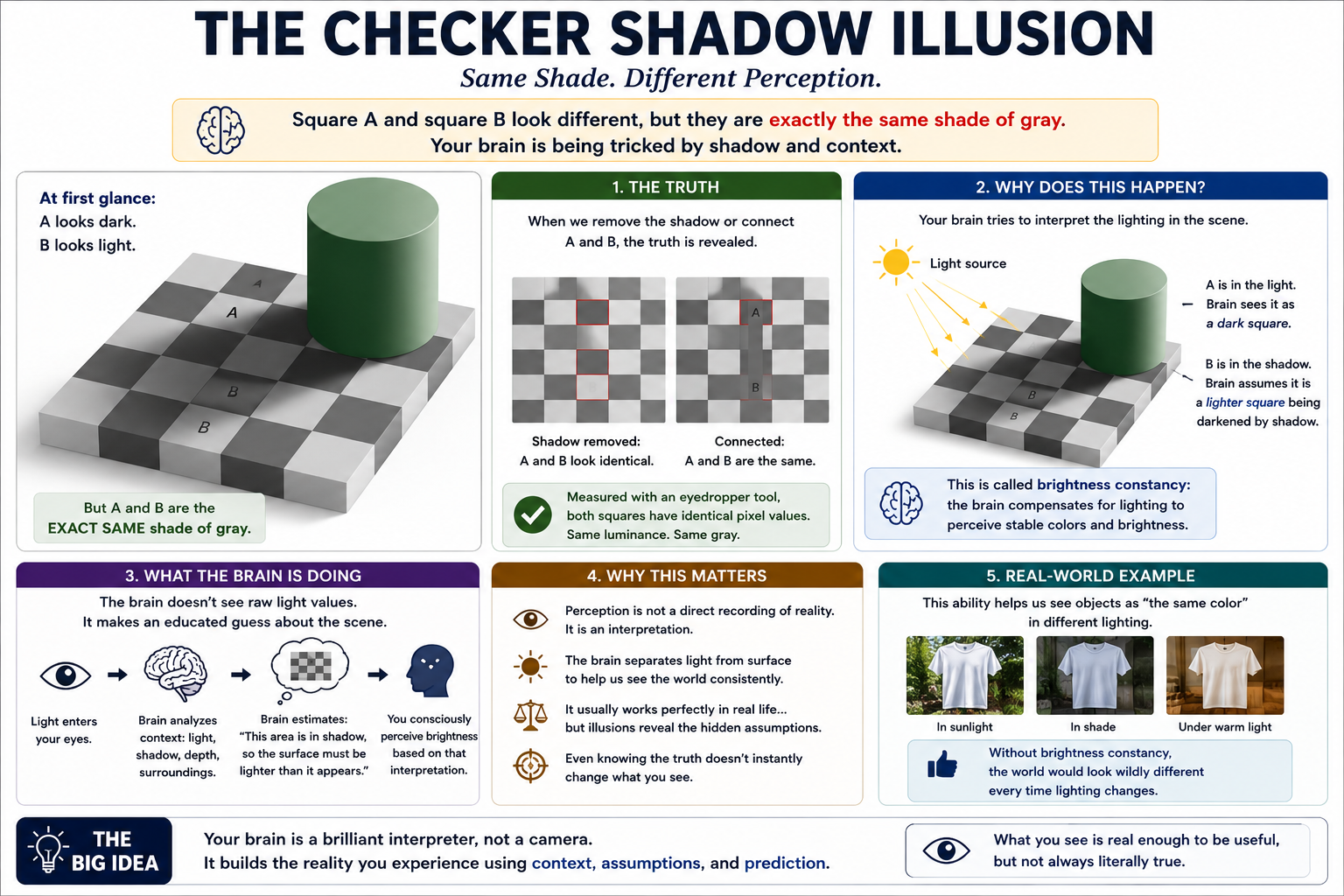
The Checker shadow illusion, created by Edward Adelson in 1995, is one of the most powerful demonstrations of how the human brain interprets context, lighting, and environmental conditions rather than simply perceiving raw visual data directly. In the illusion, a checkerboard containing a shadow cast by a cylinder includes two squares—commonly labeled A and B—that appear dramatically different in brightness, with one seeming dark and the other light, even though both squares are actually the exact same shade of gray. This occurs because the visual system does not judge brightness in isolation; instead, the brain continuously attempts to determine how shadows, illumination, and object surfaces interact within a scene. Since square B appears to lie within a shadow, the brain automatically compensates by mentally “brightening” it, interpreting it as a lighter square darkened by shadow rather than recognizing its true luminance value. This process, known as Brightness constancy, normally helps humans perceive stable object properties despite constantly changing lighting conditions in the real world. The illusion became scientifically important because it revealed that perception is inferential and predictive rather than literal; the brain actively constructs a model of reality by estimating lighting, depth, material properties, and environmental structure. Psychologically, the checker shadow illusion demonstrates that conscious experience is deeply shaped by context and interpretation, showing that humans perceive meaning and relationships rather than raw sensory measurements alone. Even when people intellectually know that the two squares are identical, the illusion often persists, revealing that perceptual systems operate automatically and independently of conscious reasoning. From a systems engineering perspective, the illusion demonstrates that intelligent perceptual systems rely heavily on contextual modeling and predictive correction mechanisms to stabilize perception efficiently, though these same mechanisms can be exploited under specially engineered conditions. Ultimately, the checker shadow illusion reveals a profound truth about human perception: what feels unquestionably obvious may actually be the brain’s best constructed interpretation of reality rather than objective reality itself.

Optical illusions strongly reinforce the concept of the XSE Vantage Point. Many illusions change dramatically depending upon:

  • perspective,
  • angle,
  • framing,
  • context,
  • scale,
  • or environmental conditions.

Likewise, systems behavior often appears radically different depending on observational position.

Thus, XSE encourages expanding perspective beyond immediate appearances.

This helps reduce:

  • impulsive interpretation,
  • rigid thinking,
  • cognitive tunnel vision,
  • and overconfidence.

Perspective expansion improves systems understanding.

Luxxacation & Optical Illusions

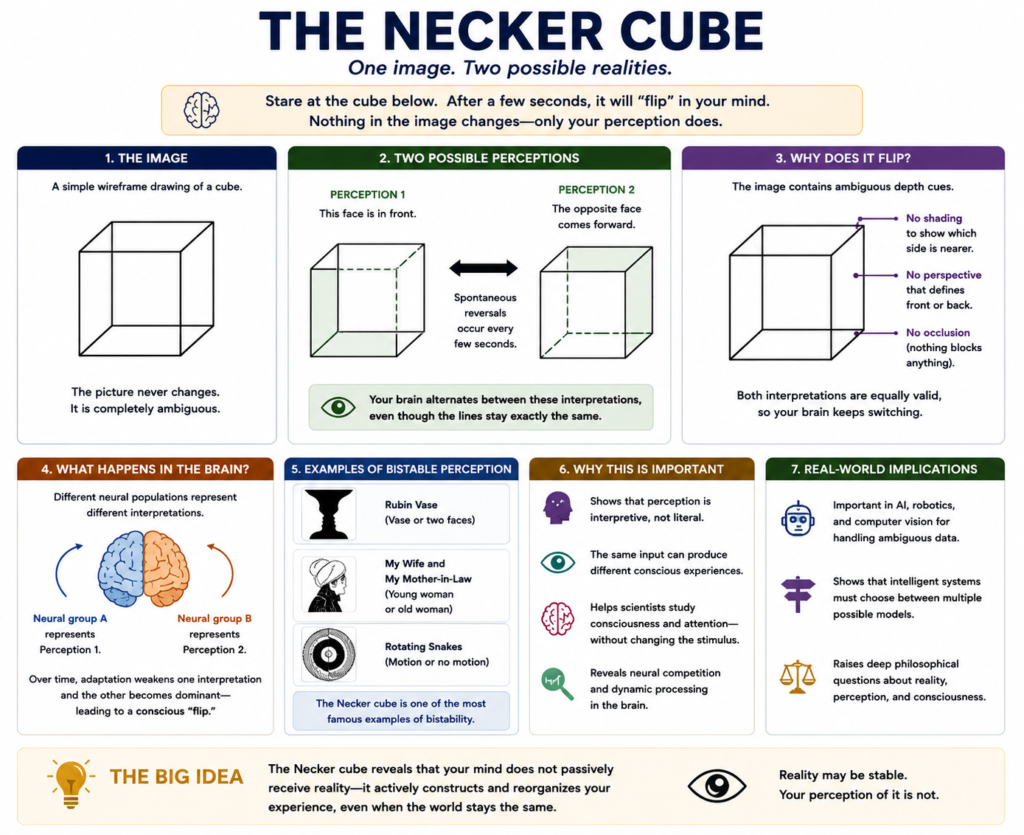
The Necker cube is one of the most important perceptual illusions in psychology and neuroscience because it demonstrates how the human brain can generate multiple conscious interpretations from the exact same unchanging visual information. First described in 1832 by Louis Albert Necker, the illusion typically appears as a simple wireframe drawing of a transparent cube that spontaneously “flips” orientation in the viewer’s mind. At one moment, one face of the cube appears closest to the observer, and then suddenly the opposite face seems to come forward, even though nothing in the image itself has physically changed. This occurs because the cube contains ambiguous depth cues and lacks definitive perspective, shading, and occlusion information, allowing the brain to construct more than one equally plausible spatial interpretation. Psychologically, the Necker cube became profoundly significant because it revealed that perception is not determined solely by sensory input, but is instead an active, interpretive, and dynamically constructed process. The illusion became a foundational example of Perceptual bistability, in which the brain alternates between competing interpretations of the same stimulus. Modern neuroscience suggests that different neural populations compete to represent alternative spatial models, causing conscious awareness to shift back and forth between them over time. The Necker cube fascinated researchers because it provided a rare opportunity to study changes in conscious experience without any change occurring in the external environment itself, making it highly valuable in research involving attention, awareness, neural competition, and the mechanisms of consciousness. From a systems engineering perspective, the illusion demonstrates that intelligent systems often maintain multiple competing predictive models simultaneously when sensory information is ambiguous, dynamically selecting between interpretations based on probabilistic inference rather than fixed certainty. The Necker cube ultimately reveals a profound truth about human perception: the mind does not simply observe reality directly, but continuously constructs, updates, and reorganizes internal models of reality based on interpretation, expectation, and incomplete information.

Optical illusions also translate naturally through Luxxacation:

Luxxacation ElementIllusion Translation
Take TimePause and investigate beyond appearances
Build StrengthDevelop discernment and critical thinking
Rise AboveGain deeper systems awareness and perspective

The process of Luxxacation itself becomes partially a process of:

moving beyond illusion toward greater alignment with reality.

The Deeper Meaning of Optical Illusions

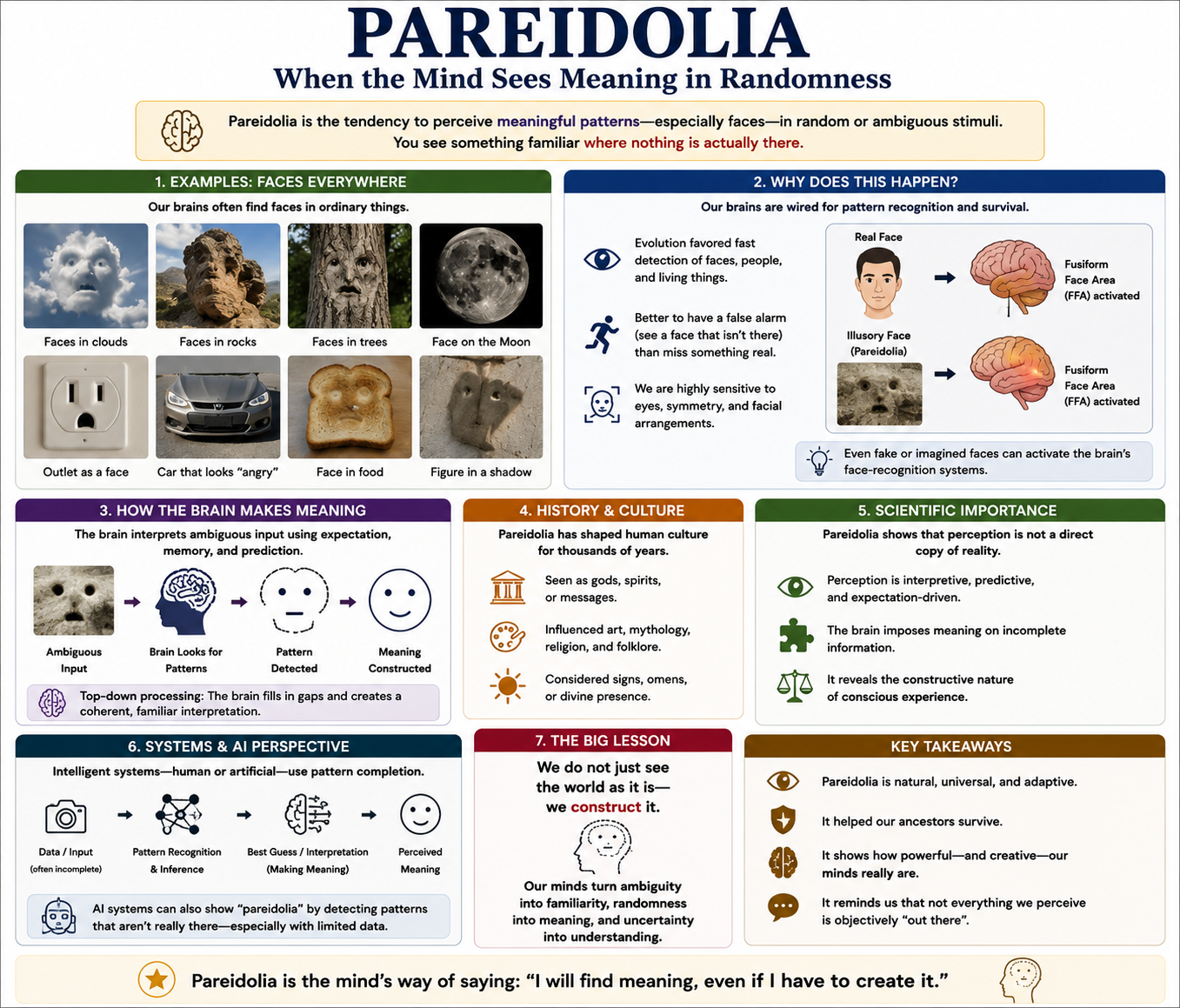
The Pareidolia phenomenon reveals a profound truth about the human mind: human beings are not passive observers of reality, but active interpreters constantly searching for meaning, structure, and familiarity within the world around them. Pareidolia occurs when the brain perceives recognizable patterns — especially faces — in random or ambiguous stimuli, such as seeing faces in clouds, animals in rock formations, expressions in car headlights, or figures in shadows. Psychologically, this happens because the human visual system evolved to prioritize rapid pattern recognition and social detection, particularly facial recognition, which was critically important for survival, communication, and emotional interpretation throughout human evolution. As a result, the brain became highly sensitive to facial arrangements, symmetry, and socially meaningful configurations, often preferring false positives over the risk of missing important signals. Modern neuroscience has shown that even illusory faces can activate specialized facial-recognition regions such as the Fusiform face area, demonstrating how deeply embedded these interpretive systems are within human cognition. Historically, pareidolia influenced mythology, religion, folklore, and art, as people frequently interpreted naturally occurring patterns as spiritual signs, omens, or divine manifestations. Scientifically, the phenomenon became highly significant because it demonstrated that perception is not merely a direct recording of objective reality, but rather an active predictive process in which the brain continuously organizes, completes, and interprets incomplete information according to prior experience, expectation, and biological relevance. From the perspective of modern predictive-processing theories, the brain constantly attempts to determine the most meaningful explanation for ambiguous sensory input, especially favoring biologically important interpretations such as faces or living beings. In systems engineering terms, pareidolia demonstrates that intelligent systems operate probabilistically, using pattern completion, inference, and predictive modeling to rapidly construct coherent interpretations from limited data. While this makes perception adaptive and efficient, it also means that the mind can impose meaning onto randomness and perceive significance where none objectively exists. Ultimately, pareidolia reveals that the human experience of reality is deeply shaped by interpretation, expectation, and meaning-making, reminding us that perception itself is an active construction of the mind rather than a purely objective reflection of the external world.

Perhaps the deepest lesson optical illusions teach within XSE is this:

Human beings are interpretive systems, not perfectly objective observers.

This does not mean reality is unreal.
Nor does it mean truth is unattainable.

Rather, it means human beings interact with reality through:

  • perceptual systems,
  • cognitive models,
  • assumptions,
  • memories,
  • emotions,
  • context,
  • and interpretation frameworks.

Thus, XSE strongly emphasizes:

  • truth-seeking,
  • investigation,
  • systems awareness,
  • integrity,
  • humility,
  • and iterative recalibration toward reality.

Because systems flourish only when aligned with what is true.

Systems Flourish Only When Aligned with the Truth

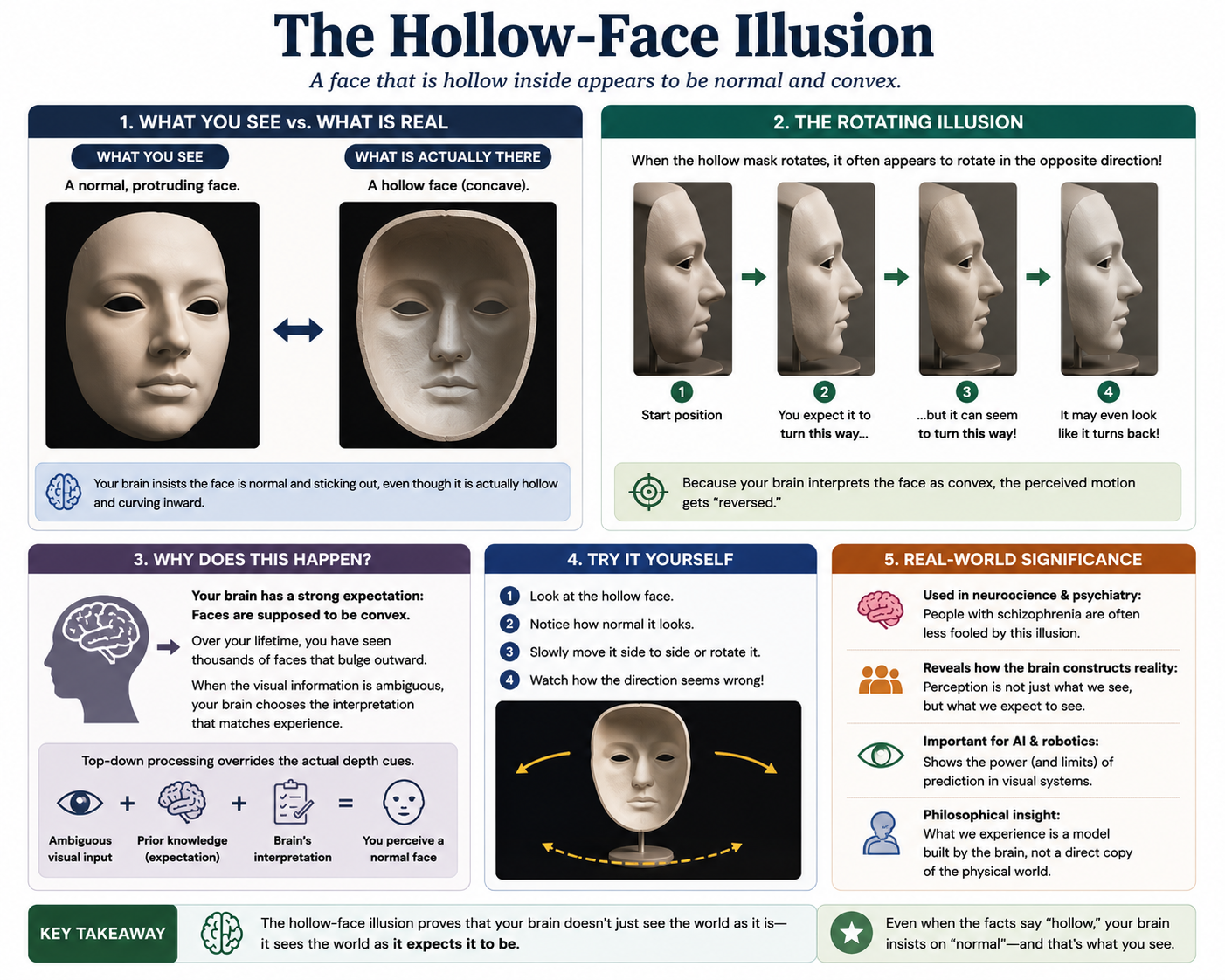
The Hollow-face illusion is a striking perceptual illusion that demonstrates how strongly the human brain relies on prior knowledge and predictive expectations when interpreting visual information. In the illusion, a hollow inward-facing mask or concave face is perceived by most viewers as a normal outward-facing convex face, and when the mask rotates it can even appear to rotate in the opposite direction, creating an eerie and physically impossible visual experience. This occurs because the visual system has developed an extremely powerful expectation that human faces are naturally convex, with noses and facial features protruding outward, so the brain automatically overrides contradictory depth information in favor of the interpretation it considers most probable based on lifelong experience. Psychologically and neuroscientifically, the hollow-face illusion became highly significant because it demonstrated that perception is not merely driven by raw sensory input but is instead heavily shaped by top-down processing, predictive interpretation, and prior assumptions about the structure of the world. The illusion revealed that the brain continuously constructs reality by combining sensory data with internal models and expectations, often favoring familiar interpretations even when objective visual evidence suggests otherwise. The hollow-face illusion also became important in consciousness and psychiatric research because studies found that some individuals with Schizophrenia may be less susceptible to the illusion, suggesting differences in how predictive expectations and sensory information are weighted within perceptual processing. From a systems engineering perspective, the illusion demonstrates that intelligent perceptual systems rely heavily on probabilistic prediction and prior modeling to efficiently stabilize interpretation in complex environments, though these same mechanisms can create powerful perceptual distortions under specially engineered conditions. Ultimately, the hollow-face illusion reveals a profound truth about human cognition and perception: what humans consciously experience is not simply objective reality itself, but the brain’s actively constructed interpretation of reality shaped by expectation, prior experience, and predictive inference.

Within Independent Integration Systems Engineering (XSE), optical illusions are far more than visual curiosities.

They are profound demonstrations of:

  • the interpretive nature of perception,
  • the limitations of cognition,
  • the importance of perspective,
  • the influence of context,
  • and the necessity of truth-seeking.

Illusions reveal that the human mind continuously:

  • predicts,
  • compares,
  • filters,
  • constructs,
  • and interprets reality rather than merely recording it passively.

This insight strongly connects to:

  • the Mind aspect,
  • the Mind Gateway,
  • Human Factors Engineering,
  • Investigative Skills,
  • the XSE Vantage Point,
  • entropy resistance,
  • and integrity-based systems calibration.

Ultimately, optical illusions reinforce one of the deepest principles within XSE:

Things are not always as they seem.

Therefore, human flourishing requires:

  • humility,
  • investigation,
  • perspective,
  • critical thinking,
  • and continual recalibration toward truth and reality.

Because within XSE:

integrity is founded on truth,

and systems flourish only when aligned with reality itself.