Investigative Skills: XSE's 2nd Advancing Asset
The Disciplined Pursuit of Truth Through Systems Investigation, Perceptual Calibration, & Contextual Understanding

Investigative Skills
The Second Advancing Asset of XSE
Investigative Skills are the second Advancing Asset of Independent Integration Systems Engineering (XSE), paired with the second Advancing Position, the Investigative Systems Engineer. They are the disciplined investigative competencies developed during the stage in which the Systems Engineer learns to investigate XSE’s existing architecture with increasing rigor, accuracy, integrity, and independence.
Investigative Skills do not add another Factor set to XSE, replace XSE’s 2FA, or redefine what XSE analyzes. Instead, they develop the practical capabilities necessary to investigate XSE’s 40 Factors, their relationships, applicable Derived Dynamics and Dynamic Mechanics, and the other relevant components of the developing XESAS Synthesis.
This is a learning, investigation, integration, and mastery phase. While these investigative capabilities and the applicable XSE architecture are being learned, practiced, integrated, and demonstrated, the individual occupies the position of Investigative Systems Engineer.
Once the required mastery has been demonstrated, the individual graduates to Pilot Systems Engineer, paired with the XSE Vantage Point, from which the integrated XESAS Synthesis can be skillfully employed.
Importantly, graduation does not mean that investigation ends. The Investigative Skills developed during this stage become part of the Pilot Systems Engineer’s continuing operating capability.
The Investigative Lens & XSE Keyway
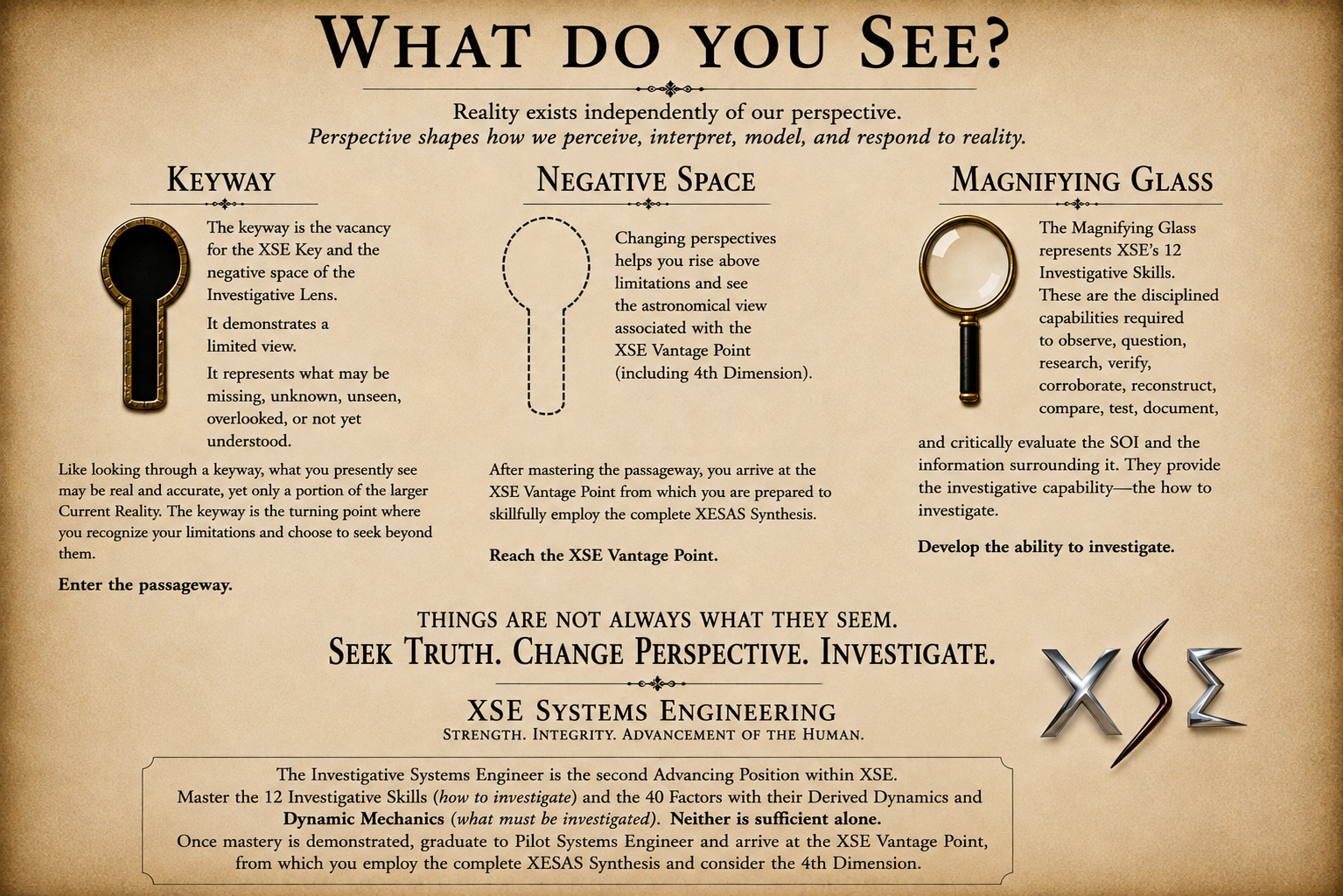
Investigative Skills are symbolized by the XSE Investigative Lens.
Within the Lens, the XSE Keyway appears as meaningful negative space—a symbolic vacancy representing what remains unknown, missing, unverified, insufficiently understood, or perhaps not yet recognized at all.
This vacancy is intentional.
A capable investigator must possess sufficient humility to acknowledge:
There may be something here that I do not yet know.
The XSE Keyway therefore carries forward the Strategic Detachment and humility introduced by the XSE Key. When the Key is applied to the Keyway, it symbolically unlocks entry into XSE’s deeper investigative passageway.
The Lens represents what happens next: disciplined investigation.
Together, they express an important XSE investigative principle:
XSE Key → Detach from the limitations of the present view.
XSE Keyway → Acknowledge the vacancy in present understanding.
Investigative Lens → Investigate what remains to be established.
The relationship between the Keyway and Lens therefore unites two requirements of sound investigation:
The humility to acknowledge what one does not know + the investigative capability to pursue a more supportable understanding.
The Purpose of Investigative Skills
A System of Interest (SOI) cannot always be adequately understood from its most obvious characteristics.
Surface appearances may be incomplete. Sources can be mistaken, outdated, derivative, or insufficient. Important Factors may initially be overlooked. An observed problem may actually be an Output of something occurring elsewhere in the system. Multiple Factors may interact to create a condition that none would produce independently. Feedback can reinforce or counteract a Dynamic over time, while apparent correlations may be mistaken for causes.
The Investigative Systems Engineer therefore learns not merely to look at a system, but to investigate it.
The objective is to progressively answer questions such as:
- What is actually known about the SOI?
- How is it known?
- What evidence supports it?
- What remains unknown or uncertain?
- Which XSE Factors are applicable?
- What Sources and Resources are involved?
- What Inputs enter and Outputs leave the system?
- How are relevant Factors related?
- What changed across relevant Epochs?
- What Derived Dynamics appear to emerge from Factor interactions?
- What Dynamic Mechanics explain how those Dynamics operate?
- What feedback is returning to the system?
- What does the evidence indicate about Current Reality, lifecycle condition, and Trajectory?
- What alternative explanations remain plausible?
- What evidence could require the present understanding to be revised?
The Investigative Systems Engineer is learning how to pursue these questions without allowing assumptions, preferences, or desired conclusions to substitute for evidence.
Investigative Skills as an Advancing Asset
Within this stage of XSE, an important distinction must be maintained:
XSE’s architecture establishes what must be considered and integrated. Investigative Skills develop the capability required to investigate that architecture competently.
This distinction is particularly important in relation to XSE’s 2FA.
XSE’s 2FA identifies the two Factor categories that must be comprehensively considered and appropriately applied:
20 Actual Factors + 20 Analytical Factors = XSE’s 2FA
Investigative Skills do not constitute a third authentication Factor.
Rather, they provide the disciplined capabilities through which the Investigative Systems Engineer learns to observe, question, research, establish, verify, corroborate, document, challenge, and integrate what is being asserted about the two existing Factor sets.
Put simply:
XSE 2FA → What Factor architecture must be comprehensively addressed?
Investigative Skills → How will it be investigated with sufficient rigor?
Both are required within the investigative passageway, but they serve different functions.
The 12 Core Areas of Investigative Development
For purposes of XSE investigative training, Investigative Skills are organized into 12 core areas of investigative development.
These twelve areas structure the development of investigative capability. They are not additional XSE Factors, do not constitute another authentication layer, and do not alter the existing 40-Factor 2FA architecture.
Instead, the Investigative Systems Engineer learns to apply these capabilities across XSE’s existing architecture.
1. Observation & Situational Awareness
The Investigative Systems Engineer learns to observe carefully before interpreting.
This includes recognizing relevant conditions, changes, anomalies, Inputs, Outputs, interfaces, environmental influences, expected versus unexpected behavior, and potentially significant absences.
A critical distinction is maintained between:
What was observed
and
what the investigator believes the observation means.
This helps prevent interpretation from entering the developing XESAS Synthesis prematurely as established fact.
Observation also includes recognizing the investigator’s own position within the system and considering how proximity, expectation, attention, or prior knowledge may influence what is noticed.
2. Investigative Questioning & Interviewing
Where people are appropriate Sources of information, the Investigative Systems Engineer learns disciplined questioning techniques designed to obtain and clarify information rather than manufacture a preferred answer.
This can include open-ended, clarifying, chronological, comparative, and verification-oriented questioning.
The investigator learns to distinguish among:
Direct observation → recollection → interpretation → inference → assumption → secondhand information → uncertainty
Questioning can also be directed toward the system itself:
What changed?
When did it change?
What entered?
What left?
What preceded the event?
What followed it?
What should be observable if the proposed explanation is correct?
The objective is not merely to ask more questions, but to ask better questions that progressively reduce uncertainty.
3. Evidence Recognition & Documentation
The Investigative Systems Engineer learns to identify information capable of supporting, refining, or challenging conclusions about the SOI and to document findings sufficiently for the reasoning process to remain traceable.
Depending upon the SOI, relevant information might include measurements, records, observations, specifications, system logs, communications, research, historical records, data, photographs, or other legitimate Sources.
The central principle is:
A defensible conclusion should remain connected to the evidence and reasoning through which it was reached.
The investigator should also distinguish what has been established from what remains inferred, hypothetical, disputed, incomplete, or unknown.
Formal evidentiary or forensic procedures, where applicable, remain the responsibility of appropriately qualified or authorized professionals.
4. Verification & Corroboration
Finding information is not the same as establishing it.
The Investigative Systems Engineer learns to verify important claims and, where appropriate, seek independent corroboration before relying upon them within the developing Synthesis.
This becomes particularly important when investigating apparent relationships among XSE Factors or proposed Derived Dynamics.
The investigator asks:
Can this be independently supported?
What is the original Source?
Does another Source corroborate it?
What contradicts it?
Could another explanation account for the same evidence?
What would increase or decrease confidence in this conclusion?
Verification protects XSE investigation from becoming dependent upon unsupported repetition.
5. Source Evaluation & Research
Investigative Skills reinforce XSE’s emphasis upon Sources and Resources, particularly through the Z Axis and Z Axiom.
The Investigative Systems Engineer learns to trace claims toward their origins:
Claim → Immediate Source → Underlying Source → Original Evidence, Record, or Appropriate Authority
Sources are evaluated according to applicable considerations such as provenance, relevance, authority, context, currency, independence, methodology, limitations, and proximity to the underlying information.
The goal is not merely to accumulate information.
It is to determine:
What is this Source actually capable of establishing?
The distinction between information quantity and Source quality becomes increasingly important as XESAS develops.
6. Timeline & Epoch Reconstruction
Systems develop through time.
The Investigative Systems Engineer learns to reconstruct relevant Epochs, events, Inputs, Outputs, decisions, changes, conditions, and system responses to understand how Current Reality developed.
A basic investigative sequence might appear as:
Prior Condition → Input/Event → Interaction → System Response → Output → Feedback → Subsequent Condition
Chronology can reveal important relationships and eliminate impossible explanations, but sequence alone does not establish causation.
The investigator must continue testing what the available evidence actually supports.
Epoch reconstruction also prepares the Investigative Systems Engineer to compare:
Past Conditions → Current Reality → Developing Trajectories
7. Hypothesis Development & Testing
Investigative Systems Engineers learn to resist premature attachment to a single explanation.
Instead, critical and creative thinking are used to develop multiple plausible hypotheses and test them against available evidence.
For each explanation, the investigator asks:
What should be observable if this is correct?
What evidence supports it?
What evidence would weaken it?
What evidence would falsify or substantially challenge it?
What competing explanation could account for the same observations?
What additional investigation could distinguish among the alternatives?
Creative thinking expands the field of possibilities.
Critical thinking tests them.
This combination helps prevent the developing Synthesis from becoming organized around the first plausible explanation encountered.
8. Contradiction & Inconsistency Analysis
Conflicting information is not something to hide, ignore, or automatically discard.
It is something to investigate.
The Investigative Systems Engineer learns to identify discrepancies among Sources, records, timelines, Factors, expected Outputs, actual Outputs, assumptions, and proposed system explanations.
A contradiction may indicate inaccurate information, different perspectives, changing conditions, an overlooked Factor, an incomplete model, an unreliable Source, or a misunderstood Dynamic.
The contradiction itself does not establish which explanation is correct.
Instead:
A contradiction identifies where investigation should continue.
This makes inconsistency potentially valuable rather than merely inconvenient.
9. Pattern, Relationship & Link Analysis
This competency becomes especially important as the Investigative Systems Engineer progresses beyond individual Factors toward Factor relationships and interactions.
The investigator maps dependencies, recurring sequences, interfaces, feedback patterns, concentrations, anomalies, associations, Inputs, Outputs, and other potentially meaningful connections within and between systems.
The purpose is not simply to find patterns.
Humans can perceive patterns that are coincidental, incomplete, or unsupported.
The task is to determine whether an apparent relationship is:
observable → repeatable or otherwise supportable → systemically relevant → sufficiently evidenced
This provides the critical bridge from Factors into the investigation of Derived Dynamics.
10. Investigative Reporting & Developing XESAS Integration
During this stage, the Investigative Systems Engineer learns how to organize findings within the developing XESAS Synthesis.
The investigator should be able to distinguish clearly among:
Established information → evidence-supported inference → working hypothesis → uncertainty → unresolved question
Sources, Factor relationships, Epochs, apparent Dynamics, identified Mechanics, Inputs and Outputs, feedback, contradictions, assumptions, and limitations should remain sufficiently traceable to permit later reassessment.
At this stage, the Investigative Systems Engineer is learning and demonstrating the ability to integrate these findings.
Full demonstrated mastery of integrated XESAS operation belongs to the subsequent Pilot Systems Engineer position.
11. Bias Control & Analytical Discipline
One of the most important objects of investigation is the investigation itself.
The Investigative Systems Engineer learns to recognize potential confirmation bias, anchoring, premature closure, selective evidence, overconfidence, attachment to preferred explanations, and other influences that can distort analysis.
A powerful investigative question is:
What evidence would cause me to change my conclusion?
This competency extends the Strategic Detachment introduced by the XSE Key into disciplined investigative practice.
The investigator’s objective is not to prove themselves correct.
It is to develop the most supportable understanding of the SOI that the available evidence permits, while remaining willing to revise that understanding when stronger information becomes available.
This discipline directly supports XSE’s Alpha Axiom:
“Integrity is founded on truth.”
12. Legal, Ethical & Scope Awareness
Investigation must itself operate within legitimate boundaries.
The Investigative Systems Engineer learns to consider applicable law, privacy, authorization, ethical constraints, professional scope, information-handling requirements, intellectual property, safety considerations, and the limitations of their own qualifications.
XSE Investigative Skills concern investigative reasoning, systems analysis, lawful research, verification, and disciplined inquiry.
They do not confer police authority, private-investigator licensure, forensic credentials, medical or mental-health qualifications, legal authority, or another regulated professional credential.
Where an investigation enters a regulated field, appropriately qualified or authorized professionals and Sources should be used as required.
Applying Investigative Skills Across XSE’s 2FA
The 12 investigative competencies do not replace or reorganize XSE’s 40 Factors.
Instead, the Investigative Systems Engineer learns to apply appropriate Investigative Skills across the existing 2FA architecture.
The 20 Actual Factors direct investigation toward the human, systemic, contextual, and disciplinary considerations XSE requires to be addressed as applicable to the SOI:
Mind, Body, Spirit → Three Gateways → Seven Spheres of Integration → Seven Domains of Study
The 20 Analytical Factors provide XSE’s organizing and analytical architecture:
X, Y & Z Axes → Take Time, Build Strength & Rise Above → Seven Advancing Assets & Positions → Seven Axioms
For each applicable Factor, the investigator learns to ask:
What is actually present?
What is absent?
What evidence establishes its condition?
What remains uncertain?
Which Sources and Resources inform the analysis?
What Inputs affect it?
What Outputs does it produce?
How has it changed across Epochs?
What other Factors does it interact with?
What happens because these Factors interact?
That final question marks an important transition.
The investigation is moving beyond the Factors themselves.
From Factors to Relationships
Passing through XSE’s 2FA does not end with forty isolated determinations.
Systems derive much of their behavior from relationships among components, conditions, people, environments, Inputs, Outputs, Sources, Resources, and other Factors.
The Investigative Systems Engineer therefore moves from:
What Factors are present?
to:
How are the relevant Factors related?
Relationships may be direct or indirect, reinforcing or counteracting, stable or changing, local or distributed, immediate or delayed.
A relationship should not be assumed merely because two conditions appear together.
The investigator applies chronology, corroboration, Source evaluation, hypothesis testing, contradiction analysis, and other Investigative Skills to determine what the available evidence supports.
This progression can be expressed as:
Factors → Relationships → Derived Dynamics → Dynamic Mechanics → Integrated XESAS Understanding
Investigating Derived Dynamics
Systems behavior frequently emerges through interaction.
The Investigative Systems Engineer therefore learns to investigate the Derived Dynamics associated with relevant relationships among XSE Factors.
The central question becomes:
What are these Factors producing together?
A proposed Derived Dynamic is not accepted merely because a pattern appears interesting or plausible.
The investigator applies observation, Epoch reconstruction, corroboration, competing hypotheses, relationship analysis, Source verification, contradiction testing, and disconfirming evidence to determine what can reasonably be supported.
This creates the progression:
Factors → Relationships → Potential Derived Dynamic → Investigation & Testing → Supported, Revised, or Rejected Understanding
Derived Dynamics therefore represent a deeper level of investigation than Factor identification alone.
Investigating Dynamic Mechanics
Once a relevant Dynamic is sufficiently supported, investigation proceeds deeper:
How does this Dynamic actually operate within the system?
This brings the Investigative Systems Engineer into Dynamic Mechanics.
The investigator may trace sequences such as:
Source → Input → Gateway → Factor → Interaction → Derived Dynamic → Dynamic Mechanics → Output → Receiving System → Effect → Feedback → Changed System Condition
Questions become increasingly mechanistic:
What initiates the Dynamic?
What sustains it?
What amplifies it?
What inhibits it?
What Resources does it require?
Through which interfaces or Gateways does it operate?
What Outputs does it produce?
Where do those Outputs travel?
What other systems receive them?
What feedback returns?
How does that feedback alter subsequent behavior?
The Investigative Systems Engineer thereby progresses from understanding what exists, to investigating what interactions produce, to determining how resulting system behavior operates.
Building Toward XESAS Mastery
Throughout the Investigative Systems Engineer phase, findings are progressively organized within the developing XESAS Synthesis.
The process is iterative rather than strictly linear:
Observe → Investigate → Verify → Apply XSE’s 2FA → Examine Factor Relationships → Test Derived Dynamics → Investigate Dynamic Mechanics → Trace Inputs, Outputs & Feedback → Reassess → Integrate → Update the Synthesis
New evidence may require previous conclusions to change.
A newly recognized Factor can alter an apparent Dynamic.
A stronger Source may invalidate an earlier assumption.
A contradiction can reveal a missing relationship.
Understanding a Dynamic Mechanic can change the interpretation of an Output.
Feedback can reveal that the system no longer behaves as an earlier model predicted.
The Investigative Systems Engineer therefore learns to keep the developing Synthesis responsive to Current Reality rather than attached to an outdated explanation of it.
The Investigative Systems Engineer Is a Transitional Position
This point is essential to XSE’s Advancing Asset architecture:
Investigative Systems Engineer is the position occupied while Investigative Skills and the applicable XSE architecture are being learned, practiced, integrated, and mastered.
It is not XSE’s final humanly attainable position.
During this phase, the individual develops the capability to:
- investigate both sides of XSE’s 2FA;
- evaluate Sources and Resources;
- reconstruct relevant Epochs;
- trace Inputs and Outputs;
- analyze feedback;
- investigate Factor relationships;
- identify and test Derived Dynamics;
- investigate Dynamic Mechanics;
- manage uncertainty and contradiction;
- control bias where reasonably possible; and
- progressively integrate findings within the developing XESAS Synthesis.
Once the required mastery has been demonstrated, the purpose of the second Advancing Position has been fulfilled.
Graduation to Pilot Systems Engineer
Upon demonstrated mastery, the Investigative Systems Engineer graduates to Pilot Systems Engineer, the third and highest humanly attainable Advancing Position within XSE, paired with the third Advancing Asset: the XSE Vantage Point.
The mastered Investigative Skills are not left behind.
They become part of the Pilot’s continuing operating capability.
The distinction is:
The Investigative Systems Engineer is learning, practicing, integrating, and demonstrating how to investigate XSE’s architecture.
The Pilot Systems Engineer has demonstrated sufficient mastery to employ the integrated XESAS Synthesis from the XSE Vantage Point.
The Pilot therefore continues to observe, investigate, verify, question, update, and integrate.
Graduation does not imply that the Pilot now knows everything, that uncertainty has disappeared, or that investigation is complete. Systems change. New information becomes available. Sources improve. Current Reality develops. Trajectories shift.
The difference is that the Pilot has demonstrated the required capability to conduct this work from the advanced operating position of the XSE Vantage Point.
The Advancement Architecture
The complete progression surrounding Investigative Skills can therefore be expressed as:
XSE KEY
Strategic Detachment & Humility
Step outside the limitations of the present view.↓
XSE KEYWAY
Acknowledged Vacancy
Recognize what may be missing, unknown, or insufficiently established.↓
INVESTIGATIVE LENS / INVESTIGATIVE SKILLS
Disciplined Investigation
Develop the capability to investigate rigorously.↓
XSE 2FA
20 Actual + 20 Analytical Factors
Comprehensively investigate and appropriately apply both Factor categories.↓
FACTOR RELATIONSHIPS
Determine how applicable Factors interact.↓
DERIVED DYNAMICS
Investigate what those interactions produce.↓
DYNAMIC MECHANICS
Determine how supported Dynamics actually operate.↓
DEVELOPING XESAS SYNTHESIS
Integrate, test, trace, reassess, and update.↓
DEMONSTRATED MASTERY
↓
GRADUATION TO PILOT SYSTEMS ENGINEER
↓
ASSUME THE XSE VANTAGE POINT
Employ the integrated XESAS Synthesis while continuing investigation, verification, and model updating.↓ / ORIENTED THROUGHOUT
XSE ZENITH — TRUTH
The continuing orienting reference, not a humanly attained state of exhaustive knowledge.
In Summary
Investigative Skills are XSE’s second Advancing Asset, symbolized by the Investigative Lens and developed during the transitional position of Investigative Systems Engineer. The meaningful vacancy of the XSE Keyway within the Lens represents the humility to acknowledge what remains unknown; the Lens represents the disciplined capability used to investigate it.
Investigative Skills do not redefine XSE’s architecture or add another Factor set. They provide the investigative capability required to comprehensively address XSE’s 2FA—the 20 Actual and 20 Analytical Factors—and then progress beyond the individual Factors into their relationships, Derived Dynamics, and Dynamic Mechanics.
Through the 12 core areas of investigative development, the Investigative Systems Engineer learns to follow evidence rather than assumptions, evaluate Sources, reconstruct relevant Epochs, test competing explanations, examine contradictions, map relationships, control bias, trace system behavior, and progressively integrate findings within XESAS.
Once the required investigative and architectural mastery has been demonstrated, the individual graduates from Investigative Systems Engineer to Pilot Systems Engineer and assumes the XSE Vantage Point.
Investigation does not end there.
The Key develops the humility to step outside what is presently seen.
The Keyway acknowledges what may still be absent from understanding.
The Investigative Lens develops the skill to seek what remains to be established.
The passageway develops mastery.
The Vantage Point positions the Pilot to integrate and navigate.
The Zenith—Truth—remains the orienting reference.
XSE Investigative Skills are educational systems-analysis, research, and reasoning competencies. They do not confer law-enforcement authority, private-investigator licensure, forensic credentials, medical or mental-health qualifications, legal authority, or authorization to perform activities reserved to appropriately licensed, credentialed, or otherwise qualified professionals.