

An XSE Systems Engineering Publication
Independent Integration Systems Engineering, Inc.
Educational content review contributed by:
Dr. Rod Marriott, MD (Retired OB/GYN)
Chief Medical Systems Advisor (Non-Clinical; No Patient Care or Medical Oversight)
This content is for educational purposes only and does not constitute medical advice.
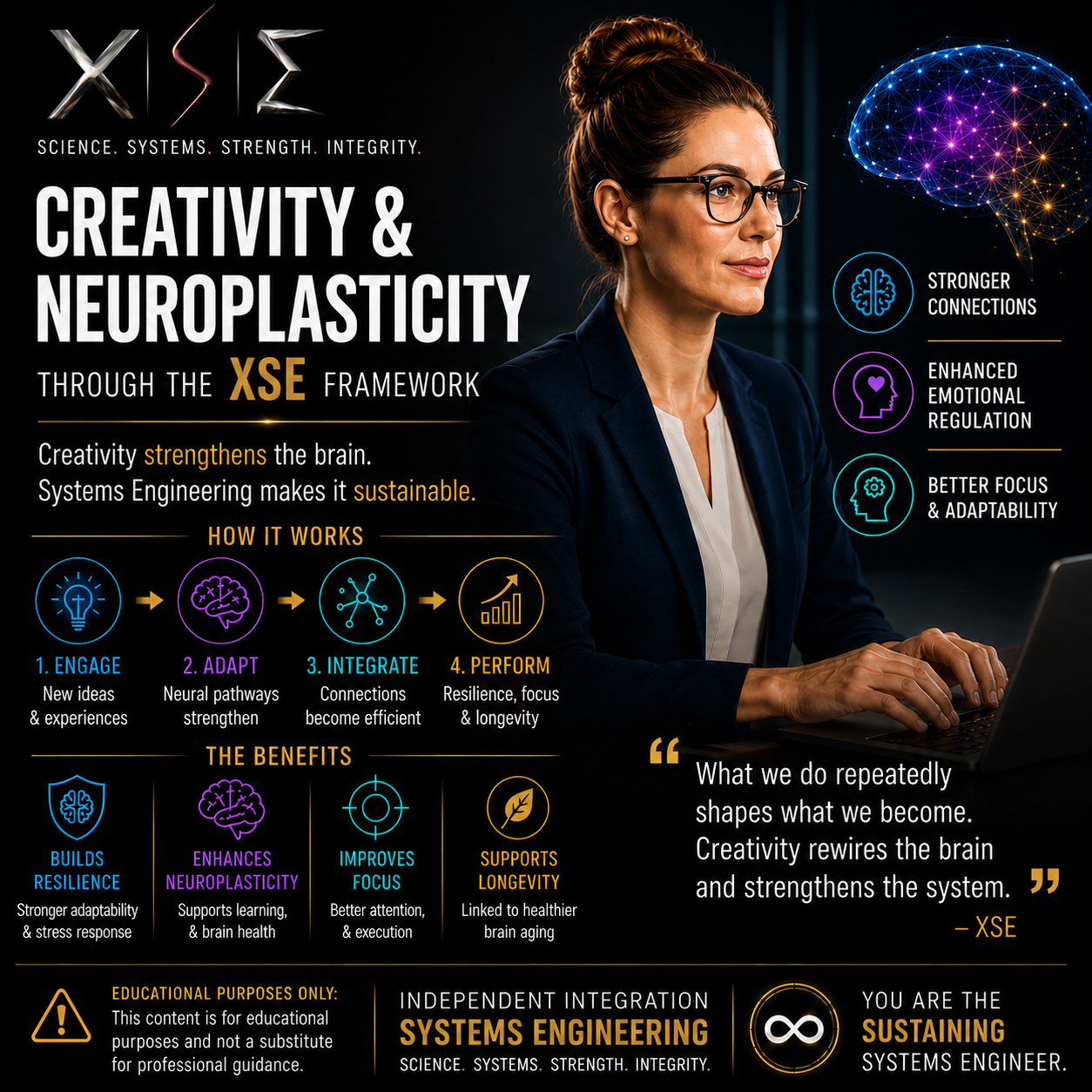
Modern neuroscience increasingly demonstrates that creativity is not merely entertainment or artistic expression — it is a measurable driver of neurological resilience, adaptive cognition, and functional brain longevity. Emerging evidence suggests that sustained engagement in creative practices may support neural efficiency, preserve cognitive flexibility, and strengthen adaptive brain-network dynamics associated with healthy aging and long-term cognitive performance. [1,2,3,4,5] Within the framework of Independent Integration Systems Engineering (XSE), creativity can be understood as a systems-level input influencing the integrated dynamics of Mind, Body, and Spirit through interconnected feedback loops, adaptive regulation, environmental interaction, and behavioral reinforcement systems. Recent research in Nature Communications examining creativity, neural dynamics, and adaptive brain-network function reinforces the growing understanding that cognitively enriching experiences can alter brain connectivity and support neural adaptability across the lifespan. [1] These findings align with decades of research surrounding neuroplasticity, enriched environments, cognitive reserve, and systems-level neurological adaptation. [2,3,4,5] Importantly, creativity in this context extends beyond artistic talent alone. It encompasses active engagement with novelty, problem-solving, movement, emotional processing, imagination, coordination, and adaptive learning — all of which recruit widespread neural systems simultaneously.
Creativity as a Neurobiological Systems Input
Neuroplasticity refers to the brain’s capacity to reorganize and strengthen neural pathways in response to experience, learning, environmental demands, and repeated behavioral engagement. [2,3] The brain is not static; rather, it continuously adapts based on the quality, intensity, frequency, and diversity of incoming stimuli. Creative engagement appears particularly effective at stimulating these adaptive mechanisms because it often combines:
• Novel problem-solving
• Emotional engagement
• Sensorimotor integration
• Attention regulation
• Cognitive flexibility
• Multisensory processing
• Behavioral adaptation
• Predictive modeling
Research increasingly suggests that enriched cognitive environments stimulate synaptic remodeling, support functional connectivity, and reinforce adaptive neural coordination. [2,3,4] The newer Nature Communications paper identified significant relationships between creative cognition and dynamic neural-network organization, supporting the growing scientific understanding that creativity involves large-scale integration across multiple brain systems rather than isolated regional activation. [1] From an XSE perspective, this reflects the principle that complex human performance emerges from the integration of multiple interacting subsystems rather than isolated components alone.
The Brain as a Complex Adaptive System
Systems engineering principles emphasize that highly complex systems exhibit emergent properties that cannot be fully understood through reductionism alone. The human brain is among the most sophisticated known complex adaptive systems, characterized by nonlinear interactions, distributed processing, dynamic feedback loops, and continual adaptation. [5,6] XSE emphasizes multidimensional analysis and “Vantage Point” thinking to evaluate systems not merely as isolated structures, but as evolving systems interacting across time, environments, and behavioral conditions. Creativity appears to engage the brain in a similarly multidimensional manner by simultaneously recruiting cognitive, emotional, sensory, motor, attentional, and executivecontrol networks. [1,2,3,4,5] This systems-level activation may help explain why cognitively enriching activities are associated with improved resilience, adaptability, and preservation of functional performance across aging populations. [3,4]
Neural Efficiency, Cognitive Flexibility, and Adaptive Connectivity
One of the most important themes emerging from neuroscience research is that cognitive resilience is closely linked to efficient communication between neural systems. [5] Functional connectivity refers to how effectively different brain regions coordinate activity and exchange information. Stronger integration among neural systems is associated with:
• Better attentional control
• Faster information processing
• Improved working memory
• Greater behavioral adaptability
• Enhanced emotional regulation
• Improved executive functioning
Creative cognition appears strongly associated with these adaptive network dynamics. [1] Research in neuroplasticity and cognitive reserve further suggests that sustained engagement with mentally stimulating activities may help preserve neurological efficiency and adaptive flexibility over time. [2,3,4] Within XSE terminology, this resembles strengthening communication pathways between interconnected subsystems to improve overall systems resilience and operational adaptability.
Creativity, Learning, and Adaptive Challenge
Novelty and challenge are central drivers of neuroplastic adaptation. [2] The brain strengthens itself through repeated exposure to meaningful cognitive demand, adaptive problem-solving, and environmental complexity. This principle is reflected across many domains, including:
• Music training
• Dance and movement
• Language acquisition
• Strategic gaming
• Programming
• Design work
• Visual arts
• Improvisation
• Complex skill acquisition
Studies examining programming and language learning have shown overlapping cognitive demands involving syntax processing, working memory, sequential reasoning, abstraction, and adaptive problem-solving. [6] Similarly, strategic gaming and other cognitively demanding activities may strengthen attentional systems, decision-making processes, and behavioral flexibility when approached intentionally and in moderation. From an XSE perspective, adaptive challenge functions similarly to systems stress-testing: carefully applied complexity can stimulate refinement, resilience, and operational optimization within the human system.
Creativity and the XSE POWER Training Triangle
The XSE POWER Training Triangle conceptualizes human development through integrated strengthening of Mind, Body, and Spirit operating together as an interconnected system. Creative engagement may influence all three dimensions simultaneously:
Mind
Creativity challenges cognition, learning capacity, imagination, critical thinking, attentional control, and adaptive reasoning. [1,2,3,4,5]
Body
Many creative activities involve coordinated movement, sensory integration, proprioception, rhythm, and behavioral execution.
Spirit
Purposeful creative engagement may contribute to meaning, fulfillment, emotional integration, resilience, and internal motivation.
Within XSE, these domains are continuously interacting through feedback loops rather than functioning independently.
Creativity in the Cyber Age
Modern digital environments increasingly expose individuals to fragmented attention, passive information consumption, overstimulation, and chronic cognitive distraction. Intentional creative engagement may help counterbalance these pressures by restoring:
• Deep focus
• Adaptive thinking
• Intentional attention
• Emotional regulation
• Cognitive flexibility
• Curiosity
• Purposeful engagement
Research increasingly supports the importance of active participation and enriched environments in maintaining cognitive adaptability and neural resilience. [2,3,4,5] Within the XSE framework, this aligns with the principle that systems must intentionally manage inputs and environments to maintain integrity and optimized function.
Practical Applications of Creativity-Based Cognitive Development
Current scientific evidence suggests that creativity-related cognitive benefits are associated primarily with active engagement and adaptive challenge rather than artistic talent alone. [1,2,3,4,5] Potential activities may include:
• Learning music
• Dance and movement practices
• Writing or journaling
• Drawing or painting
• Strategic games
• Learning languages
• Programming or design work
• Creative problem-solving
• Complex crafting
• Improvisational speaking
• Gardening and environmental design
• Multisensory creative hobbies
Importantly, activities should be approached responsibly according to individual condition, abilities, and appropriate professional guidance where necessary.
XSE Perspective on Long-Term Human Performance
Within XSE, the individual is both the systems engineer and the system of interest. This perspective encourages intentional evaluation of behavioral inputs, environmental exposures, habits, adaptive responses, and long-term trajectories. Creativity may therefore function as:
• Cognitive conditioning
• Adaptive systems training
• Neural coordination exercise
• Emotional integration practice
• Behavioral flexibility development
• Attention calibration
• Feedback-loop refinement
The growing body of scientific literature surrounding creativity and neuroplasticity increasingly supports the idea that repeated cognitive engagement shapes long-term neurological adaptability and resilience. [1,2,3,4,5] In this sense, creativity may be viewed as a form of systems maintenance for the human brain — helping preserve flexibility, responsiveness, and adaptive capacity within increasingly complex technological environments.
Conclusion
Emerging neuroscience continues to support the idea that creativity is deeply connected to neuroplasticity, adaptive brain-network dynamics, cognitive flexibility, and long-term neurological resilience. [1,2,3,4,5] Activities involving novelty, emotional engagement, multisensory processing, movement, adaptive challenge, and intentional problem-solving appear capable of strengthening neural connectivity and supporting healthier cognitive functioning across the lifespan. Within the XSE framework, creativity can be understood as a systems-level process influencing the integration of Mind, Body, and Spirit through dynamic feedback loops and adaptive regulation mechanisms. As technological complexity and cognitive demands continue increasing in the cyber age, intentional creative engagement may become increasingly important for preserving attentional stability, emotional resilience, adaptive cognition, and long-term human performance. Importantly, this article is for educational and informational purposes only and is not medical, psychological, or therapeutic advice. Individuals with medical, neurological, or mental health concerns should consult appropriately licensed healthcare professionals regarding diagnosis, treatment, or individualized care decisions.
References
1. Coronel-Oliveros, C., Migeot, J., Lehue, F. et al. Creative experiences and brain clocks. Nat Commun 16, 8336 (2025). https://doi.org/10.1038/s41467-025-64173-9.
2. Kolb B, Gibb R. Brain Plasticity and Behaviour in the Developing Brain. J Can Acad Child Adolesc Psychiatry. 2011;20(4):265-276. https://pmc.ncbi.nlm.nih.gov/articles/PMC3222570/
3. Stern Y. Cognitive reserve in ageing and Alzheimer’s disease. Lancet Neurol. 2012;11(11):1006-1012. https://doi.org/10.1016/S1474-4422(12)70191-6
4. Park DC, Bischof GN. The aging mind: neuroplasticity in response to cognitive training. Dialogues Clin Neurosci. 2013;15(1):109-119. https://doi.org/10.31887/DCNS.2013.15.1/dpark
5. Bullmore E, Sporns O. Complex brain networks: graph theoretical analysis of structural and functional systems. Nat Rev Neurosci. 2009;10(3):186-198. https://doi.org/10.1038/nrn2575
6. Mitchell M. Complexity: A Guided Tour. New York: Oxford University Press; 2009. https://global.oup.com/academic/product/complexity-9780199798100
7. Fedorenko E, Ivanova A, Dhamala R, Bers M. The Language of Programming: A Cognitive Perspective. Trends Cogn Sci. 2019;23(7):525-528. https://doi.org/10.1016/j.tics.2019.04.010
Educational Disclaimer
This content is provided for educational and informational purposes only and has been reviewed for general biological accuracy within the context of systems-based education. It is not intended to diagnose, treat, cure, or prevent any disease or medical condition. This information does not constitute medical advice and does not establish a physician-patient relationship. It should not be used as a substitute for professional medical advice. Always consult a qualified healthcare provider before making decisions related to health, treatment, or supplementation. Published by Independent Integration Systems Engineering, Inc. (XSE). For more information and redistribution, see XSE.world policies and disclosures.