

CREATE Goals are the Courageous, Realistic, Envisioned, Aligned, Testable, and End-Dated micro-level operational goals within Independent Integration Systems Engineering (XSE) through which Desired Results (777) are translated into actionable and evaluable systems-engineering objectives. Developed within the third sub-element of Take Time, CREATE Goals specify what the System of Interest will deliberately work to accomplish in order to move from its established Current Reality, Position, and developing Trajectory toward its Desired Results. For applicable human systems, CREATE Goals are developed across each of the three Human Aspects—Mind, Body, and Spirit—so that all three are deliberately considered within the integrated whole-system configuration. Each CREATE Goal should be aligned with and traceable to the applicable 777 Desired Result(s) it supports and should account for relevant XSE Dynamic Mechanics, Position, constraints, Sources, Resources, and whole-system conditions. CREATE Goals subsequently provide an operational basis for deriving Gateway Guarding specifications, configuring appropriate Target Tracking and Data Collection, and determining the System Work required during Build Strength.
Within XSE, CREATE Goals function as:
- micro-level operational planning structures;
- translations of Desired Results into actionable objectives;
- Mind, Body, and Spirit advancement objectives for applicable human systems;
- operational structures for intentionally influencing and evaluating developing Trajectory;
- implementation-oriented systems requirements;
- alignment mechanisms between intended Results and actual operation;
- reference conditions for subsequent evaluation;
- a basis for determining relevant Gateway Guarding requirements;
- a basis for determining what evidence should subsequently be observed or collected;
- and operational objectives around which the next whole-system configuration can be engineered.
CREATE Goals occupy a specific position within the larger XSE architecture:
Current Reality
↓
Relevant XSE Dynamic Mechanics—including Current Trajectory
↓
Astronomical Plotting / Position
↓
Desired Results (777): Mind | Body | Spirit
↓
CREATE Goals: Mind | Body | Spirit
↓
Gateway Guarding
↓
Primary Target & Target Tracking / Data Collection Configuration
↓
↓
Whole-System Configuration
↓
Build Strength / System Operation
↓
Target Tracking, Data Collection & Feedback
↓
Analysis, Reassessment & Recalibration
CREATE Goals therefore provide a critical bridge between determining where the integrated system should go and engineering what it will actually work to accomplish to help get there.
CREATE Goals Within Take Time
CREATE Goals are developed within the first Element of Luxxacation:
TAKE TIME
Take Time is organized around three primary sub-elements.
1. Assess Current System State, Dynamic Mechanics, Position & Trajectory
The first sub-element establishes the Current Reality of the System of Interest.
It examines not only the present state of the system, but what is dynamically occurring within and to the SOI, where it is positioned within the larger systems picture, and where its existing course appears to be taking it if meaningful changes are not made.
For applicable human systems, this includes examination of the integrated:
Mind | Body | Spirit
along with relevant:
- system states;
- Gateways;
- Inputs and Outputs;
- feedback;
- Target Tracking and other available data;
- recurring patterns;
- strengths and vulnerabilities;
- constraints;
- Sources and Resources;
- environmental conditions;
- dependencies;
- life-cycle conditions;
- relevant XSE Dynamic Mechanics;
- Astronomical Plotting / Position;
- Current Trajectory;
- and other evidence necessary to understand actual system operation.
Relevant Dynamic Mechanics may include such considerations as:
- Mass / substance;
- Energy;
- System Force;
- Inertia;
- Momentum;
- System Work;
- Power;
- Rate of Change;
- Velocity;
- Acceleration / Deceleration;
- Displacement;
- and Trajectory.
Not every mechanic will necessarily have equal significance for every SOI or CREATE Goal. The purpose is to investigate the mechanics actually relevant to the system rather than mechanically applying every concept without regard to context.
This first sub-element asks:
Where is the system now, what is dynamically happening within and to it, where is it positioned within the larger systems picture, and where is its present course taking it?
2. Pinpoint Desired Results (777)
The second sub-element determines and records the Results toward which the system should intentionally be directed.
For applicable human systems, Desired Results (777) are established separately across all three Human Aspects:
Mind | Body | Spirit
at progressively expanding time horizons of:
- 7 hours
- 7 days
- 7 weeks
- 7 months
- 7 years
- 77 years
Thus, 777 does not merely establish six time horizons. It establishes a Mind–Body–Spirit Desired Results architecture across those horizons.
Its purpose is not to imply certainty about the future.
Rather, it encourages consideration of immediate, intermediate, long-range, and enduring Results together so that short-term objectives and decisions can be evaluated in relation to the broader intended direction of the integrated system.
This second sub-element asks:
Where should the system go?
3. Determine How the System Will Achieve Its Desired Results
The third sub-element moves from desired future conditions into operational systems engineering.
It asks:
How are we going to get the system there?
CREATE Goals are micro-elements within this third sub-element of Take Time.
For applicable human systems, CREATE Goals are developed across each of the three Human Aspects:
Mind CREATE Goal(s)
Body CREATE Goal(s)
Spirit CREATE Goal(s)
This ensures that operational planning does not concentrate upon one Aspect while unintentionally neglecting the others.
This does not mean that each Aspect must always receive exactly the same number, scale, or priority of CREATE Goals.
The appropriate configuration should respond to:
- Current Reality;
- relevant Dynamic Mechanics;
- Position;
- Current Trajectory;
- Desired Results;
- constraints;
- Sources and Resources;
- responsibilities;
- priorities;
- and the needs of the integrated system.
The requirement is that:
Mind, Body, and Spirit are each deliberately considered and appropriately represented within the CREATE configuration.
The hierarchy is therefore:
TAKE TIME
1. Assess Current System State, Dynamic Mechanics, Position & Trajectory
Where are we, what is happening, where are we positioned, and where are we heading?
↓
2. Pinpoint Desired Results (777)
Where should Mind, Body, and Spirit go across the 777 horizons?
↓
3. Determine How to Get There
How will the integrated system pursue those Desired Results?
Within Sub-Element Three:
Mind | Body | Spirit CREATE Goals
What specific operational objectives will move each Human Aspect toward its applicable Desired Results?
↓
Gateway Guarding
What relevant exchanges and recurring interaction patterns should be deliberately regulated across the corresponding Gateways?
↓
Primary Target & Target Tracking / Data Collection Configuration
What especially important source of deviation should be targeted, and what evidence should be observed or collected during operation?
↓
XESAS Synthesis
How should the relevant Factors, Derived Dynamics, requirements, Sources, Resources, constraints, and findings be coordinated into the next whole-system configuration?
CREATE Goals are therefore not an additional top-level sub-element of Take Time. They are micro-level operational goal structures developed within its third sub-element.
Desired Results (777) and CREATE Goals
Desired Results and CREATE Goals perform related but distinctly different functions.
Desired Results (777) establish the intended Results.
CREATE Goals establish actionable and evaluable objectives for pursuing those Results.
For applicable human systems:
| Human Aspect | 777 Function | CREATE Function |
|---|---|---|
| Mind | Establish intended Mind Results | Establish operational goals supporting those Results |
| Body | Establish intended Body Results | Establish operational goals supporting those Results |
| Spirit | Establish intended Spirit Results | Establish operational goals supporting those Results |
A Desired Result may describe an intended future condition several weeks, months, years, or decades from the present.
That Result does not necessarily specify what the system should work to accomplish today, this week, or during the current operating cycle.
CREATE Goals provide that additional operational resolution.
Every CREATE Goal should therefore be reasonably aligned with and traceable to one or more applicable Desired Results.
For each CREATE Goal, ask:
Which Mind, Body, or Spirit Desired Result does this goal support?
How is accomplishing this goal expected to contribute to that Result?
Does this goal remain coherent with relevant Desired Results at other 777 horizons?
Does it remain coherent with the other Human Aspects and the integrated system as a whole?
Does it make sense given the system’s Current Reality, Dynamic Mechanics, Position, Resources, constraints, and Current Trajectory?
If a meaningful relationship cannot be established, the proposed goal should be reconsidered.
This protects against both activity without meaningful advancement and local optimization at the expense of the integrated system.
The 777 establishes the larger destination architecture.
CREATE Goals translate that architecture into operational objectives.
The CREATE Framework
Each CREATE Goal should be:
| Letter | Meaning | Primary Systems Function |
|---|---|---|
| C | Courageous | Supports appropriate advancement beyond unnecessary avoidance, fear, resistance, or stagnation |
| R | Realistic | Grounds the objective in Current Reality, relevant Dynamic Mechanics, constraints, capabilities, Sources, Resources, and Position |
| E | Envisioned | Establishes sufficient clarity concerning the intended objective and future operating condition |
| A | Aligned | Maintains coherence with applicable Desired Results, Mind–Body–Spirit integration, Integrity, governing principles, Position, and intended Trajectory |
| T | Testable | Makes implementation, progress, relevant effects, and achievement capable of evaluation through appropriate evidence |
| E | End-Dated | Establishes an appropriate completion date, operating period, milestone, or formal reassessment point |
Together, these characteristics help ensure that CREATE Goals are not merely aspirations but operationally meaningful systems-engineering objectives.
Courageous
Within XSE, Courageous means that a CREATE Goal supports appropriate advancement beyond unnecessary avoidance, fear, resistance, or stagnation when such advancement is necessary to move the system toward its Desired Results.
Courageous does not mean:
- reckless;
- impulsive;
- unnecessarily dangerous;
- disproportionate;
- or detached from Current Reality.
Rather, the goal should involve a reasoned willingness to confront appropriate:
- difficulty;
- uncertainty;
- effort;
- discomfort;
- resistance;
- or challenge
when necessary for meaningful advancement.
Ask:
Does this objective require appropriate advancement beyond something presently limiting the system?
Courage should remain proportionate to actual risks, responsibilities, constraints, capabilities, and operating conditions.
CREATE therefore concerns reasoned courage in service of appropriate advancement, not risk for its own sake.
Realistic
Realistic means that the CREATE Goal is grounded in the established Current Reality of the System of Interest.
This directly connects CREATE Goals to the first sub-element of Take Time.
The goal should account for relevant:
- capabilities;
- limitations;
- responsibilities;
- constraints;
- Sources;
- Resources;
- available Time;
- environment;
- actual system state;
- life-cycle position;
- Astronomical Plotting / Position;
- and relevant XSE Dynamic Mechanics.
This last point is particularly important.
A system possessing substantial Inertia, limited available Energy, strong opposing Forces, insufficient Resources, or established Momentum away from the Desired Result may require a substantially different goal configuration, sequence, Time horizon, or allocation of System Work than a system already moving constructively toward that Result.
Likewise, a proposed goal should consider the amount and type of change reasonably required rather than assuming unlimited acceleration or instantaneous Displacement.
For applicable human systems, Realistic also means considering the interaction among Mind, Body, and Spirit.
A proposed objective for one Aspect should not simply assume unlimited capability or sacrifice from the others.
Realistic does not mean easy, conservative, or unambitious.
It means:
The objective has been engineered with sufficient regard for reality that meaningful implementation is reasonably possible.
Ask:
Given what Current Reality, the relevant Dynamic Mechanics, Position, constraints, Sources, and Resources reveal about the integrated system, is this objective reasonably implementable?
Envisioned
Envisioned means that the intended objective and resulting future condition are represented with sufficient clarity that the systems engineer can meaningfully understand what is being pursued before implementation begins.
The emphasis is not merely upon visualization.
Envisioning establishes directional and operational clarity.
Ask:
- What exactly are we trying to accomplish?
- Which Human Aspect does this goal primarily address?
- Which Desired Result does it support?
- What should be different if the goal succeeds?
- What would successful implementation look like?
- What relevant change in system state is intended?
- How does this objective contribute to the integrated whole?
An Envisioned goal provides a sufficiently clear representation of the intended future condition to guide subsequent systems engineering and operation.
Aligned
Aligned means that the CREATE Goal is demonstrably coherent with the larger system architecture.
Most importantly:
Every CREATE Goal should be aligned with its applicable Desired Results (777).
For applicable human systems, alignment should also be examined horizontally across Mind, Body, and Spirit.
A Mind goal should not be evaluated solely as a Mind goal.
A Body goal should not be evaluated solely as a Body goal.
A Spirit goal should not be evaluated solely as a Spirit goal.
Each exists within an integrated human system.
The goal should therefore additionally be evaluated in relation to:
- the other Human Aspects;
- Integrity;
- the XSE Axioms;
- other CREATE Goals;
- responsibilities;
- system constraints;
- dependencies;
- Sources and Resources;
- the larger System of Interest;
- the SOI’s Position within the broader systems picture;
- relevant Dynamic Mechanics;
- and intended whole-system Trajectory.
Alignment helps prevent local optimization at the expense of the larger system.
Within XSE, successfully completing an isolated objective is therefore not sufficient by itself.
The objective should contribute coherently to the Desired Results and integrated system it is intended to support.
Testable
Testable means that a CREATE Goal is formulated with sufficient specificity that its implementation, progress, relevant effects, and eventual achievement can be evaluated through appropriate evidence.
Testability connects planning to evidence and feedback.
Ask:
- What evidence would indicate that this goal is being implemented?
- What would indicate progress?
- What would indicate successful completion?
- What would indicate deviation or failure?
- What relevant conditions should be observed?
- What Gateway interactions may need monitoring?
- What Dynamic Mechanics may indicate meaningful change?
- What foreseeable obstacles could interfere with achievement?
- What evidence would indicate that recalibration is necessary?
- Are there relevant effects upon other Human Aspects that should also be observed?
A Testable CREATE Goal does not necessarily require a single numerical metric.
Depending upon the System of Interest, appropriate evidence may be:
- quantitative;
- qualitative;
- behavioral;
- observational;
- milestone-based;
- condition-based;
- performance-based;
- or otherwise appropriate to the system.
CREATE’s Testable requirement also helps determine what evidence should subsequently be collected.
Target Tracking provides one structured source of recurring operational evidence within XSE, while other appropriate Data Collection methods may also be required depending upon the SOI, CREATE Goal, and question being evaluated.
Thus:
Testable asks: How will we know?
End-Dated
End-Dated means that the CREATE Goal has an appropriate temporal boundary or formal reassessment point.
Depending upon the objective, this may include:
- a completion date;
- an operating period;
- milestone dates;
- a scheduled review;
- or another meaningful temporal reference.
Not every systems objective has a natural point of permanent completion.
Some involve maintaining an operating condition or continuing a constructive practice.
In those cases, End-Dated may establish a formal reassessment point rather than an artificial completion date.
This prevents goals from continuing indefinitely without evaluation.
Ask:
By when should this objective be accomplished, or when will it be formally reassessed?
Thus:
Testable = How will we know?
End-Dated = By when will we accomplish or reassess it?
From Human Aspects to CREATE Goals to Gateway Guarding
Within applicable human systems:
Mind, Body, and Spirit are Human Aspects.
Their corresponding:
Mind, Body, and Spirit Gateways are interfaces.
CREATE Goals are developed to address the Human Aspects.
Gateway Guarding specifications are then derived for the corresponding Gateways.
Therefore:
Mind Desired Results
↓
Mind CREATE Goal(s)
↓
Mind Gateway Guarding Requirements
Body Desired Results
↓
Body CREATE Goal(s)
↓
Body Gateway Guarding Requirements
Spirit Desired Results
↓
Spirit CREATE Goal(s)
↓
Spirit Gateway Guarding Requirements
These streams should subsequently be examined together rather than treated as independent silos.
Thus:
Mind + Body + Spirit Desired Results
↓
Mind + Body + Spirit CREATE Goals
↓
Integrated Gateway Guarding Configuration
↓
Primary Target & Target Tracking / Data Collection Configuration
↓
XESAS Synthesis
↓
Whole-System Configuration
From CREATE Goals to Gateway Guarding
Once CREATE Goals have been established across Mind, Body, and Spirit, XSE increases the operational resolution of the configuration.
The next question becomes:
Given these goals, what relevant Inputs, Outputs, exposures, influences, and recurring interaction patterns should be deliberately sought, accepted, reinforced, expressed, restricted, resisted, rejected, or prevented?
CREATE Goals therefore provide an operational basis for deriving Gateway Guarding specifications.
For applicable human systems, Gateway Guarding is considered across the:
Mind Gateway | Body Gateway | Spirit Gateway
Four basic specifications can be considered for each relevant Gateway:
YES Input
What should be deliberately sought, admitted, accepted, or reinforced because it supports the CREATE Goals and Desired Results?
YES Output
What should be deliberately done, expressed, produced, or enacted because it supports the CREATE Goals and Desired Results?
NO Input
What should be deliberately restricted, resisted, rejected, or prevented because it is expected to interfere with the CREATE Goals, Desired Results, Integrity, or intended direction?
NO Output
What should be deliberately restrained, inhibited, discontinued, or prevented because it would interfere with the intended configuration?
For each Mind, Body, and Spirit Gateway, the systems engineer can deliberately consider all four categories and establish the specifications that are relevant and useful to the current configuration.
This avoids manufacturing unnecessary specifications merely to fill categories while ensuring that the full regulatory structure is considered.
The progression becomes:
777 Desired Result
↓
CREATE Goal
↓
Corresponding Gateway Guarding Requirements
↓
Relevant YES Inputs | YES Outputs | NO Inputs | NO Outputs
Gateway Guarding is therefore not arbitrarily attached to CREATE Goals.
Its specifications are derived by investigating which relevant Gateway exchanges and recurring interaction patterns are expected to support or interfere with the CREATE configuration and corresponding Desired Results.
CREATE Goals and the Primary Target
CREATE Goals also help establish the operational context for identifying the Primary Target.
The Primary Target represents an especially important obstacle, behavior, influence, condition, pattern, or source of deviation presently considered significant to system progress.
CREATE Goals help clarify:
What is the system actually trying to accomplish?
The Primary Target then helps clarify:
What especially important condition is interfering with that accomplishment or intended Trajectory?
This relationship makes the Primary Target meaningful in context rather than merely identifying something undesirable in isolation.
CREATE Goals and Target Tracking
Planning does not establish that the system will actually operate according to the intended configuration.
That requires feedback.
Relevant CREATE Goals, Gateway Guarding specifications, and the Primary Target therefore help inform the configuration of Target Tracking.
Target Tracking is configured during Take Time and conducted principally through strategically positioned Watches during Build Strength.
It asks:
What is actually occurring during system operation, and how does that compare with the configuration engineered during Take Time?
For applicable human systems, recurring Watches may observe relevant conditions involving:
Mind | Body | Spirit | Primary Target
along with applicable evidence concerning:
- CREATE Goal implementation;
- Gateway Guarding;
- relevant Inputs and Outputs;
- Executive Power;
- Dynamic Mechanics;
- deviation;
- successful Resets;
- cross-Aspect effects;
- and developing patterns.
Target Tracking therefore provides recurring evidence connecting whole-person planning with actual whole-person operation.
Importantly:
Target Tracking observes, records, and compares operation; it does not itself perform the corrective System Work.
Where deviation is detected, the resulting evidence can inform appropriate correction through applicable mechanisms such as ECC governance, Executive Power, Gateway Guarding, changed operating conditions, additional Resources, or other relevant System Work.
CREATE Goals and Data Collection
The Testable requirement of CREATE makes Data Collection an important part of the architecture.
A well-engineered CREATE Goal should make it possible to determine:
- what evidence matters;
- when that evidence should be gathered;
- what would constitute meaningful progress;
- what would indicate deviation;
- what would indicate completion;
- and what evidence might require reassessment.
Target Tracking provides a recurring operational Data Collection structure, but it is not necessarily the only evidence source.
Depending upon the SOI and CREATE Goal, appropriate evidence may also come from other:
- observations;
- records;
- measurements;
- milestones;
- performance indicators;
- system outputs;
- external evidence;
- or suitable data sources.
Thus:
CREATE establishes what should be Testable. Data Collection supplies appropriate evidence. Analysis determines what that evidence supports.
CREATE Goals and Executive Power
CREATE Goals establish what the system intends to accomplish, but establishing an objective does not itself accomplish the required System Work.
During Build Strength, implementation depends partly upon whether the system possesses sufficient operational capacity to:
- initiate;
- act;
- restrain;
- redirect;
- persist;
- recover;
- Reset;
- and perform the required Work within relevant Time.
Within applicable human systems, this connects CREATE Goals to ECC governance and Executive Power.
The relationship can be expressed as:
CREATE Goal
What should be accomplished?
↓
Gateway Guarding
What relevant exchanges and interaction patterns should be regulated?
↓
ECC Governance
How should intentional executive direction be governed?
↓
Executive Power
Does that governance become effective and timely System Work?
↓
Target Tracking / Data Collection
What evidence indicates what actually occurred?
Willpower may be understood as the closest common secular term for an important capacity at the core of Executive Power, but Executive Power is broader than willpower alone.
This distinction is important because a well-designed goal still requires effective implementation under actual operating conditions.
CREATE Goals and the XSE Dynamic Mechanics
CREATE Goals should not be engineered as though the System of Interest were mechanically static.
The system already possesses relevant conditions and dynamics before the goal is established.
Depending upon the SOI, the systems engineer may need to consider:
Mass / Substance ↔ Energy ↔ Force ↔ Inertia ↔ Momentum ↔ Work ↔ Power ↔ Rate of Change / Velocity ↔ Acceleration / Deceleration ↔ Displacement ↔ Trajectory
These mechanics are not assumed to form one mandatory linear sequence. They may interact in different ways depending upon the system.
CREATE Goals can therefore ask:
What existing Forces support or oppose this objective?
What Inertia must be overcome or constructively preserved?
What Momentum already exists?
What Energy and Resources are available?
What System Work is actually required?
Within what Time must that Work occur?
What Rate of Change is realistic and appropriate?
What Displacement or change in system state is intended?
How should accomplishing this objective influence developing Trajectory?
This gives CREATE Goals a more explicitly mechanical foundation within XSE.
CREATE Goals and Astronomical Plotting / Position
CREATE Goals should also be evaluated from the larger XSE Vantage Point.
Astronomical Plotting helps establish the SOI’s Position within the broader multidimensional systems picture.
This matters because a goal that appears advantageous when viewed only locally may become poorly configured when broader:
- relationships;
- dependencies;
- Spheres;
- Forces;
- Resources;
- constraints;
- life-cycle conditions;
- risks;
- opportunities;
- or long-term consequences
are considered.
Astronomical Plotting therefore adds another question to CREATE:
Does this objective make sense not only from where the system wants to go, but from where the system is actually positioned within the larger picture?
CREATE Goals Within the Three Integrated Mechanics of XSE
CREATE Goals operate within the larger architecture of XSE’s Three Integrated Mechanics.
Luxxacation — Torque
Luxxacation provides the recursive transformational Torque through:
Take Time → Build Strength → Rise Above
CREATE Goals are engineered during Take Time, operated during Build Strength, reviewed and strengthened through Rise Above, and reconsidered during subsequent Take Time cycles.
Executive Power — Power
Executive Power concerns whether the required executive governance becomes effective and timely System Work toward the CREATE Goals during actual operation.
Astronomical Plotting — Position
Astronomical Plotting provides the larger reference architecture through which the SOI’s Position and the appropriateness of its intended movement can be evaluated.
CREATE Goals are not themselves one of the Three Integrated Mechanics.
Rather, they are operational goal structures engineered and pursued within their coordinated architecture.
CREATE Goals and XESAS Synthesis
CREATE Goals should not move directly from planning into Build Strength as isolated objectives.
Before the operating configuration is finalized, the relevant findings are brought together through XESAS Synthesis.
XESAS Synthesis can consider CREATE Goals in coordinated relationship with:
- the 40 foundational XSE Factors;
- XSE 2FA;
- relevant Dynamic Mechanics;
- Astronomical Plotting / Position;
- Desired Results;
- Gateway Guarding;
- Integrity;
- ICC;
- ECC;
- Executive Power;
- the Primary Target;
- Target Tracking configuration;
- Sources;
- Resources;
- constraints;
- dependencies;
- feedback;
- and other relevant Derived Dynamics.
It asks:
How should these goals and the other relevant elements be coordinated so that the system can operate coherently as a whole?
This is important because multiple individually reasonable CREATE Goals may conflict when combined.
XESAS Synthesis helps identify such:
- contradictions;
- dependencies;
- sequencing requirements;
- competing Resource demands;
- tradeoffs;
- opportunities;
- and potential synergies
before the next operating configuration is placed into action.
CREATE Goals and Build Strength
CREATE Goals are engineered during Take Time and implemented predominantly during Build Strength.
During Take Time:
The system determines what Mind, Body, and Spirit should work to accomplish and integrates those objectives into the whole-system configuration.
During Build Strength:
The system attempts to carry out that configuration under actual operating conditions.
CREATE Goals therefore cross the planning-to-operation interface.
They originate as micro-elements of the third sub-element of Take Time and subsequently guide:
- action;
- practice;
- implementation;
- persistence;
- Gateway regulation;
- Executive Power;
- System Work;
- and appropriate correction during Build Strength.
CREATE Goals Within the Complete Feedback Architecture
The complete relationship can now be represented as:
TAKE TIME
1. Establish Current Reality
Where is the system now?
↓
Assess Relevant XSE Dynamic Mechanics—including Current Trajectory
What is dynamically happening within and to the SOI, and where is its present course taking it?
↓
Astronomical Plotting / Position
Where is the SOI positioned within the larger systems picture?
↓
2. Pinpoint Desired Results (777)
Where should Mind, Body, and Spirit go across the 777 horizons?
↓
3. Determine How to Get There
CREATE Goals
What Courageous, Realistic, Envisioned, Aligned, Testable, and End-Dated objectives should move each Human Aspect toward its Desired Results?
↓
Gateway Guarding
What relevant Inputs, Outputs, exposures, influences, and recurring interaction patterns should be deliberately regulated?
↓
Primary Target & Target Tracking / Data Collection Configuration
What especially important deviation source should be targeted, and what evidence should be observed or collected during operation?
↓
XESAS Synthesis
How should the relevant Factors, Derived Dynamics, requirements, Sources, Resources, constraints, and findings be coordinated?
↓
Whole-System Configuration
↓
BUILD STRENGTH
Implement → Guard → Govern → Perform System Work → Persist → Track → Detect Deviation → Reset / Correct → Continue
↓
Operational Data & Feedback
↓
RISE ABOVE
Review → Learn → Recommit → Seek Better Sources → Seek Better Resources → Strengthen Capability
↓
TAKE TIME AGAIN
Reestablish Current Reality → Analyze → Reassess Dynamic Mechanics → Reassess Position & Trajectory → Reassess CREATE Goals and other relevant Derived Dynamics → XESAS Synthesis → Reconfigure
↓
Next Operating Cycle
This creates a recursive connection among Desired Results, operational planning, Gateway regulation, executive implementation, actual system behavior, evidence, learning, and subsequent systems engineering.
CREATE Goals as Micro-Level Systems-Engineering Structures
CREATE Goals should not be understood merely as motivational affirmations, productivity techniques, wishes, or isolated goal-setting exercises.
Within XSE, they are:
micro-level systems-engineering structures used to translate higher-level Desired Results into actionable and evaluable operational objectives.
For applicable human systems, they provide the resolution necessary to move from:
“These are the Results we desire for Mind, Body, and Spirit.”
to:
“These are the specific objectives through which each Aspect will work toward those Results.”
then:
“These are the Gateway conditions and exchanges that should support those objectives.”
then:
“This is how the complete configuration should be synthesized and operated.”
and finally:
“This is the evidence we will use to determine what actually happened and what should be engineered next.”
The hierarchy can therefore be expressed succinctly:
777 provides Mind–Body–Spirit destination architecture.
CREATE provides Mind–Body–Spirit operational objectives.
Gateway Guarding provides relevant regulatory specifications for Gateway interaction.
XESAS Synthesis integrates the relevant elements into the whole-system configuration.
Executive Power helps convert governance into timely System Work during Build Strength.
Target Tracking and other appropriate Data Collection provide evidence of actual operation.
Analysis interprets that evidence.
Rise Above strengthens Sources, Resources, learning, and capability.
Subsequent Take Time and XESAS Synthesis engineer the next operating cycle.
Recursive Evaluation and Recalibration
CREATE Goals should not be assumed to remain optimal merely because they were carefully engineered.
Actual system operation produces new evidence.
Target Tracking, other Data Collection, changing system conditions, feedback, newly identified constraints, changes in Dynamic Mechanics or Position, new Sources and Resources, and unanticipated effects may indicate that a CREATE Goal should be:
- maintained;
- strengthened;
- modified;
- subdivided;
- reprioritized;
- completed;
- replaced;
- or discontinued.
For applicable human systems, recursive evaluation should also investigate whether progress involving one Aspect is producing relevant effects in the others.
A Body CREATE Goal may alter conditions affecting Mind or Spirit.
A Mind CREATE Goal may influence Body operation or Spirit orientation.
A Spirit CREATE Goal may influence Mind or Body conditions.
This reflects the XSE premise that the three Human Aspects are integrated rather than independent.
CREATE Goals therefore participate in XSE’s recursive systems-engineering process:
Take Time → Build Strength → Rise Above → Take Time Again
Each new Current-Reality assessment can reconsider:
Current Reality
↓
Dynamic Mechanics
↓
Position & Trajectory
↓
Desired Results
↓
CREATE Goals
↓
Gateway Guarding
↓
Primary Target / Target Tracking
↓
XESAS Synthesis
↓
Operation & Evidence
↓
Reassessment and Reconfiguration
so that subsequent engineering is informed by what the system has actually experienced.
Investigative and Scope Considerations
CREATE Goals are systems-engineering planning structures.
They do not guarantee outcomes, eliminate uncertainty, establish that every Desired Result is attainable, or establish causation merely because progress occurs alongside a particular intervention.
The actual system remains subject to:
- constraints;
- changing conditions;
- competing Forces;
- uncertainty;
- feedback;
- dependencies;
- external systems;
- resource limitations;
- human agency where applicable;
- and other factors that may affect Results.
For human applications, CREATE Goals are intended as educational, coaching, and systems-development tools. They are not medical, psychological, psychiatric, dietetic, legal, or other licensed professional diagnosis, treatment, or individualized professional care and should not substitute for appropriately qualified professional services where those are required.
Concise Definition
CREATE Goals are XSE’s Courageous, Realistic, Envisioned, Aligned, Testable, and End-Dated micro-level operational goals developed within the third sub-element of Take Time to translate Desired Results (777) into actionable and evaluable systems-engineering objectives. For applicable human systems, CREATE Goals are developed across each of the three Human Aspects—Mind, Body, and Spirit—so that each Aspect is deliberately addressed while remaining integrated with the whole system. Each CREATE Goal should be aligned with and traceable to its applicable Desired Result(s) and engineered in consideration of Current Reality, relevant XSE Dynamic Mechanics, Astronomical Plotting/Position, Current Trajectory, constraints, Sources, Resources, Integrity, and whole-system conditions. CREATE Goals provide an operational basis for deriving relevant Gateway Guarding specifications and configuring appropriate Target Tracking and Data Collection; they are integrated into the whole-system configuration through XESAS Synthesis, implemented predominantly during Build Strength through applicable System Work and Executive Power, evaluated through operational evidence and feedback, and recursively reassessed and recalibrated as the system progresses through subsequent Luxxacation cycles.
Using the XSE CREATE Goals Worksheet
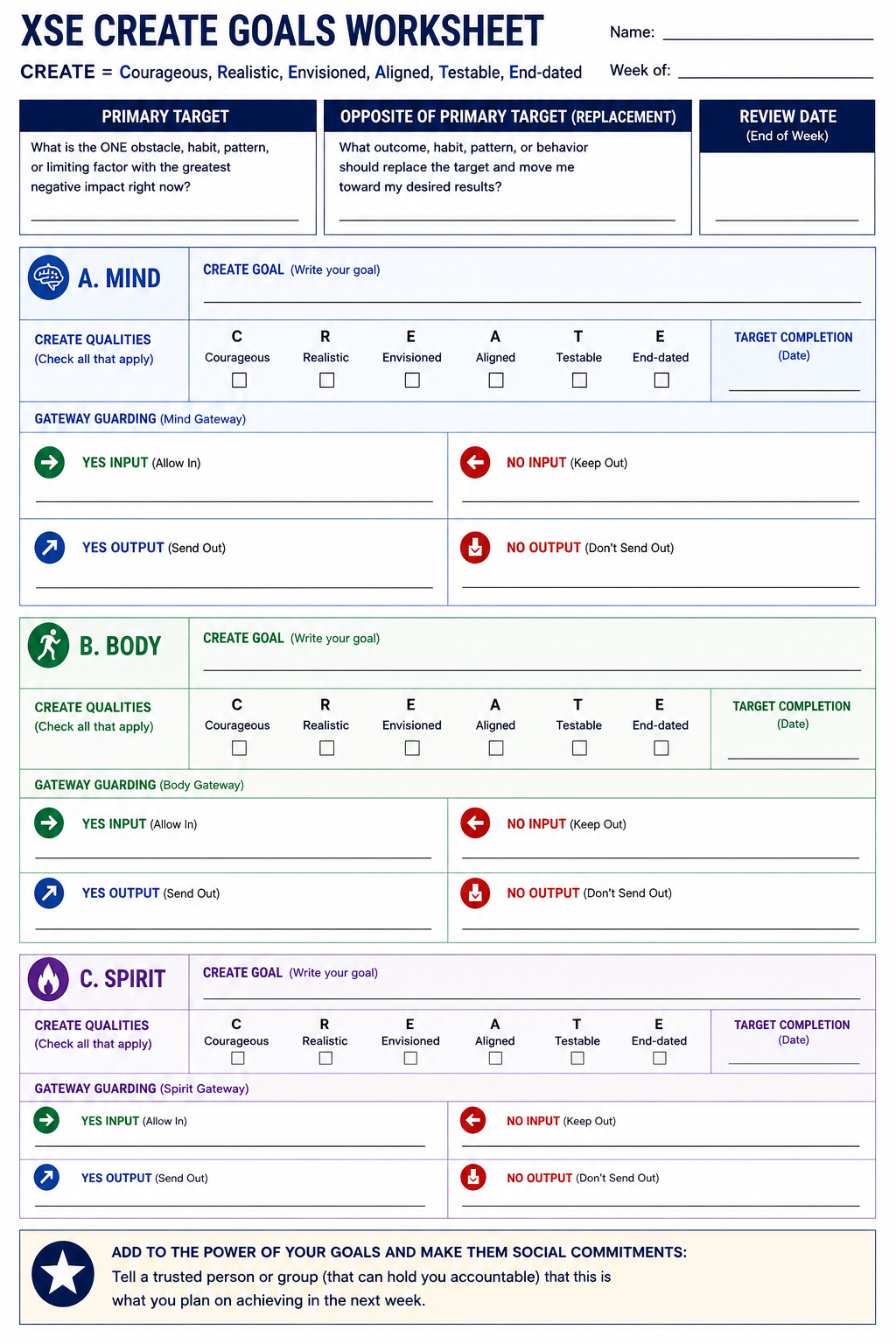
The CREATE Goals Worksheet is designed to translate the direction established during Take Time into a practical operating configuration. Although the worksheet itself does not repeat the 777, the CREATE Goals written here should already be aligned with and traceable to your applicable Desired Results (777).
For applicable human systems, CREATE Goals are developed across all three Human Aspects—Mind, Body, and Spirit—and then used to derive the Gateway Guarding specifications that help turn those goals into deliberate daily operation.
The worksheet provides two available CREATE Goal slots for each Human Aspect. You do not necessarily have to use both slots. The objective is not to create as many goals as possible, but to select a manageable configuration of goals that meaningfully supports your Desired Results.
1. Begin With Take Time
Do not begin by inventing goals in isolation. First complete the preceding Take Time work:
Assess Current System State & Trajectory → Pinpoint Desired Results (777) → Develop CREATE Goals
Review what your analysis has revealed about your Current Reality and ask:
- Where am I currently?
- What patterns are affecting my Trajectory?
- Where am I heading if nothing meaningfully changes?
- What Desired Results have I established for Mind, Body, and Spirit?
- What should I actually accomplish next to move toward those Results?
Your answers provide the basis for the CREATE Goals you will enter on the worksheet.
2. Develop Your Mind CREATE Goals
Begin with the Mind section.
Choose up to two operational goals that meaningfully support your current Mind Desired Results.
Each goal should satisfy CREATE:
C — Courageous: Does it require appropriate advancement beyond avoidance, fear, resistance, or stagnation?
R — Realistic: Is it grounded in your actual Current Reality, capabilities, constraints, responsibilities, time, and Resources?
E — Envisioned: Can you clearly describe what you intend to accomplish and what successful implementation should look like?
A — Aligned: Does it support the applicable 777 Desired Result(s), remain consistent with Integrity and the larger system, and avoid undermining Body or Spirit?
T — Testable: Will you be able to observe evidence showing whether you implemented the goal, made progress, or achieved it?
E — End-Dated: By when should it be accomplished, or when will it be formally reassessed?
Write the goal as an actionable operational objective, not merely a wish.
For example, rather than:
“Learn more.”
a CREATE Goal would establish what you intend to learn, what you will actually do, what evidence will demonstrate implementation, and when the objective will be completed or reassessed.
3. Develop Your Body CREATE Goals
Repeat the same process for Body.
Select up to two goals addressing what should actually be accomplished to move the Body toward its applicable Desired Results.
Consider relevant areas such as physical practices, recovery, routines, fitness, nourishment, sleep, environment, scheduling, or other Body-related operating conditions appropriate to your circumstances.
Importantly, evaluate these goals as part of the integrated human system. A Body goal should not be considered successful merely because it produces an isolated Body result if its implementation unnecessarily destabilizes Mind, Spirit, responsibilities, or the larger system.
For matters involving health conditions, injuries, medical treatment, individualized dietary treatment, or other areas requiring licensed expertise, use an appropriately qualified healthcare professional rather than treating the worksheet as professional medical or dietary guidance.
4. Develop Your Spirit CREATE Goals
Next, establish up to two CREATE Goals addressing Spirit.
These should translate applicable Spirit Desired Results into concrete objectives that can actually guide operation.
Depending on the individual and the Desired Results involved, these might concern practices, commitments, reflection, relationships, service, formation, values-consistent conduct, or other appropriate activities relating to the person’s spiritual and orientational life.
Again, apply all six CREATE requirements.
The Spirit goal should be Courageous, Realistic, Envisioned, Aligned, Testable, and End-Dated, rather than remaining only a broad aspiration.
5. Derive Gateway Guarding From Each CREATE Goal
After writing a CREATE Goal, ask a different question:
What must I deliberately allow, choose, produce, restrict, or refuse in order to support this goal during actual operation?
This is where the goal becomes more operational through Gateway Guarding.
The Human Aspect and its Gateway should remain conceptually distinct:
Mind CREATE Goal → Mind Gateway Guarding
Body CREATE Goal → Body Gateway Guarding
Spirit CREATE Goal → Spirit Gateway Guarding
For each Gateway, identify the most important Inputs and Outputs associated with implementing your CREATE Goal.
Because this worksheet provides only two slots per section, prioritize the specifications with the greatest anticipated operational importance.
6. Identify Your YES Inputs
A YES Input is something you deliberately choose to admit, seek, receive, consume, attend to, experience, or otherwise allow through the relevant Gateway because it supports the CREATE Goal.
Ask:
What should I deliberately allow IN because it helps actualize this goal?
Depending upon the Gateway, an Input might involve:
- information;
- instruction;
- environmental exposure;
- food or other appropriate physical inputs;
- restorative conditions;
- constructive relationships or interactions;
- learning materials;
- attention;
- practices or experiences;
- or other relevant influences entering the system.
Write up to two high-priority YES Inputs.
Be specific enough that you can later determine whether you actually chose them.
7. Identify Your NO Inputs
Gateway Guarding is not only about what you choose. It also includes what you deliberately reject, restrict, resist, or forbid.
Ask:
What Input is likely to interfere with this CREATE Goal and should therefore be restricted or refused?
Identify up to two high-priority NO Inputs for the relevant Gateway.
These could include particular distractions, exposures, information sources, environmental conditions, habitual triggers, destabilizing influences, or other Inputs that your Take Time analysis has identified as interfering with the intended configuration.
The purpose is not indiscriminate restriction. The specification should have a rational connection to the CREATE Goal and the larger Desired Results.
8. Identify Your YES Outputs
An Output is something that proceeds from the system through the relevant Gateway.
Ask:
What must I deliberately DO, produce, express, communicate, or enact to actualize this CREATE Goal?
This is particularly important because it translates the goal into specific action.
Examples might include:
- completing a particular activity;
- practicing a skill;
- performing scheduled work;
- communicating something appropriately;
- exercising;
- preparing something;
- creating;
- studying;
- serving;
- implementing a routine;
- or another observable action.
Write up to two priority YES Outputs.
Whenever practical, make these concrete enough that Target Tracking can later distinguish between intention and actual execution.
9. Identify Your NO Outputs
Next ask:
What must I deliberately NOT do, produce, express, or enact because it would interfere with this goal or its corresponding Desired Results?
Write up to two important NO Outputs.
These are behaviors or other Outputs that your configuration deliberately identifies for restraint, discontinuation, or prevention.
This completes the basic Gateway Guarding structure:
YES INPUT — What will I deliberately allow in?
NO INPUT — What will I deliberately keep out?
YES OUTPUT — What will I deliberately send out/do?
NO OUTPUT — What will I deliberately prevent myself from sending out/doing?
Those specifications turn CREATE Goals into much more explicit operating instructions.
10. Check Integration Across Mind, Body, and Spirit
After completing all three sections, examine the worksheet as a whole.
Do not assume that six individually reasonable goals necessarily produce one coherent configuration.
Ask:
- Do my Mind, Body, and Spirit goals support one another?
- Is one Aspect being neglected?
- Is one Aspect being overloaded?
- Does achieving one goal interfere unnecessarily with another?
- Are my Gateway Guarding specifications contradictory?
- Do I realistically have the time and Resources to implement this configuration?
- Are these goals still aligned with my 777 Desired Results?
- Does the overall configuration support Integrity rather than fragmentation?
If necessary, simplify.
Fewer well-engineered goals are preferable to an overloaded configuration that cannot realistically be operated.
11. Identify the Primary Target
After examining the complete configuration, identify the Primary Target that deserves particular attention during the upcoming operating cycle.
The Primary Target is not another CREATE Goal. It is the especially important:
- obstacle;
- behavior;
- pattern;
- temptation;
- influence;
- condition;
- or other significant source of deviation
that your Take Time analysis indicates is particularly important to progress at this time.
Ask:
What is most likely to pull this configuration off course?
Identifying the Primary Target helps focus Target Tracking without requiring the person to treat every variable as equally important.
12. Put the Configuration Into Operation
Once the worksheet is complete, transition from Take Time into Build Strength.
Your job now is not merely to remember that you “have goals.” You have established a more specific operating configuration:
Mind CREATE Goals + Body CREATE Goals + Spirit CREATE Goals
supported by:
YES/NO Inputs + YES/NO Outputs
and focused by:
Primary Target
This configuration now provides reference conditions against which actual operation can be observed.
13. Review the Worksheet Daily
Briefly read your active CREATE Goals and important Gateway Guarding specifications each day, preferably during the Morning Watch.
The daily review is primarily for orientation and activation, not routine redesign.
Ask:
What configuration did I determine I would operate today?
Then proceed into Build Strength.
14. Use Target Tracking to Record What Actually Happens
During strategically positioned Watches, use Target Tracking to compare the intended configuration with actual operation.
Do not rewrite a CREATE Goal merely because you had a difficult Watch.
Instead:
Observe → Record → Reset when appropriate → Continue operating → Accumulate evidence
Your Target Tracking record can help reveal whether:
- CREATE Goals are actually being implemented;
- YES Inputs are being admitted;
- NO Inputs are being guarded against;
- YES Outputs are occurring;
- NO Outputs are being restrained;
- the Primary Target is being successfully managed;
- and recurring patterns are developing across Mind, Body, and Spirit.
15. Formally Reassess Approximately Weekly
At the end of the operating cycle—commonly around seven days—return to a fuller Take Time review.
Now evaluate the worksheet using the evidence you accumulated.
For each CREATE Goal, decide whether it should be:
Maintained | Strengthened | Modified | Subdivided | Reprioritized | Completed | Replaced | Discontinued
Also reassess the corresponding Gateway Guarding specifications and Primary Target.
Do not change something merely because a week has passed. Change it when Current Reality, evidence, Desired Results, or the larger XESAS Synthesis supports reconfiguration.
A longer-term CREATE Goal may remain active across numerous weekly cycles.
The Basic Operating Principle
The worksheet can ultimately be used according to a simple systems-engineering rhythm:
Engineer it during Take Time.
Read it daily.
Operate it during Build Strength.
Guard the Gateways.
Track what actually happens.
Collect evidence rather than relying solely on memory.
Review the evidence approximately weekly.
Maintain what works and reconfigure what evidence indicates should change.
Daily Activation, Target Tracking, & Weekly Recalibration of CREATE Goals

Reviewing and Recalibrating CREATE Goals
CREATE Goals are not intended to be written once and forgotten, nor should they ordinarily be rewritten every time the system encounters difficulty. Within XSE, they function as operational reference objectives: they establish what the System of Interest has deliberately determined it will work to accomplish in support of its Desired Results (777).
For applicable human systems, active Mind, Body, and Spirit CREATE Goals should remain sufficiently visible and stable to guide actual operation while also remaining responsive to meaningful evidence, changes in Current Reality, relevant XSE Dynamic Mechanics, Position, developing Trajectory, Sources, Resources, constraints, and other material system conditions.
XSE can support this through a recurring rhythm of:
Daily Activation → Build Strength / Operation → Target Tracking & Data Collection → Operational Feedback → Recurring Take Time Review → XESAS Synthesis → Maintain or Reconfigure
This creates an important distinction among:
remembering the configuration → operating the configuration → observing what actually occurs → performing corrective Work where appropriate → analyzing accumulated evidence → deliberately changing the configuration when warranted
The purpose is to give CREATE Goals enough stability to be meaningfully tested while preserving enough adaptability to remain responsive to reality.
Daily — Review and Activate the Configuration
Active CREATE Goals should ordinarily be briefly reviewed each day, particularly around the Morning Watch.
The Morning Watch occurs after the individual’s ordinary morning preparation—including, where applicable, hygiene, breakfast or coffee, prayer or meditation, and other established preparatory practices—but before beginning the primary work and responsibilities of the operating day.
This makes it an appropriate point to consciously recall:
- current Mind CREATE Goal(s);
- current Body CREATE Goal(s);
- current Spirit CREATE Goal(s);
- important Gateway Guarding specifications;
- the Primary Target;
- relevant priorities;
- and the intended direction established through the applicable Desired Results (777).
Where useful, the individual may also briefly recall relevant conditions affecting the present course, but the Morning Watch should not ordinarily become a complete new systems analysis.
Its primary purpose is orientation and activation rather than redesign.
The person is essentially asking:
What did I determine during Take Time that I am working toward, and what does that require of me during today’s operation?
This helps reconnect immediate choices and priorities with the larger configuration established during Take Time.
In systems-engineering terms, the Morning Watch helps bring the established reference configuration back into active operational awareness before Build Strength proceeds.
During Build Strength — Operate the Configuration
Once the configuration has been activated, the emphasis shifts from planning to Build Strength.
The person now attempts to operate according to the established:
Desired Results
↓
CREATE Goals
↓
Gateway Guarding
↓
Primary Target Strategy
↓
Whole-System Configuration
The principal question is no longer:
What should I engineer?
It becomes:
Can I actually operate what was engineered under real conditions?
During Build Strength, the system encounters actual:
- Inputs and Outputs;
- exposures;
- environmental conditions;
- competing demands;
- Forces;
- Energy conditions;
- Resources;
- constraints;
- distractions;
- opportunities;
- responsibilities;
- feedback;
- Inertia;
- Momentum;
- and other relevant Dynamic Mechanics.
This is where CREATE Goals move from planned objectives into actual System Work.
During the Day — Target Track and Collect Evidence
Subsequent Target Tracking Watches primarily ask:
What is actually happening, and how does present operation compare with the configuration engineered during Take Time?
The Watches provide strategically positioned opportunities to:
- observe Mind, Body, and Spirit;
- examine relevant Gateway conditions;
- check CREATE Goal implementation;
- monitor the Primary Target;
- record relevant operating evidence;
- identify deviation;
- recognize successful operation;
- observe successful Resets;
- and determine whether corrective action appears necessary.
The distinction is important:
Daily operation tests the configuration.
Target Tracking observes and records how the configuration is actually performing.
Corrective mechanisms act when deviation requires response.
Recurring Take Time determines whether the configuration itself should change.
Target Tracking therefore does not itself perform the correction.
When correction is appropriate, the Watch provides evidence that can inform:
- ECC governance;
- willpower;
- Executive Power;
- Gateway Guarding;
- changed environmental conditions;
- Resource use;
- Reset;
- or other appropriate System Work.
Thus, during Build Strength:
Observe → Record → Compare → Detect → Correct Where Appropriate → Continue
Daily Operation Produces Evidence, Not Automatic Goal Changes
A difficult morning, temporary loss of motivation, momentary frustration, isolated Gateway failure, or single deviation does not necessarily mean that a CREATE Goal is poorly engineered.
These events become operational evidence.
The system can then distinguish among possibilities such as:
- the goal is sound but implementation was weak;
- the goal is sound but opposing Forces were stronger than anticipated;
- the system lacked sufficient Energy or Resources;
- Gateway Guarding was poorly executed;
- the Primary Target became active;
- Executive Power was insufficiently translated into timely System Work;
- the environment changed;
- the goal itself was unrealistic;
- or a larger configuration problem exists.
This distinction is essential.
Deviation from a goal is not automatically evidence that the goal should be changed.
Sometimes the correct systems response is simply:
Return to the existing sound configuration.
At other times, repeated evidence may reveal that the configuration itself requires reengineering.
Target Tracking and Data Collection help distinguish between these possibilities.
Why CREATE Goals Should Not Normally Change Every Day
A reasonably stable operating configuration provides a reference against which actual performance can be evaluated.
If CREATE Goals are repeatedly changed in response to every fluctuation in:
- mood;
- motivation;
- convenience;
- difficulty;
- temptation;
- short-term performance;
- temporary fatigue;
- or immediate circumstances,
the system continually moves its own reference conditions.
That creates a systems-engineering problem.
It becomes increasingly difficult to determine:
- whether the original goal was appropriate;
- whether implementation was effective;
- whether Executive Power was sufficient;
- which obstacles repeatedly interfered;
- whether Gateway Guarding worked;
- whether an intervention changed Dynamic Mechanics;
- whether Momentum improved;
- whether System Distance decreased;
- whether meaningful Displacement occurred;
- whether Trajectory improved;
- or what actually produced the observed Results.
Accordingly, XSE generally favors:
Configure → Operate → Observe → Accumulate Evidence → Analyze → Synthesize → Reconfigure
rather than:
Configure → Encounter Difficulty → Immediately Change the Configuration
This does not mean stubbornly maintaining a defective plan.
It means allowing enough reasonably stable operation to produce useful evidence when Current Reality permits.
Stable Enough to Test, Adaptive Enough to Correct
CREATE Goals should therefore possess two complementary qualities:
Stable enough to test.
and:
Adaptive enough to correct.
Too little review may allow:
- outdated objectives;
- poorly configured Gateway requirements;
- unrealistic operating assumptions;
- insufficient Resources;
- deteriorating Trajectory;
- or ineffective whole-system configurations
to continue unnecessarily.
Too much revision may prevent:
- reliable comparison;
- longitudinal evidence;
- meaningful interpretation;
- development of constructive Momentum;
- or identification of actual leverage points.
The objective is not rigid consistency.
It is disciplined continuity combined with evidence-based recalibration.
Target Tracking Watches — Observe and Inform Correction
The purpose of the Watches differs from the purpose of a fuller recurring Take Time review.
At each Watch, the person can compare:
Intended Operation
↕
Actual Operation
and determine whether the system is:
- On Target (O);
- deviating but successfully Reset (X);
- off Target without successful Reset (Spiral);
- or in a substantially deeper condition of deviation with reduced corrective engagement (Black Hole).
An important distinction follows:
Course correction does not necessarily require goal correction.
If the system deviates from a sound CREATE Goal, the appropriate response may simply be to Reset and return toward the existing configuration.
Changing the goal and returning to the goal are fundamentally different actions.
Target Tracking helps establish evidence concerning what actually happened so that this distinction can later be investigated rather than guessed.
Operational Correction and Executive Power
CREATE Goals establish what the system intends to accomplish.
But intention alone does not produce the necessary System Work.
Within applicable human systems, Executive Power becomes especially relevant during Build Strength.
The relationship can be expressed as:
CREATE Goal
What should be accomplished?
↓
Gateway Guarding
What relevant exchanges should be regulated?
↓
ECC Governance
What intentional response should be governed?
↓
Willpower
Can the governed direction be held under resistance?
↓
Executive Power
Can that governance become effective and timely System Work?
↓
Target Tracking & Data Collection
What actually happened?
A repeated implementation problem therefore does not automatically indicate a defective goal.
It may instead indicate a problem involving:
- initiation;
- restraint;
- persistence;
- timing;
- Gateway implementation;
- recovery;
- prioritization;
- or translation of governance into Work.
This distinction becomes valuable during recurring review.
Recurring Take Time Review
For applicable human systems, XSE can use approximately seven days as a practical default interval for fuller CREATE Goal reassessment.
This fits naturally within the 777 architecture while ordinarily providing enough operating time to begin identifying patterns across varied daily conditions.
However, approximately seven days should be understood as a default cadence rather than a universal rule.
Different Systems of Interest, operating conditions, goals, or risk levels may justify different review intervals.
During this fuller Take Time review, the person examines accumulated Target Tracking records, Data Collection, and other relevant evidence rather than relying primarily on memory of the most recent operating period.
Each active Mind, Body, and Spirit CREATE Goal can then be evaluated within the larger whole-system architecture.
Questions for the Recurring CREATE Goal Review
The systems engineer may ask:
Alignment and Desired Results
- Is this goal still aligned with its applicable Desired Result(s)?
- Is the Desired Result itself still appropriate?
- Does the goal remain coherent with the other Mind, Body, and Spirit Results?
- Does it remain consistent with Integrity and the governing XSE principles?
Evidence
- What does the accumulated operational evidence actually show?
- Was the goal sufficiently Testable?
- Was enough relevant evidence collected?
- Are observations consistent enough to support meaningful interpretation?
- What remains uncertain?
Realism and Dynamic Mechanics
- Was the goal realistically configured?
- Was sufficient Energy available?
- What System Forces supported or opposed the objective?
- What Inertia was encountered?
- What Momentum developed?
- What meaningful System Work actually occurred?
- Did System Distance decrease?
- What Displacement occurred?
- Did Rate of Change or Velocity improve?
- Did change accelerate, decelerate, stabilize, or reverse?
- How did Trajectory develop?
Position
- Has the SOI’s relevant Position changed within the larger systems picture?
- Has Astronomical Plotting revealed important changes in relationships, constraints, opportunities, Spheres, or life-cycle conditions?
- Does the goal still make sense from the SOI’s present Position?
Gateway Guarding
- Were the Gateway Guarding specifications appropriate?
- Which Inputs, Outputs, exposures, or interaction patterns repeatedly supported operation?
- Which repeatedly interfered?
- Were the specifications unnecessarily difficult, incomplete, or poorly timed?
- Did repeated Gateway conditions appear to strengthen or weaken relevant operating patterns?
Mind, Body, and Spirit Integration
- What patterns appeared across Mind, Body, and Spirit?
- Did progress in one Aspect strengthen another?
- Did a goal for one Aspect unintentionally interfere with another?
- Are priorities balanced appropriately within the integrated whole?
Primary Target and Target Tracking
- What conditions repeatedly produced deviation?
- Which Reset strategies worked?
- Which failed?
- Is the Primary Target still the most important Target?
- Should Target Tracking Zones, Watches, or criteria be modified?
Executive Power
- Was insufficient progress caused by poor goal design, or was the goal reasonable but insufficiently translated into timely System Work?
- Was initiation the problem?
- Persistence?
- Restraint?
- Timing?
- Recovery?
- Follow-through?
- Was sufficient Executive Power available to operate the configuration?
Sources, Resources, and Constraints
- Have Sources changed?
- Are stronger Sources available?
- Have Resources increased or decreased?
- Did important Resource shortages contribute to failure?
- Have constraints, responsibilities, or environmental conditions materially changed?
Whole-System Configuration
- Is the present configuration still coherent?
- Should the goal remain unchanged?
- Does another part of the configuration require modification instead?
- Does XESAS Synthesis reveal a better arrangement of the relevant elements?
The goal can then be deliberately:
Maintained | Strengthened | Modified | Subdivided | Reprioritized | Completed | Replaced | Discontinued
The central principle is:
CREATE Goals are formally reassessed at recurring intervals; they are not automatically changed at every review.
A well-engineered CREATE Goal may remain active across many operating cycles.
Longer-Term CREATE Goals Can Cross Multiple Review Cycles
Not every CREATE Goal should be achievable within approximately seven days.
A CREATE Goal may support a:
- 7-week;
- 7-month;
- 7-year;
- 77-year;
- or other longer-range
Desired Result.
Such goals may appropriately continue through multiple recurring Take Time cycles.
The recurring review simply creates an opportunity to ask:
Does the accumulated evidence still support continuing this goal and its present configuration?
If yes, the goal remains active.
The next operating cycle produces additional evidence.
This creates a recursive structure such as:
Longer-Range Desired Result
↓
CREATE Goal
↓
Operating Cycle 1
↓
Evidence
↓
Take Time Review
↓
Maintain / Adjust
↓
Operating Cycle 2
↓
Evidence
↓
Take Time Review
↓
Continue…
Recurring review therefore provides recalibration capability without destroying longer-range continuity.
When the Configuration Should Be Changed Earlier
The recurring review interval should function as a default cadence rather than an inflexible rule.
Systems engineering must remain responsive to Current Reality.
An earlier return to fuller Take Time may be appropriate when significant new evidence indicates that continuing the existing configuration no longer makes sense.
Examples may include:
- discovery that an important assumption was incorrect;
- a substantial change in Current Reality;
- an important change in system Position;
- rapid deterioration of an undesirable Trajectory;
- unexpected acceleration toward an undesirable condition;
- a substantial new supporting or opposing System Force;
- major change in available Energy;
- loss or acquisition of an important Resource;
- discovery of a materially stronger Source;
- significant change in responsibilities;
- new life-cycle conditions;
- an obviously unrealistic or defective CREATE Goal;
- evidence that required System Work cannot reasonably be completed within the intended Time;
- an important cross-Aspect conflict;
- unexpected cross-system consequences;
- material environmental change;
- safety concerns;
- or another condition making the current configuration inappropriate.
In these circumstances, the system does not need to continue operating a configuration already known to be unsuitable merely to complete an arbitrary review period.
Reality has priority over schedule.
When material conditions change, the appropriate systems-engineering response may be to return to Take Time, reassess Current Reality, relevant Dynamic Mechanics, Position and Trajectory, and reconfigure through XESAS Synthesis.
Daily, Operational, Recurring, and Exceptional Cadence
The resulting cadence can be summarized as follows.
Daily — Orient
Review and activate the current configuration.
Briefly recall:
- Mind CREATE Goals;
- Body CREATE Goals;
- Spirit CREATE Goals;
- relevant Gateway Guarding specifications;
- the Primary Target;
- and intended operating direction.
The objective is activation, not redesign.
During Build Strength — Operate, Observe, and Correct
Operate the configuration under actual conditions.
Conduct Target Tracking Watches and other relevant Data Collection.
Observe:
- actual implementation;
- Gateway interaction;
- Primary Target activity;
- Executive Power;
- relevant Dynamic Mechanics;
- deviation;
- successful Reset;
- and system effects.
Where necessary, perform appropriate corrective Work.
Do not assume that every deviation means the goal itself should change.
Recurring Take Time Review — Analyze and Resynthesize
At an appropriate recurring interval—commonly around seven days for applicable human configurations—review accumulated evidence and reassess relevant:
- Current Reality;
- Desired Results;
- CREATE Goals;
- Gateway Guarding;
- Primary Target;
- Target Tracking;
- Data Collection;
- XSE Dynamic Mechanics;
- Astronomical Plotting / Position;
- Current Trajectory;
- ICC–ECC conditions;
- Executive Power;
- Sources;
- Resources;
- constraints;
- and other applicable Derived Dynamics.
Then perform XESAS Synthesis and determine whether the whole-system configuration should be maintained or changed.
As Needed — Respond to Material Change
Return to fuller Take Time earlier when reality meaningfully changes.
Do not knowingly preserve an unsuitable configuration merely because the scheduled recurring review has not yet arrived.
Why This Cadence Matters
This rhythm gives CREATE Goals both stability and adaptability.
Too little review can allow:
- outdated goals;
- poor Gateway configurations;
- inadequate Resources;
- deteriorating Dynamic Mechanics;
- unfavorable Position;
- or undesirable Trajectory
to continue unchecked.
Too much revision can prevent the system from accumulating enough consistent evidence to determine:
- what is working;
- what is failing;
- what caused meaningful change;
- which corrective mechanisms succeed;
- whether constructive Momentum is developing;
- and whether the system is actually moving toward Desired Results.
XSE therefore seeks a disciplined balance:
Stable enough to test.
Adaptive enough to correct.
Daily activation maintains awareness.
Build Strength generates actual operation.
Target Tracking and Data Collection generate evidence.
Executive Power contributes to timely implementation and correction.
Recurring Take Time provides deeper analysis.
XESAS Synthesis coordinates the next whole-system configuration.
Exceptional review preserves responsiveness to Current Reality.
The CREATE Goal Review Feedback Architecture
The larger recurring architecture can be represented as:
CREATE Goals
↓
Daily Activation
↓
BUILD STRENGTH
Operate the Whole-System Configuration
↓
Gateway Guarding + ECC Governance + Executive Power + System Work
↓
Target Tracking Watches & Other Data Collection
↓
Operational Feedback
↓
Deviation Detection & Corrective Work
↓
Accumulated Longitudinal Evidence
↓
RECURRING TAKE TIME
Reestablish Current Reality
↓
X-Axis Analysis
↓
Reassess Relevant XSE Dynamic Mechanics
↓
Reassess Astronomical Plotting / Position & Trajectory
↓
Reassess Desired Results & CREATE Goals
↓
Reassess Gateway Guarding, Primary Target & Target Tracking
↓
Reassess Executive Power, Sources, Resources & Constraints
↓
XESAS Synthesis
↓
Maintain or Reconfigure the Whole-System Configuration
↓
NEXT BUILD STRENGTH CYCLE
↓
Repeat
CREATE Goals Across Luxxacation
This cadence also fits directly within the larger architecture of Luxxacation.
Take Time
CREATE Goals are:
- developed;
- evaluated;
- engineered;
- aligned;
- made Testable;
- integrated with Gateway Guarding;
- connected with Target Tracking and Data Collection;
- and synthesized into the whole-system configuration.
Build Strength
CREATE Goals are:
- implemented;
- pursued;
- tested against Current Reality;
- supported through Gateway Guarding;
- carried into System Work through Executive Power;
- observed through Target Tracking;
- and subjected to actual feedback.
Rise Above
The system:
- reviews;
- learns;
- recommits;
- seeks better Sources;
- seeks better Resources;
- strengthens capability;
- and prepares to improve subsequent operation.
Take Time Again
The system returns with new evidence and asks:
What should remain, what should change, and how should the next whole-system configuration be engineered?
Concise Form
Within XSE, active Mind, Body, and Spirit CREATE Goals should ordinarily be briefly reviewed during daily activation—particularly around the Morning Watch—so that the engineered configuration remains operationally salient. During Build Strength, Target Tracking and other Data Collection methods provide evidence concerning actual CREATE Goal implementation, Gateway Guarding, Executive Power, relevant XSE Dynamic Mechanics, deviation, correction, Position, and developing Trajectory. CREATE Goals should generally remain stable enough to generate meaningful evidence rather than being rewritten in response to ordinary daily fluctuations. At an appropriate recurring Take Time interval—commonly around seven days for applicable human configurations—the accumulated evidence can be analyzed and synthesized to determine whether the goals and larger whole-system configuration should be maintained, strengthened, modified, completed, replaced, or otherwise reconfigured. Earlier reassessment remains appropriate whenever material changes in Current Reality, Dynamic Mechanics, Position, Sources, Resources, constraints, safety, or other significant conditions make continued operation of the existing configuration inappropriate.
Other Goal Setting Methods or Frameworks

There are many goal-setting methods and frameworks designed to help individuals and organizations define, organize, evaluate, and pursue objectives. Different systems, circumstances, life-cycle conditions, and types of goals may benefit from different approaches, and useful concepts from established goal-setting methods can provide additional structure, perspective, or investigative tools.
Within XSE, however, goal development has a specific place within the larger systems-engineering architecture of Take Time. Desired Results (777) first establish where the system should go across relevant time horizons. CREATE Goals then translate those Desired Results into Courageous, Realistic, Envisioned, Aligned, Testable, and End-Dated operational goals. Those goals are engineered in relation to Current Reality, relevant XSE Dynamic Mechanics, Position, developing Trajectory, Sources, Resources, constraints, Integrity, and whole-system conditions.
From the CREATE Goals, relevant Gateway Guarding specifications can then be developed to identify which Inputs, Outputs, exposures, influences, and recurring interaction patterns should be deliberately sought, accepted, reinforced, expressed, restricted, resisted, rejected, or prevented during implementation. The Primary Target and Target Tracking configuration can then be established, and the relevant findings are integrated through XESAS Synthesis into the whole-system configuration carried into Build Strength.
Accordingly, other goal-setting frameworks do not need to compete with CREATE Goals. Their useful principles and techniques may instead be investigated as potential Sources, Resources, or supporting planning tools where appropriate. A particular method might improve measurability, clarify priorities, strengthen sequencing, organize milestones, improve implementation planning, reveal assumptions, or provide another useful perspective for evaluating a goal.
XSE encourages an investigative approach:
Examine the method → investigate its Sources and assumptions → determine what it does well → consider its limitations → test its usefulness against Current Reality, Desired Results, relevant Dynamic Mechanics, Position, and constraints → incorporate useful elements where appropriate → observe what happens during actual operation → evaluate the resulting evidence → refine the system through feedback.
No single conventional goal-setting method needs to be treated as universally appropriate for every System of Interest, life-cycle stage, or operating circumstance.
The accordion below introduces several commonly used goal-setting approaches. They can be explored for their particular strengths, limitations, assumptions, and potential applications while maintaining the larger XSE hierarchy.
Goal Setting in Systems Engineering
Systems engineering uses structured methods to ensure that objectives are not merely desirable, but are connected to system requirements, operational realities, constraints, stakeholders, verification criteria, and the larger purpose of the System of Interest. Because complex systems contain interacting components and competing requirements, effective goal setting generally requires more than identifying an outcome—it requires understanding how that outcome fits within the whole system and how achievement will be evaluated.
Several systems-engineering approaches can contribute to this process:
- Objective-Based Methods: Frameworks such as SMART goals—Specific, Measurable, Achievable, Relevant, and Time-bound—can help convert broad intentions into clearly defined objectives with observable criteria and time boundaries.
- Hierarchical Decomposition: High-level objectives can be decomposed into increasingly specific sub-objectives, functions, requirements, and activities. This helps connect larger system purposes with the smaller operational actions necessary to accomplish them.
- Mission and Vision Definition: Mission and vision statements can establish higher-order direction. A mission clarifies what the system exists to accomplish, while a vision describes a desired future condition. More specific objectives can then be evaluated for consistency with that larger direction.
- Requirements Analysis: Systems-engineering objectives should be connected to relevant requirements. Requirements analysis identifies what the system must accomplish, the conditions under which it must operate, applicable constraints, and the needs of relevant stakeholders. This helps prevent goals from becoming disconnected from actual system needs.
- Trade-Off Analysis: Complex systems frequently contain competing objectives involving performance, cost, schedule, risk, Resources, safety, reliability, or other considerations. Trade-off analysis helps evaluate alternatives rather than assuming that maximizing one objective necessarily optimizes the whole system.
- Risk and Resilience Considerations: Goals can be examined against foreseeable risks, vulnerabilities, failure conditions, and uncertainties. Appropriate contingency planning can then be incorporated into implementation rather than waiting until a predictable obstacle occurs.
- Operational Concepts and Scenarios: Goals become more useful when considered under the conditions in which the system must actually operate. Operational concepts and scenarios help answer questions such as: Who or what will perform the action? Under what conditions? Using what Resources? What obstacles may be encountered? What should happen when conditions change?
- Verification and Validation: Systems engineering distinguishes between specifying what should happen and determining whether it actually happened and whether the resulting system satisfies its intended need. Objectives should therefore be sufficiently Testable that evidence can later be used to evaluate implementation and Results.
- Life-Cycle Planning: A system should not be engineered solely for its immediate condition. Goals may need to account for development, operation, maintenance, adaptation, transition, decline, replacement, or other relevant life-cycle stages. This helps connect present decisions with longer-range consequences.
- Stakeholder Consideration: Systems often exist within larger systems involving customers, users, families, organizations, communities, regulators, partners, or other stakeholders. Their legitimate requirements and interactions may therefore need to be considered when establishing objectives.
- Feedback and Iterative Refinement: Systems-engineering goals need not remain static when new evidence demonstrates that assumptions, requirements, Resources, constraints, or system conditions have changed. Feedback allows goals and configurations to be evaluated and appropriately recalibrated as understanding improves.
Together, these methods demonstrate an important systems-engineering principle:
A useful goal is not merely something the system wants to accomplish; it should be connected to the larger system, grounded in reality, operationally implementable, and capable of being evaluated through evidence.
The XSE Advantage of CREATE Goals
Within XSE, CREATE Goals build upon this systems-engineering logic while occupying a specific position within the larger Take Time architecture.
Rather than beginning with an isolated goal, XSE first asks:
Where is the system now, and where is it heading?
↓
Where should it go? — Desired Results (777)
↓
How will it get there? — CREATE Goals
CREATE Goals then require operational objectives to be:
Courageous, Realistic, Envisioned, Aligned, Testable, and End-Dated.
Their particular advantage within XSE is therefore integration and traceability. A CREATE Goal is not intended to stand alone. It is derived from the system’s Desired Results (777) and then becomes the basis for engineering Gateway Guarding specifications concerning which relevant Inputs and Outputs should be deliberately chosen or forbidden. Its implementation can subsequently be observed through Target Tracking, examined through XSE analysis, and recalibrated through feedback and XESAS Synthesis.
The architecture becomes:
Current Reality & Trajectory → Desired Results (777) → CREATE Goals → Gateway Guarding → Target Tracking → Data & Feedback → Analysis → XESAS Synthesis → Reconfiguration
CREATE also incorporates several useful characteristics found separately across other goal-setting approaches. Realistic requires grounding in actual conditions and constraints; Aligned requires coherence with Desired Results, Integrity, and the larger system; Testable requires the goal to produce evidence by which implementation and Results can be evaluated; and End-Dated establishes temporal accountability. Envisioned maintains clear future-state orientation, while Courageous adds something that many technical goal frameworks do not explicitly require: appropriate willingness to confront the difficulty, uncertainty, resistance, or discomfort that meaningful advancement may demand.
This does not make CREATE universally “better” than every other goal-setting method. Other frameworks can provide valuable specialized tools. Its advantage within XSE is that CREATE is designed as part of an integrated systems-engineering chain connecting Current Reality to Desired Results, Desired Results to operational goals, goals to Gateway requirements, requirements to actual operation, and operation back to evidence and recalibration.
SMART Goals
SMART is a widely used framework for developing clear and actionable goals. The acronym commonly stands for Specific, Measurable, Achievable, Relevant, and Time-bound. SMART goals are used in business, project management, education, coaching, personal development, and many other settings because they provide a straightforward method for transforming broad intentions into objectives that can be more readily understood, implemented, and evaluated.
1. Specific
A goal should clearly identify what is to be accomplished rather than remaining vague or overly broad.
Specific goals help answer questions such as:
- What exactly needs to be accomplished?
- Who or what is involved?
- What actions or conditions are relevant?
- What would successful completion look like?
For example, “exercise more” provides relatively little operational direction, whereas “complete three scheduled strength-training sessions each week” provides considerably greater specificity.
2. Measurable
A goal should include appropriate criteria for determining whether progress is occurring and whether the objective has been achieved.
Measurement is often quantitative—for example, frequency, duration, percentage, quantity, or completion rate—but the appropriate measure depends upon the nature of the objective.
The essential question is:
What evidence will show whether progress or achievement has occurred?
3. Achievable
A goal should be reasonably attainable given the system’s actual:
- capabilities,
- constraints,
- available resources,
- responsibilities,
- time,
- and operating conditions.
Achievable does not necessarily mean easy. A useful goal may require substantial effort and development. The purpose is to ensure that the objective has a reasonable relationship to reality rather than depending upon assumptions or conditions that do not exist.
4. Relevant
A goal should meaningfully contribute to the larger purpose or objective for which it is being pursued.
Relevant asks:
Why does accomplishing this matter?
A goal may be specific and measurable yet still consume time and resources without meaningfully contributing to the larger desired outcome. Relevance helps connect individual objectives to broader priorities.
5. Time-Bound
A goal should have an appropriate timeframe, deadline, milestone, or other temporal boundary.
This answers:
By when should this be accomplished?
A defined timeframe helps establish accountability, scheduling, prioritization, and a point at which progress can be formally evaluated.
Example of a SMART Goal
A broad business goal might be:
“Improve sales.”
A SMART formulation might instead be:
“Increase monthly sales revenue by 10% by the end of the next quarter through implementation of the planned customer-development and marketing initiatives.”
The revised objective is more Specific, provides a Measurable target, can be evaluated for whether it is Achievable, is presumably Relevant to the larger business objectives, and establishes a Time-bound completion period.
SMART’s strength is its simplicity. It provides a practical checklist for determining whether an objective has been defined with enough clarity to guide action and subsequent evaluation.
SMART Goals and XSE CREATE Goals
SMART and CREATE share several important principles. XSE does not need to reject SMART in order to establish the distinctive function of CREATE. SMART can be a useful Source or Resource for understanding effective goal construction.
CREATE, however, is designed to function within the larger systems-engineering architecture of XSE rather than solely as a checklist for constructing an individual goal.
CREATE stands for:
- C — Courageous
- R — Realistic
- E — Envisioned
- A — Aligned
- T — Testable
- E — End-Dated
Some SMART concepts have close counterparts within CREATE, while others are addressed through the larger XSE architecture surrounding the CREATE Goal.
| SMART Principle | Corresponding CREATE/XSE Function |
|---|---|
| Specific | Envisioned + Gateway Guarding increase specificity from the objective itself into its actual operating Inputs and Outputs |
| Measurable | Testable requires appropriate evidence by which implementation, progress, and achievement can be evaluated |
| Achievable | Realistic grounds the goal in Current Reality, capabilities, constraints, responsibilities, and Resources |
| Relevant | Aligned connects the goal to its applicable Desired Results (777), Integrity, the other Human Aspects, and the larger system |
| Time-Bound | End-Dated establishes completion, operating, milestone, or formal reassessment boundaries |
| — | Courageous adds appropriate advancement beyond unnecessary avoidance, fear, resistance, or stagnation |
The relationship is therefore not simply a matter of substituting six CREATE words for five SMART words. Some of CREATE’s distinctive value emerges from what happens before and after the goal is written.
Specific vs. Operationally Specific
One of the most important distinctions concerns specificity.
SMART appropriately emphasizes making the goal itself specific.
CREATE also requires the intended objective to be sufficiently clear through Envisioned, but XSE then carries specificity into the operation of the system through Gateway Guarding.
For a standard weekly human-system configuration, a priority CREATE Goal is developed for each Human Aspect:
Mind | Body | Spirit
Each goal can then be operationalized through its corresponding Gateway by identifying a priority:
YES Input — What should I deliberately allow, seek, or take in?
NO Input — What should I deliberately reject, restrict, or keep out?
YES Output — What should I deliberately do, produce, express, or send out?
NO Output — What should I deliberately refrain from doing, producing, expressing, or sending out?
This adds another level of operational specificity.
For example, consider the goal:
“Complete 30 minutes of focused professional study each weekday for the next seven days.”
That goal is already quite specific.
XSE can then ask how the relevant Gateway should actually be configured to support it:
YES Input: The selected professional learning material.
NO Input: Nonessential social-media content during the scheduled study period.
YES Output: Complete and record the scheduled study session.
NO Output: Interrupt the study period to respond to nonessential notifications.
The system has now specified not only what it intends to accomplish, but important conditions concerning how it intends to operate while accomplishing it.
In that sense:
SMART emphasizes specificity of the objective; XSE extends specificity into selected operating conditions through CREATE Goals and Gateway Guarding.
Measurable vs. Testable
SMART’s Measurable criterion is particularly valuable when meaningful numerical measurements are available.
CREATE uses the broader term Testable.
Testable asks:
What evidence would allow us to determine whether the goal was implemented, whether progress occurred, and whether the intended objective was achieved?
That evidence may certainly be numerical. However, depending upon the System of Interest, appropriate evidence may also be:
- behavioral,
- observational,
- milestone-based,
- performance-based,
- condition-based,
- completion-based,
- or qualitative.
Testable therefore preserves the importance of evidence without implying that every meaningful human-system objective must necessarily be reduced to a numerical metric.
It also creates a natural connection to Target Tracking and subsequent analysis, where actual operating evidence can be compared with the intended configuration.
Achievable vs. Realistic
SMART asks whether a goal is Achievable.
CREATE asks whether it is Realistic.
The concepts substantially overlap, but within XSE, Realistic explicitly connects the CREATE Goal back to the Current-Reality assessment performed during Take Time.
The systems engineer has already investigated:
- current state,
- Trajectory,
- capabilities,
- constraints,
- available Sources and Resources,
- dependencies,
- relevant environmental conditions,
- and other factors affecting the system.
The CREATE Goal should therefore be grounded in what the preceding analysis has established about the actual system.
A goal may be ambitious without being unrealistic.
Relevant vs. Aligned
SMART’s Relevant criterion asks whether a goal contributes meaningfully to a larger objective.
CREATE’s Aligned criterion performs a related function but is intentionally embedded within XSE’s broader whole-system architecture.
A CREATE Goal should be aligned with its applicable Desired Results (777).
For applicable human systems, it should also be considered in relation to:
- Mind, Body, and Spirit;
- the other active CREATE Goals;
- Integrity;
- responsibilities;
- relevant constraints;
- the XSE Axioms;
- and whole-system Trajectory.
This is particularly important because systems can experience local optimization: improvement in one area may produce undesirable consequences elsewhere.
A Body goal, for example, should not be evaluated exclusively by asking whether it improves a Body variable. Its interaction with Mind, Spirit, responsibilities, Resources, and the larger system may also matter.
Aligned therefore asks not merely:
“Is this goal relevant?”
but also:
“Does this goal fit coherently within what the integrated system is actually trying to become and accomplish?”
Time-Bound vs. End-Dated
SMART’s Time-Bound and CREATE’s End-Dated share a strong conceptual relationship.
CREATE uses End-Dated to establish an appropriate:
- completion date,
- operating period,
- milestone,
- or formal reassessment point.
The last distinction matters for systems objectives that are not naturally “finished.”
A goal involving establishment or maintenance of a continuing condition may not have a sensible permanent completion date. In such cases, End-Dated can establish a point at which the goal will be formally evaluated and a decision made about whether to maintain, modify, replace, or conclude it.
CREATE Adds Courageous
CREATE explicitly includes something SMART does not independently identify:
Courageous
Within XSE, Courageous means that the goal calls for appropriate advancement beyond unnecessary:
- avoidance,
- fear,
- resistance,
- comfort-driven stagnation,
- or other barriers that may be preventing meaningful progress.
This does not mean reckless goal setting or unnecessary risk.
A Courageous goal must simultaneously remain Realistic, Aligned, and Testable.
The combination is important:
Courageous without Realistic can become reckless.
Realistic without Courageous can become unnecessarily comfortable or stagnant.
CREATE seeks an appropriate relationship between the two.
The Larger Advantage of CREATE Within XSE
The principal distinction is ultimately larger than the wording of the two acronyms.
SMART is primarily a framework for improving the construction of an objective.
CREATE is designed as one component within a larger XSE systems-engineering process.
Before a CREATE Goal is established, Take Time asks:
Where is the system now?
↓
Where is it heading if nothing meaningfully changes?
↓
Where should it go? — Desired Results (777)
For applicable human systems, the standard weekly configuration then establishes a priority CREATE Goal for each:
Mind | Body | Spirit
Each CREATE Goal is then operationalized further through its corresponding Gateway:
YES Input | NO Input | YES Output | NO Output
The configuration is subsequently put into operation during Build Strength.
Target Tracking provides recurring observations and data concerning what actually occurs.
The accumulated evidence can then be examined during subsequent Take Time, contributing to analysis and XESAS Synthesis to determine whether the configuration should be maintained or changed.
The larger architecture becomes:
Current Reality & Trajectory → Desired Results (777) → Mind, Body & Spirit CREATE Goals → Gateway Guarding → Build Strength → Target Tracking → Data & Feedback → Analysis → XESAS Synthesis → Reconfiguration
The CREATE Advantage in Concise Form
SMART provides an effective and accessible method for asking whether a goal is Specific, Measurable, Achievable, Relevant, and Time-Bound. Many of those principles are compatible with CREATE and can remain useful tools within systems-engineering planning.
The particular advantage of CREATE within XSE is that the goal is not treated as an isolated statement.
CREATE adds Courageous advancement; grounds objectives in Current Reality through Realistic; connects them to Desired Results and whole-system coherence through Aligned; broadens evaluation from strictly measurable to appropriately Testable; and establishes temporal accountability through End-Dated. For applicable human systems, CREATE Goals are deliberately developed across Mind, Body, and Spirit.
Most importantly, XSE then moves beyond specificity of the goal statement itself by deriving Gateway Guarding specifications—priority YES and NO Inputs and Outputs—that identify important ways the system should actually operate to actualize the goal.
SMART helps specify the goal. CREATE, within XSE, helps engineer the goal into a larger operating system: what the system is working toward, how it will operate in pursuit of it, what it will deliberately admit or reject, what it will deliberately do or refrain from doing, how actual operation will be observed, and how the configuration will subsequently be evaluated and recalibrated from evidence.
WOOP
WOOP is a goal-pursuit method based on the research of psychologist Gabriele Oettingen and her work on mental contrasting and implementation intentions. The acronym stands for Wish, Outcome, Obstacle, and Plan.
WOOP is particularly useful because it does not stop with positive visualization. It asks the individual to envision a desired Outcome, identify an important internal obstacle that could interfere with achieving it, and establish a plan for responding when that obstacle occurs.
1. Wish
Identify a meaningful wish or objective that is important to you and reasonably feasible within the relevant period.
Ask:
What do I want to accomplish?
The Wish establishes the direction of the exercise. It should be meaningful enough to matter while remaining sufficiently realistic to pursue.
2. Outcome
Identify and mentally experience the best Outcome associated with fulfilling the Wish.
Ask:
What would be the best Result of accomplishing this?
This step encourages the person to form a clear representation of the desirable consequence of success rather than simply naming a goal and moving immediately into action.
3. Obstacle
Identify the important internal obstacle that could prevent fulfillment of the Wish.
This distinction is important. WOOP’s Obstacle is not simply a list of everything in the external environment that could go wrong. The method particularly emphasizes identifying something within oneself—such as a habit, reaction, assumption, emotion, or recurring pattern—that may interfere.
Ask:
What within me is most likely to get in the way?
This creates a deliberate contrast between the desired Outcome and Current Reality.
4. Plan
Develop a concrete response for encountering the identified Obstacle.
WOOP commonly uses an if-then plan:
If [Obstacle occurs], then I will [specific response].
The purpose is to establish the response in advance rather than waiting until the obstacle is encountered under actual operating conditions.
Why WOOP Is Useful
One of WOOP’s major strengths is that it deliberately combines desired future orientation with realistic obstacle recognition.
Instead of relying upon positive thinking alone, it creates a sequence resembling:
Desired Future → Obstacle Recognition → Preplanned Response
This makes WOOP especially relevant to situations in which a person already understands what they want but repeatedly encounters a recognizable internal barrier during implementation.
WOOP also has an interesting relationship with XSE because several of its functions have conceptual counterparts within the XSE architecture—although the two systems should not be treated as identical.
WOOP Compared With XSE CREATE Goals
There is substantial conceptual compatibility between WOOP and portions of XSE:
| WOOP | Related XSE Function |
|---|---|
| Wish | Desired Results (777) establish intended Results across defined time horizons |
| Outcome | 777 + Envisioned CREATE Goals establish clearer future-state orientation |
| Obstacle | Current-Reality/Trajectory analysis and Primary Target identification investigate important sources of deviation |
| Plan | CREATE Goals + Gateway Guarding establish operational objectives and priority YES/NO Inputs and Outputs |
| If-Then Response | Anticipatory planning, Gateway Guarding, and Reset/course-correction strategies can establish responses before deviation occurs |
The comparison reveals something important: WOOP contains several functions within one compact exercise that XSE distributes across a larger systems-engineering architecture.
Wish and Desired Results (777)
WOOP begins with the Wish.
XSE begins farther upstream by examining Current Reality and Trajectory, and then uses Desired Results (777) to establish where the system should go.
For applicable human systems, Desired Results are considered separately across:
Mind | Body | Spirit
and across:
7 Hours | 7 Days | 7 Weeks | 7 Months | 7 Years | 77 Years
This provides a broader temporal and whole-person architecture than a single Wish.
A CREATE Goal is then derived from those Desired Results rather than beginning as an independent aspiration.
Thus:
WOOP: What do I wish to accomplish?
XSE: Given Current Reality and Trajectory, what Results should Mind, Body, and Spirit be directed toward—and what operational CREATE Goals will help produce those Results?
Outcome and Envisioned
WOOP’s Outcome and CREATE’s Envisioned characteristic share an important idea: the desired future should be represented clearly enough that it becomes more than an abstract intention.
CREATE, however, places Envisioned alongside five other requirements:
Courageous | Realistic | Envisioned | Aligned | Testable | End-Dated
The envisioned objective must therefore also withstand questions concerning feasibility, alignment, evidence, timing, and appropriate challenge.
Obstacle and the XSE Primary Target
This may be the strongest conceptual intersection between WOOP and XSE.
WOOP deliberately asks the person to identify an important internal Obstacle.
XSE’s Primary Target identifies an especially important obstacle, behavior, influence, pattern, temptation, condition, or other source of deviation presently considered significant to system progress.
XSE then goes one step further by asking not only:
What are we trying to eliminate or overcome?
but also:
What should replace it?
The Primary Target can therefore be paired with a deliberately selected replacement condition, behavior, pattern, or response toward which the system should be redirected.
That fits particularly well with XSE’s feedback-oriented emphasis on Reset and course correction.
Plan and Gateway Guarding
WOOP’s Plan establishes what the person will do when the identified Obstacle appears.
XSE also values anticipatory planning, but CREATE and Gateway Guarding broaden the planning question.
For each priority Mind, Body, and Spirit CREATE Goal, Gateway Guarding can specify:
YES Input — What should I deliberately allow or seek?
NO Input — What should I deliberately reject or restrict?
YES Output — What should I deliberately do, produce, or enact?
NO Output — What should I deliberately refrain from doing, producing, or enacting?
This makes the plan highly operational.
Rather than only specifying:
“If the obstacle occurs, then I will do X,”
XSE can establish in advance:
“These are the important Inputs and Outputs I will deliberately choose or forbid while operating toward this goal.”
An if-then strategy could still be incorporated when useful, particularly when Take Time analysis has identified a predictable condition that repeatedly produces deviation.
A Simple Comparison
Imagine that someone repeatedly abandons a planned study period because they become distracted by their phone.
A WOOP exercise might establish:
Wish: Complete the planned study session.
Outcome: Make meaningful progress in the subject.
Obstacle: My tendency to check my phone when studying becomes difficult.
Plan: If I feel the urge to check my phone, then I will return my attention to the next study task.
Within XSE, the same situation could be placed into a larger configuration:
Mind Desired Result: Develop the intended knowledge or capability.
Mind CREATE Goal: Complete the defined study sessions during the current operating period.
Primary Target: Habitual distraction from unnecessary phone checking.
Replacement: Sustained, deliberate attention to the selected learning task.
YES Input: Selected high-quality study material.
NO Input: Nonessential phone/social-media content during the study period.
YES Output: Complete the scheduled focused study session.
NO Output: Interrupt the session to engage with nonessential notifications.
Target Tracking: Observe and record whether the intended configuration was actually maintained, whether deviation occurred, and whether a Reset was successfully made.
The difference is therefore less about whether XSE recognizes obstacles—it clearly does—and more about how broadly the goal is integrated into the operating system surrounding it.
The Advantage of CREATE Goals Within XSE
WOOP has an important advantage of its own: it is compact. Wish → Outcome → Obstacle → Plan provides a straightforward method for connecting a desired Result to an anticipated internal obstacle and a preplanned response. That simplicity can be highly useful.
CREATE’s particular advantage within XSE is systems integration and operational depth.
A CREATE Goal does not begin or end with the goal itself. It is situated within:
Current Reality & Trajectory
↓
Desired Results (777)
↓
Mind, Body & Spirit CREATE Goals
↓
Gateway Guarding
↓
Primary Target + Replacement
↓
Build Strength
↓
Target Tracking
↓
Data & Feedback
↓
Analysis & XESAS Synthesis
↓
Reconfiguration
CREATE also requires every goal to be evaluated as Courageous, Realistic, Envisioned, Aligned, Testable, and End-Dated, while Gateway Guarding translates the goal into specific priority YES/NO Inputs and Outputs.
For human applications, CREATE additionally requires deliberate consideration of Mind, Body, and Spirit, helping prevent a goal from being optimized in isolation from the integrated person.
Finally, XSE does not merely anticipate an obstacle before operation. Target Tracking provides recurring feedback concerning what actually happened once the configuration encountered real operating conditions. That evidence can then inform the next Take Time analysis and configuration.
So I would characterize the comparison this way:
WOOP provides a powerful compact method for connecting a meaningful Wish with its desired Outcome, an important internal Obstacle, and a preplanned response. CREATE Goals operate within a broader XSE systems-engineering architecture: Desired Results establish direction; CREATE defines Courageous, Realistic, Envisioned, Aligned, Testable, and End-Dated objectives across Mind, Body, and Spirit; Gateway Guarding specifies priority Inputs and Outputs; the Primary Target and its replacement focus course correction; and Target Tracking provides operational evidence for subsequent analysis and recalibration.
In short:
WOOP helps prepare a person for an obstacle standing between a Wish and its Outcome. CREATE within XSE engineers the goal into a larger operating and feedback configuration designed to guide, observe, and recalibrate the system as it moves toward its Desired Results.
OKR (Objectives and Key Results):
- Definition: OKR is a goal-setting framework that originated in Silicon Valley. It involves setting clear objectives and defining key results that serve as measurable outcomes. OKRs are often used in business and tech environments.
Backward Goal Setting:
- Definition: In backward goal setting, individuals start with the end goal and work backward to determine the steps needed to reach that goal. It involves visualizing the desired outcome and planning the necessary actions.
BHAGs (Big, Hairy, Audacious Goals):
- Definition: Coined by Jim Collins and Jerry Porras in their book “Built to Last,” BHAGs are ambitious and long-term goals that push individuals or organizations beyond their comfort zones. BHAGs are meant to be inspiring and challenging.
CRAFT Goals:
- Definition: CRAFT stands for Challenging, Realistic, Appropriate, Flexible, and Timely. This method combines the idea of setting challenging goals with the importance of realism, appropriateness, flexibility, and timeliness.
Eisenhower Matrix:
- Definition: While not a goal-setting method per se, the Eisenhower Matrix is a productivity tool that helps prioritize tasks based on urgency and importance. It can be used to focus efforts on high-priority goals.
Pareto Principle (80/20 Rule):
- Definition: The Pareto Principle suggests that, in many situations, 80% of outcomes result from 20% of efforts. This principle can be applied to goal-setting by identifying and focusing on the most impactful activities.
GROW Model:
- Definition: The GROW (Goal, Reality, Options, Will) model is a coaching framework that helps individuals set and achieve goals. It involves exploring the current reality, defining the desired goal, identifying options, and determining the will or commitment to action.
RAPID Goal-Setting:
- Definition: RAPID stands for Review, Aspirations, Prioritization, Implementation, and Drive. This method involves reviewing past performance, setting aspirations, prioritizing goals, implementing action plans, and maintaining drive and motivation.
5S Method:
- Definition: Originating from lean manufacturing, the 5S method is a workplace organization approach that includes Sort, Set in order, Shine, Standardize, and Sustain. While not focused solely on goal-setting, it can be applied to improve efficiency and productivity.
These are just a few examples, and the choice of a goal-setting method may depend on individual preferences, organizational culture, and the specific nature of the goals being pursued. Ultimately, the effectiveness of a goal-setting method lies in its ability to provide clarity, motivation, and a structured approach to achieving desired outcomes.