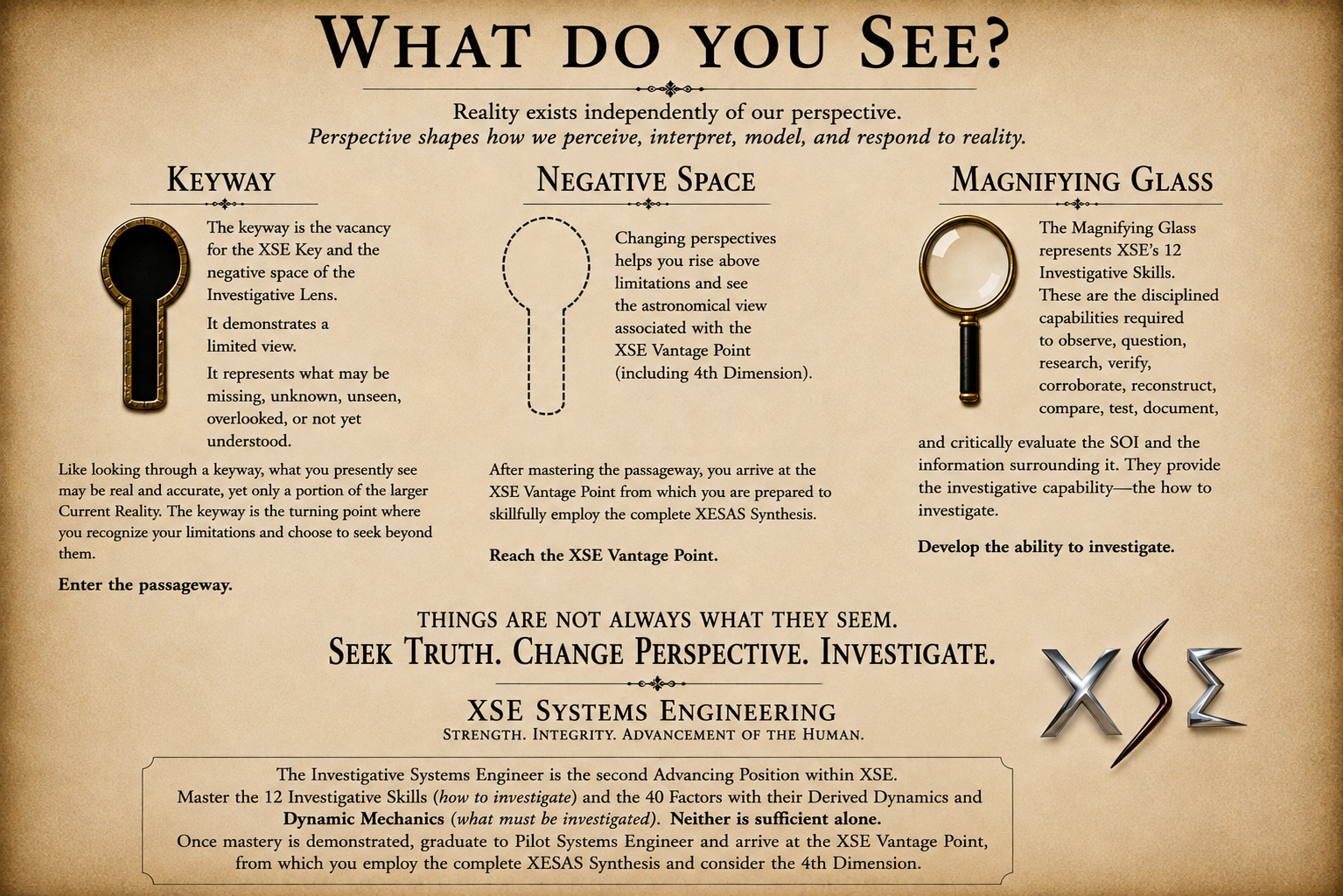

The Investigative Systems Engineer is the second Advancing Position within Independent Integration Systems Engineering (XSE), paired with the second Advancing Asset: Investigative Skills.
This position represents the active learning, investigation, integration, and mastery phase of XSE. After recognizing the limitations of a present perspective and grasping the XSE Key, the Systems Engineer applies the Key to the Keyway and advances beyond what is presently seen, known, understood, or considered into the investigative phase of XSE.
Within this phase, the Investigative Systems Engineer develops two complementary forms of mastery:
The Investigative Lens / Magnifying Glass — Investigative Skills: the disciplined capabilities required to investigate.
The Investigative Passageway — XSE Architecture: the 40 Factors of XSE (2FA), their relationships, applicable Derived Dynamics, the 12 Core Dynamic Mechanics, Integrated Mechanics, and their relevant integration within XESAS Synthesis that must be studied, investigated, understood, and mastered.
Neither is sufficient alone.
The Investigative Systems Engineer must learn both how to investigate and how to investigate, understand, and integrate XSE’s architecture.
Once the required mastery has been demonstrated, the investigative passageway has fulfilled its developmental purpose. The individual advances from Investigative Systems Engineer to Pilot Systems Engineer, arriving at the XSE Vantage Point, from which the Pilot is prepared to skillfully employ the complete XESAS Synthesis and assume the broader astronomical perspective associated with the Vantage Point, including appropriate consideration of the Fourth Dimension.
The Second Advancing Position
XSE’s three Advancing Positions correspond with three Advancing Assets:
Luxury Systems Engineer — XSE Key
↓
Investigative Systems Engineer — Investigative Skills
↓
Pilot Systems Engineer — XSE Vantage Point
Each represents a position of advancement within XSE rather than a conventional occupational title.
The Investigative Systems Engineer occupies the critical developmental position between grasping and applying the XSE Key and arriving at the XSE Vantage Point.
The Key helps initiate movement beyond the limitations of the existing perspective.
The Keyway reveals that there may be more to investigate.
The investigative passageway is where the Systems Engineer develops the capability and mastery necessary to do so.
A person cannot reasonably navigate a complex system merely because they have recognized that their existing perspective may be incomplete. They must learn to determine what is actually present, distinguish evidence from assumption, identify relevant Factors, investigate Sources and Resources, examine Inputs and Outputs through the Gateways, reconstruct changing system conditions, investigate relationships, evaluate Derived Dynamics, understand applicable Dynamic Mechanics, and continually correct their understanding as new evidence becomes available.
That is the developmental work of the Investigative Systems Engineer.
The XSE Keyway and Investigative Lens
The distinction between the Keyway, the Investigative Lens, and the investigative passageway is important.
They are related, but they are not interchangeable.
The Keyway: Recognizing What May Be Missing
The XSE Keyway is both the vacancy for the XSE Key and the negative space of the XSE Investigative Lens.
It represents limited vision and what may be absent from present understanding.
Like looking through a keyhole, what a person presently sees may be real and accurate while still representing only a portion of the larger Current Reality.
The problem is not necessarily that what you see is wrong.
The problem is that what you see may not be all there is to see.
The Keyway therefore represents an important investigative threshold: the recognition that relevant information, relationships, Sources, Factors, perspectives, conditions, or explanations may remain missing, unknown, unseen, overlooked, or not yet understood.
The Keyway is intentionally not classified as a separate Factor, Derived Dynamic, Dynamic Mechanic, or Advancing Asset. It is the vacancy positioned at the turning point before entry into the investigative phase of XSE.
Recognize the vacancy. Apply the Key. Investigate beyond what is presently seen.
The Investigative Lens / Magnifying Glass: How to Investigate
The Investigative Lens, symbolized by the magnifying glass, represents the Investigative Skills.
These are the disciplined capabilities the Investigative Systems Engineer develops to observe, question, research, verify, corroborate, reconstruct, compare, test, document, critically evaluate, and continually refine understanding of the SOI and the information surrounding it.
The Lens therefore provides investigative capability.
The Investigative Passageway: What Must Be Mastered
Beyond the threshold lies the XSE investigative passageway.
The passageway is not the Keyway itself. It represents the developmental course through which the Investigative Systems Engineer studies and masters the applicable XSE architecture—including the 40 Factors / 2FA, Factor relationships, Derived Dynamics, Dynamic Mechanics, Integrated Mechanics, Sources and Resources, feedback relationships, and their integration within XESAS Synthesis.
The relationship can therefore be expressed as:
XSE Key → Keyway → Investigative Lens + Investigative Passageway → Mastery → XSE Vantage Point
The Key provides the means for advancement.
The Keyway reveals the vacancy and limitation of present vision.
The Investigative Lens provides the skills necessary to investigate.
The passageway provides the XSE architecture to be investigated and mastered.
The Vantage Point is the Advancing Asset reached upon successful completion of that developmental passage.
The Purpose of the Investigative Systems Engineer
Systems do not necessarily reveal their complete Current Reality through surface appearances.
An apparent problem may actually be an Output of conditions elsewhere. An influential Input may have entered through an overlooked Gateway. A trusted Source may be incomplete, outdated, misinterpreted, or incorrect. A missing Resource may alter system operation. Multiple Factors may interact in ways that produce a Derived Dynamic not apparent when those Factors are considered independently. An Output may enter another system, generate additional effects, and eventually return as feedback.
The Investigative Systems Engineer therefore develops the discipline to resist premature closure.
The investigation asks questions such as:
What is actually occurring? What evidence supports that assessment? What remains unknown? Which XSE Factors are relevant? How are they interacting? What Sources and Resources are involved? What Inputs and Outputs are crossing the Gateways? What feedback is returning? What Derived Dynamics appear to emerge? What Dynamic Mechanics characterize the SOI’s state and change? How did the SOI arrive at Current Reality? Where does its present Trajectory appear to lead? What evidence would require the current understanding to change?
Investigation is not an exercise in proving what the engineer already believes.
Its purpose is to develop an increasingly defensible, reality-grounded, and correctable understanding of Current Reality.
The 12 Core Investigative Skills
The Investigative Systems Engineer develops 12 Core Investigative Skills. These skills do not constitute another XSE Factor set and do not modify XSE’s 40-Factor 2FA architecture. They provide disciplined capabilities for investigating the SOI and applying XSE’s architecture.
1. Observation & Situational Awareness
Observe relevant conditions, changes, anomalies, Inputs, Outputs, behaviors, interfaces, and environmental influences while maintaining the distinction between what was observed and what the observation is interpreted to mean.
2. Investigative Questioning & Interviewing
Develop systematic, clarifying, chronological, and appropriately non-leading questioning. When humans function as Sources, distinguish firsthand knowledge from recollection, interpretation, inference, assumption, secondhand information, and uncertainty.
3. Evidence Recognition & Documentation
Identify and appropriately document relevant information so that findings remain traceable to supporting evidence. Maintain the distinction between evidence and conclusions derived from evidence.
4. Verification & Corroboration
Test significant claims, observations, and apparent relationships against additional evidence and independent Sources where appropriate rather than accepting information merely because it appears plausible.
5. Source Evaluation & Research
Trace information toward increasingly authentic and ultimate relevant Sources, evaluating provenance, authority, competence, relevance, currency, context, limitations, and reliability. This skill has a particularly strong relationship with the Z Axis and Z Axiom.
An original or authoritative Source is not automatically correct; it must still be evaluated within the context of the inquiry and available evidence.
6. Timeline & Epoch Reconstruction
Reconstruct events and system conditions across relevant Epochs to investigate how the SOI arrived at Current Reality. Examine what preceded significant changes, what followed them, and how Factors, Inputs, Outputs, Sources, Resources, and feedback changed over time.
7. Hypothesis Development & Testing
Use critical and creative thinking to develop multiple plausible explanations for observed system conditions and test those explanations against evidence rather than attempting merely to confirm the first or preferred explanation.
8. Contradiction & Inconsistency Analysis
Identify conflicts among Sources, records, observations, timelines, Factors, expected behavior, and actual Outputs. Treat contradictions as investigative leads, not automatic proof of a particular conclusion.
9. Pattern, Relationship & Link Analysis
Investigate relationships among Factors, systems, Inputs, Outputs, Sources, Resources, Gateways, and feedback to identify meaningful dependencies, recurring patterns, and interactions that may contribute to Derived Dynamics.
10. Investigative Reporting & Developing XESAS Integration
Organize findings so that established information, evidence-supported inference, hypotheses, uncertainty, contradictions, and unresolved questions remain distinguishable and traceable while developing competence in XESAS integration.
11. Bias Control & Analytical Discipline
Continually examine the investigation for confirmation bias, anchoring, premature closure, unsupported assumptions, overconfidence, selective evidence, and attachment to preferred explanations.
12. Legal, Ethical & Scope Awareness
Ensure that investigative activities remain lawful, appropriate, integrity-based, properly sourced, and within applicable authority, competence, and professional scope.
These skills constitute the Investigative Lens through which the Investigative Systems Engineer learns to examine the SOI.
Entering the XSE Passageway: Mastering the 40 Factors
Investigative capability alone does not complete this Advancing Position.
The Investigative Systems Engineer must also develop mastery of XSE’s 40 Factors, consisting of the 20 Actual Factors and 20 Analytical Factors.
Together, both sets constitute XSE’s 2FA—Two-Factor Authentication. Both must be applied for the complete XSE methodology to have been applied.
The 20 Actual Factors address the real-world elements and conditions relevant to the SOI through the three Aspects of the Human, three Gateways, seven Spheres of Integration, and seven Domains of Study.
The 20 Analytical Factors provide the XSE architecture for analysis through the X, Y, and Z Axes; the three Elements of Luxxacation—Take Time, Build Strength, Rise Above; the seven Advancing Assets and Positions; and the seven Axioms.
Mastery requires more than memorizing Factor names.
For each relevant Factor, the investigator learns to ask:
What does this Factor reveal about the SOI? What evidence supports the assessment? What Sources and Resources are relevant? What Inputs and Outputs affect or arise from it? Through which Gateways do exchanges occur? What other Factors does it interact with? How has its condition changed across Epochs? What relationships or Derived Dynamics may involve it? What remains unknown?
The 40 Factors thereby function not merely as a checklist, but as an integrated investigative architecture.
From Factors to Relationships
The Investigative Systems Engineer then moves beyond examining Factors independently.
Complex system behavior emerges through relationships and interactions.
A Resource condition may affect a Gateway. A change within one Sphere may become an Input into another. An Output may alter the surrounding environment and later return as feedback. Multiple Factors may interact simultaneously. Conditions outside the SOI may exert forces upon its operation without becoming part of the SOI itself.
The investigator therefore examines relationships such as:
Factor ↔ Factor → Inputs/Outputs → Gateways → Sources/Resources → SOI ↔ Environment → System ↔ System → Feedback → Changed System State
The engineer is no longer merely asking:
What exists?
The investigation increasingly asks:
How are these elements related, what effects emerge from their interaction, and what does the evidence actually support?
Investigating Derived Dynamics
Relationships among Factors and system conditions can give rise to Derived Dynamics.
The Investigative Systems Engineer learns to recognize, investigate, test, and appropriately integrate these higher-order XSE dynamics rather than assuming that an apparent pattern establishes one.
The investigator asks:
Does the apparent relationship persist? Under what conditions does it occur? Which Factors and conditions are involved? What evidence supports the interpretation? What changes when relevant conditions change? Could another explanation account for the observations? What evidence would weaken or disconfirm the interpretation?
Within the established XSE architecture, Derived Dynamics include higher-order constructs such as XESAS Synthesis, Luxxacation, Integrity, the Integrative Convergence Center (ICC), Executive Control Center (ECC), Executive Power, Desired Results, the Eight Octants, Astronomical Plotting, the 147 Zones, Gateway Guarding, and XSE Dynamic Mechanics.
This is where the Investigative Lens and XSE architecture operate together: the architecture identifies relationships and dynamics requiring investigation; Investigative Skills provide the discipline for determining what the available evidence supports.
Investigating the 12 Core Dynamic Mechanics
Within XSE, Dynamic Mechanics have a specific architecture. They should not be reduced to a generic list of mechanisms such as initiation, reinforcement, inhibition, or transmission.
The Investigative Systems Engineer learns to examine the 12 Core Dynamic Mechanics:
System Mass; System Energy; System Distance; System Displacement; Trajectory; Rate of Change; Velocity; Acceleration/Deceleration; Inertia; Momentum; System Force; and System Work.
These are systems-engineering analogues used to investigate the dynamic state and change of the SOI. When applied to human systems, they are not assertions of literal physical quantities or medical measurements.
The investigator asks how these Mechanics help characterize what the SOI is doing:
What resistance to change is present? What System Energy is available or being expended? What distance or displacement separates present conditions from another state? What is the SOI’s Trajectory? At what Rate of Change is it changing? What Velocity or Acceleration/Deceleration characterizes that change? What Inertia or Momentum is present? What System Forces are influencing it? What System Work is actually being accomplished?
These Core Dynamic Mechanics are further integrated with XSE’s Three Integrated Mechanics:
Executive Power — POWER
Luxxacation — TORQUE
Astronomical Plotting — POSITION
Together, these mechanics give the Investigative Systems Engineer a structured means of examining state, change, agency, operation, and trajectory without confusing the systems-engineering model with literal human physics.
Follow the Trail
A defining habit of the Investigative Systems Engineer is learning to follow the trail rather than stop at the first plausible explanation.
If an Output appears, investigate where it originated.
If an Input enters, trace its Source.
If a Source makes a claim, trace the supporting evidence.
If two Factors appear related, investigate the relationship.
If a Derived Dynamic appears relevant, examine the conditions and relationships supporting it.
If the SOI’s dynamic state is changing, investigate its Dynamic Mechanics.
If an Output leaves the SOI, determine where it goes.
If another system receives it, investigate the resulting effects.
If those effects return, trace the feedback.
A possible investigative trail may therefore extend:
Source → Input → Gateway → Factor(s) → Relationships → Derived Dynamic → Dynamic Mechanics → Output → Receiving System → Effect → Feedback → Changed System Condition → New Input
The actual sequence will depend upon the SOI and evidence; it should not be presumed in advance.
Investigating Across Epochs
Current Reality is rarely understandable from a single snapshot.
Systems have histories.
The Investigative Systems Engineer reconstructs relevant Epochs to examine how the present state developed and how Factors, Sources, Resources, Inputs, Outputs, relationships, feedback, and Dynamic Mechanics changed across the system life cycle.
A simplified reconstruction might appear as:
Previous Condition → Change → Response → Output → Feedback → New Condition
This may reveal that the most visible event was not the beginning of the relevant change, that an important Factor shifted earlier, or that repeated feedback gradually altered the SOI.
Chronology constrains possible explanations.
Chronology alone does not establish causation.
Competing Hypotheses
The Investigative Systems Engineer does not investigate to defend a predetermined story.
Multiple explanations should remain viable until the evidence reasonably justifies narrowing them.
If system performance declines, for example, possible explanations could involve a Resource constraint, external Input, Gateway condition, interaction among several Factors, a Derived Dynamic, changing Dynamic Mechanics, faulty or incomplete measurement, or an influence that has not yet been identified.
The investigator therefore repeatedly asks:
What evidence would require me to change my present conclusion?
That question helps protect XSE investigation from becoming confirmation of what the investigator already expected to find.
Investigating the Investigation
Eventually, the Investigative Systems Engineer must turn the Investigative Lens toward the investigation itself.
Bias, assumptions, emotional attachment, selective sourcing, overconfidence, incomplete information, and premature closure can distort the developing representation of Current Reality.
The engineer therefore continually asks:
What am I assuming? What do I actually know? How do I know it? What Source supports it? What contradicts it? Have I confused correlation with causation? Have I overlooked relevant Factors or relationships? Have I considered competing explanations? What remains unknown?
This discipline is closely aligned with the Alpha Axiom:
“Integrity is founded on truth.”
The purpose is not to force evidence to conform to an existing belief.
The developing understanding must remain correctable in response to Current Reality.
Developing XESAS Synthesis
Throughout the investigative passageway, the Investigative Systems Engineer progressively develops the capability to bring what has been discovered into XESAS Synthesis.
XESAS integrates the applicable 40 Factors / 2FA, Factor relationships, Derived Dynamics, Dynamic Mechanics, Integrated Mechanics, Sources and Resources, Inputs and Outputs, Gateways, Epochs and life-cycle conditions, feedback, constraints, Current Reality, Trajectory, evidence, uncertainty, and unresolved questions into an increasingly coherent systems-level understanding.
The process remains iterative:
Investigate → Analyze → Test → Integrate → Reinvestigate → Correct → Refine
New evidence may alter a Factor assessment.
A newly identified Source may change the understanding of an Epoch.
A previously overlooked relationship may reveal a relevant Derived Dynamic.
Analysis of Dynamic Mechanics may change the interpretation of Trajectory.
Feedback may reveal that the developing model does not adequately represent Current Reality.
The Investigative Systems Engineer therefore learns that a strong XESAS Synthesis must remain reality-grounded, evidence-responsive, and correctable.
Mastery Requires Both Sides
The central requirement of the second Advancing Position can be summarized as:
Investigative Lens
Master the 12 Investigative Skills.
Investigative Passageway
Master the applicable XSE architecture—the 40 Factors / 2FA, relationships, Derived Dynamics, Dynamic Mechanics, Integrated Mechanics, and their integration within XESAS.
Together
Demonstrate sufficient proficiency to investigate, analyze, integrate, and navigate the architecture responsibly and effectively.
Knowing XSE terminology without investigative discipline is insufficient.
Possessing general investigative ability without mastering XSE architecture is also insufficient for advancement within XSE.
The Investigative Systems Engineer must integrate both.
The Investigative Systems Engineer Is a Transitional Position
The title Investigative Systems Engineer identifies the developmental position during which this mastery is being acquired and demonstrated.
It is not XSE’s final Advancing Position.
During this stage, the Systems Engineer develops the capability to observe, question, investigate, research, verify, corroborate, reconstruct, test hypotheses, control bias, master the 40 Factors, investigate relationships, evaluate Derived Dynamics, analyze Dynamic Mechanics, trace Sources and Resources, follow Inputs and Outputs through Gateways, analyze feedback, reconstruct Epochs, develop XESAS integration, distinguish established knowledge from uncertainty, and correct conclusions when evidence requires it.
The Investigative Systems Engineer remains within this developmental passageway until the mastery required by XSE has been demonstrated.
Completing the Investigative Passageway
The investigative passageway leads somewhere specific:
the XSE Vantage Point.
The progression can be represented as:
XSE Key
Grasp the means for moving beyond limitations of the present perspective.
↓
XSE Keyway
Recognize the vacancy, limited vision, and what may remain missing, unknown, unseen, overlooked, or not yet understood; apply the Key.
↓
Investigative Systems Engineer
Enter and travel the investigative passageway.
↓
Investigative Lens + XSE Architecture
Master Investigative Skills while investigating and mastering the 40 Factors / 2FA, relationships, Derived Dynamics, Dynamic Mechanics, Integrated Mechanics, and developing XESAS integration.
↓
Demonstrate Required Mastery
↓
Complete the Investigative Passageway
↓
XSE Vantage Point
↓
Pilot Systems Engineer
Graduation to Pilot Systems Engineer
When the required mastery has been demonstrated, the Investigative Systems Engineer graduates to Pilot Systems Engineer.
The Pilot occupies XSE’s third Advancing Position and is paired with the third Advancing Asset: the XSE Vantage Point.
The distinction is important.
The Investigative Systems Engineer is traveling and mastering the passageway.
The Pilot Systems Engineer has successfully traveled it and arrived at the XSE Vantage Point.
The Vantage Point represents the broader astronomical perspective from which the Pilot is prepared to skillfully employ the complete XESAS Synthesis. This includes expanding relevant reference frames, examining the SOI from broader perspectives, and appropriately considering the Fourth Dimension in temporal, spatial, mathematical, or metaphorical contexts according to the inquiry—without confusing metaphorical perspective-taking with literal physical transcendence.
Graduation does not mean abandoning Investigative Skills.
The Investigative Lens becomes mastered equipment.
Nor does the Pilot leave the 40 Factors, Derived Dynamics, or Dynamic Mechanics behind.
The passageway becomes mastered architecture available for integrated XESAS operation.
What changes is the Advancing Position from which the Systems Engineer operates.
From Key to Investigation to Flight
The progression can ultimately be summarized through XSE’s symbolism:
The XSE Key provides the means to unlock.
The Keyway reveals the vacancy and limitations of what is presently seen.
Applying the Key opens the way into deeper investigation.
The Investigative Lens provides the skills necessary to investigate rigorously.
The investigative passageway contains the XSE architecture to be investigated, integrated, and mastered.
The Investigative Systems Engineer travels that passageway by mastering both.
The XSE Vantage Point awaits at its completion.
Upon demonstrated mastery, the Investigative Systems Engineer graduates to Pilot Systems Engineer and is prepared to skillfully employ the complete XESAS Synthesis from that Advancing Position.
The Investigative Systems Engineer, therefore, means considerably more within XSE than someone who simply “investigates systems.” It is a defined developmental position within Independent Integration Systems Engineering: the stage in which the Systems Engineer develops disciplined Investigative Skills while systematically investigating and mastering XSE’s architecture, progressing from recognition of the limitations of present vision toward the broader perspective and integrated capability represented by the XSE Vantage Point.
The XSE Investigative Systems Engineer designation describes an educational and developmental position within the proprietary XSE framework. It does not confer professional engineering licensure, private-investigator licensure, law-enforcement authority, forensic credentials, medical or mental-health qualifications, or authorization to perform activities legally reserved to appropriately licensed or otherwise qualified professionals.
Optical Illusions and the Mind