The 3 Integrated Mechanics of XSE
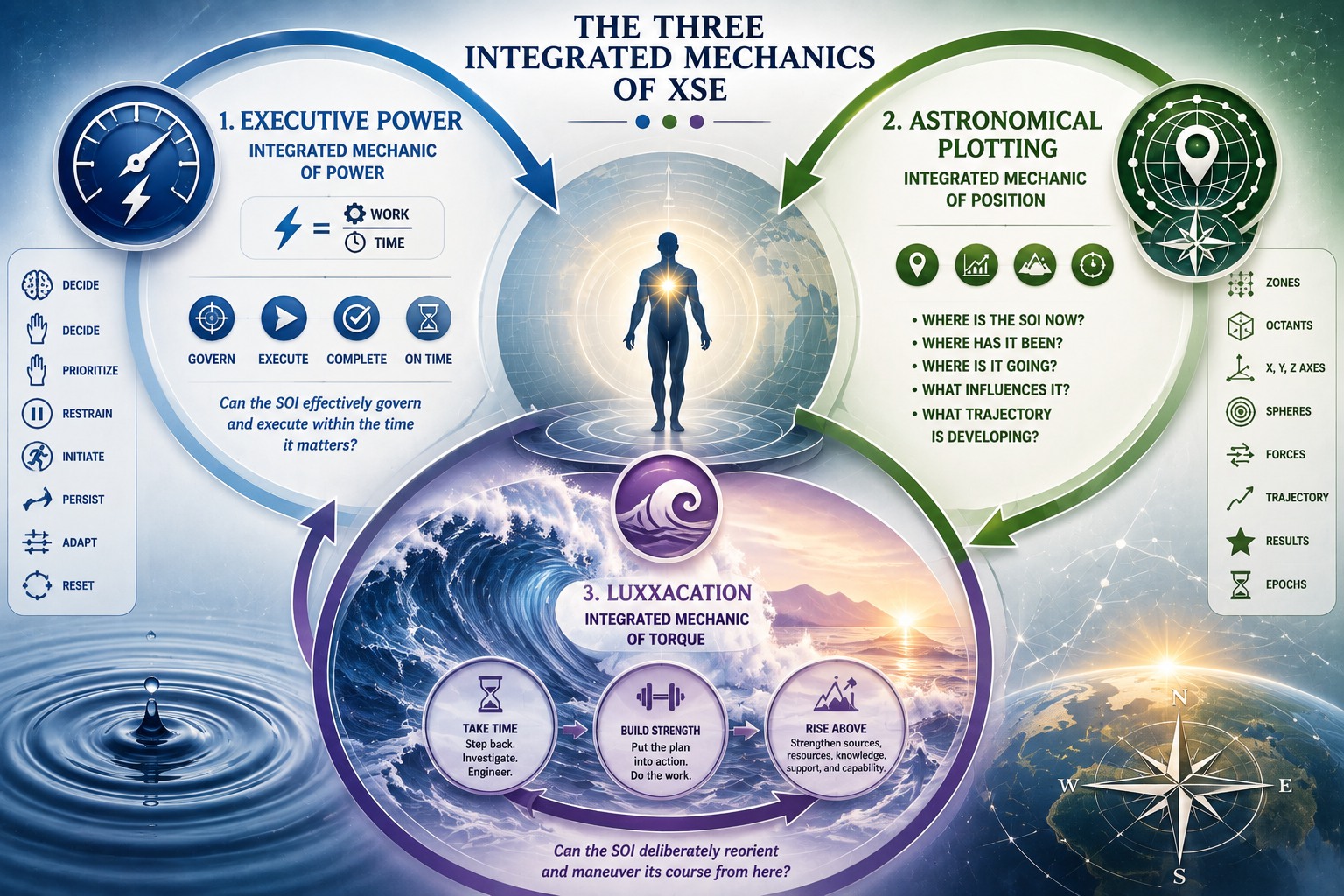
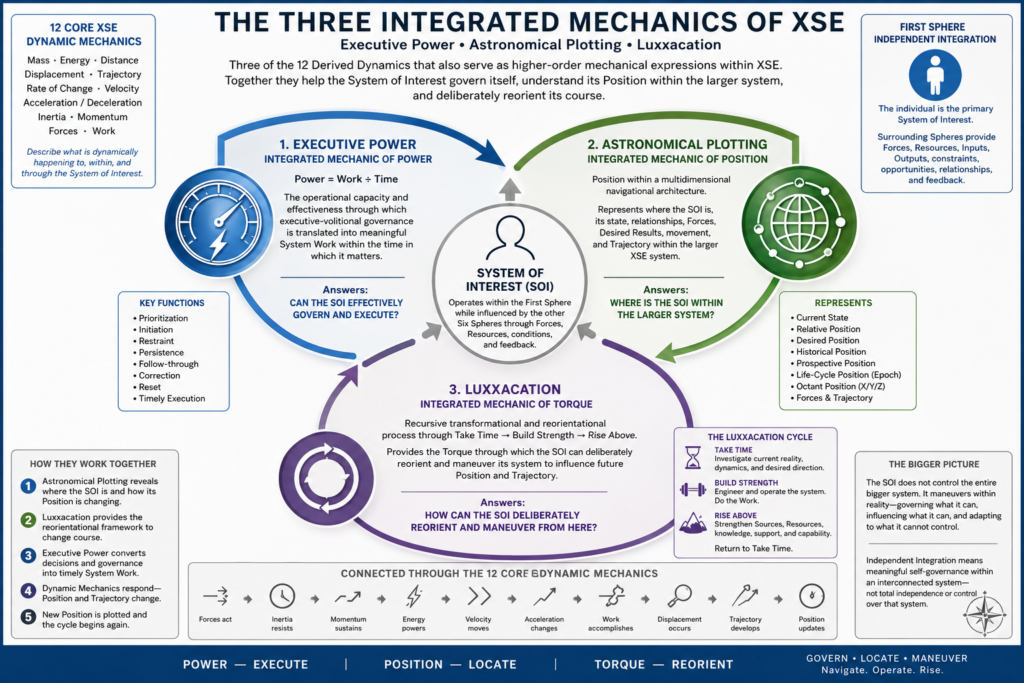
The Three Integrated Mechanics of XSE are three of the 12 Derived Dynamics that also serve as higher-order mechanical expressions within the XSE architecture: Executive Power integrates Power, Astronomical Plotting integrates Position, and Luxxacation integrates Torque. Together, they describe how the System of Interest can govern its own operation, understand its Position within the larger multidimensional system, and deliberately reorient or maneuver its course in ways that may influence future Position and Trajectory.
The 12 Core XSE Dynamic Mechanics are primarily SOI-centered. They characterize important aspects of what is dynamically happening to, within, and through the System of Interest: its Mass, Energy, Distance, Displacement, Trajectory, Rate of Change, Velocity, Acceleration/Deceleration, Inertia, Momentum, Forces, and Work.
The Three Integrated Mechanics operate at a different architectural level. They connect mechanical principles to broader XSE structures that help the SOI answer three higher-order questions:
Power — Can the SOI effectively govern and execute?
Position — Where is the SOI within the larger system?
Torque — How can the SOI deliberately reorient from here?
For a human SOI, these relationships are especially significant within the First Sphere of Integration—Individual / Independent Integration. The individual is the primary System of Interest, while the surrounding Spheres may provide Forces, Inputs, Outputs, Sources, Resources, constraints, opportunities, relationships, and feedback that influence its Dynamic Mechanics.
Thus, Independent Integration is not isolation.
The SOI is dynamically situated within a larger system while retaining a meaningful sphere of self-governance and agency.
1. Executive Power — The Integrated Mechanic of Power
Mechanical Foundation
In mechanics:
Power = Work ÷ Time
Power concerns the rate at which Work is performed.
Within XSE, this mechanical principle is integrated through the Derived Dynamic of Executive Power.
Executive Power is the operational capacity, effectiveness, and timeliness through which executive-volitional governance is translated into meaningful System Work.
Executive Power therefore concerns not merely whether the SOI knows what should be done, but whether appropriate governance becomes actual operation within the time in which that operation matters.
Executive Power and Independent Integration
Of the Three Integrated Mechanics, Executive Power is the most directly centered upon the First Sphere—Individual / Independent Integration.
It addresses the SOI’s ability to govern and operate itself.
This includes relevant capacities for:
- prioritization;
- initiation;
- restraint;
- persistence;
- follow-through;
- correction;
- redirection;
- Reset;
- and timely execution.
The core question is:
How effectively can the SOI convert appropriate executive governance into meaningful operation?
Within applicable human systems, the Executive Control Center (ECC) contributes governance, while Executive Power concerns the effectiveness with which that governance becomes action.
In condensed form:
ECC = governs
Executive Power = executes
Why Time Matters
Time is essential because the SOI does not remain suspended while action is postponed.
If a person determines that an appropriate action should occur but repeatedly delays implementation:
- existing Forces continue acting;
- Inputs and Outputs continue;
- Inertia may preserve the current condition;
- Momentum may continue;
- Energy and Resources may continue to be expended;
- feedback accumulates;
- Displacement may occur;
- and Trajectory continues developing.
Thus, unnecessary delay can itself become dynamically consequential.
Executive Power therefore asks not only:
Was the Work eventually performed?
but also:
Was it performed within the time in which it could meaningfully influence the system?
This is why Executive Power can be understood as the Integrated Mechanic of self-governance and timely execution.
High and Weak Executive Power
Higher Executive Power is generally reflected when appropriately established priorities are translated into timely, effective System Work with relatively little unnecessary delay.
Weaker Executive Power is reflected when a recurring gap develops between what the SOI appropriately determines should occur and what is actually carried into operation.
Examples may include:
- repeated procrastination;
- poor prioritization;
- delayed initiation;
- incomplete follow-through;
- ineffective restraint;
- delayed correction;
- or failure to Reset promptly after deviation.
These are operational conditions, not judgments about a person’s worth or character.
Executive Power is influenced by the larger system, including:
- Energy;
- Resources;
- fatigue;
- environmental conditions;
- habits;
- conditioning;
- Gateway Guarding;
- ICC alignment;
- Inertia;
- Momentum;
- competing Forces;
- and available time.
Accordingly:
Executive Power represents how effectively the individual SOI governs and carries itself into timely System Work within the conditions actually present.
2. Astronomical Plotting — The Integrated Mechanic of Position
Mechanical Foundation
Position describes where an object or system is located relative to a reference framework.
Within XSE, the principle of Position is integrated through Astronomical Plotting.
Astronomical Plotting is the Derived Dynamic through which relevant Position, state, movement, Forces, Dynamic Mechanics, Desired Results, and Trajectory are represented within XSE’s multidimensional navigational architecture.
Astronomical Plotting therefore answers:
Where is the SOI?
But in XSE, that question is much broader than physical location.
It includes:
- where the SOI is within its life cycle;
- where relevant conditions appear across the 147 Zones;
- where the SOI is positioned within the 8 Octants;
- how it relates to the X, Y, and Z Axes;
- where it stands relative to Desired Results;
- what Forces are acting upon it;
- what Trajectory is developing;
- and how its Position has changed across time or Epochs.
Position Within the Larger System
Astronomical Plotting is especially important because the individual SOI does not exist independently of the broader system in which it operates.
The First Sphere interacts with:
- Family / Home;
- Professional / Business;
- Community / Local;
- National / Country;
- Global / World;
- Cyber / Beyond.
These surrounding Spheres can influence the SOI through:
- relationships;
- obligations;
- environments;
- Resources;
- constraints;
- opportunities;
- laws;
- information;
- technologies;
- cultural conditions;
- and feedback.
Astronomical Plotting helps represent the SOI within this larger multidimensional picture.
Thus:
Executive Power asks how effectively the SOI can govern itself. Astronomical Plotting asks where that SOI is situated within the broader system it must navigate.
Position Is More Than Location
Within XSE, Position may include relationships such as:
Current State
What is true about the system now?
Relative Position
How is the SOI situated relative to other relevant conditions or systems?
Desired Position
Where is the SOI intended to move?
Historical Position
Where has the SOI been?
Prospective Position
Where might present operation carry the SOI?
Life-Cycle Position
What is the actual Y-Axis stage or Epoch of the system?
Octant Position
How is the SOI positioned relative to the X/Y/Z coordinate architecture?
Astronomical Plotting therefore serves as XSE’s higher-order navigational representation of Position.
Position and Dynamic Mechanics
The 12 Core Dynamic Mechanics help explain how Position changes.
For example:
- Distance describes separation from another Position;
- Displacement describes net change in Position;
- Velocity describes rate and direction of change;
- Acceleration describes change in that Velocity;
- Forces contribute to movement or redirection;
- Momentum helps sustain an established course;
- Inertia resists change;
- Trajectory describes the developing course.
Astronomical Plotting then represents the resulting state and Position.
Thus:
Dynamic Mechanics describes how the SOI changes; Astronomical Plotting represents where those changes place it within the larger system.
The plot is a navigational representation.
It is not the underlying system itself.
3. Luxxacation — The Integrated Mechanic of Torque
Mechanical Foundation
In mechanics, Torque concerns rotational effect and the ability of Force to change orientation.
Within XSE, Torque is integrated through Luxxacation.
Luxxacation is the recursive transformational and reorientational Derived Dynamic of XSE through which the System of Interest can deliberately reassess, strengthen, and redirect its operation through Take Time → Build Strength → Rise Above.
Luxxacation therefore answers:
How can the SOI deliberately turn, reorient, and maneuver from its present course toward a different one?
This makes Torque the appropriate mechanical analogue for course reorientation.
Luxxacation as Maneuver
Astronomical Plotting may reveal:
Where am I?
XSE Dynamic Mechanics may reveal:
What is happening dynamically?
Executive Power may reveal:
Can I carry appropriate governance into action?
Luxxacation then addresses:
How do I deliberately reconfigure and reorient the system from here?
Through Take Time, the SOI investigates Current Reality, Dynamic Mechanics, Trajectory, Desired Results, and the configuration required for advancement.
Through Build Strength, that configuration is placed into actual operation.
Through Rise Above, better Sources, Resources, knowledge, support, and capability are sought.
The system then returns to Take Time.
Thus:
Take Time
→ determine current course and intended direction
Build Strength
→ perform the Work required to change operation
Rise Above
→ increase capability for subsequent movement
Return to Take Time
→ reassess Position and Trajectory
This recursive turning process is why Luxxacation serves as the Integrated Mechanic of Torque.
The Three Integrated Mechanics as a Navigation-and-Control Architecture
Taken together, the Three Integrated Mechanics create a particularly useful higher-order structure.
Executive Power — Govern
Can the SOI effectively govern its own operation?
Executive Power concerns timely execution, restraint, prioritization, persistence, correction, and System Work.
Astronomical Plotting — Locate
Where is the SOI within the larger system?
Astronomical Plotting represents Position, state, relationships, Desired Results, movement, Forces, and Trajectory.
Luxxacation — Maneuver
How can the SOI deliberately reorient and change course from its present Position?
Luxxacation provides recursive transformational Torque.
This relationship can be stated simply as:
Executive Power = Govern
Astronomical Plotting = Locate
Luxxacation = Maneuver
Or mechanically:
POWER — Execute
POSITION — Locate
TORQUE — Reorient
Together, these three mechanics help bridge the First Sphere of Independent Integration with the larger XSE environment.
Relationship to the First Sphere
When the SOI is the individual person, the 12 Core XSE Dynamic Mechanics are centered upon what is dynamically happening to and within the individual SOI.
They characterize:
- what physically constitutes the embodied SOI;
- what Energy is available;
- what Forces are acting;
- what Work is occurring;
- what resists change;
- what sustains the current course;
- how rapidly the system is changing;
- and what Trajectory is developing.
However, the individual does not exist in isolation.
Other Spheres may supply:
- Forces;
- Inputs;
- Outputs;
- Resources;
- constraints;
- relationships;
- opportunities;
- and feedback
that influence those mechanics.
Thus:
The Core Dynamic Mechanics are SOI-centered but not SOI-isolated.
The Three Integrated Mechanics then help the individual engage that larger reality.
Executive Power
Supports governance within the First Sphere.
Astronomical Plotting
Represents the SOI’s Position within and relative to the larger multidimensional system.
Luxxacation
Provides the recursive Torque through which the SOI can reorient its own operation and attempt to change its future Position and Trajectory within that larger system.
Agency Without Total Control
The Three Integrated Mechanics do not imply that the individual controls the entire larger system.
A person may govern many aspects of their own operation while remaining subject to:
- external Forces;
- laws;
- biological realities;
- Resource limitations;
- other people’s choices;
- environmental conditions;
- societal systems;
- chance events;
- uncertainty;
- and conditions outside personal control.
Accordingly:
Independent Integration means meaningful self-governance within an interconnected system—not total independence from or control over that system.
Executive Power can help govern the SOI.
Astronomical Plotting can improve awareness of Position.
Luxxacation can support deliberate reorientation.
But none guarantees a particular outcome.
The SOI maneuvers within reality rather than commanding reality.
Relationship to the 12 Core Dynamic Mechanics
The Three Integrated Mechanics operate in continual relationship with the Core Dynamic Mechanics.
For example:
Astronomical Plotting
→ establishes relevant Current Position
↓
XSE Dynamic Mechanics
→ investigates Mass, Energy, Distance, Forces, Inertia, Momentum, Work, Velocity, and Trajectory
↓
Take Time
→ determines whether reorientation is required
↓
Luxxacation / Torque
→ establishes the reorientational process
↓
ECC Governance
→ determines relevant priorities and actions
↓
Executive Power / Power
→ translates those priorities into timely System Work
↓
System Work
→ interacts with Forces, Inertia, Momentum, Energy, and Resources
↓
Displacement / Velocity / Trajectory Change
↓
Astronomical Plotting
→ represents the resulting Position
↓
New Take Time
→ evaluate again
This creates a recursive navigation-and-control loop.
The Larger XSE Navigation Model
The architecture can therefore be understood through four interacting questions.
1. What is dynamically happening to the SOI?
XSE Dynamic Mechanics
2. Where is the SOI within the larger system?
Astronomical Plotting / Position
3. How effectively can the SOI govern and execute its own operation?
Executive Power / Power
4. How can the SOI deliberately reorient its course?
Luxxacation / Torque
In highly condensed form:
Dynamic Mechanics = What is happening?
Position = Where am I?
Power = Can I execute?
Torque = How do I turn from here?
Integrated Mechanics and Desired Results
The Three Integrated Mechanics also connect directly with Desired Results.
Astronomical Plotting can help establish:
Where am I now relative to where I intend to be?
System Distance then helps describe the gap.
Luxxacation asks:
What reorientation is necessary to move toward the intended state?
Executive Power asks:
Can that engineered reorientation be translated into timely System Work?
Dynamic Mechanics then reveals:
What actually happened when the configuration entered operation?
This produces:
Current Position
↓
Desired Position / Result
↓
System Distance
↓
Luxxacation / Reorientation
↓
Executive Power / Timely Work
↓
Dynamic Mechanics
↓
Changed Position
↓
Astronomical Plotting
↓
Reassessment
Integrated Mechanics and Course Correction
Course correction demonstrates all three Integrated Mechanics simultaneously.
First:
Position
Astronomical Plotting and Target Tracking reveal that the system is deviating.
Then:
Torque
Luxxacation provides the reorientational framework through which the course can be reconsidered and reconfigured.
Then:
Power
Executive Power translates the corrective decision into timely System Work.
The resulting operation changes Dynamic Mechanics.
The SOI may then develop:
- different Forces;
- reduced undesirable Momentum;
- increased constructive Momentum;
- changed Velocity;
- new Displacement;
- and a redirected Trajectory.
The new Position can then be represented again through Astronomical Plotting.
Thus:
Position detects where the system is. Torque changes orientation. Power carries the correction into Work. Dynamic Mechanics describes the resulting change.
Integrated Mechanics Across Time
The Three Integrated Mechanics are recursive rather than one-time functions.
A system repeatedly:
locates
→ governs
→ reorients
→ operates
→ moves
→ relocates
→ reassesses
This means no single Position is necessarily final.
No single reorientation is necessarily sufficient.
No single act of Executive Power determines an entire life course.
Rather, ongoing system operation continually creates new states and new Dynamic Mechanics.
Thus:
The Three Integrated Mechanics help the SOI repeatedly govern itself, locate itself, and reorient itself as conditions change across time and Epochs.
Investigative and Philosophical Boundaries
The Three Integrated Mechanics are XSE systems-engineering constructs.
They are not claims that human beings are literal mechanical machines.
Executive Power does not mean human will can be measured in watts.
Luxxacation Torque does not mean human reorientation is literal mechanical rotation measured in newton-meters.
Astronomical Position does not mean the complete reality of a person can be represented by physical coordinates.
Rather, Power, Torque, and Position provide bounded mechanical analogues that help organize systems-engineering investigation of:
- self-governance;
- timely Work;
- navigation;
- Position;
- reorientation;
- and course correction.
Likewise, these concepts do not claim that an individual can completely control all internal or external conditions affecting the SOI.
They describe structures for investigating and improving deliberate operation within reality.
Concise Definition
The Three Integrated Mechanics of XSE are three of XSE’s 12 Derived Dynamics that also serve as higher-order expressions of key mechanical principles: Executive Power integrates Power, Astronomical Plotting integrates Position, and Luxxacation integrates Torque. Together, they provide a navigation-and-control architecture through which the System of Interest can govern its own operation, understand its Position within the larger multidimensional system, and deliberately reorient or maneuver its course. Executive Power concerns timely and effective conversion of governance into System Work; Astronomical Plotting represents where the SOI is and how its Position is changing; and Luxxacation provides recursive transformational Torque for deliberate reorientation through Take Time, Build Strength, and Rise Above. The 12 Core XSE Dynamic Mechanics remain centered on what is dynamically happening to and within the SOI, while the Three Integrated Mechanics help the SOI govern, locate, and maneuver itself within the larger interconnected system.