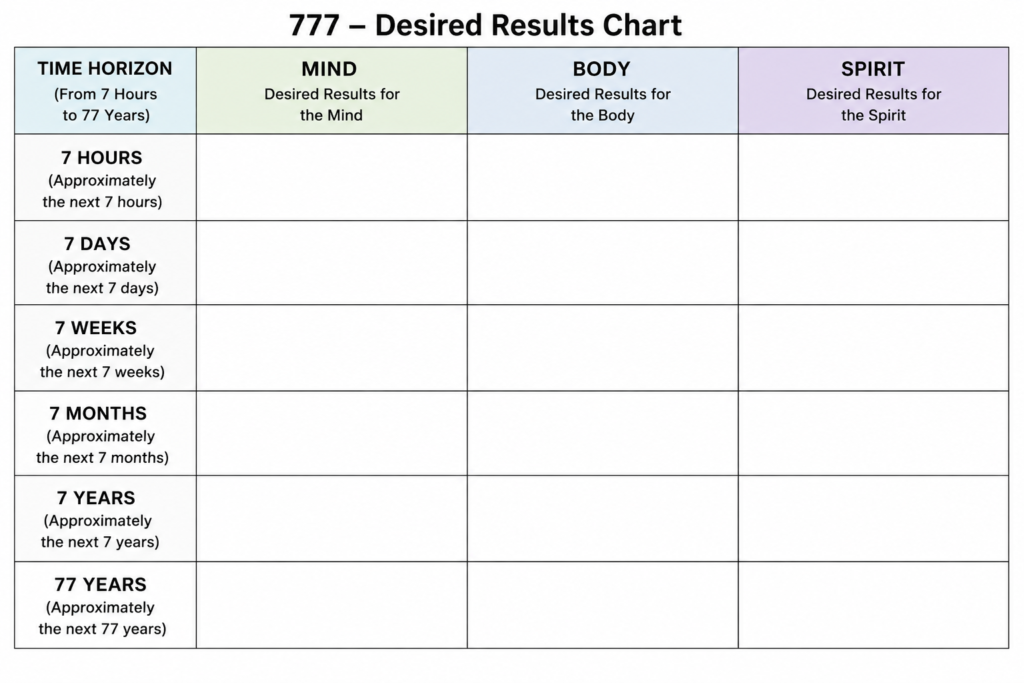

Desired Results (777) are XSE’s structured future-state outcome architecture for identifying, organizing, and recording the Results that a human System of Interest is intended to achieve, maintain, develop, preserve, or move toward across the integrated Human Aspects of Mind, Body, and Spirit and across progressively expanding time horizons ranging from approximately 7 hours to 77 years.
The framework is called 777 because its temporal architecture begins with near-term Desired Results approximately 7 hours into the future and progressively expands outward through longer horizons until reaching 77 years.
Within Independent Integration Systems Engineering (XSE), Desired Results (777) are developed within the second sub-element of Take Time, the First Element of Luxxacation, and answer the fundamental directional question:
Where should the system go?
777 is therefore not itself the primary operational goal-setting mechanism of XSE. CREATE Goals perform that function. Instead, 777 establishes the higher-level future-state reference architecture from which CREATE Goals and subsequent operational configurations can be engineered.
The overall Take Time sequence can be understood as:
1. Establish Current Reality, Relevant Dynamic Mechanics, Position & Trajectory
Where is the system now, what is dynamically happening within and to it, where is it positioned within the larger systems picture, and where is its present course taking it?
↓
2. Pinpoint Desired Results (777)
Where should the system go?
↓
3. Determine How to Get There
What should the system deliberately accomplish, regulate, configure, and operate to move toward those Desired Results?
Within this third sub-element:
CREATE Goals
↓
↓
Primary Target & Target Tracking / Data Collection Configuration
↓
↓
Whole-System Configuration
Desired Results therefore establish the larger directional and temporal reference architecture from which more operational layers of XSE can be developed.
Why It Is Called 777
The name 777 refers to the span of the framework’s time horizons:
- 7 hours
- 7 days
- 7 weeks
- 7 months
- 7 years
- 77 years
The architecture begins with what the system should be moving toward in the immediate future and progressively expands toward very long-range and enduring Results.
The name is not based upon the number of categories or individual Desired Results.
Rather:
777 represents the progression from approximately 7-hour Desired Results to 77-year Desired Results.
This creates a deliberate temporal expansion from immediate operation toward long-range system direction.
The Three Desired Results Categories
Within each 777 time horizon, Desired Results are considered separately across the three integrated Human Aspects:
Mind
Body
Spirit
For every time horizon, the person therefore considers:
What are my Desired Results for Mind?
What are my Desired Results for Body?
What are my Desired Results for Spirit?
Separating the three categories provides sufficient analytical resolution to ensure that each Human Aspect receives deliberate consideration.
They are not, however, treated as three independent human systems.
The Results are identified separately for clarity and then considered together for whole-system coherence, integration, and Integrity.
The Basic 777 Structure
| Time Horizon | Mind | Body | Spirit |
|---|---|---|---|
| 7 Hours | Desired Mind Results | Desired Body Results | Desired Spirit Results |
| 7 Days | Desired Mind Results | Desired Body Results | Desired Spirit Results |
| 7 Weeks | Desired Mind Results | Desired Body Results | Desired Spirit Results |
| 7 Months | Desired Mind Results | Desired Body Results | Desired Spirit Results |
| 7 Years | Desired Mind Results | Desired Body Results | Desired Spirit Results |
| 77 Years | Desired Mind Results | Desired Body Results | Desired Spirit Results |
The purpose is not to force identical numbers, types, or degrees of Results into every cell.
Rather, the architecture ensures deliberate consideration of:
Mind ↔ Body ↔ Spirit
across:
7 Hours → 7 Days → 7 Weeks → 7 Months → 7 Years → 77 Years
This creates both cross-Aspect and cross-horizon systems visibility.
The 7-Hour Horizon
The 7-hour horizon focuses on the immediate operating period.
It asks:
What Results should the Mind, Body, and Spirit be moving toward over approximately the next several hours?
Examples may include:
Mind
- maintaining appropriate focus;
- completing an important intellectual task;
- learning or understanding something useful;
- maintaining intentional attentional direction.
Body
- following an established operating schedule;
- completing planned movement or exercise;
- maintaining appropriate nutrition-related or recovery practices;
- supporting Energy and physical functioning.
Spirit
- maintaining gratitude;
- sustaining constructive orientation;
- resisting discouragement or self-pity;
- maintaining courage, purpose, or appropriate perspective.
The 7-hour horizon is particularly valuable because it connects the larger Desired Results architecture with actual near-term operation.
The 7-Day Horizon
The 7-day horizon considers what should be achieved, improved, stabilized, preserved, or maintained over approximately one week.
Ask:
Mind
What should be learned, completed, clarified, developed, or strengthened mentally?
Body
What physical, behavioral, scheduling, functional, or performance-related Result should improve?
Spirit
What constructive orientation, purpose, gratitude, courage, or other relevant Result should be strengthened or maintained?
The 7-day horizon can be particularly useful when developing:
- near-term CREATE Goals;
- Gateway Guarding specifications;
- Primary Target strategy;
- Target Tracking configurations;
- and recurring Take Time reviews.
The 7-Week Horizon
The 7-week horizon moves beyond immediate execution into more sustained development.
Ask:
Mind
What knowledge, cognitive skill, focus, learning, or intellectual capability should be stronger?
Body
What physical, functional, scheduling, performance, or routine-related condition should be meaningfully improved?
Spirit
What constructive orientational patterns should become more stable?
The 7-week horizon helps distinguish short-term fluctuations from more sustained changes in system operation.
The 7-Month Horizon
The 7-month horizon considers larger developmental changes across a substantial portion of a year.
Ask:
Mind
What meaningful educational, professional, cognitive, strategic, or learning Result should be achieved?
Body
What larger physical, functional, lifestyle, scheduling, capability, or performance condition should be established?
Spirit
What deeper constructive orientation, purpose, gratitude, courage, or freedom should be strengthened?
This horizon encourages planning beyond immediate habits and toward sustained systems development.
The 7-Year Horizon
The 7-year horizon considers major developmental, strategic, and life-cycle direction.
Ask:
Mind
What major intellectual, educational, professional, strategic, or cognitive Result should the person be moving toward?
Body
What long-range physical capability, lifestyle, function, or health-supportive pattern should be established or protected?
Spirit
What enduring orientation, purpose, courage, freedom, gratitude, or other constructive condition should characterize the system more strongly?
The 7-year horizon helps investigate whether present choices are coherent with major long-term direction.
It asks:
Are today’s choices, CREATE Goals, Gateway interactions, and recurring patterns helping develop the person and system intended years from now?
The 77-Year Horizon
The 77-year horizon extends the architecture toward very long-range, enduring, legacy-level, stewardship, and generational Results.
It asks:
What should ultimately endure, be preserved, be strengthened, be contributed, or be left behind across the longest horizon of the framework?
For each Aspect:
Mind
What knowledge, wisdom, understanding, teaching, intellectual contribution, or legacy should remain?
Body
What long-range stewardship, capability, habits, or effects upon future systems and generations should be considered?
Spirit
What enduring purpose, gratitude, courage, freedom, values, moral orientation, or legacy should characterize the long-term effect of the system?
The 77-year horizon does not imply that future conditions can be predicted with precision.
Its purpose is to encourage long-range systems thinking, stewardship, and consideration of consequences extending well beyond immediate personal benefit.
Why Expanding Time Horizons Matter
Complex systems can be weakened when decisions are optimized only for the present.
A choice may produce:
a desirable 7-hour Result
while undermining:
a 7-month, 7-year, or 77-year Result.
Conversely, a difficult near-term choice may support a substantially better long-term Trajectory.
The 777 therefore encourages the Systems Engineer to ask:
What happens now?
then:
What happens next?
and ultimately:
What might this direction produce over years and decades?
This can help expose:
- delayed consequences;
- short-term versus long-term tradeoffs;
- conflicting Results;
- hidden costs;
- Resource requirements;
- reinforcing patterns;
- dependencies;
- and potential Trajectory conflicts.
777 therefore provides a structured architecture for temporal systems integration.
Cross-Horizon Alignment
Desired Results should not be treated as six isolated planning periods.
They should also be compared vertically across Time:
7 Hours → 7 Days → 7 Weeks → 7 Months → 7 Years → 77 Years
Ask:
Does this short-term Result support or hinder important longer-term Results?
Are the Results forming a reasonably coherent progression?
Is one horizon being optimized at the unnecessary expense of a more important future condition?
Could a present Result create delayed consequences that become visible only from a longer Vantage Point?
The objective is not perfect predictability.
It is directional coherence across Time.
Mind, Body, and Spirit Integration
777 also requires horizontal comparison across:
Mind ↔ Body ↔ Spirit
Separating the Human Aspects helps ensure that each receives deliberate consideration.
XSE does not, however, treat them as isolated systems.
After Desired Results have been identified separately, ask:
Do the Mind, Body, and Spirit Results support one another?
Are any of them contradictory?
Would achieving one Result unnecessarily degrade another Aspect?
Can progress in one Aspect strengthen the others?
Does the combined configuration make sense for the integrated human system as a whole?
This makes 777 a whole-person systems architecture rather than three disconnected lists of aspirations.
Desired Results and Integrity
Desired Results should be evaluated in relation to Integrity.
Within XSE, Integrity concerns coherent integration and alignment among:
Mind ↔ Body ↔ Spirit
in relation to truth, reality, governing principles, responsibilities, choices, and whole-system operation.
Accordingly, 777 should not simply become a wish list.
Desired Results should be considered in relation to:
- truth;
- Current Reality;
- responsibilities;
- constraints;
- other Desired Results;
- the XSE Axioms;
- relevant Sources and Resources;
- whole-system consequences;
- Position;
- and intended Trajectory.
A Result that appears beneficial to one Aspect or one time horizon should not automatically be considered optimal if it unnecessarily degrades another important part of the integrated system.
Desired Results, Position, and Trajectory
Desired Results become especially meaningful when compared with Current Reality, Position, and Trajectory.
Within this relationship:
Current Reality establishes where the system is.
Relevant XSE Dynamic Mechanics help explain what is dynamically happening within and to the system.
Astronomical Plotting helps establish the SOI’s Position within the larger systems picture.
Trajectory describes where the developing course of the system is heading.
Desired Results (777) establish where the system should intentionally seek to go.
This creates a central comparison within Take Time:
Current Reality + Relevant Dynamic Mechanics + Position + Current Trajectory
↕
Desired Results (777)
The difference between the two helps define the systems-engineering problem addressed by the third sub-element of Take Time:
What should now be engineered to help move the system from its present condition, Position, and course toward its Desired Results?
Desired Results and XSE Dynamic Mechanics
Desired Results establish intended future states, while XSE Dynamic Mechanics help investigate the actual dynamics affecting movement toward or away from those states.
Depending upon the System of Interest, relevant questions may include:
- What Forces support or oppose the Desired Result?
- What Inertia tends to preserve the Current State?
- What Momentum is already developing?
- What Energy and Resources are available?
- What System Work would be required?
- What Rate of Change is occurring?
- Is relevant movement accelerating or decelerating?
- What Displacement has actually occurred?
- How is Trajectory developing relative to the Desired Result?
This distinction is important:
777 establishes the intended destination architecture; it does not establish that the system presently possesses the mechanics, capability, Resources, or configuration required to reach it.
Those conditions must be investigated through the larger XSE architecture and considered when the operational configuration is engineered.
Desired Results and CREATE Goals
Desired Results and CREATE Goals operate at different levels of resolution.
Desired Results (777) establish the intended Results across Mind, Body, Spirit, and the six expanding horizons of Time.
CREATE Goals establish the Courageous, Realistic, Envisioned, Aligned, Testable, and End-Dated micro-level operational goals intended to help move the system toward those Results.
Thus:
777 establishes what should result.
CREATE establishes what the system should deliberately work to accomplish to help produce those Results.
Every CREATE Goal should therefore be reasonably aligned with and traceable to one or more applicable Desired Results.
For each CREATE Goal, ask:
Which Desired Result does this support?
Which Aspect—Mind, Body, or Spirit—is most directly involved?
Which 777 horizon does it primarily serve?
Does the CREATE Goal remain coherent with important Results across the other Aspects and horizons?
Is it realistic given Current Reality, relevant Dynamic Mechanics, Position, Sources, Resources, and constraints?
This relationship can be summarized simply:
777 = Where should the system go?
CREATE = What should the system deliberately accomplish to help get there?
From CREATE Goals to Gateway Guarding
Desired Results do not directly prescribe every operational exchange required to pursue them.
Instead, XSE progressively increases operational resolution:
Desired Results (777)
establish intended Results.
↓
CREATE Goals
translate those Results into actionable and Testable operational objectives.
↓
Gateway Guarding
determines which relevant exchanges and recurring interaction patterns should be deliberately regulated in support of those objectives.
Gateway Guarding may consider relevant:
- Inputs;
- Outputs;
- exposures;
- influences;
- and recurring interaction patterns
and determine what should be:
- sought;
- accepted;
- reinforced;
- expressed;
- restricted;
- resisted;
- rejected;
- or prevented.
For applicable human systems, Gateway Guarding operates across the:
and can be operationalized through four basic specification categories:
YES Input
YES Output
NO Input
NO Output
Thus:
777 → CREATE → Gateway Guarding
represents a progressive increase in operational resolution.
Desired Results and the Primary Target
Desired Results also provide important directional context for identifying the Primary Target.
A condition becomes operationally significant not merely because it is undesirable in isolation, but because it may interfere substantially with the system’s ability to move toward its intended Results.
The comparison therefore becomes:
Where are we trying to go?
versus:
What especially important obstacle, influence, condition, behavior, or pattern is interfering with movement in that direction?
The Primary Target can then be incorporated into the Target Tracking configuration used during actual operation.
Desired Results and Target Tracking
Target Tracking provides recurring operational evidence concerning whether actual system operation remains consistent with the configuration engineered during Take Time.
Target Tracking is configured during Take Time and conducted principally through strategically positioned Watches during Build Strength.
At a Watch, the person can ask:
What is actually happening now?
What Desired Results provide the larger directional reference?
Are the CREATE Goals and Gateway Guarding specifications being implemented?
What is occurring with the Primary Target?
What evidence indicates movement, deviation, correction, or changing Trajectory?
Target Tracking does not ordinarily rewrite the 777 several times during the operating day.
Instead, it generates recurring evidence that can subsequently help determine whether:
- the Desired Results remain appropriate;
- CREATE Goals require adjustment;
- Gateway Guarding should change;
- the Primary Target remains correctly identified;
- the system is moving constructively;
- or the larger whole-system configuration should be reengineered.
Thus, Target Tracking provides an important feedback connection between intended Results and actual operation.
Desired Results and Executive Power
Desired Results establish where the system should go, but Desired Results alone do not produce movement.
Likewise, CREATE Goals establish what the system should work to accomplish, but the existence of a well-engineered goal does not guarantee that the required Work will occur.
During Build Strength, Executive Power becomes relevant to whether executive governance can be translated into effective and timely System Work.
The relationship can be summarized as:
Desired Results (777)
Where should the system go?
↓
CREATE Goals
What should the system deliberately accomplish?
↓
Gateway Guarding
What relevant exchanges and interaction patterns should be regulated?
↓
XESAS Synthesis / Whole-System Configuration
How should the relevant elements be coordinated?
↓
Executive Power & System Work
Can the engineered direction become effective operation?
↓
Target Tracking & Data Collection
What actually happened?
This distinction helps prevent lack of progress from automatically being attributed to a poorly selected Desired Result.
The problem may instead lie elsewhere within the operating system.
Desired Results and X-Axis Analysis
The X Axis can help investigate why the system is or is not progressing toward its Desired Results.
Questions might include:
- Why is progress occurring in Mind but not Body?
- Is one CREATE Goal interfering with another?
- Are particular Gateway interactions undermining a Spirit Result?
- Is a 7-hour Result producing an unintended 7-month consequence?
- Is Current Trajectory inconsistent with a 7-year Result?
- Are limited Resources creating conflict among Desired Results?
- Are relevant Dynamic Mechanics resisting intended change?
- Is insufficient Executive Power preventing the required System Work?
X-Axis analysis therefore helps investigate relationships underlying progress, stagnation, deviation, or conflict relative to the 777.
Desired Results and the Y Axis
The Y Axis considers actual system life-cycle stage.
Desired Results should be appropriate to the real life-cycle position of the System of Interest.
Ask:
Is this Desired Result coherent with where the system actually is in its life cycle?
A Result may be desirable in the abstract yet poorly timed, prematurely sequenced, or inappropriate to the system’s present life-cycle conditions.
The Y Axis helps prevent long-range aspiration from becoming disconnected from developmental and operational reality.
Desired Results and the Z Axis
The Z Axis considers Sources and Resources.
When evaluating a Desired Result, ask:
- What information supports this Result?
- What assumptions underlie it?
- What Sources should be investigated?
- How strong are those Sources?
- What Resources are currently available?
- What Resources will be required?
- What capabilities must be developed or acquired?
- Are there important Resource constraints that affect feasibility?
This helps keep the 777 grounded in actual systems conditions rather than aspiration alone.
Desired Results and the XSE Axioms
The XSE Axioms provide governing reference principles when Desired Results are selected and evaluated.
Desired Results should be considered in relation to:
“Integrity is founded on truth.”
“True & optimal intelligence is founded on integrity.”
“True & optimal strength is founded on integrity.”
“True & optimal freedom is founded on integrity.”
“Using critical & creative thinking augments intelligence.”
“The application of optimal choices enhances strength.”
“Seeking authentic and ultimate sources maximizes freedom.”
Thus, 777 functions as a structured systems-engineering architecture for deliberate Results selection rather than an unconstrained inventory of wants.
Desired Results and XESAS Synthesis
Desired Results (777) provide important directional reference conditions within XESAS Synthesis.
XESAS Synthesis brings relevant:
- XSE Factors;
- findings;
- structures;
- relationships;
- Dynamic Mechanics;
- Derived Dynamics;
- Sources;
- Resources;
- constraints;
- dependencies;
- operational requirements;
- and other applicable system conditions
into coordinated relationship.
The 777 helps XESAS Synthesis ask:
Does the proposed whole-system configuration actually support the Desired Results across Mind, Body, Spirit, and the relevant horizons of Time?
It can also help identify situations in which:
- two CREATE Goals conflict;
- one short-term Result undermines a longer-term Result;
- Resources are insufficient to pursue all Results simultaneously;
- Gateway requirements conflict;
- sequencing should change;
- or the proposed configuration does not realistically support the intended Trajectory.
XESAS Synthesis therefore helps distinguish:
a system that merely operates efficiently
from:
a system whose operation is coherently configured toward deliberately selected Results.
Desired Results Are Not Predictions
Desired Results should not be confused with forecasts.
A forecast asks:
What is likely to happen?
A Desired Result asks:
What should the system intentionally work toward?
Trajectory analysis may indicate:
Where is the present course likely to take the system if relevant conditions continue?
777 instead establishes:
Where should the system intentionally seek to go?
XSE can therefore compare:
Likely future under Current Trajectory
with:
Desired future represented through 777
The difference between them helps inform CREATE Goal development, Gateway Guarding, system configuration, and subsequent course correction.
Desired Results Should Be Recorded
Desired Results should be put on paper or otherwise deliberately recorded.
Recording them makes intended direction explicit and creates a stable reference for:
- CREATE Goal development;
- Gateway Guarding;
- Primary Target selection;
- Target Tracking;
- Data Collection;
- X-Axis analysis;
- Dynamic Mechanics evaluation;
- Position and Trajectory evaluation;
- and XESAS Synthesis.
Recording a Desired Result does not, however, make it immutable.
New evidence may indicate that a Result is:
- unrealistic;
- poorly defined;
- contradictory;
- based upon faulty assumptions;
- harmful to another important Result;
- no longer relevant;
- inappropriate to the system’s life-cycle conditions;
- inconsistent with Integrity;
- or unsuitable because Current Reality has materially changed.
During subsequent Take Time cycles, Desired Results may therefore be refined when sufficient evidence and sound reasoning support the change.
At the same time, they should not be discarded merely because implementation becomes difficult.
The Systems Engineer should distinguish between:
a poorly selected Desired Result
and:
a sound Desired Result encountering difficult operating conditions.
Difficulty may arise from:
- opposing Forces;
- Inertia;
- inadequate Energy;
- insufficient Resources;
- weak Gateway regulation;
- poor CREATE Goal design;
- insufficient Executive Power;
- environmental conditions;
- unforeseen constraints;
- or other relevant system factors.
The appropriate response therefore requires investigation rather than assumption.
777 as a Multidimensional Reference Architecture
The deeper purpose of 777 is to create a structured whole-person future-state reference architecture for intended direction across Time.
It enables several major comparisons.
Across Time
7 Hours → 7 Days → 7 Weeks → 7 Months → 7 Years → 77 Years
Are near-term Results supporting longer-range Results?
Across the Human Aspects
Mind ↔ Body ↔ Spirit
Are the Results coherently integrated?
Against Current Reality
Current Reality ↔ Desired Results
What difference exists between present conditions and intended future conditions?
Against Position
Current Position ↔ Desired Position
Where is the SOI situated within the broader systems picture, and what meaningful positional change may be required?
Against Trajectory
Current Trajectory ↔ Desired Results
Is the system actually moving in the intended direction?
Against the Dynamic Mechanics
Actual Dynamics ↔ Required Movement
Do relevant Energy, Forces, Inertia, Momentum, Work, Power, Rates of Change, and other mechanics support the movement required?
These comparisons make 777 more than ordinary goal setting.
777 provides a structured way to investigate:
What Results are desired, within which Aspect of the integrated human system, across what horizon of Time, and in relation to what larger system direction?
777 Within the XSE Feedback Architecture
The complete relationship can be summarized as follows:
TAKE TIME
1. Establish Current Reality
Where is the system now?
↓
Assess Relevant XSE Dynamic Mechanics—including Current Trajectory
What is dynamically happening within and to the SOI, and where is its present course taking it?
↓
Astronomical Plotting / Position
Where is the SOI positioned within the larger systems picture?
↓
2. Pinpoint Desired Results (777)
Identify Desired Results for:
Mind | Body | Spirit
across:
7 Hours | 7 Days | 7 Weeks | 7 Months | 7 Years | 77 Years
↓
Evaluate Cross-Aspect and Cross-Horizon Coherence
Do the Results support one another across Mind, Body, Spirit, and Time?
↓
3. Determine How to Get There
CREATE Goals
Translate Desired Results into Courageous, Realistic, Envisioned, Aligned, Testable, and End-Dated operational goals.
↓
Gateway Guarding
Determine relevant Inputs, Outputs, exposures, influences, and recurring interaction patterns that should be regulated in support of the configuration.
↓
Primary Target & Target Tracking / Data Collection Configuration
Determine what especially important source of deviation should be targeted and what evidence should be observed or collected during operation.
↓
XESAS Synthesis
Coordinate the relevant Factors, Derived Dynamics, Dynamic Mechanics, requirements, Sources, Resources, constraints, relationships, and findings.
↓
Whole-System Configuration
BUILD STRENGTH
Operate → Guard → Govern → Perform System Work → Persist → Track → Detect Deviation → Reset / Correct → Continue
↓
Operational Data & Feedback
RISE ABOVE
Review → Learn → Recommit → Seek Better Sources → Seek Better Resources → Strengthen Capability
↓
TAKE TIME AGAIN
Reestablish Current Reality → Analyze → Reassess Dynamic Mechanics → Reassess Position & Trajectory → Review Desired Results (777) → Reassess CREATE Goals and other applicable Derived Dynamics → XESAS Synthesis → Reconfigure
↓
Next Operating Cycle
↓
Repeat
This establishes a recursive feedback architecture connecting:
Current Reality → Intended Results → Operational Configuration → Actual Operation → Evidence → Learning → Reassessment → Reconfiguration
Final XSE Perspective
Within XSE, 777 occupies a specific and important role.
It does not determine every action the system should perform.
It does not prescribe every Gateway exchange.
It does not guarantee that Desired Results will be achieved.
It does not predict the future.
Instead, it establishes a structured future-state reference architecture that allows the Systems Engineer to deliberately consider:
- what Results should be pursued;
- within which Human Aspect;
- across what horizon of Time;
- how those Results relate to one another;
- whether present Position and Trajectory are consistent with them;
- and whether subsequent operation is actually moving the system in their direction.
The central relationship can therefore be expressed as:
777 = Where should the system go?
CREATE = What should the system deliberately accomplish to help get there?
Gateway Guarding = What relevant exchanges and interaction patterns should be regulated?
XESAS Synthesis = How should the relevant elements be coordinated into a whole-system configuration?
Executive Power and System Work = Can the engineered direction become effective operation?
Target Tracking and Data Collection = What actually happened?
Subsequent Take Time = What does the evidence indicate should remain, change, or be reengineered?
Concise Definition
Desired Results (777) are XSE’s structured whole-person future-state outcome architecture for identifying and recording Desired Results separately for Mind, Body, and Spirit across progressively expanding time horizons of approximately 7 hours, 7 days, 7 weeks, 7 months, 7 years, and 77 years. Developed within the second sub-element of Take Time after Current Reality, relevant XSE Dynamic Mechanics, Astronomical Plotting/Position, and Current Trajectory have been investigated, 777 establishes where the integrated human system should intentionally seek to go before the third sub-element determines how to pursue those Results through CREATE Goals, Gateway Guarding, Primary Target and Target Tracking configuration, and XESAS Synthesis. By comparing Desired Results across Mind–Body–Spirit, across expanding horizons of Time, and against Current Reality, Position, Dynamic Mechanics, and Trajectory, 777 provides a multidimensional reference architecture for whole-system planning, operational evaluation, XESAS Synthesis, and recursive recalibration across subsequent XSE cycles.