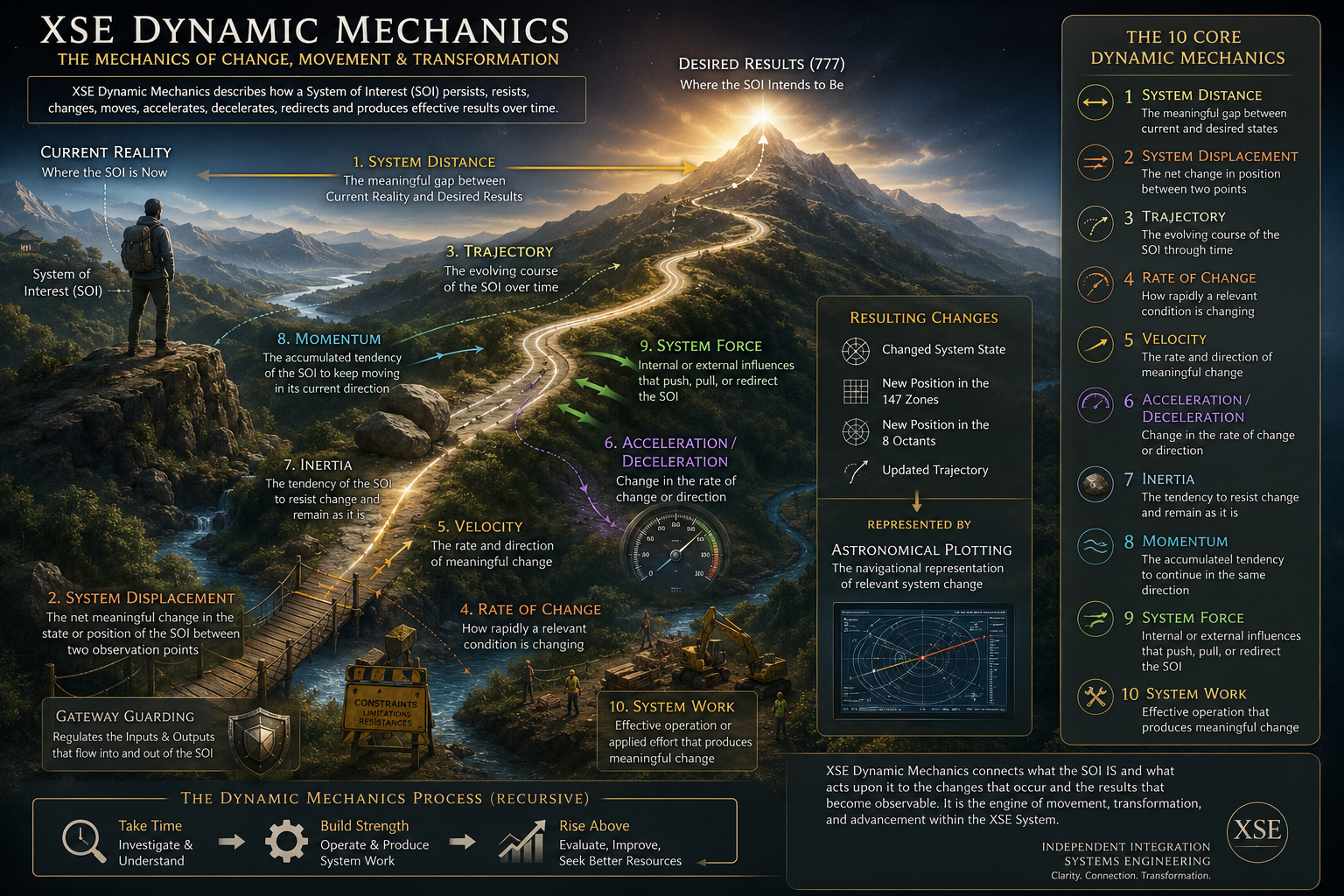
XSE Dynamic Mechanics is the higher-order Derived Dynamic of Independent Integration Systems Engineering (XSE) concerned with the mechanics through which the constitution, energetic capacity, state, and operation of a System of Interest contribute to persistence, resistance, movement, change, acceleration, deceleration, redirection, and effective transformation over time.
XSE Dynamic Mechanics organizes twelve core mechanics:
System Mass · System Energy · System Distance · System Displacement · Trajectory · Rate of Change · System Velocity · System Acceleration/Deceleration · System Inertia · System Momentum · System Force · System Work
These mechanics provide a structured vocabulary for investigating how a System of Interest (SOI) is actually operating and changing, rather than merely describing its condition at a particular observation point.
XSE Dynamic Mechanics operates in relationship with the 40 Factors of XSE, other Derived Dynamics, Inputs, Outputs, feedback, Sources, Resources, constraints, environmental conditions, choices, and other relevant system influences.
It provides a conceptual systems-engineering layer between:
what the SOI is, what capacities and conditions it possesses, and what is acting upon it
and:
the changes that subsequently become observable in its state, Zones, Octants, position, and Trajectory.
Accordingly, Dynamic Mechanics investigates questions such as:
- What materially constitutes the relevant physical SOI?
- What Energy is available, transformed, transferred, stored, or expended?
- How far is the system from a relevant Desired Result?
- What meaningful Displacement is actually occurring?
- In what direction is the system moving?
- How rapidly is change occurring?
- Is that change accelerating or decelerating?
- What resists change?
- What sustains an existing course?
- What Forces are influencing the system?
- What effective System Work is actually being accomplished?
- What Trajectory is developing as a result?
Dynamic Mechanics as a Derived Dynamic
XSE Dynamic Mechanics is not an additional foundational Factor of XSE.
The 40 Factors of XSE remain the foundational Actual and Analytical Factors used to investigate the SOI.
Dynamic Mechanics operates at the Derived Dynamic level, where relationships among Factors and other relevant system conditions can be investigated in terms of their dynamic consequences.
For example, System Momentum may be influenced by interacting conditions involving:
- Gateway Guarding;
- repeated Inputs and Outputs;
- habits and conditioning;
- available Energy;
- physical condition;
- Resources;
- environmental conditions;
- relationships;
- professional demands;
- family conditions;
- Cyber-Sphere influences;
- ECC governance;
- Executive Power;
- feedback;
- and time.
No individual Factor is itself Momentum. Rather, Momentum characterizes a higher-order dynamic condition resulting from relevant system operation and interaction.
The same distinction applies throughout Dynamic Mechanics.
Mass concerns relevant material constitution.
Energy concerns energetic capacity and transformation.
Inertia concerns resistance to change.
Momentum concerns continuation of an established course.
Force concerns influences capable of contributing to change.
Work concerns effective change-producing operation.
Velocity concerns the rate and direction of meaningful change.
Trajectory concerns the developing course of the SOI through time.
Thus:
The 40 Factors establish what must be investigated within XSE; Dynamic Mechanics helps characterize how relevant system conditions and interactions are operating and changing over time.
The 12 Core XSE Dynamic Mechanics
1. System Mass
System Mass is the XSE Dynamic Mechanic concerned with the relevant physical mass, material constitution, and composition of a physical or embodied System of Interest insofar as these characteristics affect its operation and response to physical conditions and change.
Mass is treated more literally and conservatively than many broader mechanics-inspired XSE constructs.
In physics, mass is a fundamental physical quantity and participates in relationships including:
Force = Mass × Acceleration
and:
Momentum = Mass × Velocity
For an embodied human SOI, System Mass may therefore involve relevant consideration of actual physical characteristics such as:
- total body mass;
- body composition;
- tissues;
- skeletal structure;
- organs;
- fluids;
- and other material constituents.
System Mass does not redefine knowledge, beliefs, personality, relationships, values, or other nonmaterial characteristics as literal mass. Those conditions may significantly affect system operation, but they are investigated through their appropriate Factors and Derived Dynamics.
Likewise, greater physical mass does not inherently indicate greater strength, health, capability, or system quality. Composition, function, context, and the particular system question under investigation remain essential.
System Mass asks:
What materially constitutes the relevant physical SOI participating in the mechanics under investigation?
2. System Energy
System Energy is the XSE Dynamic Mechanic concerned with energy available, stored, transferred, transformed, or expended within the System of Interest in relation to its capacity for operation and System Work.
Energy is fundamental to physical and biological operation.
For an embodied human SOI, ongoing biological activity depends upon energy transformation throughout the body. Cellular metabolism, including mitochondrial processes involved in ATP production, contributes fundamentally to physiological operation.
However:
System Energy is not synonymous with the subjective sensation of “having energy.”
Perceived vitality, fatigue, attention, motivation, physical performance, cognition, and behavioral capacity can be affected by numerous interacting physiological, environmental, behavioral, and contextual conditions.
System Energy may therefore be used to investigate relevant relationships involving:
- energetic capacity;
- energy acquisition and transformation;
- expenditure;
- replenishment;
- recovery;
- physical demands;
- energetic constraints;
- and capacity for System Work.
Within human applications, questions concerning unexplained fatigue, metabolic conditions, mitochondrial dysfunction, disease, or other health concerns require appropriate evaluation by qualified healthcare professionals. XSE uses System Energy for educational and systems-engineering analysis and does not provide medical diagnosis or treatment.
3. System Distance
System Distance is the meaningful separation or gap between two relevant system states, conditions, positions, or reference points.
One particularly important XSE application is the Distance between:
Current Reality
and:
Desired Results.
System Distance asks:
How much meaningful change separates the present condition from the intended condition?
Depending upon the SOI and the question being investigated, Distance may involve differences in:
- knowledge;
- skill;
- capability;
- behavior;
- physical condition;
- Resources;
- performance;
- relationships;
- consistency;
- configuration;
- or another appropriately defined characteristic.
System Distance does not always require a numerical value. It can also function as a structured comparative concept where exact quantification is inappropriate or unavailable.
4. System Displacement
System Displacement is the net meaningful change in the state or relevant position of the System of Interest between two observation points.
Distance describes separation.
Displacement describes where the system actually ended relative to where it began.
This distinction is important because substantial activity does not necessarily produce substantial Displacement.
A system may expend considerable time, Energy, Resources, and effort while producing little meaningful net change. Conversely, strategically directed System Work may produce significant Displacement with comparatively efficient operation.
System Displacement can therefore contribute to:
- Target Tracking;
- operating-cycle comparison;
- CREATE Goal evaluation;
- Epoch comparison;
- Desired Result evaluation;
- and Astronomical Plotting.
5. Trajectory
Trajectory is the developing course of the System of Interest through time as its state, operation, choices, relationships, Gateway Guarding, Inputs, Outputs, Energy, Work, feedback, Sources, Resources, constraints, Forces, Momentum, and other relevant influences interact.
Trajectory asks:
Where is the system actually heading?
Trajectory may exhibit:
- advancement;
- decline;
- stability;
- drift;
- deviation;
- correction;
- reversal;
- instability;
- or sustained directional progression.
Trajectory does not itself explain every mechanism producing the course.
Rather:
Trajectory describes the developing course, while the other Dynamic Mechanics help investigate what is producing, resisting, sustaining, accelerating, decelerating, or redirecting that course.
6. Rate of Change
Rate of Change describes how rapidly a relevant system characteristic, condition, capability, behavior, state, or other variable changes over a meaningful interval.
Rate of Change asks:
How quickly is this changing?
Direction alone does not establish rapidity.
A system may be:
- improving slowly;
- improving rapidly;
- declining slowly;
- declining rapidly;
- or experiencing little meaningful change.
Rate of Change therefore provides information that Trajectory alone cannot.
7. System Velocity
System Velocity is the rate and direction of meaningful change in the System of Interest or a selected system condition over time.
Rate of Change asks:
How rapidly?
System Velocity adds:
How rapidly, and in what direction?
Two systems may demonstrate comparable rates of change while moving in substantially different directions relative to their respective Desired Results.
System Velocity therefore connects:
Rate of Change + Direction → Developing Trajectory
8. System Acceleration / Deceleration
System Acceleration describes change in System Velocity or the rate of meaningful system change over time; System Deceleration describes a reduction in that rate.
This distinguishes:
change
from:
change that is itself becoming faster or slower.
A constructive Trajectory may still be decelerating.
An undesirable Trajectory may remain negative while its decline is slowing.
Constructive change may accelerate as capability, Resources, conditioning, System Work, and Momentum develop.
Acceleration and Deceleration therefore provide information about how the process of change itself is changing.
9. System Inertia
System Inertia is the tendency of an established system state, configuration, pattern, or course to resist change and remain substantially as it is unless sufficient relevant influences or interventions alter it.
Within human systems, Inertia may be associated with:
- habits;
- conditioning;
- routines;
- environmental arrangements;
- dependencies;
- commitments;
- organizational structures;
- recurring feedback;
- Resource limitations;
- physical conditions;
- established expectations;
- and other persistent configurations.
System Inertia helps explain an important systems principle:
Recognizing that change is desirable does not automatically make the system easy to change.
Inertia does not imply inevitability or lack of human agency. It characterizes resistance within the operating system that may need to be investigated and addressed.
10. System Momentum
System Momentum is the accumulated tendency of an established system course to continue because existing operation, patterns, conditioning, feedback, Resources, structures, relationships, and other reinforcing conditions are sustaining that course.
In physical mechanics:
Momentum = Mass × Velocity
Where literal physical analysis is applicable, this relationship retains its conventional meaning.
Within broader human-system applications, System Momentum functions as a systems-engineering analogue rather than a claim that behavioral, professional, relational, or developmental Momentum is measurable in physical momentum units.
Momentum and Inertia remain distinct.
Inertia asks:
What is resisting change from the existing condition?
Momentum asks:
What is contributing to continuation of the existing course?
System Momentum may be:
- constructive;
- destabilizing;
- strong;
- weak;
- increasing;
- decreasing;
- redirected;
- interrupted;
- or conflicting across different parts of the SOI.
11. System Force
System Force is an internal or external influence capable of contributing to a change in the state, direction, rate, configuration, operation, or Trajectory of the System of Interest.
Where literal physical Force is being investigated:
F = ma
may apply conventionally.
Within complex human systems, System Force functions more broadly as a bounded systems-engineering analogue for an influence capable of contributing to change.
Relevant System Forces may arise through:
- Inputs;
- Outputs and feedback;
- environmental conditions;
- relationships;
- incentives;
- constraints;
- Sources and Resources;
- policies;
- competing systems;
- physical conditions;
- Gateway conditions;
- ICC orientation;
- ECC governance;
- Executive Power;
- and deliberate interventions.
Functional classifications may include:
Propelling Force — contributes to continuation or movement along an intended course.
Restraining Force — opposes or slows movement.
Deflecting Force — contributes to directional alteration.
Corrective Force — contributes to movement back toward an intended course.
Destabilizing Force — contributes to instability or undesirable deviation.
These are functional forms of System Force rather than separate Core Dynamic Mechanics.
12. System Work
System Work is effective operation or applied effort that produces meaningful change in the state, configuration, capability, position, or functioning of the System of Interest.
System Work distinguishes:
effort expended
from:
meaningful change actually accomplished.
A system may consume substantial time, effort, Resources, and Energy without accomplishing substantial useful Work.
Conversely, a well-engineered intervention may produce meaningful change efficiently.
Energy and Work therefore maintain an important relationship:
System Energy concerns energetic capacity and transformation relevant to operation; System Work concerns effective change-producing operation.
Within Luxxacation, significant System Work commonly occurs during Build Strength, where an engineered configuration is placed into actual operation.
Build Strength and System Work are nevertheless distinct.
Build Strength is an Element of Luxxacation.
System Work characterizes the meaningful change accomplished through operation.
The Three Integrated Mechanics of XSE
In addition to the 12 Core XSE Dynamic Mechanics, three mechanically significant concepts hold a special architectural status:
Torque · Power · Position
These are designated the:
Three Integrated Mechanics of XSE
They are not omitted from XSE Dynamic Mechanics because they are unimportant. Rather, each already possesses a more specific higher-order expression within the XSE architecture.
This prevents unnecessary duplication while preserving the mechanical relationships.
The Three Integrated Mechanics are:
Torque → Luxxacation
Power → Executive Power
Position → Astronomical Plotting and XSE Positional Architecture
Together, the 12 Core Dynamic Mechanics and 3 Integrated Mechanics provide a coordinated mechanical vocabulary for investigating the constitution, capacity, operation, movement, change, execution, reorientation, and positioning of the SOI.
Integrated Mechanic 1: Torque → Luxxacation
In mechanics, Torque concerns the rotational effect of Force around an axis or pivot.
Within XSE:
Luxxacation functions as the recursive transformational and reorientational Torque of XSE.
Through:
Take Time → Build Strength → Rise Above
Luxxacation provides the recursive structure through which the system can investigate its existing course, establish a better configuration, operate that configuration, acquire stronger Sources and Resources, evaluate feedback, and return for further recalibration.
Torque therefore receives its higher-order XSE expression through intentional system reorientation.
Conceptually:
Existing Trajectory
↓
Take Time
↓
Desired Reorientation Identified
↓
Build Strength
↓
System Work
↓
Rise Above
↓
Improved Sources / Resources / Capability
↓
Changed Dynamic Mechanics
↓
Changed Trajectory
Thus:
Torque is integrated through Luxxacation as the mechanics-inspired principle of recursive system reorientation.
Integrated Mechanic 2: Power → Executive Power
In mechanics:
Power = Work ÷ Time
Power therefore concerns the rate at which Work is performed or energy is transferred.
Within XSE, this relationship receives a higher-order human-systems expression through Executive Power.
Executive Power is the XSE Derived Dynamic describing the operational capacity, effectiveness, and timeliness through which executive-volitional governance is translated into meaningful System Work.
The Work/Time relationship is especially significant because the SOI does not remain suspended while appropriate action is unnecessarily postponed.
During delay:
- Forces continue acting;
- Inputs and Outputs continue;
- Inertia may remain;
- Momentum may continue;
- feedback accumulates;
- Displacement may occur;
- and Trajectory continues developing.
Thus, Executive Power concerns not merely whether appropriate System Work eventually occurs, but whether it occurs within the time in which that Work matters.
Conceptually:
ECC Governance
↓
Executive Power
↓
Timely Initiation / Restraint / Persistence / Correction
↓
System Work
↓
Dynamic-Mechanical Change
Accordingly:
Power is integrated through Executive Power, preserving the important relationship between Work and Time while extending it into XSE’s investigation of executive-volitional operation.
Executive Power is not asserted to be literal physical Power measurable in watts. The relationship is a bounded systems-engineering analogue and does not reduce human agency or personhood to physical mechanics.
Integrated Mechanic 3: Position → Astronomical Plotting
Position concerns where a system or object is situated relative to a defined reference structure.
Within XSE, Position is addressed through a substantially developed positional and navigational architecture involving:
- Current System State;
- the X, Y, and Z Axes;
- the 147 Zones;
- the 8 Octants;
- Desired Results;
- Epoch and life-cycle conditions;
- relevant system reference points;
- and Astronomical Plotting.
Astronomical Plotting provides a navigational representation through which relevant system state, positioning, movement, direction, Displacement, Desired Results, and Trajectory can be examined across time.
Thus:
Position describes where the SOI or relevant system condition is situated; Astronomical Plotting provides XSE’s navigational framework for representing and investigating that positioning and its change.
This creates an important distinction:
Dynamic Mechanics investigates how the system is operating and changing. Astronomical Plotting represents relevant consequences of that operation within XSE’s navigational architecture.
The plot represents the system.
The plot does not cause the system’s mechanics.
The Mechanical Architecture of XSE
The combined architecture can therefore be summarized as:
12 Core XSE Dynamic Mechanics
Mass
→ material constitution
Energy
→ energetic capacity and transformation
Distance
→ separation between relevant states
Displacement
→ net meaningful change
Trajectory
→ developing course
Rate of Change
→ rapidity of change
Velocity
→ rate and direction of change
Acceleration / Deceleration
→ change in Velocity or Rate of Change
Inertia
→ resistance to change
Momentum
→ tendency of an established course to continue
Force
→ influence capable of contributing to change
Work
→ effective change-producing operation
Plus the Three Integrated Mechanics
Torque → Luxxacation
Power → Executive Power
Position → Astronomical Plotting
This architecture preserves important concepts from mechanics without forcing every mechanical term into the same category.
Mass, Energy, Force, Work, and Power
The addition of Mass and Energy provides a more complete foundation for understanding several mechanical relationships.
At the physical level:
Mass
participates in relationships involving Force, Momentum, and other physical mechanics.
Energy
provides capacity for physical Work and transformation.
Force
can contribute to physical change.
Work
involves energy transfer associated with change.
Power
relates Work to Time.
Within XSE, these relationships are retained literally where actual physical mechanics are being investigated and used as carefully bounded systems analogues where broader human-system operation is under consideration.
This produces an important XSE distinction:
Energy concerns capacity relevant to operation. System Work concerns meaningful change-producing operation. Executive Power concerns how effectively and timely executive governance is translated into appropriate System Work.
These concepts interact but are not interchangeable.
A person may possess substantial physiological capacity while demonstrating poor Executive Power in a particular situation.
A person may also demonstrate excellent prioritization, restraint, and follow-through while operating under significant limitations in available physical Energy.
Accordingly, neither Energy nor Executive Power serves as a proxy for the other.
Dynamic Mechanics and Gateway Guarding
Gateway Guarding can alter conditions affecting Dynamic Mechanics by regulating relevant Inputs and Outputs through the Mind, Body, and Spirit Gateways.
A simplified relationship is:
Gateway Guarding
↓
Accepted / Rejected Inputs and Outputs
↓
Changed Exposure / Conditioning / Feedback
↓
Changed Resources / Energy / Forces / Operating Conditions
↓
Interaction With Inertia and Momentum
↓
Changed System Work
↓
Changed Displacement / Velocity
↓
Changed Trajectory
Gateway Guarding is therefore not itself a Core Dynamic Mechanic.
It is a regulatory Derived Dynamic capable of influencing the conditions through which Dynamic Mechanics develop.
Dynamic Mechanics and the Executive Control Center
The Executive Control Center (ECC) provides XSE’s conceptual architecture for executive-volitional governance.
The ECC may contribute to:
- attentional governance;
- prioritization;
- Gateway Guarding;
- initiation;
- restraint;
- redirection;
- correction;
- feedback integration;
- and Reset.
The ECC can therefore influence Dynamic Mechanics without itself being classified as a Dynamic Mechanic.
Dynamic Mechanics and Executive Power
Executive Power helps translate ECC governance into timely System Work.
For example:
Deviation Identified
↓
ECC Establishes Corrective Governance
↓
Executive Power
↓
Timely Corrective Operation
↓
System Work
↓
Relevant Forces Change
↓
Existing Momentum Is Altered
↓
Displacement / Velocity Changes
↓
Trajectory Changes
This relationship demonstrates why Executive Power occupies the higher-order XSE expression of the Integrated Mechanic of Power.
Dynamic Mechanics and the Integrative Convergence Center
The Integrative Convergence Center (ICC) represents deeper integrated orientation involving relevant dimensions such as:
- values;
- desires;
- conscience;
- identity;
- attachments;
- motivations;
- intentions;
- and enduring directional tendencies.
These conditions may influence:
- which Inputs are sought;
- which Outputs are produced;
- where Energy and Resources are directed;
- which Forces are reinforced;
- what System Work is pursued;
- which courses are attractive or resisted;
- and where Momentum develops.
The ICC can therefore exert substantial influence upon Dynamic Mechanics while remaining conceptually distinct from them.
Dynamic Mechanics and Desired Results
Desired Results provide reference states against which Dynamic Mechanics can be investigated.
Current Reality
↓
System Distance
↓
Desired Result
Then:
CREATE Goals + Gateway Guarding
↓
ECC Governance + Executive Power
↓
Available Energy / Sources / Resources
↓
System Work
↓
System Displacement
↓
Changed System Distance
↓
Changed Velocity / Trajectory
↓
Updated Current Reality
Desired Results therefore establish where the system intends to go.
Dynamic Mechanics investigates what the system is actually doing relative to that destination.
Dynamic Mechanics and CREATE Goals
CREATE Goals establish intentional operational objectives capable of influencing Dynamic Mechanics.
They may be engineered to:
- reduce System Distance;
- direct available Energy and Resources;
- produce useful System Work;
- overcome or reduce relevant Inertia;
- interrupt undesirable Momentum;
- establish constructive Momentum;
- introduce Corrective Force;
- alter Velocity;
- decelerate an undesirable course;
- accelerate constructive change;
- or redirect Trajectory.
CREATE Goals can therefore function as deliberately engineered interventions into the operating dynamics of the SOI.
Dynamic Mechanics and Target Tracking
Target Tracking provides recurring observations from which Dynamic Mechanics may be investigated over time.
Repeated Watches may provide evidence concerning:
- changes in System Distance;
- meaningful Displacement;
- Rate of Change;
- Velocity;
- Acceleration or Deceleration;
- strengthening or weakening Momentum;
- persistent Inertia;
- relevant Energy conditions;
- effectiveness of corrective Forces;
- meaningful System Work;
- and changes in Trajectory.
Thus:
Dynamic Mechanics describes relevant dynamic conditions and relationships; Target Tracking provides longitudinal evidence useful for investigating their development.
Dynamic Mechanics and the 147 Zones
The 147 Zones provide fine-grained evaluative localization.
Dynamic Mechanics can therefore investigate questions such as:
Where are relevant Forces acting?
Where is Inertia concentrated?
Where is Momentum developing?
Where are Energy constraints affecting operation?
Where is meaningful System Work occurring?
Which Zones are changing most rapidly?
Where is meaningful Displacement occurring?
The Zones help identify where relevant Dynamic Mechanics are manifesting within XSE’s evaluative architecture.
Dynamic Mechanics and the 8 Octants
The 8 Octants provide higher-order structural positioning within the X, Y, and Z coordinate architecture.
Dynamic Mechanics can investigate whether the SOI is:
- moving toward another Octant;
- stabilizing within an Octant;
- approaching a boundary;
- accelerating;
- decelerating;
- drifting;
- reversing;
- or undergoing corrective redirection.
The Octants organize position.
Dynamic Mechanics investigates the operation contributing to changes in that position.
Astronomical Plotting can then represent relevant movement and positioning navigationally.
Dynamic Mechanics and Astronomical Plotting
Astronomical Plotting and Dynamic Mechanics perform related but distinct functions.
XSE Dynamic Mechanics investigates the mechanics contributing to actual system operation and change. Astronomical Plotting provides a navigational representation of relevant system state, Position, movement, Forces, Desired Results, Displacement, and Trajectory across time.
The relationship can be represented as:
Dynamic Mechanics
↓
Actual System Operation and Change
↓
Changed State / Zones / Octants
↓
Astronomical Plotting
↓
Observation / Investigation / Feedback
↓
Potential Reconfiguration
Astronomical Plotting therefore makes relevant Dynamic Mechanics navigationally interpretable without being the cause of those mechanics.
Dynamic Mechanics and Luxxacation
Luxxacation provides the recursive transformational and reorientational Torque of XSE.
Take Time
Relevant mechanics are investigated:
- What is the Current Reality?
- What materially constitutes the relevant SOI?
- What Energy and Resources are available?
- What is the Current Trajectory?
- What Forces are acting?
- Where is Inertia?
- What Momentum exists?
- What Distance remains?
- What Displacement has occurred?
- What Work is actually producing change?
- Is change accelerating or decelerating?
Build Strength
The engineered configuration is placed into operation:
- Energy and Resources are appropriately directed;
- CREATE Goals are enacted;
- Gateway Guarding is implemented;
- Executive Power translates governance into timely action;
- System Work occurs;
- Inertia is encountered;
- Momentum may be strengthened, weakened, or redirected;
- and real-world feedback is generated.
Rise Above
Stronger Sources, Resources, capabilities, skills, information, support, and other relevant system improvements are sought and integrated.
The system then returns to Take Time for renewed observation and recalibration.
Thus:
Luxxacation supplies recursive transformational Torque through which the SOI can intentionally attempt to reorient its Dynamic Mechanics and developing Trajectory.
Dynamic Mechanics and XESAS Synthesis
Dynamic Mechanics contributes directly to XESAS Synthesis.
Relevant investigation may ask:
- What Mass or material characteristics are relevant?
- What Energy conditions support or constrain operation?
- What Forces are acting?
- What Inertia exists?
- What Momentum should be preserved, weakened, or redirected?
- What Distance remains from Desired Results?
- What Displacement has occurred?
- What is the current Rate of Change?
- What is the relevant Velocity?
- Is change accelerating or decelerating?
- What System Work is actually producing meaningful change?
- What Trajectory is developing?
- How are these mechanics interacting with the 40 Factors and other Derived Dynamics?
Findings can then contribute to subsequent system configuration.
Thus:
Dynamic Mechanics
→ Investigation
→ XESAS Synthesis
→ Reconfiguration
→ Luxxacation
→ System Work
→ Changed Dynamic Mechanics
→ New Evidence
The relationship is recursive.
Dynamic Mechanics Across Epochs
XSE Dynamic Mechanics integrates naturally with the Epoch-transcending architecture of XESAS.
Dynamic Mechanics may be investigated:
Within an Epoch
to understand current operation and change.
Between Epochs
to investigate mechanics associated with meaningful transition.
Across Epochs
to examine persistent Momentum, changing Energy conditions, accumulated Displacement, recurring Inertia, long-term Forces, System Work, and developing Trajectory.
This helps distinguish temporary fluctuation from meaningful life-cycle transition.
Human-System Applications
When the SOI is a human person, XSE Dynamic Mechanics remains a systems-engineering framework and does not reduce the human person to a mechanical machine.
Some Dynamic Mechanics can have direct physical application.
Mass is genuinely physical.
Energy is genuinely involved in biological operation.
Physical Force, Work, Velocity, Acceleration, and other mechanics may sometimes be literally measurable.
Other applications are deliberately mechanics-inspired systems analogues.
For example:
Mass does not represent a person’s worth, identity, importance, or total human “substance.”
Energy does not automatically mean motivation, mood, spirituality, vitality, or Executive Power.
Inertia can characterize resistance of an established pattern without implying lack of agency.
Momentum can characterize continuation of an established course without implying inevitability.
Force can characterize relevant influences without claiming that psychological, social, or behavioral influences are literal Newtonian Forces.
Velocity can characterize rate and direction of meaningful system change without requiring spatial units.
Trajectory can characterize a developing course without implying deterministic destiny.
Power, through Executive Power, does not reduce human will or agency to watts.
Torque, through Luxxacation, does not imply that human transformation is literal mechanical rotation.
Position, through Astronomical Plotting, does not imply that the complete condition of a human person can be reduced to coordinates.
These distinctions preserve the analytical usefulness of mechanics while respecting the complexity of the human SOI.
Investigative and Scope Considerations
XSE Dynamic Mechanics incorporates both literal mechanical relationships where they genuinely apply and carefully bounded systems-engineering analogues where broader complex-system relationships are being investigated.
It does not claim that:
- human behavior is mechanically predetermined;
- complex human systems obey simplified Newtonian equations;
- all Dynamic Mechanics can be assigned numerical values;
- psychological or spiritual realities are reducible to physical quantities;
- mitochondrial function alone explains human vitality, fatigue, cognition, motivation, or performance;
- every System Force can be precisely quantified;
- Executive Power is literal physical Power;
- Luxxacation is literal physical Torque;
- Astronomical Plotting literally locates the totality of a human person in physical space;
- or future human states can be predicted with mechanical certainty.
Rather:
XSE Dynamic Mechanics uses appropriately bounded mechanical concepts to improve investigation of system constitution, energetic capacity, persistence, resistance, influence, operation, movement, rate, direction, effective Work, and developing Trajectory within complex Systems of Interest.
For human applications, the framework is educational and intended for systems analysis, strategic development, self-observation, planning, and coaching applications within appropriate scope. It is not medical, psychological, nutritional, legal, or other licensed professional advice.
The Complete XSE Mechanical Architecture
The architecture can be represented conceptually as:
SYSTEM OF INTEREST
↓
Mass / Material Constitution
Energy / Energetic Capacity
Current State & Configuration
↓
Forces + Constraints + Inertia + Existing Momentum
↓
System Operation
↓
System Work
↓
Distance / Displacement
↓
Rate of Change + Velocity
↓
Acceleration / Deceleration
↓
Developing Trajectory
↓
Updated System State
↓
Changed Distance From Desired Results
↓
New Dynamic Conditions
↓
Recursive Investigation and Reconfiguration
Operating in coordinated relationship with this architecture are the Three Integrated Mechanics of XSE:
TORQUE → LUXXACATION
Reorientation
POWER → EXECUTIVE POWER
Timely and effective conversion of governance into Work
POSITION → ASTRONOMICAL PLOTTING
Navigational representation of state and positioning
Together:
The 12 Core XSE Dynamic Mechanics describe important mechanics through which the SOI is constituted, energized, influenced, moved, resisted, changed, and directed. The Three Integrated Mechanics connect mechanical principles of Torque, Power, and Position to the larger XSE architectures of Luxxacation, Executive Power, and Astronomical Plotting. Together they provide an integrated mechanical framework for investigating not merely where the System of Interest is, but what is happening within and around it, how effectively it is operating, how quickly and in what direction it is changing, what is sustaining or resisting that change, and where its developing Trajectory is carrying it.