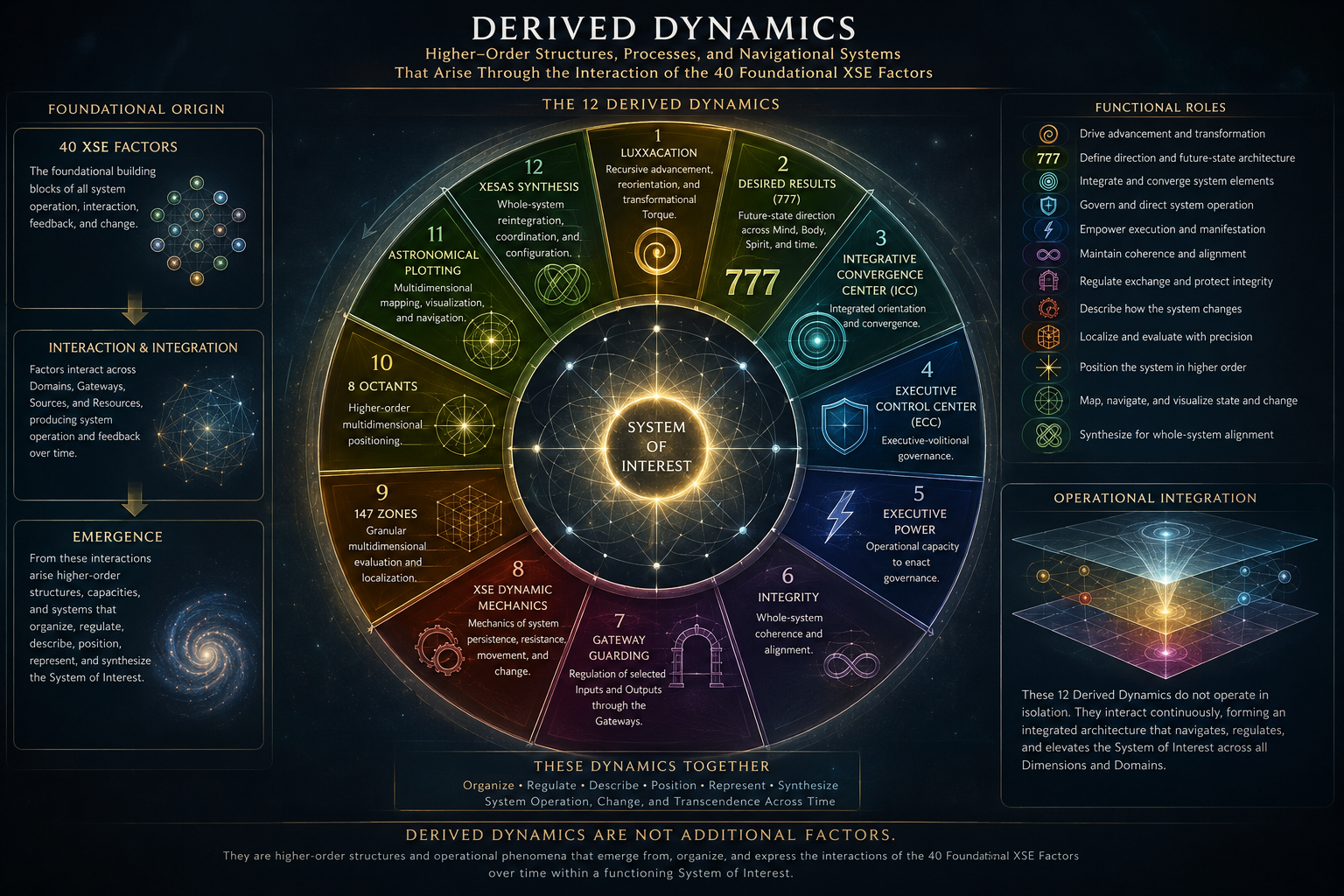
Derived Dynamics are higher-order operational realities, structures, capacities, processes, patterns, regulatory architectures, convergence phenomena, dynamic-mechanical frameworks, positioning systems, navigational representations, future-state architectures, and synthesis dynamics that arise, develop, are deliberately structured, become identifiable, or operate through the interaction and integration of foundational XSE Factors, systems, relationships, operation, and feedback across time.
Within Independent Integration Systems Engineering (XSE), Derived Dynamics are distinguished from the 40 foundational Factors of XSE.
The 40 Factors establish the foundational Actual and Analytical architecture through which a System of Interest (SOI) is investigated and engineered. Derived Dynamics describe higher-order relationships, structures, capacities, processes, configurations, mechanics, representations, and effects that become identifiable or operationally significant as those foundational Factors interact, integrate, are applied, or become organized within a functioning system.
Derived Dynamics may represent different classes of higher-order system organization, operation, and application, including:
- recursive advancement, transformation, and reorientation;
- future-state direction;
- integrated orientation and convergence;
- executive-volitional governance;
- operational Power and timely System Work;
- whole-system coherence and alignment;
- Gateway regulation and boundary control;
- mechanics of system constitution, Energy, persistence, resistance, movement, and change;
- multidimensional evaluation and localization;
- structural positioning;
- navigational representation;
- and whole-system synthesis and configuration.
The 12 Derived Dynamics of XSE are not interchangeable concepts or phenomena of identical type. Each represents a distinct class of higher-order XSE organization, operation, representation, or application.
Importantly, three of the 12 Derived Dynamics also carry a special mechanical designation as the Three Integrated Mechanics of XSE:
Luxxacation = Integrated Torque
Executive Power = Integrated Power
Astronomical Plotting = Integrated Position
These three are not additional Derived Dynamics, nor are Torque, Power, and Position duplicated among the 12 Core XSE Dynamic Mechanics. Rather, three existing Derived Dynamics integrate these mechanically significant concepts into higher-order XSE operation.
Relationship to the 40 Factors of XSE
The 40 Factors of XSE consist of:
- 20 Actual Factors, representing real-world elements affecting the system; and
- 20 Analytical Factors, representing structures, principles, perspectives, and tools used to investigate and engineer the system.
Together, these constitute XSE’s 2FA — Two-Factor Authentication requirement: both sets must be applied in order to claim that XSE methods were applied.
Derived Dynamics do not replace, expand, or constitute additional foundational Factors.
Instead:
The 40 Factors establish XSE’s foundational architecture, while Derived Dynamics describe higher-order operational realities, structures, capacities, relationships, configurations, mechanics, representations, and processes that arise, develop, are deliberately structured, or become identifiable through the interaction and application of that architecture.
Depending upon the SOI and particular Derived Dynamic, relevant interactions may involve Mind, Body, and Spirit; the three Gateways; Inputs and Outputs; the Seven Spheres of Integration; Seven Domains of Study; X, Y, and Z Axes; Take Time, Build Strength, and Rise Above; the Advancing Assets and Positions; XSE Axioms; Sources and Resources; system life-cycle conditions and Epochs; feedback; environmental influences; system relationships; XSE Dynamic Mechanics; and recursive interaction across time.
Why They Are Called Derived Dynamics
The term Derived identifies their higher-order relationship to the foundational XSE architecture.
The term Dynamics recognizes that these constructs concern system operation, relationship, direction, regulation, interaction, positioning, mechanics, representation, or change rather than merely static categories.
Derived does not mean that every Derived Dynamic spontaneously emerges through the same mechanism. Depending upon the particular Dynamic, its character may be developmental, recursive, regulatory, orientational, interactional, integrative, mechanical, evaluative, positional, representational, operational, or synthesizing.
Some are also deliberately structured or applied as future-state architectures, regulatory architectures, positioning frameworks, evaluative systems, navigational representations, or synthesis processes.
For example:
- Luxxacation provides recursive advancement, transformation, and reorientation and simultaneously serves as XSE’s Integrated Mechanic of Torque.
- Executive Power describes the effectiveness and timeliness through which executive-volitional governance becomes meaningful System Work and simultaneously serves as XSE’s Integrated Mechanic of Power.
- Astronomical Plotting maps relevant system Position, state, movement, and change and simultaneously serves as XSE’s Integrated Mechanic of Position.
- XSE Dynamic Mechanics organizes 12 Core Dynamic Mechanics through which relevant constitution, Energy, persistence, resistance, movement, and change can be investigated.
- Integrity describes higher-order whole-system coherence and alignment.
- Desired Results (777) provide a structured future-state reference architecture.
- Gateway Guarding provides a regulatory architecture governing selected Inputs and Outputs through the Gateways.
- 147 Zones and 8 Octants provide multidimensional evaluative, localization, and positioning structures.
- XESAS Synthesis reintegrates relevant XSE findings into a coherent whole-system configuration.
Thus:
What unifies the Derived Dynamics is their higher-order relationship to the foundational XSE architecture—not an assertion that they all originate, develop, or operate through one identical mechanism.
The 12 Derived Dynamics of XSE
1. Luxxacation — Integrated Mechanic: Torque
Luxxacation is the recursive advancement, transformation, and reorientation Derived Dynamic of XSE. It also serves as the first of the Three Integrated Mechanics of XSE, integrating the mechanical principle of Torque through:
Take Time → Build Strength → Rise Above
Although Take Time, Build Strength, and Rise Above are foundational Analytical Factors of XSE, their coordinated recursive operation constitutes the higher-order Derived Dynamic of Luxxacation.
In mechanics, Torque concerns rotational effect and change in orientation. Within XSE, Torque provides a bounded systems-engineering analogue for deliberate system reorientation.
Torque → Luxxacation → System Reorientation
Take Time
The system deliberately interrupts ordinary operation sufficiently to:
- Assess Current Reality and XSE Dynamic Mechanics — What is actually occurring? What mechanics of constitution, Energy, persistence, resistance, movement, and change are relevant? Where is the resulting Trajectory taking the system?
- Pinpoint Desired Results (777) — Where should the system go?
- Engineer how to get there — including CREATE Goals, Gateway Guarding specifications, Primary Target selection, Target Tracking configuration, relevant analysis, and XESAS Synthesis.
Build Strength
The system places the configuration engineered during Take Time into actual operation, where choices, Energy, Resources, Inputs, Outputs, interactions, feedback, Executive Power, and System Work contribute to new system conditions.
Rise Above
The system seeks stronger Sources, Resources, understanding, support, tools, and capabilities to improve subsequent operation.
Luxxacation is therefore recursive:
Take Time → Build Strength → Rise Above → Take Time Again
Luxxacation is both a Derived Dynamic and XSE’s Integrated Mechanic of Torque.
2. Desired Results (777)
Desired Results (777) are XSE’s structured whole-person future-state outcome architecture through which Desired Results are separately identified for:
Mind | Body | Spirit
across progressively expanding time horizons:
7 Hours | 7 Days | 7 Weeks | 7 Months | 7 Years | 77 Years
Desired Results are established within the second sub-element of Take Time, after Current Reality and relevant Dynamic Mechanics, including Current Trajectory, have been investigated.
They answer:
Where should the system go?
The 777 allows Results to be evaluated both horizontally across Mind, Body, and Spirit and vertically across expanding horizons of time.
This can help identify cross-Aspect conflicts, short- versus long-term tradeoffs, whole-system alignment, Integrity considerations, System Distance, and differences between Current Trajectory and intended future direction.
Desired Results do not themselves specify all actions necessary to achieve those Results. They provide the future-state reference architecture from which CREATE Goals and subsequent operational configuration can be developed.
Desired Results (777)
↓
CREATE Goals
↓
Gateway Guarding Specifications
↓
Build Strength / Actual Operation
↓
XSE Dynamic Mechanics
↓
Target Tracking / Operational Evidence
↓
X-Axis Analysis
↓
XESAS Synthesis and Reconfiguration
3. Integrative Convergence Center (ICC)
The Integrative Convergence Center (ICC) is XSE’s conceptual systems-engineering model of deeper integrated orientation, where relevant values, desires, conscience, identity, attachments, motivations, intentions, and enduring directional tendencies converge and progressively influence what the person gravitates toward.
The ICC helps investigate the distinction between:
what a person consciously states they want
and
the direction toward which the integrated patterns of the system appear to be converging.
The ICC therefore contributes to investigation of orientation, alignment, motivation, recurring attraction, enduring direction, and longer-term Trajectory.
The ICC is a conceptual XSE framework rather than a claimed anatomical structure or exhaustive psychological, philosophical, or metaphysical explanation of personhood, consciousness, soul/spirit, moral agency, or free will.
4. Executive Control Center (ECC)
The Executive Control Center (ECC) is the conceptual, non-exhaustive XSE framework of executive-volitional governance through which intentional attention, prioritization, inhibition and restraint, Gateway regulation, behavioral direction, feedback integration, adaptive correction, and course regulation are exercised.
The ECC asks:
What within the system requires intentional governance, and how is that governance being exercised?
Through interaction with Gateway Guarding, Executive Power, feedback, and other system conditions, ECC operation may contribute to changes in XSE Dynamic Mechanics and resulting Trajectory.
The ECC is a systems-engineering construct and is not presented as a newly discovered anatomical structure, clinical model, or exhaustive explanation of human agency.
5. Executive Power — Integrated Mechanic: Power
Executive Power is the XSE Derived Dynamic describing the operational capacity, effectiveness, and timeliness through which executive-volitional governance is translated into meaningful System Work.
It also serves as the second of the Three Integrated Mechanics of XSE, integrating the mechanical principle of Power.
Executive Power may be expressed through timely initiation, prioritization, restraint, persistence, redirection, correction, Reset, and follow-through.
It addresses the operational difference between:
knowing, deciding, or intending what should be done
and
effectively carrying appropriate governance into System Work within the time in which that Work matters.
In mechanics:
Power = Work ÷ Time
Within XSE, this relationship emphasizes that meaningful Work cannot always be separated from when it occurs.
The SOI continues operating during delay. Forces continue acting, Inputs and Outputs continue, Inertia may persist, Momentum may develop, Energy and Resources may be expended, feedback accumulates, and Trajectory continues evolving.
Thus:
Power → Executive Power → Timely System Work
What is commonly called willpower may be understood within XSE as an effort-intensive expression of Executive Power, particularly when appropriate operation must occur against substantial resistance. Executive Power is broader than willpower alone and may become more efficient as Gateway Guarding, habits, Resources, system configuration, constructive Momentum, and other supporting conditions improve.
Executive Power is not asserted to be literal physical Power measurable in watts. The Work/Time relationship provides a bounded systems-engineering analogue for investigating the effectiveness and timeliness of executive operation.
Executive Power is both a Derived Dynamic and XSE’s Integrated Mechanic of Power.
6. Integrity
Integrity is the degree of coherent integration and alignment among the Mind, Body, and Spirit Aspects of the human system, considered in relation to truth, reality, governing principles, choices, responsibilities, and whole-system operation.
Integrity concerns more than simple internal consistency. A system can be internally consistent while nevertheless being poorly aligned with reality.
Integrity provides a higher-order whole-system reference through which XSE can ask:
Does this configuration produce coherent strengthening of the integrated system, or does it optimize one part while unnecessarily degrading another?
Integrity is therefore central to evaluating Desired Results, CREATE Goals, Gateway Guarding, Executive Governance, XSE Dynamic Mechanics, Trajectory, and XESAS Synthesis.
7. Gateway Guarding
Gateway Guarding is the higher-order regulatory Derived Dynamic through which relevant Inputs and Outputs are deliberately selected, admitted, encouraged, restricted, rejected, produced, inhibited, or prevented across the Mind, Body, and Spirit Gateways in order to support CREATE Goals, Desired Results (777), Integrity, and intended system direction.
Gateway Guarding provides an operational boundary-control and exchange-regulation architecture between the human system and its internal and external environments.
Inputs and Outputs are the exchanges.
The Gateways are the interfaces through which those exchanges interact with the system.
Gateway Guarding is the higher-order regulatory architecture governing selected exchanges.
Relevant Gateway Guarding specifications may identify:
YES Input — What should deliberately be admitted or sought?
YES Output — What should deliberately be produced or enacted?
NO Input — What should deliberately be restricted, rejected, avoided, or refused?
NO Output — What should deliberately be inhibited, prevented, discontinued, or refused?
Gateway Guarding is engineered during Take Time, implemented during Build Strength, and may be observed through Target Tracking.
A general operational relationship may appear as:
Condition → Potential Input → Gateway Guarding → Admitted/Rejected Input → System Effect → Potential Output → Gateway Guarding → Produced/Prevented Output → Environmental Response → Feedback
Gateway Guarding can thereby alter conditions contributing to System Energy, Forces, Inertia, Momentum, System Work, Rate of Change, Velocity, and Trajectory without functioning as the sole controller of those mechanics.
8. XSE Dynamic Mechanics
XSE Dynamic Mechanics is the Derived Dynamic concerned with the mechanics through which the constitution, energetic capacity, state, and operation of a System of Interest contribute to persistence, resistance, movement, change, acceleration, deceleration, redirection, and effective transformation over time.
XSE Dynamic Mechanics contains 12 Core XSE Dynamic Mechanics:
- System Mass — relevant physical mass, material constitution, and composition of a physical or embodied SOI.
- System Energy — Energy available, stored, transferred, transformed, or expended in relation to operation and System Work.
- System Distance — meaningful separation between relevant system states, conditions, positions, or reference points.
- System Displacement — net meaningful change between relevant system states or observation points.
- Trajectory — the developing course of the SOI through time.
- Rate of Change — how rapidly a relevant system characteristic or condition changes.
- System Velocity — the rate and direction of meaningful system change.
- System Acceleration/Deceleration — change in Velocity or Rate of Change over time.
- System Inertia — the tendency of an established state, configuration, pattern, or course to resist change.
- System Momentum — the accumulated tendency of an established system course to continue.
- System Force — an internal or external influence capable of contributing to change in system state, direction, rate, configuration, operation, or Trajectory.
- System Work — effective operation or applied effort that produces meaningful system change.
Together, these mechanics help investigate:
What constitutes the relevant SOI? What Energy is available? What is acting upon it? What resists change? What sustains existing movement? What meaningful Work is occurring? How much change results? How rapidly and in what direction is that change occurring? And what Trajectory is consequently developing?
For human systems, literal physical and biological quantities are distinguished from mechanics-inspired systems analogues. XSE Dynamic Mechanics does not reduce the human person or human agency to deterministic physical mechanics.
The Three Integrated Mechanics of XSE
The Three Integrated Mechanics of XSE are three of the 12 Derived Dynamics themselves, each integrating a mechanically significant concept into a broader higher-order XSE architecture.
They are:
Luxxacation — Integrated Torque
Torque concerns rotational effect and reorientation in mechanics. Within XSE, this mechanical principle receives its higher-order systems expression through Luxxacation.
Torque → Luxxacation → System Reorientation
Executive Power — Integrated Power
Power concerns the relationship between Work and Time. Within XSE, this mechanical principle receives its higher-order systems expression through Executive Power.
Power → Executive Power → Timely System Work
Astronomical Plotting — Integrated Position
Position concerns where a system or object is situated relative to a reference framework. Within XSE, this mechanical principle receives its higher-order systems expression through Astronomical Plotting and the broader XSE positional architecture.
Position → Astronomical Plotting → Navigational Representation
Accordingly:
Three of XSE’s 12 Derived Dynamics simultaneously serve as the Three Integrated Mechanics of XSE: Luxxacation integrates Torque, Executive Power integrates Power, and Astronomical Plotting integrates Position.
They are called Integrated Mechanics because the underlying mechanical concepts are not treated as isolated additions to the Core Dynamic Mechanics. Each has instead been integrated into an existing higher-order Derived Dynamic whose scope extends beyond the mechanical concept alone.
This produces a clear distinction:
The 12 Core XSE Dynamic Mechanics are organized within the Derived Dynamic of XSE Dynamic Mechanics. Torque, Power, and Position are integrated at a higher architectural level through three other Derived Dynamics: Luxxacation, Executive Power, and Astronomical Plotting.
9. 147 Zones
The 147 Zones are XSE’s granular multidimensional evaluative field through which relevant internal and external Forces, influences, conditions, relationships, interactions, risks, opportunities, dependencies, contradictions, vulnerabilities, strengths, and leverage points can be localized and investigated.
The Zones increase analytical resolution by allowing the Systems Engineer to move from generalized whole-system observations toward more precisely situated relationships and effects.
Zone analysis may help identify where important System Forces originate, where Inertia is concentrated, where constructive or destabilizing Momentum is developing, where Gateway Guarding repeatedly succeeds or fails, where Energy constraints affect operation, where System Work produces meaningful change, or where effects propagate across Spheres.
Thus:
147 Zones provide granular multidimensional evaluation and localization of relevant system conditions and interactions.
10. 8 Octants
The 8 Octants are XSE’s higher-order spatial and structural organizational framework through which multidimensional system positioning can be categorized, compared, and interpreted within the X, Y, and Z coordinate architecture.
Because each Axis possesses positive and negative directional relationships, their intersection produces eight coordinate combinations:
+++ | ++− | +−+ | +−− | −++ | −+− | −−+ | −−−
Each Octant represents a particular combination of X-, Y-, and Z-axis conditions whose actual meaning must be investigated in relation to the SOI.
In simplified form:
147 Zones provide finer multidimensional localization.
8 Octants provide higher-order multidimensional positioning.
Dynamic Mechanics may contribute to changes that become observable through changing Zone and Octant conditions, but the Octants themselves do not produce those mechanics.
11. Astronomical Plotting — Integrated Mechanic: Position
Astronomical Plotting is the XSE Derived Dynamic for multidimensionally mapping and visualizing relevant system Position, state, movement, Forces, Dynamic Mechanics, Trajectory, Desired Results, and change across time to support systems analysis, navigation, feedback, and course correction.
It also serves as the third of the Three Integrated Mechanics of XSE, integrating the mechanical principle of Position into XSE’s broader navigational architecture.
Astronomical Plotting may integrate relevant information from the 147 Zones, 8 Octants, X/Y/Z Axes, XSE Dynamic Mechanics, Desired Results, Sources and Resources, Forces and constraints, System Distance and Displacement, system life-cycle Position, Epoch conditions, and other applicable XSE Factors and Derived Dynamics.
It can support questions such as:
Where is the system now?
Where has it been?
Where is it positioned relative to relevant reference structures?
What is acting upon it?
What Dynamic Mechanics appear relevant?
What movement and Displacement have occurred?
What Trajectory is developing?
Where is the system intended to go?
The distinction between Dynamic Mechanics and Astronomical Plotting is fundamental:
XSE Dynamic Mechanics investigates important mechanics through which the SOI is constituted, energized, influenced, resisted, moved, and changed. Astronomical Plotting represents relevant Position, state, movement, and change for investigation and navigation.
Actual SOI Operation
↓
XSE Dynamic Mechanics
↓
Changed State / Position / Trajectory
↓
Changed Zone / Octant Conditions
↓
Astronomical Plotting
The map represents relevant aspects of the system.
The map is not the system itself.
Thus:
Astronomical Plotting is both a Derived Dynamic and XSE’s Integrated Mechanic of Position.
12. XESAS Synthesis
XESAS Synthesis is the higher-order Derived Dynamic through which relevant XSE Factors, principles, structures, system states, relationships, findings, Sources, Resources, constraints, Dynamic Mechanics, and other Derived Dynamics are brought into coordinated relationship within the XSE Epoch-Transcending Synergizing Axiomatic System (XESAS) to form a coherent whole-system configuration within and across relevant system life-cycle-defined Epochs.
The distinction between XESAS and XESAS Synthesis is fundamental:
XESAS is the architecture.
XESAS Synthesis is the higher-order Derived Dynamic through which relevant elements within that architecture are put together into a coherent whole-system configuration.
Where XSE analysis differentiates and investigates the system, XESAS Synthesis asks:
Given what is now understood, how should the relevant elements relate and work together?
It considers how relevant elements should relate, interact, sequence, balance, reinforce, constrain, complement, or adapt in relation to one another.
Relevant considerations may include dependencies, priorities, constraints, conflicts, complementarities, leverage points, tradeoffs, feedback relationships, Sources, Resources, Gateway Guarding, cross-Sphere effects, cross-Epoch relationships, Integrity, XSE Dynamic Mechanics, Current Trajectory, Desired Results, and potential synergies.
XESAS Synthesis Within Take Time
Within the practical Luxxacation cycle, XESAS Synthesis belongs principally within Take Time.
The sequence develops approximately as:
Current Reality
↓
XSE Dynamic Mechanics & Current Trajectory
↓
Desired Results (777)
↓
CREATE Goals
↓
Gateway Guarding Specifications
↓
Primary Target Selection
↓
Target Tracking Configuration
↓
Relevant Analysis
↓
XESAS Synthesis
↓
Whole-System Configuration
↓
Build Strength
Take Time therefore progresses from understanding Current Reality and its Dynamic Mechanics to engineering how relevant elements should work together during the next operating cycle.
Data Collection, Analysis, Dynamic Interpretation, and Synthesis
XSE distinguishes among several related but different activities.
Data Collection
Data collection establishes evidence concerning:
What is actually happening?
Relevant evidence may include Target Tracking, observations, records, measurements, tests, Input and Output records, Gateway conditions, performance information, environmental conditions, and other appropriate Sources.
X-Axis Analysis
Analysis investigates the evidence.
It asks:
What does this information reveal about how the system is structured and operating?
The X Axis can investigate relationships, dependencies, constraints, patterns, feedback, risks, opportunities, leverage points, interactions, Forces, and potential causes requiring further investigation.
Dynamic-Mechanics Interpretation
Relevant evidence can then be considered through XSE Dynamic Mechanics.
It asks questions including:
What material characteristics of the SOI are relevant?
What Energy conditions support or constrain operation?
What is changing?
What System Distance exists?
What Displacement has occurred?
What is the current Trajectory?
What are the Rate of Change and Velocity?
Is change accelerating or decelerating?
What Inertia and Momentum are evident?
What Forces appear relevant?
What System Work is producing meaningful change?
XESAS Synthesis
Synthesis puts relevant understanding back together.
It asks:
Given what the investigation has revealed, how should the relevant elements now be configured together?
The sequence can therefore be represented as:
Collect → Record → Analyze → Interpret Dynamic Mechanics → Synthesize → Configure → Operate
Target Tracking and the Derived Dynamics
For applicable human systems, Target Tracking provides recurring systems-state observation, progress recording, feedback, and course-correction evidence during actual operation.
It reconnects the principal Take Time questions:
Current Reality & Dynamic Mechanics:
What is actually happening, and how is the system changing?
Desired Results (777):
Where is the system trying to go?
CREATE Goals + Gateway Guarding:
Is the system operating according to what was engineered to help get it there?
Depending upon the SOI and objectives being investigated, Target Tracking may contribute evidence concerning Mind, Body, and Spirit; the Primary Target; CREATE Goal implementation; Gateway Guarding performance; successful Resets; unresolved deviation; cross-Zone propagation; relevant Energy conditions; System Distance; System Displacement; Trajectory; Rate of Change; Velocity; Acceleration/Deceleration; Inertia; Momentum; relevant Forces; System Work; and changes in Position represented through Astronomical Plotting.
Not every Dynamic Mechanic must be tracked during every operating cycle. Relevant mechanics are selected according to the SOI, Desired Results, CREATE Goals, available evidence, and system question being investigated.
Target Tracking evidence can return to subsequent Take Time through:
X-Axis Analysis → Dynamic-Mechanics Interpretation → XESAS Synthesis → Reconfiguration
The 12 Classes of Higher-Order XSE Operation
| Derived Dynamic | Primary Higher-Order Function |
|---|---|
| Luxxacation | Recursive advancement, transformation, and reorientation; Integrated Mechanic: Torque |
| Desired Results (777) | Future-state direction across Mind, Body, Spirit, and time |
| Integrative Convergence Center (ICC) | Integrated orientation and convergence |
| Executive Control Center (ECC) | Executive-volitional governance |
| Executive Power | Effective and timely translation of governance into System Work; Integrated Mechanic: Power |
| Integrity | Whole-system coherence and alignment |
| Gateway Guarding | Gateway regulation and Input/Output boundary control |
| XSE Dynamic Mechanics | Framework containing the 12 Core XSE Dynamic Mechanics |
| 147 Zones | Granular multidimensional evaluation and localization |
| 8 Octants | Higher-order multidimensional structural positioning |
| Astronomical Plotting | Multidimensional mapping, visualization, and navigation; Integrated Mechanic: Position |
| XESAS Synthesis | Whole-system reintegration, coordination, and configuration |
The classifications describe their primary functions rather than rigid boundaries. The Derived Dynamics interact extensively.
Most importantly, the architecture distinguishes between:
12 Derived Dynamics total
within which:
1 Derived Dynamic—XSE Dynamic Mechanics—contains the 12 Core Dynamic Mechanics
and:
3 Derived Dynamics—Luxxacation, Executive Power, and Astronomical Plotting—simultaneously serve as the Three Integrated Mechanics of XSE.
Recursive Interaction Among Derived Dynamics
The Derived Dynamics do not operate as twelve isolated modules.
Their relationships may develop recursively:
Desired Results (777) establish intended direction
↓
CREATE Goals operationalize that direction
↓
Gateway Guarding regulates relevant Inputs and Outputs
↓
ECC contributes intentional governance
↓
Executive Power / Integrated Power translates governance into timely System Work
↓
Energy, Resources, Forces, Work, and other Core Dynamic Mechanics interact through actual operation
↓
Inertia and Momentum resist, sustain, or influence developing change
↓
Distance, Displacement, Rate of Change, Velocity, and Acceleration/Deceleration characterize resulting movement
↓
Trajectory develops
↓
Target Tracking records relevant evidence
↓
Integrity may strengthen or weaken
↓
ICC orientation may influence subsequent choices and direction
↓
147 Zones help localize relevant conditions
↓
8 Octants organize higher-order Position
↓
Astronomical Plotting / Integrated Position represents relevant Position, state, movement, and change
↓
X-Axis Analysis investigates what occurred
↓
XESAS Synthesis reintegrates the findings
↓
Luxxacation / Integrated Torque carries the system recursively into another advancement and reorientation cycle
This recursive interaction is central to the meaning of Derived Dynamics: their significance lies not only in what each describes individually, but also in how they influence and interact with the larger system across time.
Derived Dynamics Across Epochs
Because XESAS is Epoch-Transcending, Derived Dynamics may be investigated within, between, and across different system life-cycle-defined Epochs.
A Derived Dynamic may develop in one Epoch, strengthen or weaken in another, change expression as life-cycle conditions change, produce delayed consequences, influence subsequent configurations, or remain relevant across multiple Epochs.
Dynamic Mechanics are particularly important across Epochs because material conditions and Energy conditions may change; Inertia established in one Epoch may persist into another; Momentum may continue across an Epoch boundary; previous System Work may produce delayed Displacement; Forces may appear or disappear; Velocity may increase or decrease; and Trajectory may persist, accelerate, decelerate, or redirect.
XESAS can therefore examine relationships within an Epoch, between Epochs, and across Epochs without treating each new system state as disconnected from what preceded it.
Operational and Philosophical Boundaries
Within XSE, Derived Dynamics are treated as systems-engineering constructs, operationally investigable phenomena or models, developmental interaction structures, higher-order organizational frameworks, applied regulatory or positioning architectures, dynamic-mechanical frameworks and analogues, navigational representations, and analytically useful structures.
They are not presented as exhaustive explanations of the human person.
XSE does not claim that Derived Dynamics fully explain, originate, reduce, or exhaust consciousness, intellect, personhood, moral agency, free will, soul/spirit, transcendence, or ultimate reality.
Constructs such as the ECC and ICC are not presented as clinical diagnoses, anatomical discoveries, or substitutes for established medical or psychological frameworks.
Likewise, mechanical terminology within XSE does not assert that human beings are literal mechanical objects or that human behavior can be exhaustively represented through physical equations.
Some mechanical concepts may apply literally when actual physical phenomena are being investigated. Others function as deliberately bounded systems-engineering analogues.
For example:
- Mass may refer to actual physical mass and material constitution where relevant.
- Energy may refer to actual physical or biological energy processes where appropriate.
- Behavioral Momentum is not asserted to be literal physical momentum.
- Social or psychological Force is not asserted to be measurable in Newtons.
- Executive Power is not literal physical Power measurable in watts.
- Luxxacation as Integrated Torque is not literal mechanical rotation or Torque measurable in newton-meters.
- Astronomical Plotting as Integrated Position does not reduce the complete reality of a person or other complex SOI to coordinates.
XSE is an educational and strategic systems-engineering framework. Human-system applications do not replace individualized medical, psychological, legal, dietetic, or other appropriately licensed professional services.
Constraints and Operating Conditions
Derived Dynamics operate within real system conditions, including biological constraints, cognitive and attentional limitations, environmental conditions, informational uncertainty, legal constraints, Resource limitations, Energy availability and demands, temporal realities, system life-cycle stage, interpersonal influences, societal conditions, technological conditions, competing System Forces, and recursive feedback.
Accordingly, depending upon the Dynamic involved, its operational expression may be strengthened, weakened, redirected, stabilized, destabilized, reinforced, constrained, adapted, accelerated, decelerated, recalibrated, or transformed over time.
Derived Dynamics Within Recursive XSE Operation
The generalized relationship can be represented as:
Foundational XSE Factors
↓
System Operation & Interaction
↓
Observation / Data Collection
↓
X-Axis Analysis
↓
XSE Dynamic Mechanics Characterize Relevant Constitution, Capacity, Persistence & Change
↓
Current Trajectory Is Evaluated
↓
Desired Results (777) Establish Future Direction
↓
CREATE Goals Establish Operational Objectives
↓
Gateway Guarding Establishes Relevant Input/Output Controls
↓
XESAS Synthesis Coordinates the Whole-System Configuration
↓
Build Strength Places the Configuration Into Operation
↓
Executive Power / Integrated Power Contributes to Timely System Work
↓
System Work & Other Dynamic Mechanics Produce or Characterize Change
↓
Target Tracking & Other Feedback Produce New Evidence
↓
Astronomical Plotting / Integrated Position Represents Relevant Position, State & Change
↓
Rise Above Seeks Better Sources, Resources & Capability
↓
Luxxacation / Integrated Torque Continues the Recursive Reorientation Cycle
↓
Take Time Begins Again
↓
Analysis, Dynamic-Mechanics Interpretation & XESAS Synthesis Are Repeated Using the New Reality
This reflects a central systems-engineering principle within XSE:
System operation continues to generate new reality after the initial engineering decisions have been made.
New operation produces new evidence. New evidence can alter analysis. Changed analysis can alter understanding of Dynamic Mechanics. Changed Dynamic Mechanics can alter Trajectory. Changed understanding can alter synthesis. Changed synthesis can improve subsequent configuration and operation.
Concise Definition
Derived Dynamics are higher-order operational realities, structures, capacities, processes, patterns, regulatory architectures, dynamic-mechanical frameworks, positioning systems, navigational representations, future-state architectures, convergence phenomena, and synthesis dynamics that arise, develop, are deliberately structured, become identifiable, or operate through the interaction and integration of foundational XSE Factors, systems, relationships, operation, and feedback across time. They represent 12 distinct classes of higher-order XSE organization and operation rather than additional foundational Factors. One Derived Dynamic, XSE Dynamic Mechanics, organizes the 12 Core XSE Dynamic Mechanics, while three of the 12 Derived Dynamics simultaneously serve as the Three Integrated Mechanics of XSE: Luxxacation integrates Torque, Executive Power integrates Power, and Astronomical Plotting integrates Position. Together, the Derived Dynamics provide higher-order structures for understanding and engineering system direction, regulation, operation, mechanics, positioning, representation, integration, and change across time.