
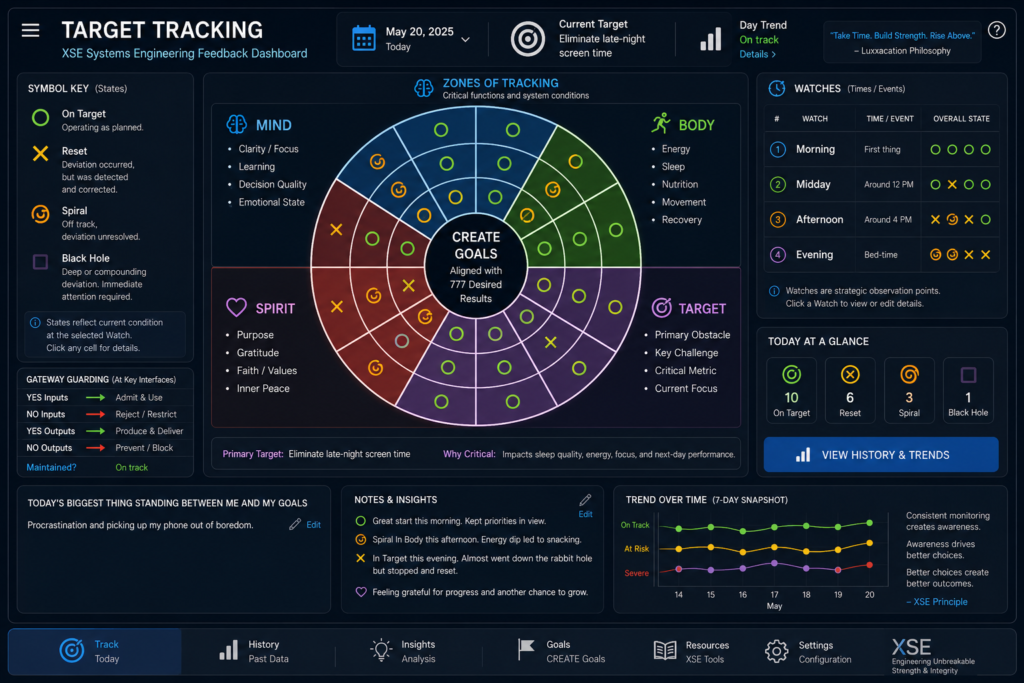
Target Tracking is designed around a simple systems-engineering principle:
A system is easier to keep on its intended course when its state, operation, and developing Trajectory are observed at meaningful intervals, allowing deviation to be recognized and corrective action initiated before substantial off-course movement accumulates.
Target Tracking is XSE’s recurring systems-state observation, progress-recording, feedback, and course-correction support method through which actual system operation is compared with the configuration engineered during Take Time. Target Tracking is configured during Take Time and conducted principally through strategically positioned Watches during Build Strength, reconnecting Current Reality, Desired Results (777), CREATE Goals, Gateway Guarding, the Primary Target, and intended system direction with what is actually occurring during operation.
Through recurring Watches, Target Tracking records relevant operating states, deviations, Resets, Gateway conditions, CREATE Goal implementation, Primary Target activity, Executive Power, and other applicable operational evidence. This evidence can help reveal changes in XSE Dynamic Mechanics—including Trajectory—as well as Position and developing system patterns, enabling timely recognition of deviation and informing appropriate correction while generating longitudinal evidence across Watches, days, weeks, longer periods, and potentially Epochs.
The accumulated evidence subsequently returns to Take Time, where it contributes to renewed Current Reality assessment, X-Axis analysis, reassessment of the 12 Core XSE Dynamic Mechanics, Astronomical Plotting and Position, evaluation of relevant Derived Dynamics, and XESAS Synthesis. Target Tracking thereby creates a recurring operational feedback connection between what XSE engineered the system to do, what the system actually did, what changed as a result, and how the next whole-system configuration can be improved.
In concise form:
Target Tracking is XSE’s recurring operational observation, progress-recording, feedback, and course-correction support method, configured during Take Time and conducted principally through Watches during Build Strength, that compares actual system operation with Desired Results, CREATE Goals, Gateway Guarding, the Primary Target, and intended direction while generating longitudinal evidence for subsequent analysis, XESAS Synthesis, and whole-system reconfiguration.
Establishing the Facts with Data

Target Tracking is XSE’s recurring systems-state observation, progress-recording, feedback, and course-correction support method through which actual system operation is compared with the configuration engineered during Take Time. Target Tracking is configured during Take Time and conducted principally through strategically positioned Watches during Build Strength, reconnecting Current Reality, Desired Results (777), CREATE Goals, Gateway Guarding, the Primary Target, and intended system direction with what is actually occurring during operation.
Through recurring Watches, Target Tracking records relevant operating states, deviations, Resets, Gateway conditions, CREATE Goal implementation, Primary Target activity, Executive Power, and other applicable operational evidence. This evidence can help reveal changes in XSE Dynamic Mechanics—including Trajectory—as well as Position and developing system patterns, allowing deviation to be recognized in time to inform appropriate corrective action while generating longitudinal evidence across Watches, days, weeks, operating cycles, longer periods, and potentially Epochs.
The accumulated evidence subsequently returns to Take Time, where it contributes to renewed Current Reality assessment, X-Axis analysis, reassessment of the 12 Core XSE Dynamic Mechanics, Astronomical Plotting and Position, evaluation of relevant Derived Dynamics, and XESAS Synthesis.
Target Tracking thereby creates a recurring operational feedback connection between:
what XSE engineered the system to do → what the system actually did → what changed during operation → and how the next whole-system configuration can be improved.
The Systems-Engineering Principle Behind Target Tracking
Target Tracking is designed around a simple systems-engineering principle:
A system is easier to keep on its intended course when its state, operation, and developing Trajectory are observed at meaningful intervals, allowing deviation to be recognized and corrective action initiated before substantial off-course movement accumulates.
For an applicable human System of Interest, Target Tracking ordinarily uses a circular Target divided into concentric rings and categorical Zones. The rings represent successive Watches during the operating period, while the Zones represent important areas of system operation being monitored.
At each Watch, the individual briefly evaluates the relevant Zones and records the observed operational condition using a small set of recognizable symbols.
The purpose is not perfection, constant self-surveillance, or punishment for deviation. Its purpose is to establish a practical recurring feedback system through which a person can:
observe → record → compare → recognize → reset → learn → recalibrate
before smaller deviations unnecessarily develop into larger ones.
Target Tracking therefore occupies an important position between Take Time and Build Strength.
During Take Time, the Target Tracking configuration is engineered from the understanding developed through Current Reality assessment, XSE analysis, Desired Results, CREATE Goals, Gateway Guarding, Primary Target identification, and XESAS Synthesis.
During Build Strength, strategically positioned Watches briefly interrupt ordinary operation so that the actual system state can be observed and compared with that reference configuration. When deviation is detected, the Watch can inform timely corrective action before operation continues.
The resulting observations accumulate as longitudinal evidence that can return to subsequent Take Time for deeper analysis, resynthesis, and whole-system reconfiguration.
Thus:
Take Time configures Target Tracking → Build Strength generates Target Tracking observations → Target Tracking informs correction during operation → accumulated evidence returns to Take Time for analysis and XESAS Synthesis.
Target Tracking Reconnects the Three Take Time Questions During Operation
Target Tracking occupies a particularly important position within XSE because it brings the reference architecture established through Take Time back into recurring comparison with Current Reality during Build Strength.
The three broad Take Time questions establish:
1. Current Reality, Dynamic Mechanics & Trajectory
Where is the system now, what is dynamically happening, and where is the present course taking it?
2. Desired Results (777)
Where should the system go?
3. Engineered Means of Advancement
How has the system been configured to move from Current Reality toward those Desired Results?
Within this third area, CREATE Goals establish micro-level operational objectives intended to help achieve Desired Results, while corresponding Gateway Guarding specifications establish relevant Input and Output requirements for the operating cycle.
Target Tracking brings these levels back into recurring comparison during actual operation:
CURRENT REALITY + DYNAMIC MECHANICS + TRAJECTORY
Where am I now, what is happening, and where is this course taking me?
↕ TARGET TRACKING ↕
DESIRED RESULTS (777)
Where am I trying to go?
↕ TARGET TRACKING ↕
CREATE GOALS + GATEWAY GUARDING SPECIFICATIONS
What did I determine I should do—and deliberately admit, produce, restrict, or prevent—to help get there?
↕ TARGET TRACKING ↕
ACTUAL SYSTEM OPERATION
At a Watch, the essential systems-engineering comparison becomes:
Where am I now? → Where am I trying to go? → Am I presently operating according to the configuration engineered to help get me there?
Target Tracking does not ordinarily mean completely repeating Take Time at every Watch.
A person does not necessarily rewrite Desired Results, redesign CREATE Goals, reengineer Gateway Guarding, perform a complete X-Axis analysis, or conduct another full XESAS Synthesis several times each day.
Instead, Target Tracking uses the architecture already established during Take Time as a reference configuration against which actual operation can be repeatedly checked.
When a Watch reveals a relatively small deviation, immediate corrective action or Reset may be sufficient.
When repeated Watches reveal a larger, persistent, or recurring pattern, the accumulated evidence can be carried into a subsequent fuller Take Time process for deeper analysis, XESAS Synthesis, and reconfiguration.
Desired Results (777)
Desired Results (777) establish where the System of Interest should go across three categories:
and across six progressively expanding time horizons:
- 7 hours
- 7 days
- 7 weeks
- 7 months
- 7 years
- 77 years
The framework is called 777 because its temporal scope extends from approximately 7-hour Desired Results to 77-year Desired Results.
777 provides the larger future-state architecture against which Current Reality, relevant Dynamic Mechanics, Trajectory, Position, and actual operation can be compared.
Desired Results answer:
Where should the system go?
Target Tracking does not ordinarily redefine those Desired Results at each Watch. Instead, it provides recurring operational evidence concerning whether the system’s actual operation remains consistent with movement toward them.
CREATE Goals
CREATE Goals are the Courageous, Realistic, Envisioned, Aligned, Testable, and End-Dated micro-level operational goals developed within Take Time to translate Desired Results (777) into actionable systems-engineering objectives.
They answer:
What specifically should the system work to accomplish in order to move toward its Desired Results?
CREATE Goals should be aligned with and traceable to relevant Desired Results.
Because CREATE Goals are Testable, their implementation, progress, relevant effects, and achievement should be capable of evaluation through appropriate evidence.
Target Tracking can provide an important recurring source of that evidence during actual operation.
Gateway Guarding
CREATE Goals provide an important operational basis for engineering the Gateway Guarding specifications used during the operating cycle.
Gateway Guarding is the higher-order Derived Dynamic through which relevant Inputs and Outputs are deliberately governed across the Gateways in support of CREATE Goals, Desired Results, Integrity, and intended system direction.
For applicable human systems, Gateway Guarding operates in relation to the:
Mind Gateway | Body Gateway | Spirit Gateway
Relevant Gateway Guarding specifications may identify:
YES Inputs
Inputs deliberately sought, admitted, selected, or encouraged.
YES Outputs
Outputs deliberately produced, expressed, enacted, or maintained.
NO Inputs
Inputs deliberately restricted, rejected, avoided, or prohibited within the applicable configuration.
NO Outputs
Outputs deliberately restrained, prevented, discontinued, or prohibited within the applicable configuration.
These specifications answer:
What should the system deliberately allow in, keep out, produce, or prevent in order to support its CREATE Goals and Desired Results?
An important distinction is maintained within XSE:
Gateways are the interfaces. Inputs and Outputs are the exchanges. Gateway Guarding is the higher-order regulatory architecture governing those exchanges. Gateway Guarding specifications establish the particular Input and Output requirements engineered for the operating cycle.
Target Tracking can then provide recurring evidence concerning whether relevant Gateway Guarding specifications are actually being maintained under real operating conditions.
The Target Structure
Target Tracking is represented visually as an actual Target.
The circular design is functional rather than merely decorative.
The Target contains concentric rings, representing successive Watches during the operating period, and is divided radially into Zones, somewhat like slices of a circle.
Each intersection between a Watch ring and a Zone provides a location where the observed condition of that area can be recorded at that particular point in operation.
This makes it possible to see not merely isolated observations but the development of the system across the operating period.
Patterns may become visually apparent:
- one Zone may repeatedly deteriorate first;
- deviation in one Zone may precede deviation elsewhere;
- a particular Watch may repeatedly reveal vulnerability;
- successful Resets may cluster around particular practices or conditions;
- mornings may remain strong while evenings repeatedly deteriorate;
- Gateway Guarding may become less effective under recurring conditions;
- or strengthening in one Zone may accompany improvement elsewhere.
The Target therefore becomes a compact visual record of system state, regulation, deviation, recovery, and developing Trajectory.
The Core Target Tracking Zones
For an applicable human System of Interest, Target Tracking consistently includes four core Zones:
Mind
The Mind Zone monitors relevant cognitive operation.
This may include:
- current focus;
- attentional direction;
- priority awareness;
- mental drift;
- useful learning;
- and brief XSE information intended to sharpen understanding.
A focus rating or another simple measurement may supplement the Target Tracking symbol when useful.
The broad question is:
Is my Mind operating in a way that supports today’s intended direction?
Body
The Body Zone monitors adherence to relevant physical, behavioral, scheduling, and Gateway requirements established through CREATE Goals and Gateway Guarding.
Depending upon the individual’s configuration, this might include:
- staying on schedule;
- planned exercise;
- planned nutrition practices;
- sleep-related practices;
- movement;
- recovery practices;
- and other predetermined behavioral commitments.
The purpose is to compare:
intended operation ↔ actual operation
Fitness, nutrition, and wellness applications of Target Tracking are educational and coaching-oriented and do not constitute medical diagnosis or treatment or replace individualized care from appropriately licensed healthcare professionals.
Spirit
Within XSE’s conceptual and educational framework, the Spirit Zone provides a structured means of self-observing relevant aspects of inner orientation that the individual has chosen to monitor in relation to the intended operating configuration.
This may include awareness of whether the person is becoming increasingly occupied by conditions such as:
- self-pity;
- resentment;
- anger;
- discouragement;
- or persistent negative preoccupation;
or cultivating constructive orientations such as:
- gratitude;
- hope;
- courage;
- purpose;
- perspective;
- and appropriate concern for what is good and meaningful.
The Spirit Zone is an educational self-observation and coaching tool within XSE. It is not a psychological diagnostic instrument, clinical assessment, or substitute for mental-health care.
Primary Target
The Target Zone monitors the Primary Target identified through Take Time analysis.
The Primary Target is an obstacle, behavior, influence, temptation, pattern, condition, vulnerability, or other significant source of deviation presently identified as particularly important to the system’s progress toward its CREATE Goals and Desired Results.
It represents something presently standing significantly between:
Current Reality
and
CREATE Goals / Desired Results
The Target Zone asks:
Is the Primary Target beginning to influence the system?
The purpose is early detection.
Rather than recognizing substantial deviation only after it has fully developed, Target Tracking can help identify precursors, exposures, temptations, behaviors, or operating conditions associated with developing deviation.
The Primary Target should be selected through Take Time analysis rather than arbitrarily chosen and may be changed when subsequent evidence indicates that another Target deserves greater priority.
Optional Tracking Zones
Additional Zones may be added when they provide meaningful systems information.
Examples might include:
- AFAR, including relevant prayer or meditation practices;
- a particular CREATE Goal;
- sleep;
- work performance;
- study;
- communication;
- financial behavior;
- a specific project;
- environmental conditions;
- or another relevant variable.
Where someone is experiencing an illness or physical condition, Target Tracking may also be used simply to record self-observed symptoms or changes for personal records or, where useful, communication with an appropriately licensed healthcare professional.
Target Tracking does not diagnose illness, determine medical treatment, or replace professional medical evaluation.
The tracker should contain what produces useful system information, not every variable that could conceivably be measured.
The Four Target Tracking Symbols
Each relevant Zone at each Watch receives one of four operational symbols.
These symbols represent qualitatively different observed system states relative to the intended course, rather than merely numerical scores.
O — On Target
O means the system remained On Target.
The individual substantially did what had been planned or maintained the intended operating condition.
It represents:
intended configuration → intended operation
O does not mean perfection.
It means that the relevant objective or condition for that Zone and Watch was sufficiently maintained.
X — Deviation Detected and Reset
X means the system began to move off Target, or came close to doing so, but the deviation was recognized and corrective action successfully returned the system to Target.
X can provide operational evidence concerning:
- recognition of deviation;
- executive governance through the ECC;
- willpower;
- Executive Power;
- effective Gateway Guarding;
- corrective System Work;
- and successful course correction.
Its basic sequence is:
Deviation begins → Deviation recognized → Correction applied → Target restored
X therefore should not simply be interpreted as failure.
It records evidence that the system’s corrective mechanisms successfully operated.
Over time, X marks can help reveal which Reset and corrective strategies repeatedly succeed.
Spiral — Off Target Without Successful Reset
The Spiral indicates that the system has moved off Target and has not yet successfully returned to the intended operating condition.
It represents continuing deviation.
The appropriate response is not simply to record the Spiral and abandon the remainder of the operating period.
The Spiral provides feedback:
The system presently requires corrective attention.
A Spiral at one Watch may therefore prompt a deliberate Reset or other appropriate corrective Work before the next Watch.
Black Hole — Deep Deviation and Reduced Corrective Engagement
The Black Hole, represented by a black dot, square, or similar mark, indicates a more substantial state of deviation in which the individual is not merely off Target but has entered a condition of markedly reduced corrective engagement.
Operationally:
Deviation → Continued Deviation → Reduced Corrective Engagement → Deeper Departure from Intended Operation
The Black Hole is not a statement about a person’s worth, identity, morality, or character.
It is a systems-state symbol within the Target Tracking framework.
Its purpose is to make substantial deviation immediately recognizable so that the conditions associated with it can subsequently be investigated and stronger prevention, interruption, or recovery strategies can be developed.
Why Symbols Instead of Only Numbers?
Target Tracking symbols identify operational states relative to the intended course.
A numerical scale can indicate magnitude:
Focus = 7/10
The Target Tracking symbols answer a different question:
What happened relative to the intended operating configuration?
O — course maintained.
X — deviation developed but was successfully corrected.
Spiral — deviation occurred and remains unresolved.
Black Hole — substantial deviation accompanied by reduced corrective engagement.
Numbers can still supplement these symbols where useful.
For example:
Focus: 6/10 + X
can communicate both a quantitative rating and an operational state.
Cross-Zone Propagation
One of the most important purposes of Target Tracking is to make cross-Zone interaction visible.
Human systems are integrated.
Deviation in one area can propagate into others.
For example:
Body deviation
↓
Schedule disruption or fatigue
↓
Mind loses focus
↓
Priorities become less salient
↓
Gateway Guarding becomes less effective
↓
Primary Target becomes more influential
↓
Further deviation
The sequence may begin in another Zone, and positive propagation can occur as well.
A successful Reset in one Zone may help prevent deterioration elsewhere.
Repeated Target Tracking can therefore help reveal:
- which Zone commonly moves first;
- what tends to follow;
- when cascading effects appear;
- which Gateway conditions precede deviation;
- what times of day repeatedly present difficulty;
- which protective conditions accompany stronger operation;
- and which Reset strategies appear to interrupt a cascade.
Target Tracking itself does not establish causation from these observed patterns.
Instead, it generates evidence that can become the subject of subsequent X-Axis analysis and broader XSE investigation.
Target Tracking as Longitudinal Data Collection
A single Target provides observations about one operating period.
Repeated Targets begin to reveal system behavior across time:
Watches → Days → Weeks → Operating Cycles → Longer Periods → Epochs
An Epoch in XSE is not established merely because a certain amount of calendar time has passed. It reflects a meaningful period or state associated with system life-cycle Position, configuration, capability, operating condition, direction, or other significant system characteristics.
Longitudinal Target Tracking records may reveal:
- recurring afternoon Spirals;
- consistently strong Morning Watches;
- Primary Target activation following particular Inputs;
- improved operation under particular Gateway conditions;
- increasing successful Resets;
- repeated Black Holes under recurring circumstances;
- changes following a new CREATE Goal;
- or progressively greater stability across multiple Zones.
This is where Target Tracking becomes especially valuable to XSE:
The tracker is not merely keeping score. It is generating longitudinal systems evidence.
That evidence can contribute to investigation of changing Dynamic Mechanics, developing Trajectory, Position, recurring feedback patterns, and overall system performance.
Target Tracking and Testable CREATE Goals
Because CREATE Goals are Testable, their implementation and progress must be capable of evaluation through appropriate evidence.
Target Tracking can provide an important recurring source of that evidence.
Depending upon the CREATE Goal, Target Tracking may help record whether:
- planned actions occurred;
- schedules were maintained;
- YES Inputs were admitted;
- NO Inputs were successfully rejected;
- YES Outputs were produced;
- NO Outputs were prevented;
- the Primary Target became active;
- deviation occurred;
- corrective action succeeded;
- and relevant operating patterns changed over time.
Target Tracking does not necessarily provide all of the evidence required to evaluate every CREATE Goal.
Other:
- measurements;
- milestones;
- records;
- tests;
- system Outputs;
- observations;
- or appropriate data Sources
may also be necessary.
Target Tracking is therefore a structured recurring operational data-collection mechanism, rather than the sole source of evidence concerning system performance.
Target Tracking and Course Correction
Target Tracking is deliberately designed so that deviation does not automatically equal defeat.
One of its primary purposes is to shorten the operational distance between:
Deviation → Detection → Correction
Importantly, Target Tracking detects and records; it does not itself supply all of the mechanisms responsible for correction.
Actual course correction may involve:
- executive governance through the ECC;
- willpower;
- Executive Power;
- Gateway Guarding;
- application of relevant Sources and Resources;
- System Force;
- System Work;
- and other appropriate corrective actions.
The X symbol makes successful course correction visible.
A person who begins moving off course, recognizes the deviation, applies appropriate corrective Work, and successfully resets has generated useful systems evidence:
The corrective mechanisms worked.
Over time, XSE can investigate what enabled that recovery and determine whether those conditions can be strengthened, protected, reproduced, or incorporated into subsequent configurations.
Target Tracking therefore records not merely success and deviation but also evidence concerning regulatory performance, Executive Power, correction, and recovery capability.
Immediate Course Correction vs. Deeper Reconfiguration
Not every observation at a Watch requires a complete systems analysis.
Some deviations permit immediate correction:
Detect → Govern → Reset → Return On Target → Continue
Recurring, persistent, or substantial deviations may instead become evidence for a subsequent fuller application of Take Time.
That deeper process may involve:
Collect and Review Evidence
↓
Reestablish Current Reality
↓
Perform X-Axis Analysis
↓
Reassess Relevant XSE Dynamic Mechanics
↓
Reassess Astronomical Plotting, Position & Trajectory
↓
Reconsider Desired Results Where Appropriate
↓
Reassess CREATE Goals
↓
Refine Gateway Guarding
↓
Reconsider the Primary Target
↓
Reconfigure Target Tracking Where Appropriate
↓
Reassess Relevant Derived Dynamics
↓
Perform XESAS Synthesis Again
↓
Select the Next Whole-System Configuration
Target Tracking therefore supports systems engineering at multiple temporal scales:
immediate operational feedback and course correction during Build Strength
and:
deeper analysis, resynthesis, and whole-system reconfiguration during subsequent Take Time cycles.
Target Tracking and the X Axis
The accumulated Target Tracking record becomes evidence for X-Axis System Analysis.
The X Axis can investigate questions such as:
- Why does the Primary Target repeatedly become active at night?
- Does Body deviation tend to precede Target deviation?
- Are X Resets becoming more frequent or less frequent?
- What Inputs commonly precede a Black Hole?
- Which Morning Watch conditions accompany stronger days?
- Which CREATE Goals are consistently implemented?
- Which appear unrealistic or poorly configured?
- Which Gateway Guarding specifications appear difficult to maintain?
- Which corrective actions repeatedly accompany successful Resets?
- Are problems isolated or propagating across Zones?
- Are relevant Dynamic Mechanics changing over time?
- Is developing Trajectory becoming more or less consistent with Desired Results?
Thus:
Target Tracking observes and records the pattern.
The X Axis investigates the pattern.
This distinction helps prevent observations, associations, or correlations from being prematurely treated as established explanations or causes.
Target Tracking and XESAS Synthesis
Target Tracking evidence does not remain isolated.
When combined with broader XSE evidence and analysis, relevant findings can contribute to XESAS Synthesis.
Repeated tracking may reveal that an apparent problem cannot adequately be understood simply as insufficient effort.
The larger system might contain:
- poorly configured Inputs;
- ineffective Gateway Guarding specifications;
- an unrealistic CREATE Goal;
- insufficient Resources;
- inadequate or unreliable Sources;
- competing goals;
- an environmental constraint;
- recurring time-of-day vulnerability;
- cross-Sphere influence;
- executive-regulation difficulty;
- insufficient Executive Power;
- unfavorable Dynamic Mechanics;
- or a feedback relationship that repeatedly recreates the problem.
XESAS Synthesis can then ask:
Given what has been learned, how should the relevant Factors, Derived Dynamics, Sources, Resources, constraints, Dynamic Mechanics, and other system elements be coordinated into a more coherent configuration for the next operating cycle?
The resulting whole-system configuration can then be carried into Build Strength.
Actual operation produces new Target Tracking evidence.
That evidence returns to subsequent Take Time.
The recursive feedback loop continues.
Target Tracking Within the XSE Feedback Architecture
The overall relationship can be represented as:
TAKE TIME
Establish Current Reality
What is actually true of the SOI now?
↓
Analyze
What Factors, relationships, conditions, influences, Sources, Resources, constraints, and patterns are relevant?
↓
Examine Dynamic Mechanics, Position & Trajectory
What is dynamically occurring, where is the SOI positioned, and where is the present course taking it?
↓
Pinpoint Desired Results (777)
Where should the system go?
↓
Develop CREATE Goals
What Courageous, Realistic, Envisioned, Aligned, Testable, and End-Dated operational goals will help move it there?
↓
Engineer Gateway Guarding
Which Inputs and Outputs should be deliberately admitted, produced, restricted, or prevented?
↓
Identify the Primary Target
What presently represents a particularly important source of deviation standing between Current Reality and the intended Results?
↓
Configure Target Tracking
What should be monitored, and at which Watches, to determine how the system actually performs?
↓
Perform XESAS Synthesis
How should the relevant Factors, findings, requirements, relationships, Sources, Resources, Dynamic Mechanics, and Derived Dynamics be coordinated into a coherent whole-system configuration?
↓
WHOLE-SYSTEM CONFIGURATION
↓
BUILD STRENGTH
Put the configuration into operation
↓
Govern through the ECC
↓
Apply Willpower & Executive Power
↓
Operate Gateway Guarding
↓
Perform System Work
↓
TARGET TRACKING WATCH
Where are we now?
Where are we trying to go?
Are we presently operating according to the configuration engineered to help get us there?
↓
Observe & Record Current State
↓
Detect Deviation Where Present
↓
Reset / Correct Where Appropriate
↓
Continue Build Strength
↓
Additional Watches
↓
LONGITUDINAL EVIDENCE & FEEDBACK
↓
RISE ABOVE
Review → Learn → Recommit → Seek Better Sources → Seek Better Resources → Strengthen Capability
↓
TAKE TIME AGAIN
Review Evidence
↓
Reestablish Current Reality
↓
X-Axis Analysis
↓
Reassess Dynamic Mechanics
↓
Reassess Astronomical Plotting / Position & Trajectory
↓
Reassess Relevant Derived Dynamics
↓
Perform XESAS Synthesis Again
↓
Reconfigure
↓
Determine Whether a New Epoch Has Been Reached
↓
NEXT WHOLE-SYSTEM CONFIGURATION
↓
BUILD STRENGTH AGAIN
Target Tracking therefore functions as a recurring feedback bridge between Take Time and Build Strength: its architecture is engineered during Take Time, its Watches observe actual operation during Build Strength, and its accumulated evidence returns to subsequent Take Time for renewed analysis, synthesis, and reconfiguration.
Target Tracking for Non-Human Systems
The underlying Target Tracking architecture can also be adapted to non-human Systems of Interest, but the Zones, Watches, Targets, evidence, and operating criteria should be engineered around the actual system.
A business, project, software system, machine, or operational process would not ordinarily use:
Mind → Body → Spirit → Target
Instead, relevant Zones might represent:
- subsystems;
- interfaces;
- operational requirements;
- performance variables;
- Resources;
- constraints;
- risks;
- failure conditions;
- or other important system characteristics.
Watches might occur at:
- shift changes;
- production cycles;
- project milestones;
- system runs;
- scheduled checkpoints;
- transaction intervals;
- or meaningful event triggers.
Likewise, the O, X, Spiral, and Black Hole states would require clearly engineered operational criteria appropriate to that System of Interest rather than simply importing human behavioral meanings into a non-human system.
The underlying principle remains:
Observe the system at meaningful intervals, compare Current Reality with intended Results and planned operation, detect deviation early, record correction or continued drift, and use the resulting evidence for analysis and recalibration.
Thus, even in a non-human application, Target Tracking connects the same fundamental questions:
Where is the system now?
Where should it go?
Is it operating according to the configuration engineered to help get it there?
Target Tracking Is Not a Perfection System
Target Tracking should not be interpreted as requiring flawless daily performance.
A useful Target Tracking record may contain:
O’s, X’s, Spirals, and Black Holes.
Each provides different information.
The objective is to improve:
- awareness;
- early detection;
- corrective capability;
- understanding of system patterns;
- Gateway Guarding performance;
- feedback quality;
- executive and regulatory performance;
- alignment between actual operation and CREATE Goals;
- recovery capability;
- and progress toward Desired Results.
Progress may therefore appear not only as:
more O’s
but also as movement such as:
Black Holes → Spirals → X’s → O’s
For example, movement from repeated Black Hole states toward Spirals may, depending upon the broader evidence, indicate earlier recognition or increased corrective engagement.
Movement from Spirals toward X states may indicate that deviation is increasingly being recognized and successfully corrected.
Movement from X states toward O states may indicate improved prevention, stability, Gateway Guarding, Executive Power, or more reliable operation of the intended configuration.
These patterns should be interpreted as systems evidence requiring appropriate context and analysis, rather than as automatic proof of any particular underlying cause.
Target Tracking can therefore make improvements in system regulation, correction, and recovery visible even before consistently On-Target operation has been achieved.
Concise Definition
Target Tracking is XSE’s recurring systems-state observation, progress-recording, feedback, and course-correction support method, configured during Take Time and conducted principally through strategically positioned Watches during Build Strength. It compares actual system operation with Desired Results (777), CREATE Goals, Gateway Guarding, the Primary Target, and intended direction, enabling timely recognition of deviation while generating longitudinal evidence for subsequent X-Axis analysis, reassessment of XSE Dynamic Mechanics—including Trajectory—Astronomical Plotting and Position, XESAS Synthesis, and whole-system reconfiguration.
Keeping Vigilance on the Watches

The concentric rings of the Target represent strategically positioned Watches conducted principally during Build Strength.
The timing, number, relevant Zones, Primary Target, and other tracking requirements for these Watches are configured during Take Time according to the System of Interest, its Current Reality, Desired Results (777), CREATE Goals, Gateway Guarding specifications, known vulnerabilities, and intended operating conditions.
Once Build Strength begins, each Watch creates a brief, deliberate systems-state checkpoint within actual operation.
Its purpose is to:
observe → record → compare → detect deviation → inform correction where appropriate → continue
A Watch does not ordinarily require the individual to stop and repeat the full XSE analysis or XESAS Synthesis process. Instead, it briefly compares what is actually occurring now with the reference configuration established during Take Time.
Each Watch can therefore ask, in condensed form:
Where am I now? Is my present operation consistent with where I intend to go? If not, what requires correction before I continue?
When deviation is identified, the Watch provides feedback that can inform executive governance, Gateway Guarding, Executive Power, Reset, and other appropriate corrective System Work.
Across repeated Watches, these individual observations accumulate into longitudinal evidence concerning actual system operation, relevant Dynamic Mechanics—including developing Trajectory—Position, recurring patterns, deviation, correction, and recovery.
Morning Watch — Establish the Operating State
The Morning Watch occurs after the person’s ordinary morning routine has been completed—including, where applicable, hygiene, breakfast or coffee, prayer or meditation, and other planned preparatory activities—but before beginning the primary work or operation of the day.
The Morning Watch differs somewhat from later Watches because its principal purpose is not merely to detect deviation after substantial operation has occurred. It helps determine whether the individual has entered the operating day in the configuration intentionally established to support effective operation.
The Morning Watch may therefore examine whether relevant:
- preparatory routines were completed;
- Gateway Guarding specifications are in place;
- priorities remain clear;
- CREATE Goals are operationally salient;
- the Primary Target is recognized;
- necessary Sources and Resources are available;
- and relevant Mind, Body, and Spirit conditions support the intended course.
The Morning Watch may also include a short engineered:
- reading;
- XSE information tidbit;
- reminder;
- written notification;
- priority cue;
- Gateway Guarding reminder;
- Primary Target warning;
- or other brief preparatory Input
that was intentionally selected during Take Time to support operation during Build Strength.
Its purpose is not simply to create motivation. The Input should have an identified systems function—for example, strengthening attentional direction, reinforcing an important priority, preparing for a known vulnerability, supporting Gateway Guarding, or reminding the individual of the intended course before substantial System Work begins.
The Morning Watch asks:
Have I established the operating conditions that I determined would give this day the strongest reasonable start, and am I beginning operation on the intended course?
Midday Watch — Check the Developing Course
The Midday Watch occurs after a meaningful period of actual operation.
By this point, the system has encountered real:
- Inputs and Outputs;
- demands;
- decisions;
- environmental conditions;
- distractions;
- constraints;
- opportunities;
- Forces;
- Energy demands;
- Gateway interactions;
- and feedback.
The Midday Watch therefore provides an important comparison between the configuration engineered during Take Time and the Current Reality produced through actual operation during Build Strength.
It asks:
Am I still operating according to the intended configuration, or is meaningful deviation beginning to develop?
The individual records the applicable Target Tracking states and briefly considers whether the present course remains consistent with the intended direction.
If deviation is detected, the Watch can inform appropriate corrective action while the remaining operating period still provides meaningful opportunity for correction.
Thus, the Midday Watch helps shorten the distance between:
deviation → detection → corrective response
rather than allowing smaller deviations to accumulate unnoticed until the end of the day.
Optional Afternoon Watch — Increase Feedback Resolution
The Afternoon Watch is an optional additional checkpoint used when greater feedback resolution is warranted.
It may be particularly valuable when:
- afternoon conditions are routinely difficult;
- Energy or attentional capacity tends to change substantially;
- the Primary Target commonly becomes influential during this period;
- environmental or occupational conditions change;
- Gateway Guarding becomes more difficult;
- previous Target Tracking evidence reveals recurring afternoon deviation;
- or the current operating cycle requires closer observation.
The Afternoon Watch should not be added merely to create more tracking.
Within XSE, more measurement is not automatically better measurement. A Watch is useful when its timing provides information capable of improving awareness, regulation, correction, subsequent analysis, or system configuration.
Accordingly, some configurations may benefit from an Afternoon Watch while others may not require one.
Its central question remains:
What is the system doing now, and does anything require correction before the remaining operating period continues?
Final Watch — Close the Operating Day
The Final Watch is the principal closing checkpoint for the operating day and is preferably conducted at a consistent, intentionally selected time, where practical, before the phone or other major digital Gateways are put away for the night.
This Watch recognizes that late-day operation may occur under conditions different from those present earlier in the day.
Depending upon the individual and circumstances, these may include:
- accumulated fatigue;
- changing System Energy;
- reduced attentional sharpness;
- diminished willingness to exert effort;
- increased attraction to easier or immediately rewarding alternatives;
- weakened Gateway Guarding;
- accumulated stress;
- unfinished priorities;
- or increased vulnerability to the Primary Target.
These conditions should not automatically be assumed for every person or every day. Rather, the Final Watch provides an opportunity to determine what is actually occurring in the system at that time.
The Final Watch asks:
How am I ending this operating day, and is my present operation supporting or undermining the course I intend to continue?
Where appropriate, the Final Watch can inform final corrective actions, completion or appropriate deferral of remaining priorities, Gateway Guarding for the evening, and preparation for the next operating period.
It may also include brief reminders concerning appropriate sleep, recovery, preparation, or other previously engineered practices relevant to the individual’s configuration.
Importantly, the Final Watch is not merely an end-of-day judgment.
It completes an important portion of the day’s operational evidence record.
The Watches as a Feedback Sequence
Together, the Watches create strategically spaced observations of the SOI as it moves through actual operation:
Morning Watch → Establish the operating state
Midday Watch → Check the developing course
Optional Afternoon Watch → Increase feedback resolution where needed
Final Watch → Evaluate how the operating day is ending
Each Watch produces only a snapshot.
Together, however, the Watches begin to reveal change across time.
Repeated across operating days and longer periods, they can provide evidence concerning:
- stability and deviation;
- successful and unsuccessful Resets;
- Gateway conditions;
- Primary Target activity;
- Executive Power;
- recurring operating patterns;
- changes in relevant XSE Dynamic Mechanics;
- developing Trajectory;
- Position;
- and the effectiveness of the engineered configuration.
This is why the Watches are strategically positioned rather than continuously performed.
The purpose is not to observe the system every moment. The purpose is to observe it at sufficiently meaningful points that developing deviation, correction, and change become visible while useful action can still be taken.
In this way, the Watches help transform Target Tracking from an end-of-day record into a recurring operational feedback system:
Take Time engineers the Watches → Build Strength conducts the Watches → Watches generate evidence and inform correction → accumulated evidence returns to Take Time for deeper analysis, XESAS Synthesis, and subsequent reconfiguration.
Target Tracking for Non-Human Systems

Target Tracking for Non-Human Systems is an adaptable XSE systems-state observation, progress-recording, feedback, and course-correction support method, configured during Take Time and conducted principally through strategically positioned Watches during Build Strength.
At each Watch, relevant system conditions are observed, measured, sampled, or recorded so that actual operation can be compared with Current Reality, applicable Desired Results (777), CREATE Goals, Gateway Guarding specifications, the Primary Target, intended system direction, and the whole-system configuration established through XESAS Synthesis.
Through repeated Watches, Target Tracking can reveal alignment, deviation, correction, recovery, degradation, and developing operational patterns. It thereby supports timely recognition of deviation, informs appropriate corrective action, and generates longitudinal evidence for subsequent X-Axis analysis, reassessment of relevant XSE Dynamic Mechanics, Astronomical Plotting and Position, evaluation of relevant Derived Dynamics, XESAS Synthesis, and whole-system reconfiguration.
The underlying purpose of Target Tracking remains consistent whether the System of Interest is a human, organization, business, software platform, machine, project, process, infrastructure system, or another complex system:
Determine Current Reality → establish what the system is dynamically doing and where it is heading → compare actual operation with where the system is intended to go and how it was configured to get there → detect meaningful deviation → inform corrective action → record what occurred → use the accumulated evidence to improve subsequent systems engineering.
For non-human systems, however, the Zones, Watches, indicators, interfaces, Inputs, Outputs, thresholds, Gateway Guarding specifications, Primary Targets, and corrective mechanisms must be engineered for the particular System of Interest rather than simply transferred from the human Target Tracking configuration.
Target Tracking Reconnects the Take Time Reference Architecture With Actual Operation
Target Tracking occupies an important position within XSE because it reconnects the reference architecture established during Take Time with the system’s actual operation during Build Strength.
Take Time establishes three fundamental systems-engineering questions that Target Tracking repeatedly brings back into view during operation.
1. Establish Current Reality, Dynamic Mechanics, Position & Trajectory
The first question is:
Where is the system now, what is dynamically occurring, and where is the present course taking it?
For a non-human system, Current Reality may involve investigating:
- system state;
- performance;
- Resources;
- Inputs;
- Outputs;
- operating conditions;
- requirements;
- constraints;
- failures;
- interfaces;
- feedback;
- environmental conditions;
- relevant Dynamic Mechanics;
- Position;
- Trajectory;
- and other applicable evidence.
Each Target Tracking Watch contributes another observation of actual system operation.
Across repeated Watches, these observations can help reveal whether the system is maintaining its intended course, drifting, accelerating, decelerating, recovering, degrading, becoming more or less stable, or changing in other operationally significant ways.
Target Tracking itself does not determine why these changes are occurring. It records evidence that can subsequently be investigated through XSE analysis.
2. Pinpoint Desired Results (777)
Desired Results establish:
Where should the system go?
Within XSE, the complete 777 Desired Results architecture extends across:
- 7 hours;
- 7 days;
- 7 weeks;
- 7 months;
- 7 years;
- and 77 years.
For a non-human System of Interest whose expected or meaningful life cycle does not extend across all of these horizons, the applicability of particular horizons should be evaluated according to the system’s actual Y-Axis life-cycle characteristics rather than artificially assigning Desired Results beyond its meaningful operating life.
Target Tracking does not ordinarily redefine Desired Results at each Watch.
Instead, applicable Desired Results establish future-state reference conditions against which Current Reality, Position, developing Trajectory, and actual system operation can be compared.
3. Engineer the Means of Advancement
The third question is:
How should the system be configured to move from Current Reality toward its Desired Results?
Within this part of Take Time, CREATE Goals establish the Courageous, Realistic, Envisioned, Aligned, Testable, and End-Dated micro-level operational goals intended to move the system toward those Results.
CREATE Goals then provide an operational basis for engineering relevant Gateway Guarding specifications within the broader Gateway Guarding Derived Dynamic.
The Primary Target can be identified, Target Tracking configured, and the relevant findings ultimately brought into coordinated relationship through XESAS Synthesis to establish the whole-system configuration for the next period of operation.
Target Tracking subsequently checks whether relevant elements of that intended configuration are actually being maintained during Build Strength.
Thus, each Watch reconnects three fundamental questions:
Where is the system now?
Where is the system trying to go?
Is the system presently operating according to what was engineered to help get it there?
Target Tracking does not ordinarily mean completely re-performing Take Time at every Watch.
Rather, it brings the architecture established through Take Time into recurring comparison with actual system operation during Build Strength.
From Human-Centered to System-Specific Tracking
For an applicable human System of Interest, Target Tracking may consistently monitor:
Mind | Body | Spirit | Primary Target
These categories should not simply be transferred metaphorically onto a non-human system.
Instead, the Systems Engineer identifies relevant:
- subsystems;
- functions;
- interfaces;
- processes;
- Resources;
- requirements;
- performance characteristics;
- operating conditions;
- vulnerabilities;
- dependencies;
- Inputs;
- Outputs;
- constraints;
- and critical Targets.
These can become appropriate Target Tracking Zones for the particular System of Interest.
Thus:
Human Target Tracking
Mind | Body | Spirit | Primary Target
might become:
Critical Function A | Critical Function B | Critical Function C | Primary Target
with additional or fewer Zones established where appropriate.
The XSE feedback architecture remains consistent while its instrumentation is adapted to the actual System of Interest.
Target Tracking Begins With the Engineered Course, Not Available Measurements
Target Tracking should not begin merely by asking:
What can we measure?
Instead, it should begin by establishing:
Where is the system now, what is dynamically occurring, where is it presently heading, where is it intended to go, and what must remain sufficiently on course for it to get there?
The hierarchy is:
Current Reality
↓
Analysis of Relevant Factors & Conditions
↓
Relevant XSE Dynamic Mechanics
↓
Astronomical Plotting / Position & Trajectory
↓
Desired Results (777)
↓
CREATE Goals
↓
Gateway Guarding Specifications
↓
Primary Target Selection
↓
Target Tracking Configuration
↓
XESAS Synthesis
↓
Whole-System Configuration
↓
Build Strength / Operation
Current Reality establishes the system’s actual starting condition.
Analysis investigates relevant Factors, conditions, relationships, influences, constraints, Sources, Resources, and other evidence.
The applicable XSE Dynamic Mechanics help characterize what is dynamically occurring within and to the System of Interest.
Astronomical Plotting places relevant system information within the broader multidimensional reference framework, helping establish Position and understand Trajectory in relation to larger system conditions.
Desired Results establish intended future Results.
CREATE Goals translate those Results into actionable and Testable operational goals.
Gateway Guarding specifications establish relevant Input and Output requirements intended to support those goals.
The Primary Target identifies a particularly important present source of deviation or threat to progress.
Target Tracking configuration determines what should be repeatedly observed during operation to provide useful evidence about whether the system remains on course.
XESAS Synthesis then brings the relevant findings, requirements, relationships, Factors, Dynamic Mechanics, Derived Dynamics, Sources, Resources, constraints, and opportunities into coordinated relationship to establish the whole-system configuration that will subsequently be operated during Build Strength.
The objective is therefore not:
Measure everything available.
It is:
Collect the information necessary to determine whether the system is actually operating according to its engineered configuration and progressing toward its intended Results.
XSE Dynamic Mechanics in Non-Human Systems
In non-human systems, applicable XSE Dynamic Mechanics should be interpreted according to the actual nature of the System of Interest.
Where a Dynamic Mechanic corresponds to a physically measurable property—such as Mass, Energy, Force, Work, Momentum, or Acceleration—established scientific and engineering definitions, equations, dimensions, and units should be preserved where they are applicable.
Where XSE applies broader systems-level constructs or relationships, those applications should be clearly distinguished from literal physical quantities.
Target Tracking may therefore incorporate direct measurements of relevant Dynamic Mechanics when the System of Interest permits them.
For example, an engineered physical system may provide measurable evidence concerning:
- Energy consumption;
- applied Force;
- Work performed;
- changing Velocity;
- Acceleration;
- Momentum;
- Mass;
- or other relevant mechanical conditions.
A business or project may instead require system-specific operational measures that should not be represented as literal physical quantities unless such a relationship is actually established and appropriate.
This distinction preserves both the adaptability of XSE and the integrity of established scientific and engineering terminology.
Establishing Target Tracking Zones
Target Tracking Zones for a non-human system should represent portions, functions, interfaces, or conditions of the system whose state provides useful evidence concerning whether the system remains on course.
Possible Zones could include:
- operations;
- finance;
- personnel;
- production;
- quality;
- safety;
- cybersecurity;
- customer experience;
- communications;
- logistics;
- supply chain;
- equipment;
- software;
- infrastructure;
- environmental conditions;
- compliance;
- scheduling;
- Resource availability;
- project milestones;
- or other system-specific functions.
The correct Zones depend upon the System of Interest.
The objective is not to track everything.
The objective is to identify a sufficiently small and useful set of system conditions capable of revealing whether the system is:
On Target → beginning to deviate → successfully recovering → remaining off Target → or entering substantial degradation.
The Primary Target
A non-human system may have a Primary Target representing the obstacle, vulnerability, failure mode, condition, bottleneck, threat, or other significant source of deviation presently considered especially important to achieving its CREATE Goals and Desired Results.
Examples might include:
- production bottlenecks;
- excessive costs;
- schedule slippage;
- declining quality;
- customer attrition;
- excessive downtime;
- cybersecurity vulnerabilities;
- supply shortages;
- communication failures;
- equipment degradation;
- inadequate staffing;
- recurring defects;
- Resource depletion;
- or another significant source of system deviation.
The Primary Target should be identified through Take Time analysis rather than arbitrarily selected.
It is also not necessarily permanent.
As the system changes, accumulated Target Tracking evidence and subsequent analysis may indicate that another Target has become a more significant source of deviation.
Gateway Guarding in Non-Human Systems
Gateway Guarding can become particularly concrete in non-human engineered systems because such systems often contain identifiable interfaces through which:
- information;
- data;
- material;
- Energy;
- Resources;
- people;
- commands;
- transactions;
- signals;
- or other exchanges
enter or leave the system.
An important distinction should be maintained:
Gateways are the interfaces. Inputs and Outputs are the exchanges. Gateway Guarding is the higher-order regulatory architecture governing those exchanges. Gateway Guarding specifications establish the particular Input and Output requirements engineered for the operating cycle.
CREATE Goals provide an operational basis for determining what should occur at relevant Gateways.
For important interfaces, the Systems Engineer can specify:
YES Inputs
What should enter or be admitted?
NO Inputs
What should be restricted, rejected, filtered, or prevented from entering?
YES Outputs
What should the system produce or permit to leave?
NO Outputs
What should be inhibited, prevented, rejected, contained, or discontinued?
Target Tracking can then monitor whether relevant Gateway Guarding specifications are actually being maintained during operation.
A software system, for example, might monitor:
authorized Inputs | unauthorized Inputs | valid data | malformed data | expected Outputs | erroneous Outputs | latency | failures | security events
A manufacturing system might monitor:
incoming material quality | process Inputs | operating conditions | acceptable Outputs | defects | waste | rejected products
The Gateway Guarding architecture remains consistent while the particular specifications and variables change with the System of Interest.
Watches for Non-Human Systems
For a non-human system, a Watch is:
a deliberately selected operational observation point at which relevant system state is sampled, recorded, measured, or evaluated against intended operation.
A Watch does not need to correspond to morning, midday, afternoon, or night.
Instead, Watches should be engineered according to the system’s temporal, operational, and life-cycle characteristics.
Time-Based Watches
Examples include:
- hourly;
- once per shift;
- daily;
- weekly;
- monthly;
- or at the beginning and end of an operating cycle.
Phase-Based Watches
For example:
Start-Up → Mid-Operation → Pre-Completion → Shutdown
Milestone-Based Watches
For example:
Project Initiation → Design Review → Prototype → Testing → Deployment
Event-Based Watches
A Watch may be triggered when:
- a threshold is crossed;
- a fault occurs;
- an important Input arrives;
- an Output fails inspection;
- an environmental condition changes;
- a customer complaint occurs;
- a Resource falls below a specified level;
- or another significant system event occurs.
Continuous or Automated Monitoring
For software, machinery, networks, infrastructure, or other instrumented systems, some Target Tracking may occur continuously through:
- sensors;
- logs;
- telemetry;
- dashboards;
- automated monitoring;
- alerts;
- or other instrumentation.
The appropriate Watch architecture should therefore be engineered around the System of Interest rather than imposed upon it.
The Four Target Tracking States
Where useful, XSE’s four-state symbolic language can be retained for non-human systems.
O — On Target
The relevant system function, condition, requirement, or activity is operating within its intended condition.
Intended Configuration → Intended Operation
X — Deviation Detected and Reset
The system began moving outside its intended condition, but the deviation was detected and successfully corrected.
Deviation → Detection → Correction → Intended Operation Restored
This state is particularly valuable because it records evidence of successful system recovery and corrective capability.
Spiral — Off Target Without Successful Reset
A meaningful deviation has occurred and remains unresolved.
The system is operating off course and requires corrective attention.
Black Hole — Deep or Compounding Deviation
The system has entered a substantially degraded condition in which deviation has become severe, persistent, cascading, or substantially more difficult to correct.
Significant intervention, investigation, recovery, or reconfiguration may be required.
These symbols function as XSE operational-state classifications.
They do not replace:
- quantitative measurements;
- technical alarms;
- established engineering requirements;
- safety classifications;
- regulatory thresholds;
- quality specifications;
- verification or validation criteria;
- or applicable professional standards.
Instead, an XSE Target Tracking state may be paired with the underlying system data.
For example:
X — Schedule deviation detected and corrected | 2 days behind → recovered
or:
Spiral — Cost control | 8% above planned expenditure and unresolved
This preserves both rapid visual recognition and engineering precision.
Target Tracking and Testable CREATE Goals
Because CREATE Goals are Testable, their implementation, progress, relevant effects, and achievement should be capable of evaluation using appropriate evidence.
Target Tracking may provide an important recurring source of that evidence.
Depending upon the system and goal, it might record:
- whether required actions occurred;
- whether milestones were met;
- whether performance remained within requirements;
- whether Gateway Guarding specifications were maintained;
- whether the Primary Target became active;
- whether deviation occurred;
- whether corrective action succeeded;
- and whether relevant operating patterns changed over time.
Target Tracking should not be assumed to provide all evidence necessary for every CREATE Goal.
Some CREATE Goals may require:
- formal testing;
- verification;
- validation;
- inspection;
- measurement;
- milestone reviews;
- performance data;
- audit information;
- external observations;
- or other appropriate evidence.
Target Tracking is therefore one structured mechanism for recurring operational evidence collection, not a replacement for other necessary systems-engineering verification, validation, safety, regulatory, or evaluation methods.
Detecting Cross-Zone Propagation
One particularly important function of Target Tracking in complex systems is detecting cross-Zone propagation.
A deviation in one subsystem can affect others.
For example:
Supplier Delay
↓
Material Shortage
↓
Production Delay
↓
Schedule Slippage
↓
Increased Cost
↓
Customer Impact
Target Tracking can help reveal:
- where deviation appears to begin;
- where it subsequently appears;
- which interfaces may transmit its effects;
- which feedback relationships may reinforce it;
- where successful intervention occurred;
- and where further intervention might be investigated.
Positive propagation should also be observed.
An improvement in one subsystem may strengthen several others.
Importantly, Target Tracking itself does not establish causation merely because a sequence or correlation appears repeatedly.
It generates evidence from which causal hypotheses and system relationships can subsequently be investigated through X-Axis analysis and other appropriate methods.
Target Tracking as an Operational Feedback Bridge
Target Tracking is configured during Take Time and conducted principally during Build Strength.
During Take Time, the Systems Engineer determines:
- what should be tracked;
- which Zones are relevant;
- where Watches should occur;
- what thresholds or criteria apply;
- what the Primary Target is;
- which Gateway Guarding conditions are relevant;
- what evidence should be collected;
- and how Target Tracking fits within the larger whole-system configuration.
These decisions are ultimately incorporated into the configuration established through XESAS Synthesis.
During Build Strength, the system operates.
Strategically positioned Watches then sample, observe, measure, or evaluate relevant system conditions against that established reference configuration.
A Watch therefore does not ordinarily constitute a new application of Take Time.
Rather, it is a:
brief engineered feedback checkpoint within actual system operation.
The operational sequence becomes:
Whole-System Configuration
↓
Build Strength / System Operation
↓
Target Tracking Watch
↓
Observe / Measure Actual State
↓
Record
↓
Compare Actual vs. Intended Operation
↓
Detect Alignment or Deviation
↓
Inform Corrective Action Where Appropriate
↓
Continue Operation
Depending upon the System of Interest, actual correction may then be performed through:
- human operators;
- controllers;
- automated processes;
- management structures;
- control algorithms;
- actuators;
- Resource allocation;
- altered Inputs or Outputs;
- maintenance;
- applied Force or Work;
- reconfiguration;
- or other appropriate system-specific mechanisms.
Target Tracking therefore observes, records, compares, and informs.
The appropriate components, controllers, operators, or governance mechanisms of the System of Interest perform the corrective action.
Repeated Watches then generate longitudinal evidence that can return to subsequent Take Time for deeper investigation and resynthesis.
From Tracking to X-Axis Analysis
Target Tracking primarily establishes:
What happened?
The X Axis can subsequently investigate:
What does the accumulated evidence reveal about the system, its relationships, and the possible reasons relevant patterns are occurring?
The Systems Engineer may examine accumulated Target Tracking evidence for:
- recurring deviations;
- correlations;
- failure patterns;
- timing relationships;
- Gateway conditions;
- Gateway Guarding failures;
- Resource limitations;
- cross-Zone cascades;
- feedback loops;
- successful Resets;
- unsuccessful interventions;
- environmental influences;
- dependencies;
- changing Dynamic Mechanics;
- changes in Position or Trajectory;
- and possible causal relationships or root causes requiring further investigation.
Thus:
Target Tracking observes and records.
X-Axis analysis investigates and interprets.
This distinction helps prevent raw observations, correlations, or temporal sequences from being prematurely treated as established explanations or causes.
Reapplying the X, Y, and Z Axes
Although the X Axis is particularly important for investigating accumulated Target Tracking evidence, subsequent Take Time should not be limited to X-Axis analysis alone.
Relevant evidence can be reconsidered through all three XSE Axes.
X Axis — System Analysis
Investigate what the accumulated evidence reveals about system operation, relationships, patterns, dependencies, feedback, risks, opportunities, and possible leverage points.
Y Axis — System Life-Cycle Stage
Reassess the system’s actual developmental or operational life-cycle Position and whether meaningful changes indicate movement toward or into a different Epoch.
Z Axis — Sources and Resources
Reevaluate the Sources supporting understanding and decision-making, the Resources available to the system, relevant deficiencies, and additional Sources or Resources that may improve subsequent operation.
The Axes are related analytical dimensions and need not be treated as three rigidly isolated or strictly sequential procedures.
Immediate Course Correction vs. Deeper Reconfiguration
Not every Target Tracking observation requires complete systems analysis.
Some deviations permit relatively immediate correction:
Detect → Inform Correction → Correct → Verify / Observe → Return On Target → Continue
Persistent, recurring, severe, cascading, or poorly understood deviations may instead become evidence for subsequent deeper systems engineering:
Collect & Review Evidence
↓
Reestablish Current Reality
↓
Reapply Relevant X, Y & Z Analysis
↓
Reassess Relevant XSE Dynamic Mechanics
↓
Reassess Astronomical Plotting / Position & Trajectory
↓
Reconsider Desired Results Where Appropriate
↓
Reassess CREATE Goals
↓
Refine Gateway Guarding Specifications
↓
Reconsider the Primary Target
↓
Reconfigure Target Tracking Where Appropriate
↓
Reassess Relevant Derived Dynamics
↓
Perform XESAS Synthesis Again
↓
Select the Next Whole-System Configuration
Target Tracking therefore supports systems engineering at multiple temporal scales:
immediate operational detection and correction during Build Strength
and:
deeper analysis, synthesis, and whole-system reconfiguration during subsequent Take Time cycles.
Target Tracking and XESAS Synthesis
Target Tracking evidence can contribute to XESAS Synthesis after appropriate analysis.
Repeated observations may reveal that an apparent performance problem cannot adequately be understood in isolation.
The larger system may contain:
- poorly configured Inputs;
- inappropriate Outputs;
- ineffective Gateway Guarding specifications;
- an unrealistic CREATE Goal;
- insufficient Resources;
- inadequate Sources;
- competing objectives;
- environmental constraints;
- life-cycle limitations;
- cross-Sphere influences;
- dependencies;
- interface problems;
- unfavorable Dynamic Mechanics;
- changing Position or Trajectory;
- or feedback relationships that repeatedly recreate the problem.
XESAS Synthesis can then ask:
Given what XSE has revealed, how should the relevant Factors, requirements, relationships, Sources, Resources, constraints, Dynamic Mechanics, Derived Dynamics, and opportunities be brought into coordinated relationship within the next whole-system configuration?
The revised configuration can subsequently be placed into operation through Build Strength.
Target Tracking then generates new evidence concerning how that configuration actually performs.
That evidence returns to subsequent Take Time, where it can be analyzed and synthesized again.
The resulting architecture is therefore recursive:
Engineer → Operate → Observe → Correct → Learn → Analyze → Synthesize → Reconfigure → Operate Again
Target Tracking Within the Larger XSE Architecture
For a non-human System of Interest, the larger feedback architecture can therefore be represented as:
TAKE TIME
Establish Current Reality
What is actually true of the System of Interest now?
↓
Analyze Relevant Factors & Conditions
What relationships, Forces, influences, constraints, Sources, Resources, risks, opportunities, and other conditions matter?
↓
Examine Relevant XSE Dynamic Mechanics
What is dynamically happening within and to the system?
↓
Astronomical Plotting / Position & Trajectory
Where is the system positioned within the larger reference framework, and where is its present course taking it?
↓
Pinpoint Desired Results (777)
Where should the system go?
↓
Develop CREATE Goals
What Courageous, Realistic, Envisioned, Aligned, Testable, and End-Dated operational goals will help move it there?
↓
Engineer Gateway Guarding Specifications
Which Inputs and Outputs should be deliberately admitted, produced, restricted, rejected, contained, or prevented?
↓
Identify the Primary Target
What presently represents a particularly important source of deviation or threat to progress?
↓
Configure Target Tracking
What should be observed, where, when, and against what criteria?
↓
Perform XESAS Synthesis
How should the relevant Factors, findings, requirements, relationships, Sources, Resources, constraints, Dynamic Mechanics, and Derived Dynamics be coordinated into a coherent whole-system configuration?
↓
WHOLE-SYSTEM CONFIGURATION
↓
BUILD STRENGTH
Operate the Configuration
↓
TARGET TRACKING WATCH
Where is the system now?
Where is it trying to go?
Is it operating according to the configuration engineered to help get it there?
↓
O | X | Spiral | Black Hole + Underlying Data
↓
Deviation Detected Where Applicable
↓
Corrective Action Informed and Performed Through Appropriate System Mechanisms
↓
Continue Operation
↓
Additional Watches
↓
ACCUMULATED LONGITUDINAL EVIDENCE
↓
RISE ABOVE
Review → Learn → Recommit
↓
Seek Better Sources
↓
Seek Better Resources & Strengthen Capability
↓
TAKE TIME AGAIN
Review Accumulated Operational Evidence
↓
Reestablish Current Reality
↓
Reapply Relevant X, Y & Z Analysis
↓
Reassess XSE Dynamic Mechanics
↓
Reassess Astronomical Plotting / Position & Trajectory
↓
Reassess Relevant Derived Dynamics
↓
Perform XESAS Synthesis Again
↓
Reconfigure the System
↓
Determine Whether a New Epoch Has Been Reached
↓
Begin the Next Operating Cycle
Target Tracking therefore functions as a recurring operational feedback bridge between Take Time and Build Strength: its architecture is engineered during Take Time, its Watches observe actual operation during Build Strength, and its accumulated evidence returns to subsequent Take Time for renewed analysis, synthesis, and reconfiguration.
Example: Target Tracking for a Business
Suppose the System of Interest is a small business.
Its Desired Results include sustainable growth, reliable operations, strong customer retention, and positive cash flow.
CREATE Goals translate those Results into specific Courageous, Realistic, Envisioned, Aligned, Testable, and End-Dated operational goals.
Gateway Guarding specifications might address important:
- financial Inputs and Outputs;
- information flows;
- staffing Inputs;
- customer communications;
- purchasing decisions;
- data exchanges;
- and operational Outputs.
Its Target Tracking Zones might include:
Operations | Finance | Customers | Personnel | Primary Target
Its Watches might occur:
Opening → Midday → Closing → Weekly Review
Suppose its present Primary Target is:
Order Fulfillment Delay
At each Watch:
O — operating according to intended conditions.
X — deviation occurred but was successfully corrected.
Spiral — unresolved deviation.
Black Hole — severe or compounding degradation requiring substantial intervention.
After several weeks, the evidence might show that fulfillment problems repeatedly coincide with periods of staffing shortage.
That observation does not by itself establish causation.
It becomes evidence for X-Axis investigation.
Further analysis may reveal relationships among:
Staffing → Scheduling → Workload → Fulfillment → Customer Experience → Revenue
The Y Axis may additionally reveal that the business has entered a life-cycle stage in which its previous staffing configuration is no longer adequate.
The Z Axis may identify additional Sources or Resources needed to understand or address the problem.
Relevant Dynamic Mechanics, Position, and Trajectory may also be reassessed as part of the larger XSE investigation.
Those findings can subsequently contribute to XESAS Synthesis and the engineering of a better whole-system configuration for the next operating cycle.
Target Tracking can then provide new operational evidence concerning whether that revised configuration actually performs as intended.
The Essential Principle
Target Tracking for non-human systems should:
retain the XSE architecture while changing the instrumentation to fit the System of Interest.
The human implementation may ask:
How are Mind, Body, Spirit, and the Primary Target doing at this Watch?
A non-human implementation instead asks:
Which critical system states must be observed at this Watch to determine whether the System of Interest remains on course?
At the deepest operational level, however, both are asking the same fundamental questions:
Where is the system now?
Where is it trying to go?
Is it presently operating according to what was engineered to help get it there?
That allows Target Tracking to scale from an individual human system to a:
project, organization, business, software platform, production process, machine, infrastructure system, or larger system-of-systems.
Concise Definition
Target Tracking for Non-Human Systems is an adaptable XSE systems-state observation, progress-recording, feedback, and course-correction support method, configured during Take Time and conducted principally through strategically positioned Watches during Build Strength. Its Zones, Watches, indicators, thresholds, and criteria are engineered for the particular System of Interest so that actual operation can be compared with Current Reality, applicable Desired Results (777), CREATE Goals, Gateway Guarding specifications, the Primary Target, intended direction, and the whole-system configuration established through XESAS Synthesis. Target Tracking detects and records alignment, deviation, correction, recovery, and developing system patterns, generating longitudinal operational evidence that can subsequently inform X-Axis analysis, reassessment of relevant XSE Dynamic Mechanics, Astronomical Plotting and Position, XESAS Synthesis, and whole-system reconfiguration.
Data Collection is Vital in Systems Engineering

Systems engineering depends upon understanding a system as it actually operates, not merely as it was designed to operate, expected to operate, intended to operate, or assumed to operate.
That makes Data Collection a vital part of effective systems engineering.
Plans, requirements, goals, models, configurations, and expectations can describe what a system should do. Data provides evidence of what the system is actually doing.
Through deliberate observation, measurement, recording, Target Tracking, testing, feedback, and other appropriate evidence-generating methods, Data Collection helps establish and continually refine understanding of the Current Reality of the System of Interest (SOI).
That evidence can subsequently be analyzed to investigate:
- system states and conditions;
- patterns and changes over time;
- Inputs and Outputs;
- relationships and dependencies;
- relevant XSE Dynamic Mechanics;
- Position and Trajectory;
- deviations;
- constraints;
- risks and vulnerabilities;
- successful and unsuccessful corrections;
- opportunities;
- and potential leverage points.
Within Independent Integration Systems Engineering (XSE), Data Collection is therefore not confined to a single moment in the engineering process.
It begins as an important part of Take Time, where evidence is gathered and evaluated to help establish Current Reality and engineer the next whole-system configuration.
It continues during Build Strength, where actual system operation produces new evidence through Target Tracking, Watches, measurements, logs, testing, Outputs, feedback, and other appropriate forms of observation.
That accumulated evidence subsequently returns to Take Time, where it can contribute to renewed analysis, reassessment of the system, XESAS Synthesis, and subsequent whole-system reconfiguration.
The recurring relationship is:
Take Time establishes what needs to be understood and collects available evidence → Build Strength generates new operational evidence → Data Collection and Target Tracking capture relevant evidence → subsequent Take Time analyzes and synthesizes it → the next configuration is engineered.
Data Collection therefore provides an important evidentiary thread through the recursive operation of XSE and Luxxacation.
Take Time to Establish Current Reality
Before attempting to engineer a better course, XSE begins by establishing the Current Reality of the System of Interest.
Three fundamental questions are:
Where is the system now?
What is dynamically happening within and to the system?
Where is its present course taking it?
These questions correspond to important dimensions of the larger XSE architecture:
Current Reality / Position helps establish where the system presently is.
XSE Dynamic Mechanics help characterize what is dynamically occurring within and to the System of Interest.
Trajectory describes the developing course of the system through time.
Answering these questions responsibly requires more than:
- assumptions;
- impressions;
- intentions;
- expectations;
- isolated memories;
- or preconceived explanations.
It requires the deliberate consideration of relevant evidence.
Depending upon the System of Interest, useful data may include:
- observations and measurements;
- system states;
- operating conditions;
- Inputs and Outputs;
- performance records;
- Target Tracking records;
- Watch states;
- feedback;
- schedules and milestones;
- recurring behaviors or events;
- successes and failures;
- Resources and Resource conditions;
- environmental conditions;
- system logs;
- test results;
- interface conditions;
- deviations and Resets;
- relevant physical measurements;
- and other qualitative or quantitative evidence appropriate to the SOI.
The appropriate form of Data Collection depends upon the system being engineered.
The objective is not simply to collect more information.
The objective is to collect:
relevant and sufficiently reliable evidence that improves understanding of system reality and supports responsible systems-engineering decisions.
Data Collection Continues During Build Strength
Data Collection does not end when Take Time establishes Current Reality or when XESAS Synthesis produces the next whole-system configuration.
Once that configuration is placed into operation through Build Strength, the system begins generating new evidence.
Actual operation can reveal conditions that planning alone could not fully establish.
The system may:
- operate as intended;
- deviate;
- recover;
- accelerate;
- decelerate;
- encounter unexpected constraints;
- experience changing Inputs;
- produce unexpected Outputs;
- encounter Resource limitations;
- reveal new relationships;
- demonstrate successful correction;
- produce unintended consequences;
- or begin developing a different Trajectory than anticipated.
Depending upon the System of Interest, evidence during Build Strength may be captured through:
- Target Tracking Watches;
- direct observation;
- automated monitoring;
- sensors;
- logs;
- performance measurements;
- tests;
- inspections;
- system Outputs;
- feedback;
- operational records;
- milestone reviews;
- or other appropriate methods.
This is critical because:
a configuration cannot be evaluated solely by what it was engineered to accomplish; its actual operation must also be observed.
Data Collection and the Feedback Loop
Systems engineering is fundamentally concerned with relationships, interactions, change, regulation, and feedback.
A general operational feedback sequence can be represented as:
Intended State / Configuration
↓
System Operation
↓
Data Collection
↓
Comparison of Actual vs. Intended Operation
↓
Alignment or Deviation Detection
↓
Analysis Where Needed
↓
Corrective Action Where Appropriate
↓
Continued Operation
↓
New Evidence
Data Collection helps close the feedback loop between what was intended and what actually occurred.
Without relevant information returning from actual operation, it becomes substantially more difficult to determine whether the system is:
- progressing;
- remaining stable;
- beginning to drift;
- deteriorating;
- responding successfully to an intervention;
- experiencing unexpected effects;
- changing Position;
- developing a different Trajectory;
- or moving toward an entirely different state than anticipated.
Importantly, Data Collection does not itself perform course correction.
It provides evidence that can inform correction.
The actual corrective action must occur through whatever mechanisms are appropriate to the System of Interest, which may include:
- executive governance;
- Executive Power;
- Gateway Guarding;
- human operators;
- management structures;
- controllers;
- automated processes;
- algorithms;
- actuators;
- Resource allocation;
- maintenance;
- altered Inputs or Outputs;
- additional System Work;
- or other appropriate mechanisms.
From Individual Observations to System Patterns
A single observation can provide evidence concerning one moment or condition.
Repeated observations can reveal something much more important:
patterns across time.
For example:
Event → Input → System Response → Output → Feedback → Repeated Response
may eventually reveal a recurring feedback loop.
Similarly:
Deviation in one subsystem → effect upon another subsystem → additional deviation → cascading effects
may reveal that what initially appeared to be several isolated problems is actually an interconnected systems phenomenon.
This is one reason longitudinal data can be particularly valuable.
Across repeated observations, the Systems Engineer can begin asking:
- What repeatedly happens before this deviation occurs?
- Which condition tends to change first?
- What tends to follow?
- Where does deviation appear to spread?
- Which Inputs are associated with different Outputs?
- What conditions accompany successful recovery?
- Which interventions appear to improve operation?
- Which interventions repeatedly fail?
- Which Dynamic Mechanics appear to be changing?
- Is Position changing?
- What does the developing Trajectory indicate?
- Are recurring patterns persisting across operating cycles or Epochs?
Data does not automatically answer these questions or establish causation.
It provides evidence with which those questions can be investigated.
Data Collection Is Not the Same as Analysis
Within XSE, it is important to distinguish collecting evidence from analyzing evidence.
Data Collection asks:
What is happening?
What evidence do we have?
For example:
“The system exceeded its intended threshold during four consecutive observation periods.”
is an observation supported by collected data.
Questions such as:
Why is this occurring?
What other conditions accompany it?
Which interfaces are involved?
What relationships may be significant?
Which feedback loops may be reinforcing it?
Where might useful leverage points exist?
belong to systems analysis.
Within XSE, collected evidence can subsequently be investigated through the X Axis — System Analysis to examine relevant:
- relationships;
- dependencies;
- interactions;
- patterns;
- constraints;
- feedback;
- contradictions;
- risks;
- opportunities;
- and possible leverage points.
This establishes an important discipline:
Collect → Analyze
rather than:
Assume → React
Correlation, sequence, or repeated association within collected data should not automatically be treated as proof of causation.
Data Collection and Target Tracking
Within XSE, Target Tracking provides a structured method for repeatedly collecting relevant operational evidence at strategically positioned Watches.
Target Tracking is:
configured during Take Time and conducted principally during Build Strength.
During Take Time, the Systems Engineer determines what should be tracked, where and when Watches should occur, what criteria are relevant, what the Primary Target is, and what information will provide useful evidence concerning actual operation.
During Build Strength, those Watches provide strategically positioned observations of the operating system.
For applicable human systems, Target Tracking can monitor conditions associated with:
Mind | Body | Spirit | Primary Target
along with other appropriately configured Zones where useful.
For non-human systems, Zones and Watches are engineered around the actual:
- functions;
- subsystems;
- interfaces;
- requirements;
- risks;
- operating conditions;
- vulnerabilities;
- Resources;
- and characteristics
of the System of Interest.
Target Tracking therefore creates repeated snapshots of system operation.
Over time:
Watches → Operating Days / Cycles → Longitudinal Evidence → Patterns → Analysis
Repeated observations may make:
- recurring deviations;
- successful Resets;
- unsuccessful corrections;
- Gateway conditions;
- Primary Target activity;
- cross-Zone propagation;
- changing Dynamic Mechanics;
- changes in Position;
- developing Trajectory;
- vulnerabilities;
- and other operational patterns
more visible for subsequent investigation.
Data Supports Desired Results and CREATE Goals
Data Collection also provides an important evidentiary connection between Desired Results (777) and actual system operation.
Within XSE:
Desired Results (777) establish intended future Results.
↓
CREATE Goals translate those Results into Courageous, Realistic, Envisioned, Aligned, Testable, and End-Dated operational goals.
↓
Gateway Guarding governs relevant Inputs and Outputs in support of the intended course.
↓
Target Tracking observes whether relevant portions of the resulting configuration are actually being maintained during operation.
↓
Data Collection preserves evidence of what actually occurred.
This creates a recursive architecture:
Desired Results (777)
↓
CREATE Goals
↓
Gateway Guarding Specifications
↓
Target Tracking Configuration
↓
XESAS Synthesis
↓
Whole-System Configuration
↓
Build Strength / System Operation
↓
Target Tracking / Data Collection
↓
Feedback & Deviation Detection
↓
Appropriate Correction
↓
Accumulated Evidence
↓
Subsequent X-Axis Analysis
↓
XESAS Synthesis / Resynthesis
↓
Whole-System Reconfiguration
↓
Continued Operation
Data thereby provides an important connection between:
intention → configuration → actual operation → evidence → subsequent engineering.
Data Helps Determine Whether Change Actually Worked
Systems engineering does not end when a change is implemented.
After an intervention or new configuration is placed into operation, the system should continue to be appropriately observed.
The next question becomes:
What actually happened after the change?
Relevant evidence may indicate:
Improvement
No Meaningful Change
Temporary Improvement
Partial Improvement
Unexpected Consequences
New Problems
Successful Recovery
or:
Sustained Improvement
Without subsequent observation, it may be difficult to distinguish among these possibilities.
This is one reason XSE operates recursively rather than as a single linear intervention:
Observe → Analyze → Synthesize → Configure → Operate → Observe Again
Every operating cycle can produce additional evidence capable of informing the next.
Data Collection and the 12 Core XSE Dynamic Mechanics
Data Collection can provide important evidence concerning the 12 Core XSE Dynamic Mechanics and how they change during system operation.
For some Systems of Interest, certain Dynamic Mechanics may correspond directly to physically measurable quantities.
Where collected data concerns physically measurable properties such as Mass, Energy, Force, Work, Velocity, Acceleration, or Momentum, established scientific and engineering definitions, equations, dimensions, and units should be preserved wherever applicable.
Broader XSE systems-level applications should be clearly distinguished from literal physical quantities.
Accordingly, XSE does not redefine established physical measurements merely to fit a systems metaphor.
Rather, appropriate data can help establish what is actually dynamically occurring within and to the SOI, while subsequent analysis investigates the significance of those conditions within the larger system.
Data Collection, Astronomical Plotting, Position & Trajectory
Data can also contribute to the larger navigational understanding developed through Astronomical Plotting.
Repeated evidence can help investigate:
Where is the system?
What is acting upon it?
What is changing?
Where has it been?
Where is its present Trajectory taking it?
How does that compare with its Desired Results?
Astronomical Plotting can bring relevant system states, Dynamic Mechanics, Sources, Resources, relationships, life-cycle conditions, Position, time, and Trajectory into a broader multidimensional reference framework.
Data Collection supplies part of the evidence from which that larger systems picture can be developed and refined.
Data Quality Matters
More data does not automatically produce better systems engineering.
Data may be:
- incomplete;
- inaccurate;
- poorly defined;
- outdated;
- biased;
- inconsistently collected;
- improperly measured;
- taken out of context;
- irrelevant to the actual question;
- insufficiently granular;
- excessively granular;
- or interpreted beyond what it can reasonably establish.
Useful data should therefore be sufficiently:
Relevant
Accurate
Timely
Consistent
Contextualized
Appropriately Detailed
and:
Traceable to its Source
The Systems Engineer should avoid the common mistake of measuring something merely because it is easy to measure.
The better question is:
What evidence do we actually need in order to understand, evaluate, operate, and improve this system?
Data should also never be treated as an exhaustive representation of reality.
Measurements, observations, logs, records, and datasets can contain:
- uncertainty;
- error;
- limitations;
- missing variables;
- measurement effects;
- sampling limitations;
- or incomplete context.
Data therefore provides evidence concerning observable system reality, which must be critically evaluated alongside other relevant Sources and Factors.
Data, Sources & Resources
Within XSE, Data Collection also intersects with the Z Axis — Sources and Resources.
The Systems Engineer should consider:
Sources
- Where did the information originate?
- How authoritative or reliable is the Source?
- Is it primary or derivative?
- Is the information current?
- Can it be verified?
- What limitations or biases may affect it?
Resources
- What instrumentation is available?
- What measurement capability exists?
- What records can be accessed?
- What personnel or expertise are available?
- What tools are required?
- What time, Energy, funding, technology, or other Resources are necessary to collect and evaluate the evidence appropriately?
Thus, the Z Axis can help evaluate both:
the Sources from which evidence originates
and:
the Resources available for obtaining, preserving, validating, interpreting, and applying it.
Data Collection and XSE 2FA
Within XSE, Data Collection operates within rather than in place of the complete 40-Factor architecture.
Evidence may arise from, describe, or concern any of the 20 Actual Factors, while the 20 Analytical Factors provide structures, perspectives, principles, and tools through which the system and its evidence can be investigated.
Accordingly:
Data Collection contributes evidence to XSE 2FA; it does not substitute for consideration of both sets of 20 foundational Factors.
A large dataset alone does not constitute a complete XSE analysis.
The purpose of XSE 2FA is to ensure that observable system conditions are considered together with the broader analytical architecture required to investigate and engineer the system as an integrated whole.
Data and Truth
Within XSE, the importance of Data Collection connects naturally with the Alpha Axiom:
“Integrity is founded on truth.”
Data should never be confused with truth in its entirety.
No measurement, observation, record, or dataset necessarily captures every relevant dimension of a complex system.
However, disciplined collection and examination of relevant evidence can help:
- challenge assumptions;
- expose discrepancies;
- test expectations;
- identify deviation;
- reveal patterns;
- improve understanding;
- and develop a more accurate representation of the system’s observable condition.
Data Collection is therefore an important discipline of Take Time, while continued evidence collection during Build Strength helps keep that understanding connected to actual system operation.
Take Time to look.
Take Time to observe.
Take Time to record.
Take Time to compare.
Then investigate what the evidence actually supports.
From Data to XESAS Synthesis
Data Collection is not the final objective.
Its value lies partly in what can responsibly be learned and engineered from the evidence afterward.
Within the broader XSE process:
Data Collection asks:
What is happening, and what evidence do we have?
X-Axis Analysis asks:
What does that evidence reveal about the system and its relationships?
XESAS Synthesis asks:
Given what is now understood, how should the relevant system elements be brought into coordinated relationship within the next whole-system configuration?
Build Strength asks:
What happens when that configuration is actually placed into operation?
Continued Data Collection asks:
What actually happened when it was?
The larger recursive process becomes:
Establish Current Reality → Collect → Analyze → Synthesize → Configure → Operate → Observe & Collect → Detect Deviation → Correct Where Appropriate → Learn → Reanalyze → Resynthesize → Reconfigure
And then the process continues.
Data Collection Across Luxxacation
The relationship can be summarized within the larger Luxxacation architecture:
TAKE TIME
Establish Current Reality
↓
Determine Evidence Requirements
↓
Collect Available Evidence
↓
Analyze Relevant Factors & Conditions
↓
Examine Relevant XSE Dynamic Mechanics
↓
Astronomical Plotting / Position & Trajectory
↓
Establish Desired Results (777)
↓
Develop CREATE Goals
↓
Engineer Gateway Guarding
↓
Configure Target Tracking
↓
Perform XESAS Synthesis
↓
Establish the Whole-System Configuration
BUILD STRENGTH
Operate the Configuration
↓
Observe / Measure
↓
Conduct Target Tracking Watches
↓
Collect Operational Evidence
↓
Compare Actual vs. Intended Operation
↓
Detect Alignment or Deviation
↓
Inform & Perform Appropriate Correction
↓
Continue Operation
↓
Accumulate Longitudinal Evidence
RISE ABOVE
Review Evidence
↓
Learn
↓
Recommit
↓
Seek Better Sources
↓
Seek Better Resources
↓
Strengthen Capability
TAKE TIME AGAIN
Integrate New Evidence
↓
Reestablish Current Reality
↓
Analyze
↓
Reassess Relevant Dynamic Mechanics
↓
Reassess Astronomical Plotting / Position & Trajectory
↓
Reassess Relevant Derived Dynamics
↓
Perform XESAS Synthesis Again
↓
Reconfigure
↓
Determine Whether a New Epoch Has Been Reached
↓
Begin Again
In this way, Data Collection becomes an evidentiary connection across recursive XSE operation rather than an isolated activity performed only at the beginning of an engineering cycle.
The Bottom Line
Data Collection provides a critical connection between system reality and systems-engineering decision-making.
Without sufficiently reliable evidence, the Systems Engineer risks engineering a system around assumptions concerning what the system is doing.
With relevant, appropriately collected, critically evaluated, and carefully interpreted evidence, the Systems Engineer is better equipped to:
- establish Current Reality;
- investigate relevant Dynamic Mechanics;
- understand Position and developing Trajectory;
- identify meaningful patterns;
- detect deviation;
- investigate system relationships;
- assess progress toward Desired Results;
- evaluate CREATE Goal implementation;
- evaluate Gateway Guarding;
- assess interventions and corrections;
- recognize developing problems;
- identify changing conditions;
- improve XESAS Synthesis;
- make better-informed systems-engineering decisions;
- and continually recalibrate the system as new evidence becomes available.
The fundamental XSE principle is therefore:
Do not merely assume where the system is or what it is doing. Collect sufficient relevant evidence to investigate its actual condition, observe what happens during operation, and return that evidence to the engineering process so the next course can be better informed.